

Solution Manual for Financial Accounting: An Integrated Approach, 6th Edition
- Accounting
- 150 pages
- Shared February 2025
- 122 downloads
Solution Manual for Financial Accounting: An Integrated Approach, 6th Edition helps you tackle difficult exercises with expert guidance.
Preview 31 of 150 pages
See the first 31 pages exactly as they appear in the document.
Page 1 Read page 1 as text
Chapter 1 Introduction to financial accounting Practice Problems Practice Problem A 1 Account Classification Cash at bank Asset Inventory Asset Sales Revenue Wages Expense Cost of goods sold Expense Share capital Equity Accounts payable Liability 2 Income Statement For the year ending 30 June 2016 $ Sales 210,000 Cost of goods sold (70,000) Gross profit 140,000 Wages (40,000) Net Profit 100,000 3 Balance Sheet As at 30 June 2016 Assets Liabilities and shareholders’ equity $ $ Cash at bank 210 , 000 Accounts payable 30 , 000 Inventory 60 , 000 Share capital 140 , 000 Retained profits 100,000 * 270 , 000 270,000 *Opening retained profit + profit – dividend = closing balance retained profit (0 + 100,000 – 0 = 100,000)
Page 2 Page 3 Read page 3 as text
Trotman: Financial Accounting 6 e – Practice Problem Solutions Practice Problem B 1 Accrual profit = total sales – total expenses = $750 , 000 + 260 , 000 – 580 , 000 – 240 , 000 = $190 , 000 2 Sales revenue = 2 , 000 x $8 = $16 , 000 Cost of goods sold = 2 , 000 x $5 = $10 , 000 Practice Problem C Shareholders’ equity = Assets – Liabilities = (Property, Plant and Equipment $1 , 500 , 000 + Accounts Receivable $400 , 000 + Cash $100 , 000 + Inventory $500 , 000) – (Bank loan $250 , 000 + Wages Payable $90 , 000) = $2 , 500 , 000 – 340 , 000 = $2 , 160 , 000
Page 4 Read page 4 as text
Chapter 2 Measuring and evaluating financial position and financial performance Practice Problems Practice Problem A $ Sales (300,000 + 100,000) 400,000 COGS (70,000) Other operating expenses (80,000 + 30,000) (110,000) Net profit before ta x 220,000 Practice Problem B PSM Limited Balance sheet as at 30 June 2016 $000 Current a ssets Cash 11,636 Accounts receivable 47,515 Inventory 66,479 Prepayments 3,958 Investments 3,371 132,959 Non - current assets Other receivable 361 Investments 2,087 Property, plant and equipment 67,760 Other long term assets 42,742 112,950 Total assets 245,909 Current liabilities Accounts payable 43,091 Provisions for employee entitlements 30,919 74,010 Non - current liabilities Long - term borrowings 30,866 Provisions for employee entitlements 3,969 34,835 Total liabilities 108,845 Net assets 137,064 Shareholders’ equity Share capital 108,518 Retained profits 28,546 Total shareholders’ equity 137,064
Page 5 Read page 5 as text
Trotman: Financial Accounting 6 e – Practice Problem Solutions Practice Problem C 1 NE 2 +Revenue, +Net Profit 3 +Expense, – Net Profit 4 NE 5 NE 6 NE 7 NE 8 +Revenue, +Expense, +Net Profit 9 +Expense, – Net Profit 10 NE 11 +Expense, – Net Profit 12 NE Practice Problem D Income Statement for the Month of September 2016 $ $ Sales 30,000 Expenses: Wages 7,000 Cleaning 1,000 Rent 2,000 10,000 Net Profit 20,000 Balance Sheet as at 30 September 2016 $ $ Cash 1 102,000 Accounts Payable 1,000 Accounts Receivable 2 19,000 1,000 Shareholders’ equity Share capital 100,000 Retained profits 3 20,000 120,000 121,000 121,000 1 100,000 – 2,000 + 11,000 – 7,000 = 102,000 2 30,000 – 11,000 = 19,000 3 As there is no opening retained profits and no dividends, it is profit figure from the income statement
Page 6 Read page 6 as text
Chapter 3 The double - entry system Practice Problems Practice Problem A 1 ASSETS = LIABILITIES + SHAREHOLDER S’ EQUITY Cash Accounts receivable Inventory Accounts payable Rent payable Tax payable Retained profits Revenue Expenses $ $ $ $ $ $ $ $ $ 1 +10,000 +10,000 2 +9,600 - 9,600 3 +6,100 +6,100 4 - 6,300 - 6,300 5 - 6,400 - 6,400 6 2,400 - 2,400 7 - 2,900 - 2,900 8 350 - 350 9 - 450 - 450 Total - 50 400 - 300 - 200 - 500 350 - 450 10,000 - 9,150 50 = 50 NB. Increases in expenses have been entered as minus figures. 2 Flashy Fashions Ltd Income statement For the year ended 30 September 2016 $ Sales 10,000 Less Cost of goods sold 6,400 Gross profit 3,600 Less Operating Expenses Rent 2,400 Profit before tax 1,200 Less tax expense 350 Net Profit 850 Flashy Fashions Ltd Balance sheet as at 30 September 2016 Current Assets $ Current Liabilities $ Cash 750 Accounts Payable 400 Accounts Receivable 800 Tax Payable 350 Inventory 600 Prepaid rent 200 Shareholders’ equity Share Capital 500 Retained Profits 1,100 2,350 2,350
Page 7 Read page 7 as text
T rotman: Financial Accounting 6 e – Practice Problem Solutions Practice Problem B 1 $160,000. 2 $105,000. 3 $180,000. 4 $140,000.
Page 8 Read page 8 as text
T rotman: Financial Accounting 6 e – Practice Problem Solutions Practice Problem C 1 Assets = Liabilities + Shareholders’ equity Cash A/R Inventory Pre - payments Equip Accum. Dep A/P Loan Share Capital Opening Retained Profits Revenues Expenses Dividends 90 , 000 106 , 000 118 , 000 45 , 000 400 , 000 – 125 , 000 110 , 000 240 , 000 200 , 000 84 , 000 1 +23 , 000 – 23 , 000 2 +80 , 000 +80 , 000 3 +76 , 000 – 32 , 000 +76 , 000 – 32 , 000 4 – 4 , 000 – 4 , 000 5 – 60 , 000 – 60 , 000 6 – 7 , 000 – 7 , 000 7 – 9 , 000 – 9 , 000 8 – 13 , 000 – 13 , 000 9 – 28 , 000 +28 , 000 10 – 6 , 000 – 6 , 000 11 – 36 , 000 – 36 , 000 43 , 000 159 , 000 114 , 000 36 , 000 400 , 000 – 129 , 000 74 , 000 180 , 000 280 , 000 84 , 000 76 , 000 – 65 , 000 – 6 , 000
Page 9 Read page 9 as text
T rotman: Financial Accounting 6 e – Practice Problem Solutions Practice Problem C (cont’d) 2 Newcombe Ltd Income Statement for the month ended 30 June 2016 $ $ Sales 76 , 000 Cost of goods sold (32 , 000) Gross profit 44 , 000 Operating expenses Wages 13 , 000 Prepaid expenses 9 , 000 Administrative 7 , 000 Depreciation 4 , 000 (33 , 000) Net profit 11 , 000 Newcombe Ltd Statement of retained profits for the month ended 30 June 2016 $ Opening retained profits 84 , 000 Add net profit for the month 11 , 000 95 , 000 Less dividends declared (6 , 000) Closing retained profits 89 , 000 Newcombe Ltd Balance Sheet as at 30 June 201 6 Current assets $ Current liabilities $ Cash 43 , 000 Accounts payable 74 , 000 Accounts receivable 159 , 000 Inventory 114 , 000 Noncurrent liabilities Prepayments 36 , 000 Long - term loan 180 , 000 352 , 000 254 , 000 Noncurrent assets Shareholders’ equity Equipment 400 , 000 Share capital* 280 , 000 Accumulated depreciation (129 , 000) Retained profits 89 , 000 271 , 000 369 , 000 Total assets 623 , 000 Total liabilities and equity 623 , 000 3 Net Profit Total Assets Total Liabilities Shareholders’ Equity 1 No effect No effect No effect No effect 2 No effect Increase No effect Increase 3 Increase Increase No Effect Increase 4 Decrease Decrease No Effect Decrease 5 No Effect Decrease Decrease No Effect 6 Decrease Decrease No Effect Decrease 7 Decrease Decrease No Effect Decrease 8 Decrease Decrease No Effect Decrease 9 No Effect No Effect No Effect No Effect 10 No Effect Decrease No Effect Decrease 11 No Effect Decrease Decrease No Effect NB: If Net Profit increases it increases to Retained Profits and therefore Shareholders’ Equity increases.
Page 10 Read page 10 as text
T rotman: Financial Accounting 6 e – Practice Problem Solutions 4 1 DR Cash $23,000 CR Accounts receivable $23,000 2 DR Cash 80,000 CR Share capital 80,000 3 DR Cost of Goods Sold 32,000 CR Inventory 32,000 DR Accounts receivable 76,000 CR Sales revenue 76,000 4 DR Depreciation expense 4,000 CR Accumulated depreciation 4,000 5 DR Long - term loan 60,000 CR Cash 60,000 6 DR Administrative expense 7,000 CR Cash 7,000 7 DR Prepayments 9,000 CR Expense 9,000 8 DR Wages 13,000 CR Cash 13,000 9 DR Inventory 28,000 CR Cash 28,000 10 DR Retained profits 6,000 CR Cash 6,000 11 DR Accounts payable 36,000 CR Cash 36,000
Page 11 Read page 11 as text
Chapter 4 Record - keeping Practice Problems Practice Problem A 1 No transaction since no exchange yet. 2 Yes, an exchange of money for advice. 3 No transaction for Bartlett as the exchanges that changed share price were between investors, not involving Bartlett. 4 Yes, an exchange of advertising received for a promise to pay, so a credit transaction. 5 Yes, for same reason as 4 – work received in exchange for a promise to pay for it. 6 Yes, an exchange of a sort. The teenager received cash and the company got some benefit (e.g. avoided a later lawsuit or other problem ) . 7 Yes, goods received in exchange for a combination of cash and promise to pay. 8 Yes, an exchange of cash for a removal of the promise to pay. 9 Yes, an exchange of cash for political benefit. The illegality doesn’t change the fact that a transaction happened. 10 Yes, an exchange of cash for a promise to repay it. Practice Problem B 1 Journal entries: Hoad Ltd General journal No Description Post ref Debits Credits $ $ 1 Cash 1 200,000 Share capital 21 200,000 2 Inventory 3 20,000 Cash 1 20,000 3 Rent expense 31 4,000 Cash 1 4,000 4 Inventory 3 30,000 Accounts payable 11 30,000 5 Advertising expense 32 1,000 Expenses payable 12 1,000 6 Accounts receivable 2 90,000
Page 12 Read page 12 as text
T rotman: Financial Accounting 6 e – Practice Problem Solutions Sales 26 90,000 Cost of goods sold 30 40,000 Inventory 3 40,000 7 Accounts payable (current) 11 25,000 Cash 1 25,000 8 Cash 1 30,000 Accounts receivable 2 30,000 9 Wages expense 33 15,000 Cash 1 15,000 10 Sales commission 34 900 Cash 1 900 11 Office equipment 6 6,000 Cash 1 3,000 Accounts payable (non current) 16 3,000 12 Wages expense 33 2,000 Expenses payable 12 2,000 2 General ledger postings: Hoad Ltd General Ledger Cash 1 1 Share capital 200,000 2 Inventory 20,000 8 Accounts receivable 30,000 3 Rent 4,000 7 Accounts payable 25,000 9 Wages 15,000 10 Sales commission 900 11 Office equipment 3,000 Balance c/d 162,100 230,000 230,000 Balance b/d 162,100 Accounts Receivable 2 6 Sales 90 , 000 8 Cash 30 , 000 Balance c/d 60,000 90,000 90,000 Balance b/d 60,000
Page 13 Read page 13 as text
T rotman: Financial Accounting 6 e – Practice Problem Solutions Inventory 3 2 Cash 20,000 6 Cost of goods sold 40,000 4 Accounts payable 30,000 Balance c/d 10,000 50,000 50,000 Balance b/d 10,000 Office Equipment 6 11 Cash 3,000 Accounts payable ( noncurrent ) 3,000 6,000 Accounts Payable — Current 11 7 Cash 25,000 4 Inventory 30,000 Balance c/d 5,000 30,000 30,000 Balance b/d 5,000 Expenses Payable 12 5 Advertising 1,000 12 Wages 2,000 3,000 Accounts Payable — Noncurrent 16 11 Office equipment 3,000 Share Capital 21 1 Cash 200,000
Page 14 Read page 14 as text
T rotman: Financial Accounting 6 e – Practice Problem Solutions Sales 26 6 Accounts receivable 90,000 Cost of Goods Sold 26 6 Inventory 40,000 Rent Expense 31 3 Cash 4,000 Advertising Expense 32 5 Expenses payable 1,000 Wages Expense 33 9 Cash 15,000 12 Expenses payable 2,000 17,000 Sales Commission 34 10 Cash 900
Page 15 Read page 15 as text
T rotman: Financial Accounting 6 e – Practice Problem Solutions 3 Trial balance: Hoad Ltd Trial balance as at 30 November 20 1 6 Account Debit Credit $ $ 1 Cash 162,100 2 Accounts receivable 60,000 3 Inventory 10,000 6 Office equipment 6,000 11 Accounts payable — current 5,000 12 Expenses payable 3,000 16 Accounts payable noncurrent 3,000 21 Share capital 200,000 26 Sales 90,000 30 Cost of goods sold 40,000 31 Rent 4,000 32 Advertising 1,000 33 Wages 17,000 34 Sales commission 900 301,000 301,000 4 Closing entries: DR Sales 90,000 CR P & L Summary 90,000 DR P & L Summary 62,900 CR Cost of goods sold 40,000 CR Rent 4,000 CR Advertising 1,000 CR Wages 17,000 CR Sales commission 900 DR P & L Summary 27,100 CR Retained profits 27,100
Page 16 Read page 16 as text
T rotman: Financial Accounting 6 e – Practice Problem Solutions 5 Hoad Ltd Income statement For the month of November 20 1 6 $ $ Sales 90,000 Less Cost of goods sold 40,000 Gross profit 50,000 Less Operating Expenses Rent 4,000 Advertising 1,000 Wages 17,000 Sales Commission 900 22,900 Net Profit 27,100 Hoad Ltd Balance sheet as at 30 November 20 16 Current Assets $ Current Liabilities $ Cash 162,100 Accounts Payable 5,000 Accounts Receivable 60,000 Expenses Payable 3,000 Inventory 10,000 8,000 232,100 Noncurrent Liabilities Noncurrent Assets Accounts Payable 3,000 Office Equipment 6,000 Total Liabilities 11,000 Shareholders’ equity Share Capital 200,000 Retained Profits 27,100 227,100 Total Assets 238,100 Total Liabilities and Equity 238,100 Practice Problem C DR CR 30/6 Sales Revenue 270,000 Investment Revenue 36,000 Cost of Goods Sold 121,000 Wages Expense 98,000 General Expense 7,000 P&L Summary 80,000 P&L Summary 80,000 Retained profits 80,000 2 (a) Sales Revenue: $0 (b) Retained Earnings= $125,000 (Opening balance) + $80,000= $205,000
Page 17 Read page 17 as text
Chapter 5 Accrual accounting adjustments Practice Problems Practice Problem A Adjust? Journal entry $ $ a Y DR Accounts receivable 3,200 CR Revenue 3,200 b Y DR Cost of goods sold expense 1,900 CR Inventory 1,900 c Y DR Unearned revenue 3,900 CR Revenue 3,900 d Y DR Store building (asset) 62,320 CR Maintenance expense 62,320 e Y DR Audit expense 2,350 CR Accounts payable 2,350 f Y DR Automobile (asset) 17,220 CR Accounts payable 17,220 Practice Problem B 1 Revenues: Sales $340,000 2 Expenses: $ COGS 120,000 Interest (200,000 x 10%) 20,000 Wages (180,000 + 40,000) 220,000 Electricity 22,000 I nsurance (24,000 x 9/12) 18,000 3 600,000 – 56,000 + 220,000 – 60,000 + 200,000 – 8,000 – 180,000 + 80,000 – 24,000 = $77 2,000 Practice Problem C 1 18 , 000 (17 , 000 + 3 , 000 – 2 ,000) 2 8 ,000 3 5 , 000 (4 , 500 + 3 , 000 – 2 ,500)
Page 18 Read page 18 as text
T rotman: Financial Accounting 6 e – Practice Problem Solutions 4 2 ,000 (0 + 2,000 – 0) 5 1 , 000 (2,000 ÷ 2) 6 1 January 20 11, i.e. motor vehicle depreciation is $5,000 per year (change in accumulated depreciation)
Page 19 Read page 19 as text
Chapter 6 Financial reporting, principles, accounting standards and auditing Practice Problems Practice Problem A 1 Investments $8500 2 Deposit on equipment, $500 0 3 Inventory, $900 4 Nil , past transaction has not occurred 5 Nil , past transaction has not occurred 6 Inventory, 98% x $1200 = $ 1176 Practice Problem B 1 No liability , no present obligation 2 Liability – unearned revenue (also called ‘revenue received in advance’) $ 240 3 Unearned revenue $200 000 4 Wages payable $ 24 500 Payroll tax payables $ 1 960 5 Nil, at this point. Potentially a contingent liability
Page 20 Read page 20 as text
Chapter 7 Internal control and cash Practice Problems Practice Problem A The answer to this problem could be quite wide - ranging. One approach is to say that internal control involves managing and safeguarding assets and that managers such as Janet, should care about internal control because they are responsible for these management and safeguarding activities, on behalf of the owners. Some details that might be included would be to list particular components of internal control and note management’s responsibility for each. Some such components are as follows: • Keeping control over the company is part of management’s general objective and so internal control is consistent with and helpful to managers’ general purposes. • Some specific aspects of internal control Janet may want to think about: − physical protection of assets (fences, safes, locks , passwords on computers ) − economic protection of assets (avoiding obsolescence, keeping assets maintained and so on) − insurance against loss (probably cheaper the better the control is) − generally staying aware of the location, condition, economic value and other important features of assets. • Some techniques that are helpful to managers like Janet: − segregation of duties − good, reliable records − timely reports on assets’ use and condition − periodic verification of records − cost - effective physical protection − proper motivation and monitoring of employees, customers and others with access to assets.
Page 21 Read page 21 as text
Trotman: Financial Accounting 6 e – Practice Problem Solutions Practice Problem B 1 Bank reconciliation statement: Johnson Ltd Bank reconciliation statement 30 September 201 6 $ $ Ending Balance as per bank statement 8,401 CR Add: Deposit not credit by bank 430 8,831 Less: Outstanding cheques No 597 260 No 613 214 No 615 357 No 616 262 1,093 Adjusted: Balance as per Cash at Bank account 7,738 DR Ending Balance per company records 8,061 DR Add: Increase reported bank statement but not entered in company records: Error in recording Cheque 610 27 8,088 Deduct: Decreases reported on bank statement but not entered in company records: Accounts receivable — dishonoured cheque 335 Bank charges 15 350 Adjusted: Balance as per Cash at Bank account 7,738 DR 2 General journal entries: Date Description Debit Credit 2016 Sep 30 Cash at bank 27 Repairs expense 27 To correct error in recording $258 cheque as $285. 30 Accounts receivable — D Lewis 335 Cash at bank 335 To record dishonoured cheque. 30 Bank charges 15 Cash at bank 15 To record bank service charge. 3 Points to note: ● A business could dispense with its own cash records and rely entirely on bank statements but, in most cases, such an arrangement would fail to provide information that would be adequate for internal control purposes. ● Bank errors are rare , but possible, due to the rigid internal checks in force so that the bank statements provided would generally be accurate records. Problems would arise in respect of lack of detail and absence of an up - to - date record. ● The bank statement furnishes adequate details of c harges levied by the bank. However, it provides a minimum of information concerning cheques that have
Page 22 Read page 22 as text
Trotman: Financial Accounting 6 e – Practice Problem Solutions been cleared and deposits that have been made. Businesses require details of other parties involved in transactions, and about the accounts affected by these transactions, and these are not forthcoming from the bank. ● The information shown on the bank statement may not be sufficiently up - to - date for internal control purposes. Such statements are normally obtained from the bank on a weekly or monthly basis but if they constituted a firm’s sole cash record it would be n ecessary to arrange for them to be furnished more frequently. ● Sums deposited are normally recorded by the bank very promptly. However, cheques that are written by the customer can only be debited to his or her account when presented for payment. Delay in presentation will inevitably lead to an overstatement of cash at bank and could mislead management. Decisions could be made on the assumption that ample funds were available; this could lead to financial problems when all cheques had been cleared. ● In ge neral, most businesses prefer to maintain their own cash records. This is so that the records will: • be in a form that is useful to the enterprise • be in sufficient detail • be kept up - to - date • as a form of control .
Page 23 Read page 23 as text
Chapter 8 Accounts receivable and further record - keeping Practice Problem Practice Problem A 1 To determine the desired closing amount of the Allowance for Doubtful Debts, the CFO prepares a schedule as follows: Age Category Amount Percentage Estimated Uncollectable Not yet due $95,000 1% 950 1 - 30 days overdue $25,000 3% 750 31 - 60 days overdue $11,000 10% 1,100 61 - 90 days overdue $4,000 25% 1,000 Over 90 days overdue $2,000 50% 1,000 Total $137,000 $4,800 2 Don’t forget that the Allowance for Doubtful Debts has an opening balance of $1,000 CR (in the question). As the calculated desired closing balance for the Allowance for Doubtful Debts is $,4800, an additional $,3800 will need to be added to this account using the following journal entry: DR Bad debts expense $3,800 CR Allowance for Doubtful Debts $3,800
Page 24 Read page 24 as text
Practice Problem B 1 Postings to general ledger and subsidiary ledgers: GENERAL LEDGER Debtors Balance 2,100 Bank 1,500 Sales 1,600 Balance b/d 2,200 Creditors Bank 1,400 Balance 1,800 Purchases 6,600 Balance b/d 7,000 DEBTORS LEDGER Xavier Balance 400 Bank 400 Sales 700 Young Balance 800 Bank 800 Sales 300 Zoeller Balance 900 Bank 300 Sales 600 Balance b/d 1,200 CREDITORS LEDGER Adler Bank 600 Balance 1,000 Purchases 5,000 Balance b/d 5,400 Barnes Bank 800 Balance 800 Purchases 1,600 Balance b/d 1,600 2 Supporting schedules: Schedule of debtors at 31 January 2016 $ Xavier 700 Young 300 Zoeller 1,200 2,200 Schedule of creditors at 31 January 2016 $ Adler 5,400 Barnes 1,600 7,000
Page 25 Read page 25 as text
Chapter 9 Inventory Practice Problems Practice Problem A 1 Cost of goods sold: $ = Beginning inventory 246 720 + Purchases 1 690 000 – Ending inventory (324 800) 1 611 920 2 If the correct COGS is $1 548 325, this means that some of what appeared to have been sold was not. It was lost or stolen, or it strayed! The amount lost is $63 595, which could be left in the COGS expense or could be shown separately, so that the COGS expense would be the accurate, smaller amount. Total expense would not be different; the perpetual method just allows it to be split into $1 548 325 COGS and $63 595 loss, which were lumped together under the periodic method. The need for the $63 595 adjustment indicates that the company has what seems a serious problem somewhere: there are errors in the records, inventories are being lost somehow or there are more sinister things going on, such as employee theft. Practice Problem B 1 a Flows of physical units: Date Purchases Sales Balance $ $ $ Apr 1 150 2 100 250 6 70 180 13 120 60 15 200 260 18 200 60 23 50 110 350 390 Available cost: (150 × $4) + (100 × $5) + (200 × $6) + (50 × $7) = $2650 Cost of goods sold (periodic basis): LIFO = most recently purchased 390 units = (50 × $7) = (200 × $6) + (100 × $5) + (40 × $4) = $2 210
Page 26 Read page 26 as text
Trotman: Financial Accounting 6 e – Practice Problem Solutions (or = $2 650 – ending inventory = $2 650 – (110 × $4) = $2 210) b FIFO = earliest purchased 390 units = (150 × $4) + (100 × $5) + (140 × $6) = $1 940 (or = $2 650 – ending inventory = $2 650 – [(50 × $7) + (60 × $66] = $1 940 c Weighted average = average of available cost = 390 × ($2 650 ÷ 500 units) = $390 × $5.30 = $2 067 (or = $2 650 – ending inventory = $2 650 – (110 × $5.30) = $2 067) 2 a Ending inventories (calculated in part 1 ): LIFO = 110 × 4 = $440 b FIFO = (50 × $7) + (60 × $6) = $710 c Average = (110 × $5.30 ) = $583 3 a Using lower of cost or market: LIFO would not be affected, because its unit cost of $4 is already below market. b FIFO cost is above market, so the inventory value would be reduced to $5 per unit, or $550. The $160 difference would be transferred to an expense account. c Average cost is also above market, so the inventory value would also be reduced to $550. The $33 difference would be transferred to an expense account (This would leave profit under FIFO and average cost the same, since both begin with the same inventory value (150 × $4) and end with the same value ($550).) 4 Ending inventory COGS a LIFO: Ending = (60 × $4) + (50 × $7) $590 COGS = $ 2650 – ending $2 060 b FIFO: Same as 1 and 2 $710 $1 940 c Moving average: First average: $4 Second average: 150 $4 ( ) 100 $5 ( ) + 150 100 + - - - - - - - - - - - - - - - - - - - - - - - - - - - - - - - - - - - - - - - - - - - - - - - - - - - - - - - - - $4.40 = Third average: 60 $4.40 ( ) 200 $6 ( ) + 60 200 + - - - - - - - - - - - - - - - - - - - - - - - - - - - - - - - - - - - - - - - - - - - - - - - - - - - - - - - - - - - - - - $5.63 = Fourth average: 60 $5.63 ( ) 50 $7 ( ) + 60 50 + - - - - - - - - - - - - - - - - - - - - - - - - - - - - - - - - - - - - - - - - - - - - - - - - - - - - - - - - - - - $6.25 =
Page 27 Read page 27 as text
Trotman: Financial Accounting 6 e – Practice Problem Solutions Ending: 110 × $6.25 $688 COGS = $2 650 – ending $1 962 Regarding lower of c ost or market, there would now be no difference in profit for any of the methods, because all have ending inventory costs higher than market ($550) and all ending inventories would therefore be reduced to that $550.
Page 28 Read page 28 as text
Chapter 10 Noncurrent assets Practice Problems Practice Problem A 1 Depreciation would be 10 per cent of cost per year: $10 , 000 in 201 5 and 201 6 . The entry would debit depreciation expense and credit accumulated depreciation with the $10 , 000. 2 Depreciation for 201 5 would be 20 per cent of $100 , 000 = $20 , 000 Depreciation for 201 6 would be 20 per cent of ($100 , 000 - $20 , 000) = $16 , 000 3 (a) Accumulated depreciation increases by $10,000. Retained profits decreases by $6,000 ($10,000 - $4,000 tax). (b) Depreciation expense under SL = $10,000 Depreciation expense under reducing balance = ($100,000 - $20,000) x 20% = $16,000. Therefore difference is $6,000 before tax and $3,600 after tax. (c) Accumulated depreciation increases by $16,000; retained profits decreases by $9,600. Practice Problem B 1 Schedules: $ Land At cost 320,000 Building At cost 180,000 Demolition 1,200 Construction costs 40,000 Architects fees 4,000 Legal fees 500 225,700 Less salvage 200 225,500 Machinery At cost 200,000 New machinery 50,000 Sales tax (4%) 2,000 Freight and installation 750 Improvement to existing machine 500 253,250 2 Shareholders’ equity would decline by $400, being repairs to machinery damaged during demolition.
Page 29 Read page 29 as text
Chapter 11 Liabilities Practice Problems Practice Problem A 1 Estimated Expense = $78,500 + $62,000 = $140,500 Liability = $50,000 + $140,500 – ($84,000 + $78,000) = $28,500 2 DR Warranty expense $140,500 CR Provision for warranty $140,500 DR Provision for warranty $162,000 CR Inventory $78,000 CR Cash (or Wages payable) $84,000 Practice Problem B 6 Apr Dr. Cash 4 , 400 Cr. GST payable 400 Cr. Consulting revenue 4 , 000 8 Apr Dr. Cash 4 , 950 Cr. GST payable 450 Cr. Consulting revenue 4 , 500 15 Apr Dr. GST payable 256 Cr. Cash 256 Practice Problem C $ 1 Accrued salaries: 10,000 + 630,000 – 600,000 40,000 2 Bill payable 48 , 000 Interest payable 960 [$48 , 000 2 / 12 12 / 100 ] 3 Unearned rental revenue 3 , 000 [ 1 3 1 2 $6 , 000] 4 GST payable 21 , 200 [$212 , 000 10%] 5 Electricity payable 40 , 000
Page 30 Read page 30 as text
Trotman: Financial Accounting 6 e – Practice Problem Solutions 6 Portion of long - term debt due within 1 year 22 , 000 [ 110 000 5 , ] 7 Provision for warranties 17 , 100 Provision for warranties $ $ Cash payments 25 , 200 Opening balance 10 , 600 Closing balance 17 , 100 Expense 31 , 700 42 , 300 42 , 300 Balance 17 , 100 Practice Problem D Expense = $147,600. Liability = $42,000 + $147,600 - $157,400 = $32,200
Page 31 Read page 31 as text
Chapter 12 Completing the balance sheet Practice Problems Practice Problem A 1 a Revenue = dividends received = 23% $160 , 000 = $36 , 800 b Investment account would remain unchanged at $ 1 , 500 , 000 . 2 a Revenue since acquisition = $400 , 000 23% = $92 , 000. b Present balance in balance sheet investment account: $ Initial investment 1 , 500 , 000 Share of profit (above) 92 , 000 Less dividends ($160 , 000 23%) (36 , 800 ) Present balance 1 , 555 , 200 Practice Problem B 1 $900,000 2 100,000 x 1.20 = $120,000 3 No record would have been made. 4 $1,130,000 , i.e. 900,000 + (2.00 – 1.20 + 1.50) x 100,000 5 Would show revenue under the equity method, i.e. $3.50 x 100,000 (but it would not be called dividend revenue) 6 Increases investment in P Ltd by $150,000 ($1.50 x 100,000)
119 more pages in the full document
Unlock it once and it stays in your library, ready to chat with or turn into flashcards.
Unlock the full documentMore Accounting study materials
See all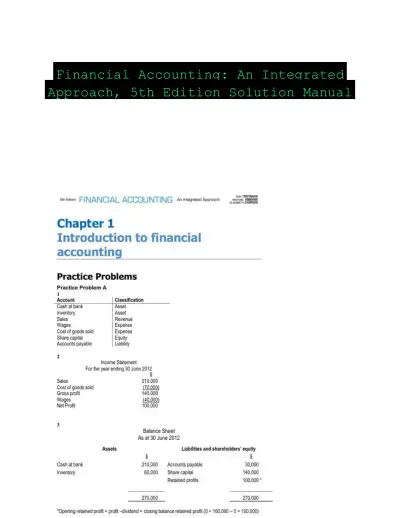 Textbook Guides
Financial Accounting: An Integrated Approach, 5th Edition Solution Manual
Accounting
42 pagesMay 2025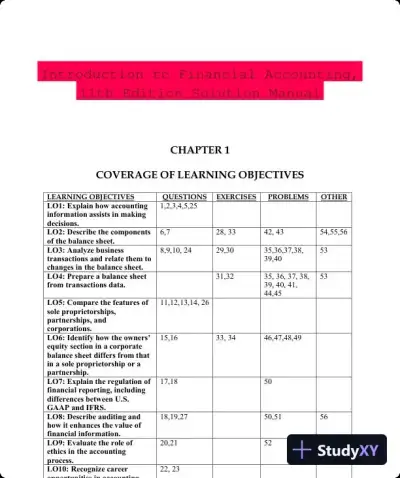 Textbook Guides
Introduction to Financial Accounting, 11th Edition Solution Manual
Accounting
524 pages173downloadsFeb 2025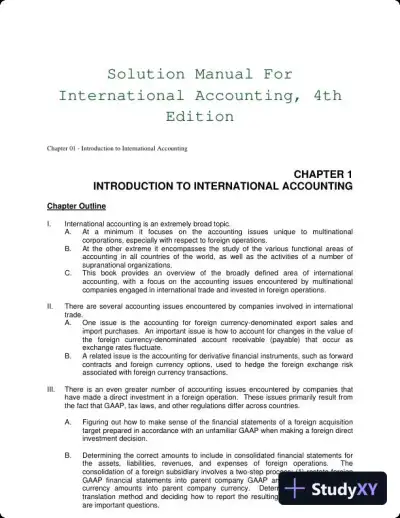 Textbook Guides
Solution Manual For International Accounting, 4th Edition
Accounting
309 pages161downloadsFeb 2025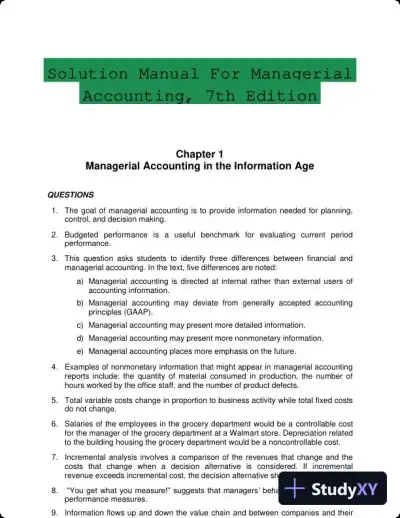 Textbook Guides
Solution Manual For Managerial Accounting, 7th Edition
Accounting
361 pages159downloadsFeb 2025 Class Notes
Class Notes For Advanced Accounting, 4th Edition
Accounting
149 pages159downloadsFeb 2025 Textbook Guides
Financial Accounting 6th Canadian Edition Solution Manual
Accounting
867 pages156downloadsFeb 2025 Textbook Guides
Accounting Theory, 7th Edition Solution Manual
Accounting
325 pages153downloadsFeb 2025 Textbook Guides
Financial Accounting, 9th Edition Solution Manual
Accounting
1024 pages134downloadsFeb 2025
Study this document with CramX
Once it is in your library, every tool can work from it.