

Solution Manual for Intermediate Accounting, 2nd Edition
- Accounting
- 401 pages
- Shared May 2025
Find clear solutions to every textbook problem with Solution Manual for Intermediate Accounting, 2nd Edition, your essential resource for textbook answers.
Preview 16 of 401 pages
See the first 16 pages exactly as they appear in the document.
Page 1 Read page 1 as text
S OLUTIONS M ANUAL to accompany Intermediate Accounting Volume 2 Second Edition Kin Lo University of British Columba George Fisher Douglas College
Page 2 Page 3 Read page 3 as text
Contents Chapter 11: Current Liabilities and Contingencies ................................ ................ 1 Chapter 12: Non - Current Financial L iabilities ................................ ..................... 43 Chapter 13: Equities ................................ ................................ ............................. 88 Chapter 14: Complex Financial Instruments ................................ ...................... 126 Chapter 15: Earnings per Share ................................ ................................ .......... 1 58 Chapter 16: Accounting for Income Taxes ........................................................205 Chapter 17: Pensions and Other Employee Future Benefits ..............................238 Chapter 18: Accounting for Leases ................................ ................................ .... 256 Chapter 19: Statement of Cash Flows ................................ ................................ 291 Chapter 20: Accounting Changes ................................ ................................ ....... 346
Page 4 Read page 4 as text
Chapter 11 Current Liabilities and Contingencies 11-1 Chapter 11 Current Liabilities and Contingencies M. Problems P11-1. Suggested solution: Item Liability Financial or non - financial obligation? Explanation 1. Accounts payable F 2. Warranties payable N Obligation is to deliver goods or services 3. USD bank loan F 4. Bank overdraft F 5. Sales tax payable N Obligation is not contractual in nature 6. Notes payable F 7. Unearned revenue N Obligation is to deliver goods or services 8. Finance lease obligation F 9. HST payable N Obligation is not contractual in nature 10. Bank loan F 11. Bonds payable F 12. Obligation under customer loyalty plan N Obligation is to deliver goods or services 13. Income taxes payable N Obligation is not contractual in nature P11-2. Suggested solution: To be classified as a liability, the item must: i) be a present obligation; ii) have arisen from a past event; and iii) be expected to result in an outflow of economic benefits. This is an “and” situation as all three criteria must be present before a liability is recorded. The precise amount of the obligation need not be known, provided that a reliable estimate can be made of the amount due. Provisions are liabilities in which there is some uncertainty as to the timing or amount of payment. Trade accounts payable meet the criteria of a liability as set out below: * Present obligation: The debtor is presently contractually obliged to pay for goods or services received. * Past event: The trade payable arose from a good or service the debtor previously received or consumed.
Page 5 Read page 5 as text
Chapter 11 Current Liabilities and Contingencies 11-2 * Outflow of economic benefits: Trade payables are typically settled in cash—an outflow of economic benefits. P11-3. Suggested solution: a. Provisions are liabilities in which there is some uncertainty as to the timing or amount of payment. b. Financial liabilities are contracts to deliver cash or other financial assets to another party. They differ from non-financial liabilities as the latter category is typically settled through the provision of goods or services. c. A non-exhaustive list of financial liabilities includes accounts payable; bank loans; notes payable; bonds payable; and finance leases. A non-exhaustive list of non-financial obligations includes warranties payable; unearned revenue; and income taxes payable. P11-4. Suggested solution: a. The three broad categories of liabilities are: 1. Financial liabilities held for trading 2. Other financial liabilities 3. Non-financial liabilities b. * Held-for-trading liabilities are initially recognized at fair value. * Other financial liabilities are initially reported at fair value minus the transaction costs directly resulting from incurring the obligation. * The initial measurement of non-financial liabilities depends on their nature. For instance, warranties are recorded at management’s best estimate of the downstream cost of meeting the entity’s contractual obligations, while prepaid magazine subscription revenue is valued at the consideration initially received. c. * Held-for-trading liabilities are subsequently recognized at fair value. * Other financial liabilities are subsequently measured at amortized cost using the effective rate method. * Non-financial liabilities are subsequently measured at the initial obligation less the amount earned to date or satisfied to date through performance. For example, a publisher that received $750 in advance for a three-year subscription and has delivered the magazine for one year would report an obligation of $500 ($750 – $250).
Page 6 Read page 6 as text
Chapter 11 Current Liabilities and Contingencies 11-3 P11-5. Suggested solution: Item Liability Current or non-current liability, or potentially both? Explanation 1. Accounts payable C 2. Warranties payable B The obligation that is expected to be settled within one year of the balance sheet date is current, the balance non- current 3. Deposits B The classification of the deposit as current or non-current depends upon the expected settlement date. If less than one year after the balance sheet date, the obligation is classified as current 4. Bank overdraft C 5. Sales tax payable C 6. Bank loan maturing in five years was in default during the year; before year-end, the lender grants a grace period that extends 12 months after the balance sheet date N The obligation is reported as a non- current liability because the grace period was granted before the balance sheet date and extends twelve months after year- end 7. Five-year term loan, amortized payments are payable annually B The principal portion of the payments due within one year of the balance sheet date are classified as current, the balance as non-current 8. Unearned revenue B The classification of the obligation as current or non-current depends upon when revenue is the expected to be recognized. If less than one year after the balance sheet date, the obligation is classified as current 9. Finance lease obligation B The principal portion of the payments due within one year of the balance sheet date are classified as current, the balance as non-current 10. HST payable C 11. 90-day bank loan C 12. Bond payable that matures in two years N The obligation is reported as non-current as the maturity date is two years after the balance sheet date 13. Obligation under customer loyalty plan B The classification of the obligation as current or non-current depends upon the
Page 7 Read page 7 as text
Chapter 11 Current Liabilities and Contingencies 11-4 expected redemption date. If less than one year after the balance sheet date, the obligation is classified as current 14. Income taxes payable C 15. Bank loan that matures in five years that is currently in default C 16. Three-year bank loan that matures six months after the balance sheet date C P11-6. Suggested solution: Summary journal entries 1. Dr. Inventory 10,000 Dr. HST recoverable ($10,000 × 12%) 1,200 Cr. Accounts payable ($10,000 + $1,200) 11,200 2. Dr. Equipment ($20,000 + $500) 20,500 Dr. HST recoverable ($20,500 × 12%) 2,460 Cr. Accounts payable ($20,500 + $2,460) 22,960 3. Dr. Cash [$15,000 × (1 + 12%)] 16,800 Cr. Sales 15,000 Cr. HST payable ($15,000 × 12%) 1,800 Dr. Cost of goods sold ($15,000 x 50%) 7,500 Cr. Inventory 7,500 4. Dr. Accounts receivable [$20,000 × (1 + 12%)] 22,400 Cr. Sales 20,000 Cr. HST payable ($20,000 × 12%) 2,400 Dr. Cost of goods sold ($20,000 x 50%) 10,000 Cr. Inventory 10,000 5. Dr. Accounts payable 22,960 Cr. Cash 22,960 6. Dr. HST payable ($12,000 + $1,800 + $2,400) 16,200 Cr. HST recoverable ($8,000 + $1,200 + $2,460) 11,660 Cr. Cash ($16,200 – $11,660) 4,540
Page 8 Read page 8 as text
Chapter 11 Current Liabilities and Contingencies 11-5 P11-7. Suggested solution: Summary journal entries 1. Dr. Inventory 12,000 Dr. HST recoverable ($12,000 × 15%) 1,800 Cr. Accounts payable ($12,000 + $1,800) 13,800 2. Dr. Equipment ($15,000 + $1,000) 16,000 Dr. HST recoverable ($16,000 × 15%) 2,400 Cr. Accounts payable ($16,000 + $2,400) 18,400 3. Dr. Cash [$11,000 × (1 + 15%)] 12,650 Cr. Sales 11,000 Cr. HST payable ($11,000 × 15%) 1,650 Dr. Cost of goods sold ($11,000 x 80%) 8,800 Cr. Inventory 8,800 4. Dr. Accounts receivable [$20,000 × (1 + 15%)] 23,000 Cr. Sales 20,000 Cr. HST payable ($20,000 × 15%) 3,000 Dr. Cost of goods sold ($20,000 x 80%) 16,000 Cr. Inventory 16,000 5. Dr. Accounts payable 13,800 Cr. Cash 13,800 6. Dr. HST payable ($22,000 + $1,650 + $3,000) 26,650 Cr. HST recoverable ($20,000 + $1,800 + $2,400) 24,200 Cr. Cash ($26,650 – $24,200) 2,450
Page 9 Read page 9 as text
Chapter 11 Current Liabilities and Contingencies 11-6 P11-8. Suggested solution: Summary journal entries 1. Dr. Inventory ($42,000 – $2,000) 40,000 Dr. GST recoverable ($40,000 × 5%) 2,000 Cr. Accounts payable [$40,000 × (1 + 5%)] 42,000 The purchase of inventory for resale is PST exempt. 2. Dr. Cash [$30,000 × (1 + 5%) × (1 + 10%)] 34,650 Cr. Sales 30,000 Cr. GST payable ($30,000 × 5%) 1,500 Cr. PST payable [$30,000 × (1 + 5%) × 10%] 3,150 Dr. Cost of goods sold ($30,000 × 2/3) 20,000 Cr. Inventory 20,000 3. Dr. Accounts receivable [$60,000 × (1 + 5%) × (1 + 10%)] 69,300 Cr. Sales 60,000 Cr. GST payable ($60,000 × 5%) 3,000 Cr. PST payable [$60,000 × (1 + 5%) × 10%] 6,300 Dr. Cost of goods sold ($60,000 × 2/3) 40,000 Cr. Inventory 40,000 4. Dr. GST payable ($20,000 + $1,500 + $3,000) 24,500 Dr. PST payable ( $22,000 + $3,150 + $6,300) 31,450 Cr. GST recoverable ($21,000 + $2,000) 23,000 Cr. Cash ($24,500 + $31,450 – $23,000) 32,950
Page 10 Read page 10 as text
Chapter 11 Current Liabilities and Contingencies 11-7 P11-9. Suggested solution: Summary journal entries 1. Dr. Inventory 30,000 Dr. GST recoverable ($30,000 × 5%) 1,500 Cr. Accounts payable [$30,000 × (1 + 5%)] 31,500 The purchase of inventory for resale is PST exempt. 2. Dr. Cash [$20,000 × (1 + 5% + 5%)] 22,000 Cr. Sales 20,000 Cr. GST payable ($20,000 × 5%) 1,000 Cr. PST payable ($20,000 × 5%) 1,000 Dr. Cost of goods sold ($20,000 × 75%) 15,000 Cr. Inventory 15,000 3. Dr. Accounts receivable [$50,000 × (1 + 5% + 5%)] 55,000 Cr. Sales 50,000 Cr. GST payable ($50,000 × 5%) 2,500 Cr. PST payable ($50,000 × 5%) 2,500 Dr. Cost of goods sold ($50,000 × 75%) 37,500 Cr. Inventory 37,500 4. Dr. GST payable ($18,000 + $1,000 + $2,500) 21,500 Dr. PST payable ( $14,000 + $1,000 + $2,500) 17,500 Cr. GST recoverable ($15,000 + $1,500) 16,500 Cr. Cash ($21,500 + $17,500 – $16,500) 22,500
Page 11 Read page 11 as text
Chapter 11 Current Liabilities and Contingencies 11-8 P11-10. Suggested solution: Oct. 31, 2015 Dr. Retained earnings 30,000 Cr. Dividends payable on preferred shares (10,000 sh × $1.00/sh × 2) + (5,000 sh × $2.00/sh) 30,000 The preferred shares B are non-cumulative in nature and as such are not entitled to dividends for 2014 as they were not declared. Nov. 30, 2015 Dr. Retained earnings 50,000 Cr. Dividends payable on common shares (100,000 sh × $0.50 sh) 50,000 Dec. 1, 2015 Dr. Dividends payable on preferred shares 30,000 Cr. Cash 30,000 Jan. 2, 2016 Dr. Dividends payable on common shares 50,000 Cr. Cash 50,000 P11-11. Suggested solution: Oct. 31, 2016 Dr. Retained earnings 175,000 Cr. Dividends payable on preferred shares (50,000 sh × $2.00/sh) + (25,000 sh × $1.00/sh × 3) 175,000 The preferred shares A are non-cumulative in nature and as such are not entitled to dividends for 2014 or 2015 as they were not declared. Nov. 30, 2016 Dr. Retained earnings 300,000 Cr. Common stock dividends distributable (200,000 sh × 10%/sh × $15.00) 300,000 Dec. 1, 2016 Dr. Dividends payable on preferred shares 175,000 Cr. Cash 175,000 Jan. 2, 2017 Dr. Common stock dividends distributable 300,000 Cr. Common shares 300,000
Page 12 Read page 12 as text
Chapter 11 Current Liabilities and Contingencies 11-9 P11-12. Suggested solution: Jan. 31 Dr. Franchise fee expense 2,500 Cr. Royalty fee payable ($50,000 × 5%) 2,500 Dr. Sales and marketing expense 1,250 Cr. Royalty fee payable ($50,000 × 2.5%) 1,250 Feb. 15 Dr. Royalty fee payable 3,750 Cr. Cash ($2,500 + $1,250) 3,750 Feb. 28 Dr. Franchise fee expense 2,000 Cr. Royalty fee payable ($40,000 × 5%) 2,000 Dr. Sales and marketing expense 1,000 Cr. Royalty fee payable ($40,000 × 2.5%) 1,000 Mar. 15 Dr. Royalty fee payable 3,000 Cr. Cash ($2,000 + $1,000) 3,000 Mar. 31 Dr. Franchise fee expense 3,000 Cr. Royalty fee payable ($60,000 × 5%) 3,000 Dr. Sales and marketing expense 1,500 Cr. Royalty fee payable ($60,000 × 2.5%) 1,500 Apr. 15 Dr. Royalty fee payable 4,500 Cr. Cash ($3,000 + $1,500) 4,500
Page 13 Read page 13 as text
Chapter 11 Current Liabilities and Contingencies 11-10 P11-13. Suggested solution: a. Jan. 1, 2016 Dr. Franchise agreement 30,000 Cr. Cash 30,000 Dec. 31, 2016 Dr. Amortization expense - franchise 3,000 Cr. Franchise agreement ($30,000/10 years) 3,000 Dec. 31, 2016 Dr. Royalty fee expense 59,500 Cr. Royalty fee payable ($850,000 × 7%) 59,500 Dec. 31, 2016 Dr. Sales and marketing expense 17,000 Cr. Royalty fee payable ($850,000 × 2%) 17,000 b. Jan. 15, 2017 Dr. Royalty fee payable 76,500 Cr. Cash ($59,500 + $17,000) 76,500 P11-14. Suggested solution: a. Summary journal entries 20 1 4 Dr. Cash (6 × $2,000) 12,000 Cr. Deferred revenue 12,000 20 1 4 Dr. Cash (2 × $3,000) 6,00 0 Dr. Deferred revenue (2 × $2,000) 4,000 Cr. Revenue (2 × $5,000) 10,000 Dr. Cost of goods sold (2 × $2,300) 4,600 Cr. Cash 4,600 20 1 5 Dr. Cash (4 × $3,000) 12,000 Dr. Deferred revenue (4 × $2,000) 8,000 Cr. Revenue (4 × $5, 000) 20,000 Dr. Cost of goods sold (4 × $2,300) 9,200 Cr. Cash 9,200 b. The balance in the deferred revenue account as at December 31, 20 1 4 was $8,000 ($12,000 – $4,000 or $2,000 × 4)
Page 14 Read page 14 as text
Chapter 11 Current Liabilities and Contingencies 11-11 P11-15. Suggested solution: 1. Dr. Warranty expense 30,000 Cr. Provision for warranty obligations 30,000 2,500 × ($5 + $7) = $30,000 2. Dr. Provision for warranty obligations 6,000 Cr. Wage expense 6,000 3. The total provision for warranty obligations that will be reported at year-end is $24,000 ($30,000 – $6,000). Of this amount, $6,500 will be reported as a current obligation [(2,500 × $5) – $6,000 = $6,500] and the $17,500 balance as a non-current liability (2,500 × $7 = $17,500) or ($24,000 – $6,500 = $17,500). 4. Companies offer warranties that their products will be free from defects for a specified period to facilitate the sale of their merchandise. P11-16. Suggested solution: The obligation is initially valued at the spot exchange rate evident on the transaction date and revalued at period end using the period ending spot rate. May 1, 2016 Dr. Cash (US$140,000 × $1.02) 142,800 Cr. Bank loan 142,800 Dec. 31, 2016 Dr. Foreign exchange loss (US$140,000 × ($1.04 – $1.02)) 2,800 Cr. Bank loan 2,800
Page 15 Read page 15 as text
Chapter 11 Current Liabilities and Contingencies 11-12 P11-17. Suggested solution: The obligation is initially valued at the spot exchange rate evident on the transaction date and revalued at period end and payment date using the applicable spot rate. Dec. 15, 2015 Dr. Supplies expense (US$5,000 × $1.04) 5,200 Cr. Trade account payable 5,200 Dec. 31, 2015 Dr. Trade account payable 150 Cr. Foreign exchange gain (US$5,000 × ($1.04 – $1.01)) 150 Jan. 3, 2016 Dr. Foreign exchange loss 100 Cr. Trade account payable (US$5,000 × ($1.03 – $1.01)) 100 Dr. Trade account payable ($5,200 - $150 + $100) 5,150 Cr. Cash (US$5,000 × $1.03) 5,150 P11-18. Suggested solution: a. Revenue is recognized for the award portion of company-offered rewards when the customer claims their reward. Revenue is recognized for the award portion of third-party rewards at the time of sale. b. The awards portion is determined using fair value techniques. Sales revenue is a residual amount equal to the price charged less that allocated to awards revenue. P11-19. Suggested solution: Summary journal entries To recognize the sales - related revenue in 2015 a. Dr. Cash (20,000 × $600) 12 ,000,000 Cr. Sales 12,000 ,000 Dr. Cost of goods sold (20,000 × $350) 7,000,000 Cr. Inventory 7,000,00 0 Dr. Manufacturer’s rebate expense ((20,000 × $50 × 30%) 300,000 Cr. Provision for manufacturer’s rebates 300,000 To recognize the issuance of the rebate cheques in 2016 b. Dr . Provision for manufacturer’s rebates 300 ,000 Cr. Cash 300 , 000
Page 16 Read page 16 as text
Chapter 11 Current Liabilities and Contingencies 11-13 P11-20. Suggested solution: a. Dr. Computer system 19,231 Cr. Note payable ($20,000 / 1.04) 19,231 Using a BAII PLUS financial calculator 1N, 4 I/Y, 20000 FV, CPT PV PV = –19,231 b. Dr. Interest expense 769 Cr. Note payable 769 $19,231 × 4% = $769 c. Dr. Note payable 20,000 Cr. Cash 20,000 No entry for interest is required as it had been accrued on December 31, 2014. P11-21. Suggested solution: a. Dr. Automobile 40,000 Cr. Note payable 30,000 Cr. Cash 10,000 b. Dr. Interest expense 605 Cr. Accrued interest payable 605 $30,000 × 4% × 184 / 365 = $605 (rounded) c. Dr. Interest expense 296 Dr. Accrued interest payable 605 Dr. Note payable 30,000 Cr. Cash ($30,000 + $296 + $605) 30,901 $30,000 × 4% × 90 / 365 = $296 (rounded)
385 more pages in the full document
Unlock it once and it stays in your library, ready to chat with or turn into flashcards.
Unlock the full documentMore Accounting study materials
See all Textbook Guides
Solution Manual for Intermediate Accounting, Vol. 2, 2nd Edition
Accounting
465 pagesMay 2025 Textbook Guides
Introduction to Financial Accounting, 11th Edition Solution Manual
Accounting
524 pages173downloadsFeb 2025 Textbook Guides
Solution Manual For International Accounting, 4th Edition
Accounting
309 pages161downloadsFeb 2025 Textbook Guides
Solution Manual For Managerial Accounting, 7th Edition
Accounting
361 pages159downloadsFeb 2025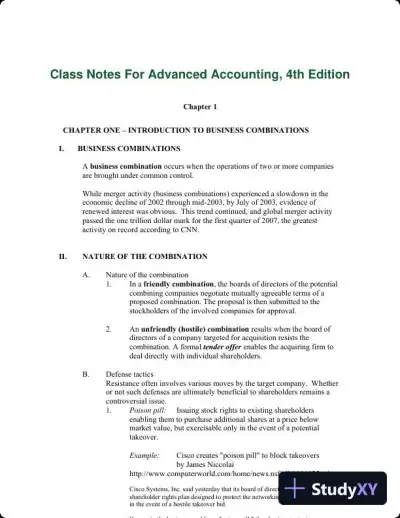 Class Notes
Class Notes For Advanced Accounting, 4th Edition
Accounting
149 pages159downloadsFeb 2025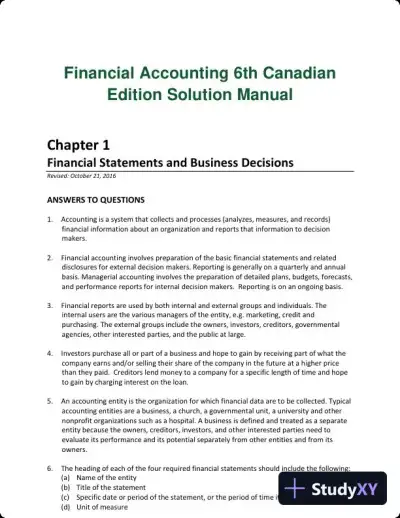 Textbook Guides
Financial Accounting 6th Canadian Edition Solution Manual
Accounting
867 pages156downloadsFeb 2025 Textbook Guides
Accounting Theory, 7th Edition Solution Manual
Accounting
325 pages153downloadsFeb 2025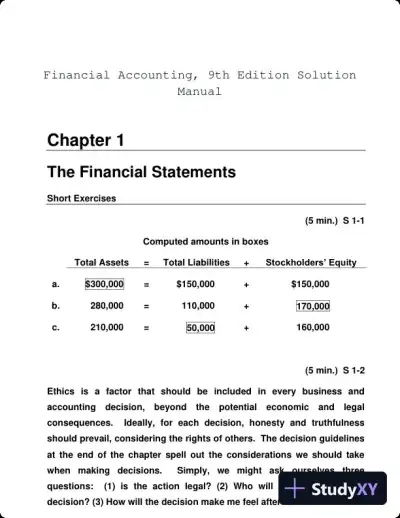 Textbook Guides
Financial Accounting, 9th Edition Solution Manual
Accounting
1024 pages134downloadsFeb 2025
Study this document with CramX
Once it is in your library, every tool can work from it.