

Solution Manual for Intermediate Accounting, Vol. 2, 2nd Edition
- Accounting
- 465 pages
- Shared May 2025
Need help with textbook problems? Solution Manual for Intermediate Accounting, Vol. 2, 2nd Edition has all the answers and solutions to get you through.
Preview 16 of 465 pages
See the first 16 pages exactly as they appear in the document.
Page 1 Read page 1 as text
Resource Manual Lori Novak Red River College for Intermediate Accounting Volume 2 | Second Edition Kin Lo University of British Columbia George Fisher Douglas College
Page 2 Page 3 Read page 3 as text
Contents Preface ......................................................................................................................2 ■ Sample Syllabus 1 (traditional classroom) ....................................................................3 ■ Sample Syllabus 2 (online course) .................................................................................8 ■ Student Handout “How to get an A”............................................................................12 ■ Tips for taking the course from traditional to hybrid, blended or online .....................13 Volume 2 Chapter 11 Current Liabilities and Contingencies .......................................................15 Chapter 12 Non-Current Financial Liabilities ..............................................................21 Chapter 13 Equities ......................................................................................................26 Chapter 14 Complex Financial Instruments .................................................................31 Chapter 15 Earnings Per Share .....................................................................................36 Chapter 16 Accounting for Income Taxes ....................................................................41 Chapter 17 Pensions and Other Employee Future Benefits .........................................46 Chapter 18 Accounting for Leases ...............................................................................50 Chapter 19 Statement of Cash Flows ...........................................................................56 Chapter 20 Accounting Changes ..................................................................................60
Page 4 Read page 4 as text
3 SYLLABUS Intermediate Accounting 2 Semester: _______________________ Effective date: ____________________ Class days and times: Monday Tuesday Wednesday Thursday Friday COURSE DESCRIPTION In this course, students will learn about measurement, valuation and presentation of liabilities and shareholders’ equity elements. Specific topics covered are financial and non-financial liabilities, complex financial instruments, contributed capital, retained earnings, and accumulated other comprehensive income, leases, pensions, income taxes and accounting changes. International Financial Reporting Standards and Accounting Standards for Private Enterprises are continually referenced as the relevant GAAP for this level of financial accounting. With the completion of Intermediate Accounting 1 & 2, students will have a solid foundation in financial accounting and may use this education to launch a career or continue on to advanced accounting courses and programs. At the end of this course, you will be able to: • apply the conceptual framework and International Financial Accounting Standards to make choices between acceptable methods of accounting for liabilities and shareholders’ equity items. • measure and account for financial and non-financial liabilities. • measure and account for complex debt and equity instruments. • explain how income taxes are accounting for and reconciled with government required reporting. Measure and account for permanent and temporary differences related to income taxes. • account for leases from both the perspective of the lessee and lessor using appropriate measurement criteria and techniques. • identify different types of pensions and the components of each. Prepare calculations for pension expense and account for pension assets and liabilities. • explain earnings per share disclosures and calculate both basic and diluted figures. • record and report accounting changes in the financial statements using appropriate measurement and presentation criteria. • list the disclosures required for the various liability and shareholders’ equity items.
Page 5 Read page 5 as text
4 NEEDS AND RESOURCES Required Background To successfully complete this course, you must have completed Intermediate Accounting 1. A grade of C or better is recommended. Students should have a solid understanding of fundamental accounting. Required Materials To successfully complete this course, you will need: • Intermediate Accounting, Second Edition, Volume 2, Kin Lo, George Fisher. ISBN __________________ • Internet access • Financial calculator Online Resources • CICA Handbook (electronic access provided _____________) COURSE SCHEDULE (suggested based on 16 week term- 1 hour class time) Week Class Topic Required Reading Assignments 1 Chapter 11 Introduction to Liabilities P.504 - 508 P11 - 5 2 Current liabilities P.509 - 527 P11 - 8, P11 - 15, P11 - 35 3 Contingencies P.527 - 534 P11 - 38 4 Commitments & Guarantees P.534 - 536 P11 - 47 5 Assignment review 6 Chapter 12 Introduction to non-current financial liabilities P.565-572 P12-3, P12-5 7 Accounting for non-financial liabilities P.572-583 P12-7,P12- 13, P12-21 8 Derecognition of financial liabilities P.584-588 P12-30 9 Comprehensive Example & other issues P.588-597 P12-42, P12- 47 10 Assignment review 11 Chapter 13 Components of equity P.620-627 P13-2, P13-3, P13-10, P13- 11 12 Contributed capital equity transactions P.628-637 P13-22, P13- 25 13 Retained earnings equity transactions P.637-642 P13-36 14 Statement of changes in equity & Comprehensive illustration P.642-650 P13-44, P13- 37 15 Assignment review
Page 6 Read page 6 as text
5 Week Class Topic Required Reading Assignments 16 Chapter 14 Introduction to complex financial instruments P.675-681 P14-6 17 Accounting for complex financial instruments P.682-688 P14-8, P14- 10, P14-15, P14-16 18 Assignment review 19 Accounting for complex financial instruments/Compensation plans P.688-694 P14-27,P14-3 20 Hedging & hedge accounting P.694-704 P14-37, P14- 39 21 Assignment review 22 Term test review 23 Term test (Chapters 11-14) 24 Chapter 15 Introduction to basic & diluted EPS P.726-735 P15-5, P15-9, P15-16 25 Calculating diluted EPS P.735-746 P15-22, P15- 24, P15-28 26 Other factors effecting EPS P.746-752 P.15-35 27 Assignment review 28 Chapter 16 Introduction to income tax P.776-784 P.16-6 29 Applying the accrual method P.784-795 P16-10, P16- 11, P16-15 30 Tax losses & other considerations P.795-802 P16-30, P16- 32, P16- 36,P16-37 31 Assignment review 32 Chapter 17 Introduction to pension plans & accounting P.821-825 P17-2, P17-5, P17-7 33 Accounting for defined benefit plans P.825-837 P17-13, P17- 15, P17-19, P17-21 34 Presentation & disclosures & other issues P.837-843 P17-25, P17- 29 35 Assignment review 36 Term Test review 37 Term Test (Ch11-17, comprehensive) 38 Chapter 18 Introduction to leases P.860-866 P18-7 39 Classifying & accounting for leases P.866-874 P18-9, P18- 18
Page 7 Read page 7 as text
6 Week Class Topic Required Reading Assignments 40 Other factors & lease types P.874-885 P18-26, P.18- 28, P18-31, P18-36 41 Assignment review 42 Chapter 19 Introduction to the Statement of Cash Flow P.904-911 P19-2, P19-3, P19-8, P19- 10, P19-15, P19-18 43 Formatting the Statement of Cash Flow P.911-918 P19-23 44 Preparation of the Statement of Cash Flow P.918-933 P19-33, P19- 38 45 Specific cash flow items & comprehensive example P.933-943 P19-41 46 Assignment review 47 Chapter 20 Introduction to accounting changes P.980-990 P20-1, P20-5 48 Retrospective adjustments P.990-997 P20-9, P20- 13, P20-16, P20-23, P20- 26 49 Assignment review 50 Final Exam review 51 Final Exam review 52 Final Exam (Ch11-20, comprehensive) POLICIES AND PROCEDURES General Rules: [Insert explanation of classroom rules and procedures, including such topics as attitude, behavior, attendance, tardiness, incomplete work, and so on. Describe rules and consequences.] Grading Policies: • Term Test 1 15% • Term Test 2 35% • Final Exam 50% Grading Scale: [If applicable, insert grading scale, linking number and letter grades.]
Page 8 Read page 8 as text
7 ADDITIONAL INFORMATION [Insert additional information, specific to your school, class, students, or topic.] CONTACT INFORMATION Professor/instructor name:_____________________________ Contact phone number:________________________________ Email address:_______________________________________ Course URL:________________________________________ Office hours: Monday Tuesday Wednesday Thursday Friday
Page 9 Read page 9 as text
8 SYLLABUS Intermediate Accounting 2 Semester: _______________________ Effective date:____________________ Class days and times: Monday Tuesday Wednesday Thursday Friday COURSE DESCRIPTION In this course, students will learn about measurement, valuation and presentation of liabilities and shareholders’ equity elements. Specific topics covered are financial and non-financial liabilities, complex financial instruments, contributed capital, retained earnings, and accumulated other comprehensive income, leases, pensions, income taxes and accounting changes. International Financial Reporting Standards and Accounting Standards for Private Enterprises are continually referenced as the relevant GAAP for this level of financial accounting. With the completion of Intermediate Accounting 1 & 2, students will have a solid foundation in financial accounting and may use this education to launch a career or continue on to advanced accounting courses or programs. At the end of this course, you will be able to: • apply the conceptual framework and International Financial Accounting Standards to make choices between acceptable methods of accounting for liabilities and shareholders’ equity items. • measure and account for financial and non-financial liabilities. • measure and account for complex debt and equity instruments. • explain how income taxes are accounting for and reconciled with government required reporting. Measure and account for permanent and temporary differences related to income taxes. • account for leases from both the perspective of the lessee and lessor using appropriate measurement criteria and techniques. • identify different types of pensions and the components of each. Prepare calculations for pension expense and account for pension assets and liabilities. • explain earnings per share disclosures and calculate both basic and diluted figures. • record and report accounting changes in the financial statements using appropriate measurement and presentation criteria. • list the disclosures required for the various liability and shareholders’ equity items.
Page 10 Read page 10 as text
9 NEEDS AND RESOURCES Required Background To successfully complete this course, you must have completed Intermediate Accounting 1. A grade of C or better is recommended. Students should have a solid understanding of fundamental accounting. Required Materials To successfully complete this course, you will need: • Intermediate Accounting, Second Edition, Volume 2, Kin Lo, George Fisher. ISBN __________________ • Internet access • Financial calculator Online Resources • CICA Handbook (electronic access provided _____________) Student Readiness Each week students will be required to work through a chapter in the textbook as indicated on the schedule below and complete the indicated assignment by the due date. Assignments must be uploaded into the course dropbox no later than 11:59pm on the due date. In addition to assignments, students will be assigned a partner for work on the cases. There are four cases in total that students will be expected to work though. On the due date, each group must post their findings, analysis, and commentary to the course discussion board no later than 11:59pm. Separate and private discussion boards will be set up for group collaboration. COURSE SCHEDULE (suggested for 16 week online course) Week Topic Required Reading Assignments Due Date 1 Chapter 11 Current Liabilities P.504 - 536 P11 - 47 2 Chapter 12 Non - current Financial Liabilities P.565 - 597 P12 - 42 3 Chapter 13 Equities P.620 - 650 P13 - 44 4 Discussion post due – Chapt er 13 Case 1 Peterborough Printers 5 Chapter 14 Complex Financial Instruments P.675 - 704 P14 - 39 6 Discussion post due – Chapter 14 Case 1 Ultramart 7 Chapter 15 Earnings per share P.726 - 752 P15 - 35 8 Chapter 16 Accounting for income tax P.77 6 - 802 P.16 - 36
Page 11 Read page 11 as text
Preface 10 Week Topic Required Reading Assignments Due Date 9 Chapter 17 Pensions and Other Employee Future Benefits P.821-843 P17-29 10 Discussion post due – Chapter 17 Case 2 Tubular Ltd. 11 Chapter 18 Accounting for Leases P.860-885 P18-31 12 Chapter 19 Statement of Cash Flows P.904-943 P19-41 13 Chapter 20 Accounting Changes P.980-997 P20-26 14 Discussion post due – Chapter 20 Capstone Case 1 Gibraltar Enterprises 15 Review Week 16 Final Exam (Ch11-20, comprehensive) POLICIES AND PROCEDURES General Rules: [Insert explanation of classroom rules and procedures, including such topics as attitude, behavior, attendance, tardiness, incomplete work, and so on. Describe rules and consequences.] Grading Policies: • 10 Assignments (2% each) 20% • 3 Chapter Case Discussion posts (5% each) 15% • Capstone Case Discussion post 15% • Final Exam 50% Grading Scale: [If applicable, insert grading scale, linking number and letter grades.] ADDITIONAL INFORMATION [Insert additional information, specific to your school, class, students, or topic.] CONTACT INFORMATION Professor/instructor name:_____________________________ Contact phone number:________________________________ Email address:_______________________________________
Page 12 Read page 12 as text
Preface 11 Course URL:________________________________________ Office hours: Monday Tuesday Wednesday Thursday Friday
Page 13 Read page 13 as text
Preface 12 STUDENT HANDOUT Tips on how to use the resources and online tools to get an A in this class: ■ READ the chapter. Yes, I know it’s hard, but it’s an important 30 minutes to an hour spent in learning this material. ■ WATCH the Demo Docs. Right after reading, view the interactive multi-media demo docs for the chapter. ■ PRACTISE homework online. Sure it makes sense when your professor goes over the assignment—they’ve been doing this for a long time. There is no substitute for doing problems/exercises. That’s how you learn accounting. And the online homework assignments are algorithmic, so they are already set up for you to practise problems until you “get it.” ■ STUDY in groups. Creating study groups is a great way to expand your learning. These groups will not only increase your number of resources to go to for help, but they also create a sort of accountability that will help keep you on track for success. ■ Learn WHY as well as HOW. Sure the “how” to do it is a big part of accounting, but if you can learn why you are doing a particular accounting task, it will be much easier to perform the task. ■ RELATE topics to your personal life or job. The best way to ensure you understand a topic is to apply it to your life or job. ■ ASK questions. When online, use the “Ask my instructor” button to ask specific homework questions at the point you have them. Also, ask questions while in class. Don’t assume you are the only one who doesn’t understand. Your questions help you and other students learn.
Page 14 Read page 14 as text
Preface 13 Tips for Taking Your Course from Traditional to Hybrid, Blended, or Online 1. Don’t try to take the “entire” course online in one semester. Decide on a two- semester strategy for implementation, implementing graded online homework FIRST. By only implementing the homework portion of the online solution, you don’t overwhelm yourself with having to learn every piece of the online component in one semester, regardless of whether it is MyAccountingLab or some other solution. Additionally, this allows you the flexibility to add other graded assignments later that first semester, if you choose. 2. Define homework by chapter in your syllabi, rather than identifying specific exercises or problems . During the first semester, as you and your students get accustomed to the online resources, you may need to be more flexible. Further, this gets your students used to looking “online” for their assignments. 3. Schedule one day in class in a computer lab (or some class time, if you can’t get into a computer lab), to demonstrate. This allows you to gain a “captive audience” so that you can show the class some of the resources you want them to use. It also allows you to highlight some of the resources that they may find useful in their learning. 4. Use MyAccountingLab’s static/book match problems to demonstrate in class problems or exercises. This is a good way to not only save you time in setting up in class assignments, but also demonstrates to the student the completion ease of the MyAccountingLab homework solution. I set up a “static” course that has all the book match problems in it and use that course for demonstrating this in class. 5. Same as Item 4, except using only the Excel spreadsheets. Have the students print out the Excel or PDF worksheets for book match/static questions before covering the material in class. Again, this establishes the online centre as the “go to” place for students to glean information. 6. The first assignments I give after demonstrating the online login/registration are submitted via their online e-mail account. For this, I use the “e-mail students option” from the gradebook. I submit their first assignment via e-mail to try in myaccountinglab.com. This is a “bonus” points only assignment; the students are eager to try online tools (no penalty—only bonus point reward) and it gets them registered more quickly in myaccountinglab.com. I suggest using something like the built-in pre-test chapter questions. 7. Have students give each other feedback. One of the problems with teaching online is that giving feedback to all of your students all the time can quickly get out of control. The way to deal with this is to have students give the initial drafts of their papers to other students for feedback. You give a grade to the feedback based on how helpful the original
Page 15 Read page 15 as text
Preface 14 author finds it. Then you only have to review papers one time, and many of the problems should be worked out before you see them. 8. Set up discussion forums . You might, for example, ask a critical thinking question on one of the key chapter topics. Your students will have a certain amount of time to (1) post an answer to your question, and (2) post a response or comment on the answer of another student. You can offer extra credit for the “best” response. Alternatively, you might ask students to answer one of the end-of-chapter or additional online questions/case problems within a set period of time. The first one to respond can get an extra credit point. The first student who “adds value” to the answer can also get an extra point.
Page 16 Read page 16 as text
15 CHAPTER 11 Current liabilities and contingencies LEARNING OBJECTIVES 1 1 - 1 . Describe the nature of liabilities and differentiate between financial and non - financial liabilities. 11 - 2. Describe the nature of current liabilities and account for common curren t liabilities including provisions. 11 - 3. Describe the nature of contingent assets and liabilities and account for these items. 11 - 4 . Describe the nature of commitments and guarantees and apply accrual accounting to them. OVERALL APPROACH This chapter serves two roles. The first is an overview of liabilities, and the second is detailed coverage of current liabilities, contingencies, and commitments. Chapter 12 then deals with non-current financial liabilities, while later chapters cover other more specialized topics that partially involve liabilities (complex financial instruments, accounting for income taxes, pensions, leases). KEY POINTS Overview of liabilities : Section B (Pages 506-508) discusses the definition, recognition, classification, and measurement of liabilities. Here, classification precedes measurement because the method of measurement depends on the classification of the particular liability. The definition of a liability was first introduced in Chapter 2 as part of the conceptual framework. As it will have been a considerable length of time since students covered Chapter 2, it is important to review the three essential characteristics of a liability (a present obligation, arising from past events, and future outflow of resources). It is useful to compare these characteristics with those that define an asset. The recognition of liabilities, consistent with other financial statement elements, depends on the ability to reliably measure the liability. Reliable measurement does not require certainty—liabilities can be recognized even if they are uncertain in amount or timing. It is necessary to distinguish financial from non-financial liabilities because the measurement bases differ. Financial liabilities are a type of financial instrument, so the standards for financial instruments are important for these liabilities.
449 more pages in the full document
Unlock it once and it stays in your library, ready to chat with or turn into flashcards.
Unlock the full documentMore Accounting study materials
See all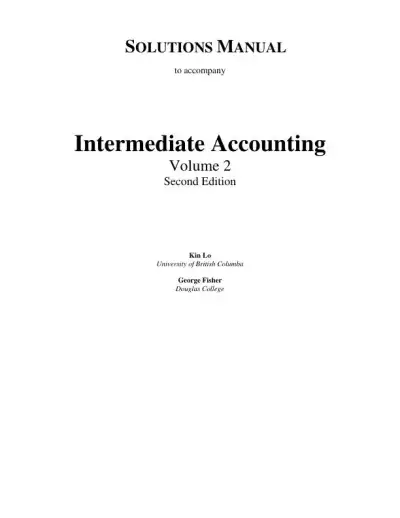 Textbook Guides
Solution Manual for Intermediate Accounting, 2nd Edition
Accounting
401 pagesMay 2025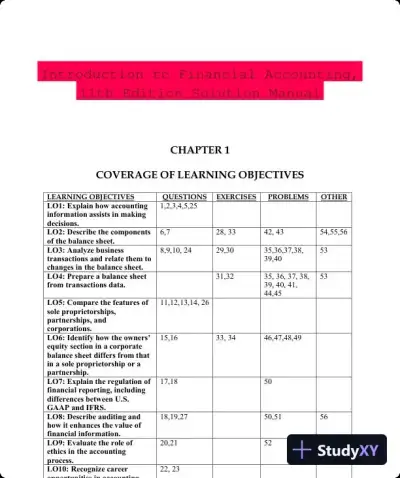 Textbook Guides
Introduction to Financial Accounting, 11th Edition Solution Manual
Accounting
524 pages173downloadsFeb 2025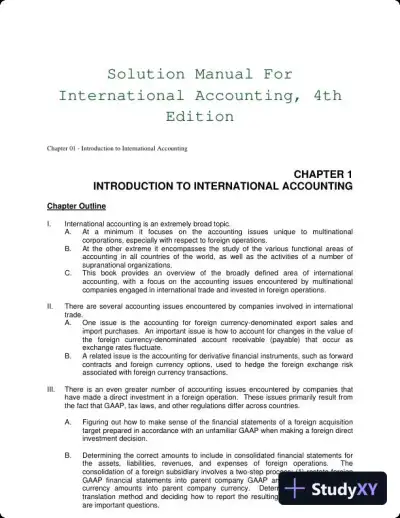 Textbook Guides
Solution Manual For International Accounting, 4th Edition
Accounting
309 pages161downloadsFeb 2025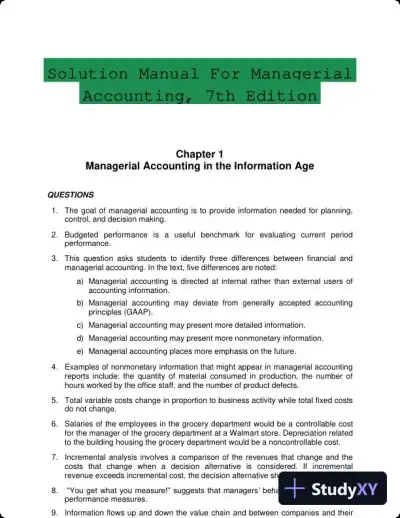 Textbook Guides
Solution Manual For Managerial Accounting, 7th Edition
Accounting
361 pages159downloadsFeb 2025 Class Notes
Class Notes For Advanced Accounting, 4th Edition
Accounting
149 pages159downloadsFeb 2025 Textbook Guides
Financial Accounting 6th Canadian Edition Solution Manual
Accounting
867 pages156downloadsFeb 2025 Textbook Guides
Accounting Theory, 7th Edition Solution Manual
Accounting
325 pages153downloadsFeb 2025 Textbook Guides
Financial Accounting, 9th Edition Solution Manual
Accounting
1024 pages134downloadsFeb 2025
Study this document with CramX
Once it is in your library, every tool can work from it.