

Anatomy and Physiology - The Urinary System
- Anatomy and Physiology
- Texas A&M University
- 37 pages
- Shared March 2026
Preview 10 of 37 pages
See the first 10 pages exactly as they appear in the document.
Page 1 Read page 1 as text
Study Guide Anatomy and Physiology – The Urinary System 1. Quiz: Regulation of Urine Concentration 1. Question The highest concentration of solutes is associated within which region of the nephron loop? Answer Choices • in the actual loop portion of the nephron loop • in the ascending limb of the nephron loop • in the descending limb of the nephron loop Correct Answer in the actual loop portion of the nephron loop Why This Is Correct The bottom (loop portion) of the nephron loop (Loop of Henle) is where the filtrate becomes most concentrated . This happens because: • the descending limb allows water to leave , concentrating the filtrate • the deeper you go into the medulla, the more salty (hypertonic) the environment becomes So the highest solute concentration occurs at the deepest part of the loop . 2. Question Which part of the nephron loop is associated with active transport of solutes out of the nephron?
Page 2 Read page 2 as text
Study Guide Answer Choices • in the actual loop portion of the nephron loop • the ascending limb of the nephron loop • the descending limb of the nephron loop Correct Answer the ascending limb of the nephron loop Why This Is Correct The ascending limb pumps solutes like sodium (Na ⁺ ) and chloride (Cl ⁻ ) out of the nephron using active transport (especially in the thick ascending limb). Important point: The ascending limb is not permeable to water , so water stays inside while solutes leave — this helps create the concentration gradient needed to concentrate urine. 2. Ureters The ureters are two thin tubes — one coming from each kidney . Their main job is to carry urine from the kidneys to the urinary bladder . How Ureters Enter the Urinary Bladder The ureters enter the urinary bladder from the back side . A special thing about them is that they enter the bladder at an angle . Why is this angle important? When the bladder fills up with urine, pressure builds inside it, and this pressure pushes on the ureter openings , forcing them to close . This helps prevent urine from flowing backward into the ureters.
Page 3 Read page 3 as text
Study Guide 2.1 Layers of the Ureter Wall If you look at a cross - section of a ureter, you can see it has three tissue layers : Inner Layer: Mucosa The mucosa is the innermost layer and it includes: • transitional epithelium • a connective tissue layer called the lamina propria The ureter also secretes mucus , which protects the ureter lining from the urine. Middle Layer: Muscularis The muscularis is the middle layer made of smooth muscle . It has two muscle directions: • longitudinal • circular These smooth muscle fibers create peristalsis , which pushes urine forward toward the bladder. Outer Layer: Adventitia The outer layer is called the adventitia . It is made of areolar connective tissue and contains: • nerves • blood vessels • lymphatic vessels This layer helps support and protect the ureter from the outside.
Page 4 Read page 4 as text
Study Guide Key Takeaways • Ureters carry urine: kidneys → urinary bladder • Enter bladder at an angle to prevent backflow • 3 layers: mucosa, muscularis, adventitia • Peristalsis in muscularis moves urine forward 3. Quiz: Ureters 1. Question The ureters leave the kidneys and enter the urinary bladder on the __________ side. Answer Choices • anterior • posterior • superior Correct Answer posterior Why This Is Correct The ureters travel downward from the kidneys and enter the urinary bladder from the posterior (back) side . This helps prevent urine from flowing backward toward the kidneys. 2. Question Under normal circumstances, how many ureters enter the urinary bladder?
Page 5 Read page 5 as text
Study Guide Answer Choices • 1 • 2 • 3 Correct Answer 2 Why This Is Correct Normally, there are two ureters — one coming from the right kidney and one from the left kidney . Each ureter carries urine into the bladder for storage before it is eliminated. 4. Urinary Bladder The urinary bladder is a muscular, sac - like organ that stores urine until it is ready to leave the body. 4.1 The Trigone (Triangular Base Area) Inside the bladder, there is a smooth triangular region called the trigone . This trigone is formed by three openings: • Two ureter openings (where urine enters from the kidneys) • One urethra opening (where urine leaves the bladder) So, the trigone acts like a control area where urine enters and exits. What Happens When the Bladder Is Empty vs Full? When the bladder is empty • it collapses • folds form in the bladder wall called rugae These folds allow the bladder to stretch later.
Page 6 Read page 6 as text
Study Guide When the bladder fills with urine • the rugae (folds) stretch out • the bladder becomes more spherical • the inside becomes smooth This happens because the bladder expands to hold more urine. 4.2 Layers of the Urinary Bladder Wall The bladder wall has three layers , similar to the urethra: Mucosa This is the inner lining of the bladder. It helps protect the bladder from the stored urine. Muscularis (Detrusor Muscle) The muscular layer of the bladder is called the: detrusor muscle This strong muscle helps the bladder contract during urination. Adventitia The outer layer is the adventitia . It supports and protects the bladder from the outside. Internal Urethral Sphincter Around the opening of the urethra, there are circular smooth muscle fibers that form the: internal urethral sphincter This sphincter helps control the flow of urine from the bladder into the urethra.
Page 7 Read page 7 as text
Study Guide 5. Quiz: Urinary Bladder 1. Question The trigone is an area located within the __________. Answer Choices • urethra • urinary bladder • renal pelvis area Correct Answer urinary bladder Why This Is Correct The trigone is a smooth triangular region located inside the urinary bladder . It is formed by the openings of: • the two ureters (where urine enters) • the urethra (where urine leaves) 6. Anatomy of the Kidneys The urinary system plays a huge role in keeping the body stable (maintaining homeostasis ). It helps by: removing harmful substances from the blood controlling water balance helping regulate blood pressure and pH The main organs of this system are the kidneys . Each kidney contains millions of tiny filtering units called nephrons .
Page 8 Read page 8 as text
Study Guide The urinary system also includes: • ureters (carry urine to bladder) • urinary bladder (stores urine) • urethra (releases urine outside) What the Urinary System Does Blood is filtered by two kidneys , and the kidneys produce urine , which contains: • toxic substances • waste products Urine flows like this: Kidneys → Ureters → Urinary bladder → Urethra → Outside the body 6.1 Protective Layers Around the Kidneys Each kidney is protected by three layers : Renal Fascia • thin, outer fibrous connective tissue layer • surrounds the kidney and adrenal gland • attaches the kidney to nearby structures Adipose Capsule • middle layer made of fat • cushions and protects the kidneys Renal Capsule • inner fibrous membrane • helps prevent infections from entering the kidney
Page 9 Read page 9 as text
Study Guide 6.2 Main Regions Inside the Kidney Inside the kidney, there are three main regions : Renal Cortex • outer region • borders the convex (curved) side of the kidney Renal Medulla • deeper region next to the cortex • made of cone - shaped structures called: renal pyramids (medullary pyramids) The tips of pyramids are called: renal papillae (point inward) Between pyramids are unstriped areas called: renal columns Renal Sinus • a cavity near the medulla • opens to the outside through the: renal hilus Through the renal hilus, these enter/exit the kidney: • ureter • nerves • blood vessels • lymphatic vessels The renal sinus contains the: renal pelvis (funnel - shaped) → joins the ureter
Page 10 Read page 10 as text
Study Guide Blood and Nerve Supply of the Kidneys Since kidneys filter blood, they need a strong blood supply . Blood Flow Into the Kidney (Arteries) Blood enters through the: renal artery → renal hilus Then it branches step - by - step: 1. segmental arteries 2. interlobar arteries (between pyramids) 3. arcuate arteries (curve along cortex – medulla border) 4. interlobular arteries (enter cortex) 5. afferent arterioles → glomerulus
27 more pages in the full document
Unlock it once and it stays in your library, ready to chat with or turn into flashcards.
Unlock the full documentMore Anatomy and Physiology study materials
See all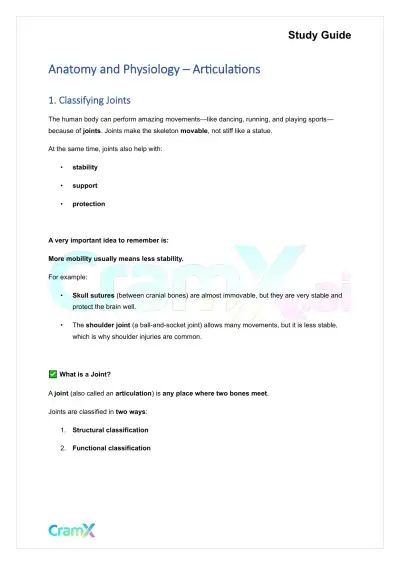 Quick Guides
Anatomy and Physiology - Articulations
Anatomy and Physiology
16 pagesMar 2026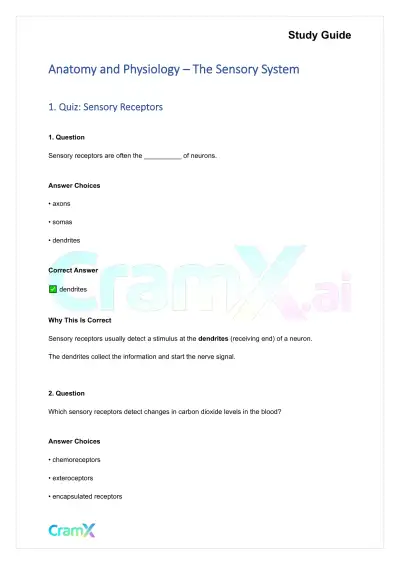 Quick Guides
Anatomy and Physiology - The Sensory System
Anatomy and Physiology
55 pagesMar 2026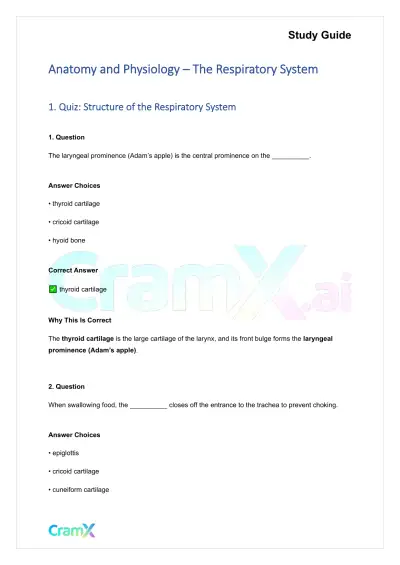 Quick Guides
Anatomy and Physiology - The Respiratory System
Anatomy and Physiology
50 pagesMar 2026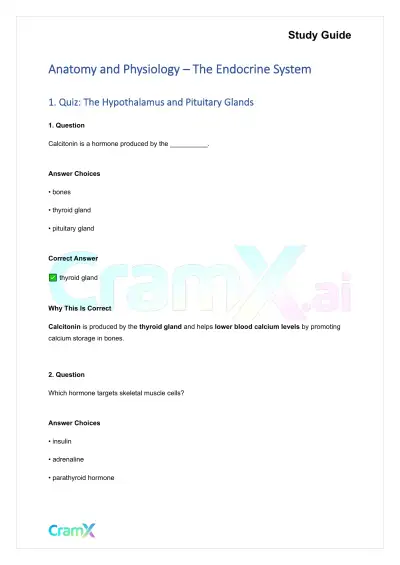 Quick Guides
Anatomy and Physiology - The Endocrine System
Anatomy and Physiology
32 pagesMar 2026 Quick Guides
Anatomy and Physiology - The Muscular System
Anatomy and Physiology
39 pagesMar 2026 Quick Guides
Anatomy and Physiology - Muscle Tissue
Anatomy and Physiology
37 pagesMar 2026 Quick Guides
Anatomy and Physiology - The Digestive System
Anatomy and Physiology
81 pagesMar 2026 Quick Guides
Anatomy and Physiology - The Integumentary System
Anatomy and Physiology
24 pagesMar 2026
Study this document with CramX
Once it is in your library, every tool can work from it.