
Test Bank For Anatomy & Physiology, 6th Edition

Unlock the secrets to mastering your exam with Test Bank For Anatomy & Physiology, 6th Edition, filled with practice questions and detailed solutions.

Benjamin Fisher
Contributor
4.9
41
10 months ago
Preview (16 of 824 Pages)
100%
Log in to unlock

Page 1

Test Bank For Anatomy & Physiology, 6th Edition - Page 1 preview image

Loading page ...

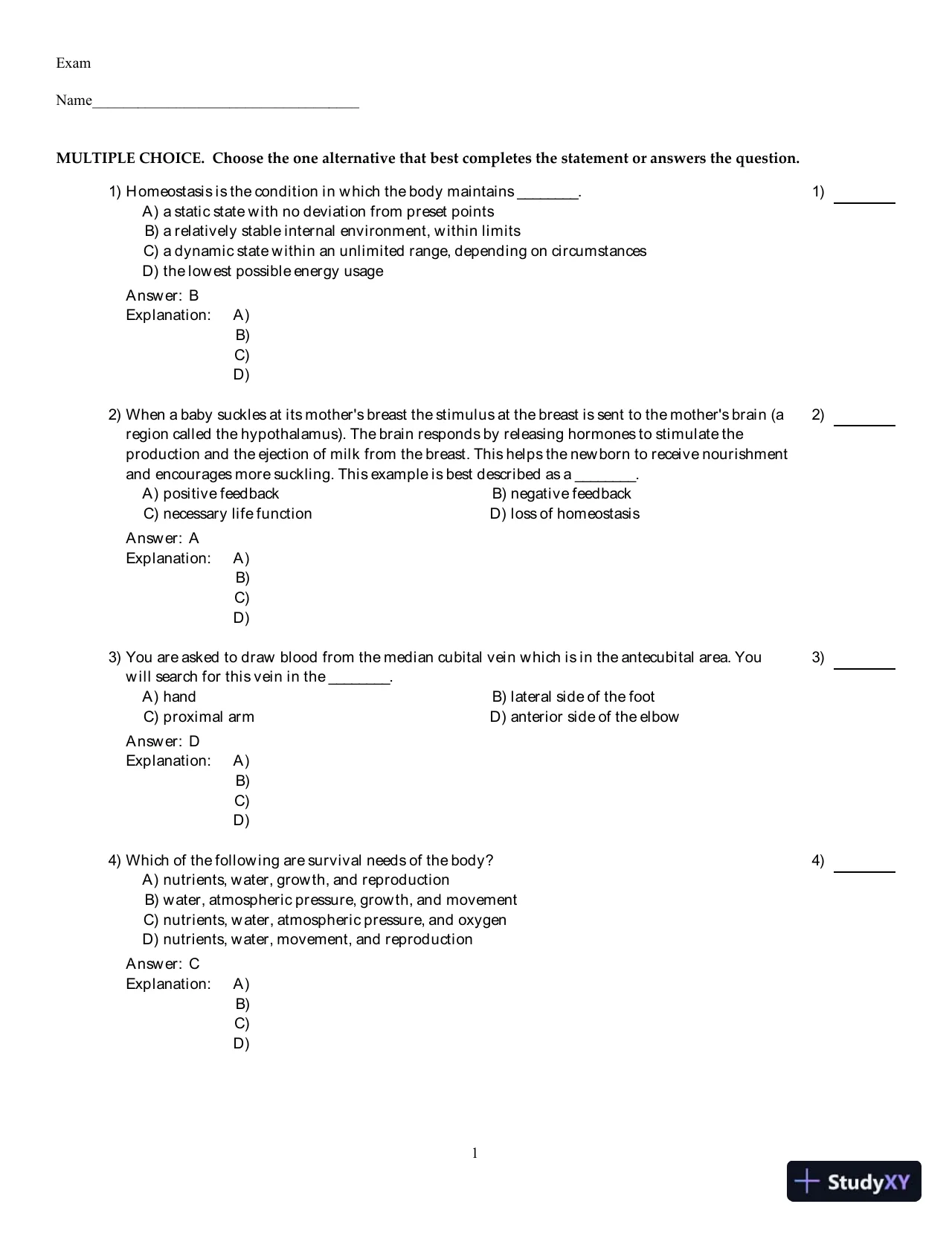
ExamName___________________________________MULTIPLE CHOICE. Choose the one alternative that best completes the statement or answers the question.1)Homeostasis is the condition in which the body maintains ________.1)A)a static state with no deviation from preset pointsB)a relatively stable internal environment, within limitsC)a dynamic state within an unlimited range, depending on circumstancesD)the lowest possible energy usageAnswer:BExplanation:A)B)C)D)2)When a baby suckles at its mother's breast the stimulus at the breast is sent to the mother's brain (aregion called the hypothalamus). The brain responds by releasing hormones to stimulate theproduction and the ejection of milk from the breast. This helps the newborn to receive nourishmentand encourages more suckling. This example is best described as a ________.2)A)positive feedbackB)negative feedbackC)necessary life functionD)loss of homeostasisAnswer:AExplanation:A)B)C)D)3)You are asked to draw blood from the median cubital vein which is in the antecubital area. Youwill search for this vein in the ________.3)A)handB)lateral side of the footC)proximal armD)anterior side of the elbowAnswer:DExplanation:A)B)C)D)4)Which of the following are survival needs of the body?4)A)nutrients, water, growth, and reproductionB)water, atmospheric pressure, growth, and movementC)nutrients, water, atmospheric pressure, and oxygenD)nutrients, water, movement, and reproductionAnswer:CExplanation:A)B)C)D)1

Page 2

Test Bank For Anatomy & Physiology, 6th Edition - Page 2 preview image

Loading page ...

Page 3

Test Bank For Anatomy & Physiology, 6th Edition - Page 3 preview image

Loading page ...

5)Choose the anatomical topic and definition that is not correctly matched.5)A)Microscopic anatomy: study of structures too small to be seen by the naked eye.B)Gross anatomy: study of structures visible to the eye.C)Cytology: study of the structures in a particular region.D)Embryology: study of the changes in an individual from conception to birth.Answer:CExplanation:A)B)C)D)6)What is a vertical section through the body, dividing it into anterior and posterior regions called?6)A)transverseB)medianC)frontalD)sagittalAnswer:CExplanation:A)B)C)D)7)In which body cavities are the lungs located?7)A)mediastinal, thoracic, and ventralB)pericardial, ventral, and thoracicC)pleural, ventral, and thoracicD)pleural, dorsal, and abdominalAnswer:CExplanation:A)B)C)D)8)You are asked to take a person's heart rate at the popliteal pulse point. You will look for this pulse________.8)A)at the posterior side of the wristB)on the posterior side of the kneeC)on the palmar side of the handD)in the distal end of the lower legAnswer:BExplanation:A)B)C)D)9)Which one of the following systems responds fastest to environmental stimuli?9)A)immuneB)nervousC)lymphaticD)muscularAnswer:BExplanation:A)B)C)D)2

Page 4

Test Bank For Anatomy & Physiology, 6th Edition - Page 4 preview image

Loading page ...

10)A good example of a positive feedback mechanism would be ________.10)A)regulating glucose levels in the bloodB)blood calcium level regulationC)body temperature regulationD)enhancement of labor contractionsAnswer:DExplanation:A)B)C)D)11)One of the descriptions below is from the perspective of physiological study, the rest are from ananatomical perspective. Select the description below that comes from physiological perspective.11)A)The chambers of the heart and blood vessels leading to and from the heart are separated byvalves composed of fibrous connective tissue.B)The skull is formed by 22 facial and cranial bones.C)The pancreas lies deep to the stomach within the abdominal cavity.D)The contraction of smooth muscle in blood vessels (vasoconstriction) can reduce the flow ofblood through the vessel.Answer:DExplanation:A)B)C)D)12)Expiration (breathing out) is how the body removes excessive carbon dioxide from the blood. Thisis an example of ________.12)A)excretion of metabolic wasteB)responsivenessC)metabolismD)maintaining boundariesAnswer:AExplanation:A)B)C)D)13)Histology would be best defined as a study of ________.13)A)cellsB)cell chemistryC)tissuesD)the gross structures of the bodyAnswer:CExplanation:A)B)C)D)14)The dorsal body cavity is the site of which of the following?14)A)brainB)lungsC)intestinesD)liverAnswer:AExplanation:A)B)C)D)3

Page 5

Test Bank For Anatomy & Physiology, 6th Edition - Page 5 preview image

Loading page ...

15)A structure that is composed of two or more tissue types that work together to perform specificfunctions for the body is a(n) ________.15)A)organB)complex cellC)organ systemD)complex tissueAnswer:AExplanation:A)B)C)D)16)Which of the following is the best explanation for why cells are considered the smallest units ofliving things.16)A)Cells are highly ordered and complex.B)Cells have the ability to reproduce identical copies of themselves in a process called mitosis.C)Cells cannot be seen with the naked eye and are considered microscopic.D)Cells are the simplest structure to fit all of the characteristics necessary to be considered alive.Answer:DExplanation:A)B)C)D)17)Generally what is the result of the negative feedback process?17)A)to keep the body's blood sugar level highB)to regulate excretion via the kidneysC)to control body movementD)to maintain homeostasisAnswer:DExplanation:A)B)C)D)18)Positive feedback differs from negative feedback because ________.18)A)positive feedback tends to enhance the triggering stimulus while negative feedback tends toreturn the body to a homeostatic balance or "ideal" levelB)positive feedback provides moment-to-moment wellbeing while negative feedback causes acascade effectC)positive feedback is critical to health while negative feedback serves only to alert us topotential health threatsD)positive feedback is generally beneficial while negative feedback is typically harmfulAnswer:AExplanation:A)B)C)D)4

Page 6

Test Bank For Anatomy & Physiology, 6th Edition - Page 6 preview image

Loading page ...

19)Prevention of water loss is a necessary function for life that would best fit in the category of________.19)A)excretionB)maintaining boundariesC)metabolismD)responsivenessAnswer:BExplanation:A)B)C)D)20)Which of these is not part of the dorsal cavity?20)A)spinal cordB)thoracic cavityC)vertebral cavityD)cranial cavityAnswer:BExplanation:A)B)C)D)21)The coxal joint is most likely found in ________ region of the body.21)A)handB)footC)hipD)groinAnswer:CExplanation:A)B)C)D)22)What is a vertical section through the body, dividing it into left and right, called?22)A)regionalB)transverseC)frontalD)sagittalAnswer:DExplanation:A)B)C)D)23)The body cavities that protect the nervous system are located in the ________ cavity.23)A)thoracicB)vertebralC)cranialD)ventralE)dorsalAnswer:EExplanation:A)B)C)D)E)5

Page 7

Test Bank For Anatomy & Physiology, 6th Edition - Page 7 preview image

Loading page ...

24)Which of the following statements is the most correct regarding homeostatic imbalance?24)A)The internal environment is becoming more stable.B)It is considered the cause of most diseases.C)Positive feedback mechanisms are overwhelmed.D)Negative feedback mechanisms are functioning normally.Answer:BExplanation:A)B)C)D)25)Which of the following imaging devices would best localize a tumor in a person's brain?25)A)X rayB)PETC)DSAD)MRIAnswer:DExplanation:A)B)C)D)26)Select the most correct statement.26)A)Organ systems can be composed of cells or tissues, but not both.B)The endocrine system is not a true structural organ system.C)Organ systems operate independently of each other to maintain life.D)The immune system and the lymphatic system can be grouped together.Answer:DExplanation:A)B)C)D)27)One of the descriptions below is from the perspective of anatomical study, the rest are from aphysiological perspective. Select the description below that comes from an anatomical perspective.27)A)The extremely thin tissue (simple squamous epithelium) of the lungs allows for the quickdiffusion of respiratory gases into and out of the body.B)The direction of blood flow through the heart is directed by one way valves.C)The cell-to-cell connections between heart (cardiac) muscle cells are strong. They hold thetissue together for a life time of forceful contractions.D)The innermost lining of the lungs is composed primarily of a thin tissue called simplesquamous epithelium.Answer:DExplanation:A)B)C)D)6

Page 8

Test Bank For Anatomy & Physiology, 6th Edition - Page 8 preview image

Loading page ...

28)You are told to take an axillary temperature on a small child. You will place the thermometer________.28)A)on the foreheadB)under the tongueC)in the rectumD)in the armpitAnswer:DExplanation:A)B)C)D)29)The study of anatomy and physiology assumes and describes a healthy body. Select the descriptionbelow that doesnotexplain why this approach is useful.29)A)A healthy body provides a common standard to compare to.B)Study of a healthy body provides a foundation for a more complete understanding of allhuman bodies.C)Study of a healthy body is less intimidating and more familiar to new students.D)A healthy body establishes what "normal" is.Answer:CExplanation:A)B)C)D)30)Anatomical position is important because ________.30)A)it provides the greatest circulation to the extremitiesB)it allows a common point of reference for body position to help communicate anatomicalrelationshipsC)it is the position most comfortable to hospital patientsD)it allows diagrams within textbooks to display a greater surface area of the body with onesimple diagramAnswer:BExplanation:A)B)C)D)31)Anabolic reactions are chemical reactions of the body that build things, make them bigger or morecomplex. Catabolic reactions break things down making them smaller or less complex. If the rate ofanabolic reaction in the body is much faster than the rate of catabolic reactions which of thefollowing necessary life function will be accomplished?31)A)responsivenessB)movementC)digestionD)growthAnswer:DExplanation:A)B)C)D)7

Page 9

Test Bank For Anatomy & Physiology, 6th Edition - Page 9 preview image

Loading page ...

32)Choose the following statement that is not completely correct regarding serous membranes.32)A)Visceral pericardium covers the outer surface of the heart, and parietal pericardium lines theinternal walls of the heart.B)Serous membranes secrete a watery lubricating fluid.C)Serous membranes are divided into parietal and visceral membranes with a virtual spacebetween the two.D)Serosa are very thin, double-layered structures.Answer:AExplanation:A)B)C)D)33)The thoracic cavity contains the ________. It is found ________ to the vertebral cavity.33)A)digestive viscera: inferiorB)kidneys and spleen: deepC)stomach and liver: superficialD)heart and lungs: anteriorAnswer:DExplanation:A)B)C)D)34)Some of the nerve endings in the skin are sensitive to changes in temperature. They are part of anegative feedback mechanism regulating body temperature. These nerve endings represent a(n)________ in the negative feedback mechanism.34)A)control centerB)homeostatic balance or "ideal" valueC)receptorD)effectorAnswer:CExplanation:A)B)C)D)35)Which of the following describes the operation of the heart and blood vessels?35)A)cardiovascular anatomyB)cardiovascular physiologyC)renal physiologyD)systemic anatomyAnswer:BExplanation:A)B)C)D)8

Page 10

Test Bank For Anatomy & Physiology, 6th Edition - Page 10 preview image

Loading page ...

36)One of the functional characteristics of life is excitability or responsiveness. This refers to ________.36)A)sensing changes in the environment and then reacting or responding to themB)the necessity for all organisms to reproduceC)indigestible food residues stimulating the excretory systemD)the nervous system causing all living things to sometimes experience angerAnswer:AExplanation:A)B)C)D)37)The term pollex refers to the ________.37)A)thumbB)fingersC)calfD)great toeAnswer:AExplanation:A)B)C)D)38)It is wise to study anatomy alongside with physiology because ________.38)A)anatomy and physiology are practically the same thingB)to understand anatomy requires complete understanding of physiologyC)it makes for more efficient use of students' and teachers' timeD)physiology is only explainable in terms of the underlying anatomyAnswer:DExplanation:A)B)C)D)39)Which of the following organs or structures would be found in the left iliac region?39)A)intestinesB)stomachC)liverD)appendixAnswer:AExplanation:A)B)C)D)40)The parietal pleura would represent a serous membrane ________.40)A)covering the heartB)covering individual lungsC)lining the thoracic cavityD)lining the abdominal cavityAnswer:CExplanation:A)B)C)D)9

Page 11

Test Bank For Anatomy & Physiology, 6th Edition - Page 11 preview image

Loading page ...

41)Place the following in correct sequence from simplest to most complex:1. molecules2. atoms3. tissues4. cells5. organs41)A)2-1-3-4-5B)1-2-3-4-5C)1-2-4-3-5D)2-1-4-3-5Answer:DExplanation:A)B)C)D)42)The study of large body structures, visible to the naked eye, such as the heart is called ________anatomy.42)A)systemicB)developmentalC)microscopicD)grossAnswer:DExplanation:A)B)C)D)43)In which quadrant of the abdominopelvic cavity is the stomach located?43)A)right upper quadrantB)left upper quadrantC)left lower quadrantD)right lower quadrantAnswer:BExplanation:A)B)C)D)44)The anatomical position is characterized by all of the following except ________.44)A)body erectB)palms turned posteriorlyC)thumbs pointed laterallyD)arms at sidesAnswer:BExplanation:A)B)C)D)45)Which of the following describes a parasagittal plane?45)A)a transverse cut just above the kneesB)any sagittal plane except in the midlineC)two cuts dividing the body into left and right halvesD)any cut dividing the body into anterior and posterior portionsAnswer:BExplanation:A)B)C)D)10

Page 12

Test Bank For Anatomy & Physiology, 6th Edition - Page 12 preview image

Loading page ...

SHORT ANSWER. Write the word or phrase that best completes each statement or answers the question.Figure 1.1Using Figure 1.1, match the following cavities:46)Vertebral cavity.46)Answer:BExplanation:11

Page 13

Test Bank For Anatomy & Physiology, 6th Edition - Page 13 preview image

Loading page ...

Figure 1.2Using Figure 1.2, match the following descriptions to the most appropriate letter on the diagram:47)Skeletal muscles respond with shivering reflex which provides heat to return the body'stemperature to a homeostatic balance or "ideal" value.47)Answer:EExplanation:12

Page 14

Test Bank For Anatomy & Physiology, 6th Edition - Page 14 preview image

Loading page ...

Figure 1.1Using Figure 1.1, match the following cavities:48)Thoracic cavity.48)Answer:CExplanation:13

Page 15

Test Bank For Anatomy & Physiology, 6th Edition - Page 15 preview image

Loading page ...

Figure 1.2Using Figure 1.2, match the following descriptions to the most appropriate letter on the diagram:49)Appropriate response information is sent through efferent pathways.49)Answer:DExplanation:50)A change in the temperature of the external environment (getting colder).50)Answer:AExplanation:14

Page 16

Test Bank For Anatomy & Physiology, 6th Edition - Page 16 preview image

Loading page ...

Figure 1.1Using Figure 1.1, match the following cavities:51)Cranial cavity.51)Answer:AExplanation:15
Preview Mode

This document has 824 pages. Sign in to access the full document!