

Microbiology: An Evolving Science Fourth Edition Test Bank
- Microbiology
- 500 pages
- Shared May 2025
Microbiology: An Evolving Science Fourth Edition Test Bank enhances learning with well-structured notes, key formulas, and exam-style problems.
Preview 16 of 500 pages
See the first 16 pages exactly as they appear in the document.
Page 1 Read page 1 as text
CHAPTER 1: Microbial Life: Origin and Discovery MULTIPLE CHOICE 1. Viruses are a. infectious agents that infect exclusively multicellular organisms. b. noncellular particles that take over the metabolism of a cell to generate more virus particles. c. pathogens that replicate in complex growth media. d. cellular particles that belong to the archaea domain. e. microbes that consist of lipid membrane – enclosed genomes. ANS: B DIF: Easy REF: 1.1 OBJ: 1.1a Recall the definition of a microbe | 1.1b List examples of microbes MSC: Remembering 2. Analysis of DNA sequences reveals a. the ancient convergence of two cell types (i.e., prokaryotes and eukaryotes). b. that prokaryotes and eukaryotes evolved from a common ancestral cell. c. that bacteria share a common ancestor with archaea but not with eukarya. d. that prokaryotes are cells with a nucleus. e. that the genome of Haemophilus influenzae has about 2 billion base pairs. ANS: B DIF: Easy REF: 1.1 OBJ: 1.1d Explain the implications of microbial genome sequencing MSC: Understanding 3. Which of these groups are considered to be microbes but NOT considered to be cells? a. viruses d. protists b. bacteria e. filamentous fungi c. archaea ANS: A DIF: Easy REF: 1.1 OBJ: 1.1a Recall the definition of a microbe | 1.1c Describe some problems with the definition of a microbe MSC: Understanding 4. A microbe is commonly defined as a ________ that requires a microscope to be seen. a. virus d. multicellular eukaryote b. bacterium e. living organism c. single - cellular prokaryote ANS: E DIF: Easy REF: 1.1 OBJ: 1.1a Recall the definition of a microbe MSC: Remembering 5. Which one of the following statements regarding microbial cells is FALSE? a. Microbial cells acquire food, gain energy to build themselves, and respond to environmental change. b. Most single - celled organisms require a microscope to render them visible, but some bacterial cells are large enough to be seen with naked eyes. c. Microbes function as individual entities. d. Many microbes form complex multicellular assemblages. e. Viruses are not considered microbial cells. ANS: C DIF: Easy REF: 1.1
Page 2 Page 3 Read page 3 as text
OBJ: 1.1a Recall the definition of a microbe MSC: Understanding 6. Which of the following statements is FALSE? a. A genome is the total genetic information contained in an organism’s chromosomal DNA. b. If a microbe’s genome includes genes for nitrogenase, that microbe probably can fix nitrogen. c. By comparing DNA sequences of different organisms, we can figure out how closely related they are. d. Fred Sanger developed the first applicable DNA sequencing method. e. Fred Sanger completed the sequences of Haemophilus influenzae . ANS: E DIF: Easy REF: 1.1 OBJ: 1.1d Explain the implications of microbial genome sequencing MSC: Remembering 7. The first cellular genomes to be sequenced were those of a. humans. d. prions. b. bacteria. e. fungi. c. viruses. ANS: B DIF: Easy REF: 1.1 OBJ: 1.1d Explain the implications of microbial genome sequencing MSC: Remembering 8. The environment of early Earth may have contained all of the following EXCEPT a. ferrous iron. d. oxygen. b. methane. e. hydrogen gas. c. ammonia. ANS: D DIF: Medium REF: Special Topic 1.1 OBJ: 1.1a Recall the definition of a microbe MSC: Remembering 9. The development of the theory of the “RNA world” resulted from the discovery of a. archaea. d. ribozymes. b. prions. e. endosymbionts. c. bacteria. ANS: D DIF: Medium REF: 1.6 OBJ: 1.6b Explain how studies on microbes fostered our knowledge of DNA function and enhanced DNA technology MSC: Remembering 10. What is the evidence that living cells existed on Earth up to 3.8 billion years ago? a. microfossils d. Martian folded rock formations b. 16S ribosomal RNA e. diatom shells c. Miller and Urey’s experiments ANS: A DIF: Medium REF: Special Topic 1.1 OBJ: 1.5a Explain why microbes can be challenging to classify taxonomically | 1.5b Outline how microbial classification has changed over time MSC: Remembering 11. What did van Leeuwenhoek discover using microscopic observations before and after drinking hot beverages? a. Heat did not kill microbes. b. Heat killed microbes. c. Heat did not kill algae.
Page 4 Read page 4 as text
d. Caffeine in coffee killed microbes. e. The existence of spiral - shaped microbes. ANS: B DIF: Medium REF: 1.2 OBJ: 1.2b Explain why the microscope is an important tool in the field of microbiology | 1.2c Identify the contributions of the following individuals: Nightingale, Hooke, van Leeuwenhoek, Pasteur, and Tyndall MSC: Analyzing 12. Tyndall’s spontaneous generation experiments occasionally failed due to a. nutrient chirality. d. lack of oxygen. b. dust. e. endospores. c. fermentation. ANS: E DIF: Easy REF: 1.2 OBJ: 1.2d Compare and contrast Spallanzani’s, Pasteur’s, and Tyndall’ s experiments that tested spontaneous generation MSC: Analyzing 13. The discovery of microbes occurred in the ________ century? a. seventeenth d. twentieth b. eighteenth e. twenty - first c. nineteenth ANS: C DIF: Easy REF: 1.2 OBJ: 1.2b Explain why the microscope is an important tool in the field of microbiology MSC: Remembering 14. Robert Koch won the Nobel Prize for his contribution to medical bacteriology regarding a. Escherichia coli. d. rabies. b. Bacillus subtilis. e. smallpox. c. Mycobacterium tuberculosis. ANS: C DIF: Medium REF: 1.3 OBJ: 1.3b List Koch’s postulates MSC: Remembering 15. How did European invaders to North America kill much of the native population? a. tuberculosis d. HIV b. leprosy e. bubonic plague c. smallpox ANS: C DIF: Medium REF: 1.2 OBJ: 1.2a List both positive and negative impacts that microbes have had on human history MSC: Understanding 16. Florence Nightingale a. is best known as the founder of professional nursing. b. was the first to use disinfectant to demonstrate the significance of aseptic technique. c. developed the pie chart of mortality data during the Crimean War. d. performed the first controlled experiment on the chemical conversion of matter, known today as chemotherapy. e. argued that the environment of early Earth contained mainly reduced compounds. ANS: A DIF: Easy REF: 1.2 OBJ: 1.2a List both positive and negative impacts that microbes have had on human history | 1.2c Identify the contributions of the following individuals: Nightingale, Hooke, van Leeuwenhoek, Pasteur, and Tyndall MSC: Remembering
Page 5 Read page 5 as text
17. Who developed the concept of medical statistics? a. Francis Crick d. Louis Pasteur b. Florence Nightingale e. Alexander Fleming c. Edward Jenner ANS: B DIF: Easy REF: 1.2 OBJ: 1.2c Identify the contributions of the following individuals: Nightingale, Hooke, van Leeuwenhoek, Pasteur, and Tyndall MSC: Remembering 18. The first person to visualize individual microbial cells was a. Antonie van Leeuwenhoek. d. Lady Montagu. b. Robert Hooke. e. Edward Jenner. c. Louis Pasteur. ANS: A DIF: Easy REF: 1.2 OBJ: 1.2c Identify the contributions of the following individuals: Nightingale, Hooke, van Leeuwenhoek, Pasteur, and Tyndall MSC: Remembering 19. Semme lweis and Lister noted that many of their patients’ deaths were due to a. fungi. d. pathogen transmission by doctors. b. Escherichia coli. e. Staphylococcus. c. chlorine. ANS: D DIF: Medium REF: 1.3 OBJ: 1.3a Describe what constitutes a pure culture and how to obtain one MSC: Understanding 20. What is the standard sterilization method for the controlled study of microbes? a. boiling d. autoclaving b. pasteurization e. irradiation c. filter sterilization ANS: D DIF: Medium REF: 1.2
Page 6 Read page 6 as text
OBJ: 1.2c Identify the contributions of the following individuals: Nightingale, Hooke, van Leeuwenhoek, Pasteur, and Tyndall MSC: Remembering 21. How does the Winogradsky column differ from Koch’s plate media? a. Koch’s media creates a gradient from oxygen - rich conditions at the surface to highly reduced conditions below. b. The Winogradsky column is used for culturing viruses. c. The Winogradsky column is used for growing extremophiles. d. The Winogradsky column uses the kinds of nutrients that feed humans. e. The bacteria that Winogradsky isolated can grow only on inorganic minerals. ANS: E DIF: Easy REF: 1.4 OBJ: 1.4a List Winogradsky’s contributions to microbial culture technique | 1.4b Define what distinguishes lithotrophs from other organisms MSC: Understanding 22. Suppose Pasteur’s swan - necked flasks containing boiled broth became cloudy twenty - four hours after boiling. Which choice could best explain the turbidity or cloudiness in the broth without supporting spontaneous generation? a. Endospores in the broth survived boiling and grew after the broth cooled. b. Contaminating organisms in the broth killed by boiling became alive again after the broth cooled. c. Chemicals in the broth came together to form living organisms. d. The broth allowed light to pass through it with less interference after boiling. e. Solid material in the broth dissolved during boiling. ANS: A DIF: Difficult REF: 1.2 OBJ: 1.2c Identify the contributions of the following individuals: Nightingale, Hooke, van Leeuwenhoek, Pasteur, and Tyndall | 1.2d Compare and contrast Spallanzani’s, Pasteur’s, and Tyndall’s experiments that tested spontaneous generation MSC: Applying 23. Which of the following is NOT considered to be an extremophilic condition for bacteria? a. high alkalinity d. high nutrients b. high salinity e. high temperature c. high acidity ANS: D DIF: Medium REF: 1.4 OBJ: 1.4c Explain the role of microbes in geochemical cycling, especially that of nitrogen MSC: Remembering 24. The use of agar as a more robust gelling agent in solid media was suggested by a. Robert Koch. d. Louis Pasteur. b. Ignaz Semmelweis. e. Richard Petri. c. Angelina Hesse. ANS: C DIF: Easy REF: 1.3 OBJ: 1.3a Describe what constitutes a pure culture and how to obtain one | 1.3c Assess some of the practical obstacles in applying Koch’s postulates MSC: Remembering 25. It took the advent of the polymerase chain reaction to detect the presence of the causative agent for which disease? a. anthrax d. rabies b. tuberculosis e. smallpox c. AIDS ANS: C DIF: Difficult REF: 1.3
Page 7 Read page 7 as text
OBJ: 1.3c Assess some of the practical obstacles in applying Koch’s postulates | 1.3f Describe how viruses were discovered MSC: Understanding 26. The word “vaccination” is derived from the Latin word vacca , which means a. inject. d. cow. b. smallpox. e. pustule. c. immunize. ANS: D DIF: Easy REF: 1.3 OBJ: 1.3d Recall the contributions of various individuals to the discovery and implementation of vaccination | 1.3e Compare the roles of immunization, antiseptics, and antibiotics in human disease treatment and prevention MSC: Remembering 27. What was the basis for the original smallpox vaccine? a. chickenpox virus d. smallpox virus b. cowpox virus e. anthrax c. rabies virus ANS: B DIF: Medium REF: 1.3 OBJ: 1.3d Recall the contributions of various individuals to the discovery and implementation of vaccination MSC: Remembering 28. Penicillin was first used to save the lives of many people during which war? a. the U.S. Civil War d. World War I b. the Korean War e. World War II c. the Vietnam War ANS: E DIF: Easy REF: 1.3 OBJ: 1.3e Compare the roles of immunization, antiseptics, and antibiotics in human disease treatment and prevention MSC: Remembering 29. How do many animal endosymbionts grow? a. on the surface of the host d. on inorganic minerals b. on low nutrients e. in biofilms c. by reducing iron oxide ANS: E DIF: Medium REF: 1.4 OBJ: 1.4d Compare the roles of animal endosymbionts and plant endosymbionts MSC: Remembering
Page 8 Read page 8 as text
30. All of the following are true about penicillin EXCEPT that it a. was discovered by Alexander Fleming. b. was an accidental discovery. c. is produced by a bacterium. d. was the first antibiotic used by humans. e. was purified by Florey and Chain. ANS: C DIF: Difficult REF: 1.3 OBJ: 1.3e Compare the roles of immunization, antiseptics, and antibiotics in human disease treatment and prevention MSC: Remembering 31. Which of the following statements regarding viruses is FALSE? a. Most are too small to be seen by a light microscope. b. They are “filterable agents” that can pass through porcelain filters that have a pore size that blocks microbes. c. Their genomes could be composed of DNA or RNA. d. They are smaller than plasmids and prions. e. Viral particles, when pure enough, can be crystallized. ANS: D DIF: Medium REF: 1.3 OBJ: 1.3f Describe how viruses were discovered MSC: Analyzing 32. You have isolated a bacterium that you believe to be the causative agent of a ne w disease in frogs. How would you test the third of Koch’s postulates? a. Determine the shape of the bacterial cells. b. Inject the bacteria into a healthy frog. c. Isolate the bacterium from a sick frog. d. Show that the bacterium is not present in healthy frogs. e. Grow a pure culture of the bacterium outside the frog. ANS: B DIF: Difficult REF: 1.3 OBJ: 1.3b List Koch’s postulates MSC: Applying 33. How did Sergei Winogradsky grow lithotrophs? a. enrichment culture d. endosymbiosis b. organic media e. chain of infection c. pure culture ANS: A DIF: Easy REF: 1.4 OBJ: 1.4a List Winogradsky’s contributions to microbial culture technique | 1.4b Defi ne what distinguishes lithotrophs from other organisms MSC: Understanding 34. Organisms that live symbiotically inside a larger organism are known as a. organelles. d. endosymbionts. b. cyanobacteria. e. chloroplasts. c. mitochondria. ANS: D DIF: Easy REF: 1.4 OBJ: 1.4d Compare the roles of animal endosymbionts and plant endosymbionts MSC: Remembering 35. Animal microbiomes are NOT significant in a. digesting plant fibers. d. converting ammonia to nitrate. b. bioluminescence. e. providing nutrients to the host.
Page 9 Read page 9 as text
c. protection from pathogens. ANS: D DIF: Easy REF: 1.4 OBJ: 1.4d Compare the roles of animal endosymbionts and plant endosymbionts MSC: Applying 36. Carl Woese’s discovery replaced the classification scheme of five kingdoms with a scheme of three a. phyla. d. orders. b. domains. e. genera. c. classes. ANS: B DIF: Easy REF: 1.5 OBJ: 1.5b Outline how microbial classification has changed over time | 1.5d Describe the importance of DNA sequencing in classification MSC: Remembering 37. The gene expression machinery of archaea is MOST similar to a. monera. d. eukaryotes. b. prokaryotes. e. mitochondria. c. bacteria. ANS: D DIF: Medium REF: 1.5 OBJ: 1.5e Compare and contrast archaea, bacteria, and eukaryotes MSC: Understanding 38. In the three - domain model, the bacterial ancestor of mitochondria derives from ancient a. fungi. d. archaea. b. cyanobacteria. e. protists. c. respiring bacteria. ANS: C DIF: Medium REF: 1.5 OBJ: 1.5c Appraise endosymbiosis as an explanation for mitochondria and chloroplasts MSC: Remembering 39. Which of the following organelles are thought to be of prokaryotic origin? a. chloroplast d. chloroplast and mitochondria b. mitochondria e. chloroplast and nucleus c. nucleus ANS: D DIF: Medium REF: 1.5 OBJ: 1.5c Appraise endosymbiosis as an explanation for mitochondria and chloroplasts MSC: Understanding 40. In the three - domain model, the bacterial ancestor of chloroplasts derives from ancient a. fungi. d. archaea. b. cyanobacteria. e. protists. c. proteobacteria. ANS: B DIF: Medium REF: 1.5 OBJ: 1.5c Appraise endosymbiosis as an explanation for mitochondria and chloroplasts MSC: Remembering 41. Which commonly used microbial classification advancement led to the tree by Carl Woese in 1977?
Page 10 Read page 10 as text
a. comparative genomics d. protein sequencing b. microscopy e. 16S rRNA sequencing c. X - ray diffraction ANS: E DIF: Medium REF: 1.5 OBJ: 1.5b Outline how microbial classification has changed over time | 1.5d Describe the importance of DNA sequencing in classification MSC: Understanding 42. Electron microscopes use what to focus the beam of electrons? a. electromagnets d. X - ray diffraction b. a condenser lens e. glass c. light rays ANS: A DIF: Easy REF: 1.6 OBJ: 1.6a Describe the roles of the electron microscope and the ultracentrifuge in ad vancing our knowledge of cell structure and function MSC: Remembering 43. Peter Mitchell and Jennifer Moyle discovered the ________ theory in the 1960s. a. germplasm d. DNA synthesis b. evolution e. polymerase chain reaction c. chemiosmotic ANS: C DIF: Easy REF: 1.6 OBJ: 1.6a Describe the roles of the electron microscope and the ultracentrifuge in advancing our knowledge of cell structure and function MSC: Remembering 44. The X - ray diffraction studies by which of the following scientists concluded that DNA was a double helix? a. James Watson d. Maurice Wilkins b. Rosalind Franklin e. Kary Mullis c. Francis Crick ANS: B DIF: Easy REF: 1.6 OBJ: 1.6a Describe the roles of the electron microscope and the ultracentrifuge in advancing our knowledge of cell structure and function MSC: Remembering 45. What feature of bacteria facilitated the DNA revolution in the 1970s?
Page 11 Read page 11 as text
a. They are very small. d. All of their genes were known. b. They readily recombine DNA. e. They do not cause disease. c. They have very large genomes. ANS: B DIF: Medium REF: 1.6 OBJ: 1.6b Explain how studies on microbes fostered our knowledge of DNA function and enhanced DNA technology MSC: Understanding 46. This scientist first discovered the process of transformation. a. Francis Crick d. Louis Pasteur b. Robert Koch e. Fr ederick Griffith c. Edward Jenner ANS: E DIF: Difficult REF: 1.6 OBJ: 1.6b Explain how studies on microbes fostered our knowledge of DNA function and enhanced DNA technology MSC: Remembering 47. Taq polymerase forms the basis of a technique for a. comparative genomics. d. DNA amplification. b. recombinant DNA. e. protein synthesis. c. X - ray diffraction. ANS: D DIF: Easy REF: 1.6 OBJ: 1.6c State some uses of microbes in medicine and industry MSC: Understanding 48. In 1975, scientists held a conference at Asilomar to regulate and restrict the field of a. recombinant DNA. d. DNA amplification. b. comparative genomics. e. forensic microbiology. c. DNA sequencing. ANS: A DIF: Medium REF: 1.6 OBJ: 1.6c State some uses of microbes in medicine and industry MSC: Understanding 49. The study of and cause of disease in humans, animals, and plants is called a. microbiology. d. epidemiology. b. phylogeny. e. forensics. c. genomics. ANS: D DIF: Medium REF: 1.6 OBJ: 1.6c State some uses of microbes in medicine and industry MSC: Remembering 50. The ultracentrifuge is a high - speed centrifuge ideally suited for separating individual a. cellular proteins and nucleotides. d. secondary metabolites. b. microbial cells. e. base pairs. c. mold spores. ANS: A DIF: Medium REF: 1.6 OBJ: 1.6a Describe the roles of the electron microscope and the ultracentrifuge in advancing our knowledge of cell structure and function MSC: Understanding SHORT ANSWER
Page 12 Read page 12 as text
1. What is the MOST recent evidence suggesting that all life on Earth shares a common ancestry? ANS: Many genomes have now been sequenced, and those sequences are available in databases for comparison. This field is referred to as comparative genomics. Comparisons have revealed that there is a set of core genes shared by all organisms. DIF: Difficult REF: 1.1 | 1.5 OBJ: 1.1d Explain the implications of microbial genome sequencing | 1.5b Outline how microbial classification has changed over time MSC: Analyzing 2. How are prokaryotes and eukaryotes different? ANS: A prokaryote lacks a nucleus and membrane - bounded organelles, whereas a eukaryote has a nucleus and membrane - bounded organelles. DIF: Easy REF: 1.1 | 1.5 OBJ: 1.1a Recall the definition of a microbe MSC: Remembering 3. How do microbes help in the extraction of minerals? ANS: Several lithotrophic bacteria help in the rapid oxidation of minerals, which generates strong acids that expedite the breakdown of mineral ore. Currently, approximately 20% of the world’s copper, as well as some uranium and zinc, is produced by bacterial leaching. DIF: Medium REF: 1.2 OBJ: 1.2a List both positive and negative impacts that microbes have had on human history MSC: Applying 4. Antonie van Leeuwenhoek worked as a cloth draper, inspecting the quality of cloth. How did this lead to his interest in microscopy? ANS: His work introduced him to magnifying lenses. He began the hobby of grinding lenses, ultimately making a microscope that enabled him to observe single - celled microbes. DIF: Medium REF: 1.2 OBJ: 1.2c Identify the contributions of the following individuals: Nightingale, Hooke, van Leeuwenhoek, Pasteur, and Tyndall MSC: Understanding 5. What was the major complaint about Lazzaro Spallanzani’s experiment to disprove spontaneous generation, and how did Louis Pasteur’s swan - neck flasks overcome this? ANS: Spallanzani’s flasks were plugged so as not to let organisms accidentally enter the boiled medium. Opponents argued that no growth was observed simply due to the lack of oxygen. Pasteur’s swan - neck flasks did not allow organisms to enter the flask but did allow oxygen to enter. Growth was still not observed. DIF: Medium REF: 1.2 OBJ: 1.2c Identify the contributions of the following individuals: Nightingale, Hooke, van Leeuwenhoek, Pasteur, and Tyndall MSC: Evaluating
Page 13 Read page 13 as text
6. Describe the discoveries of Louis Pasteur while working with the French beer and wine manufacturers in assessing alcohol versus vinegar production during fermentation. ANS: Previously, it was believed that the conversion of grapes and grain to wine and beer was a spontaneous chemical process. Pasteur discovered that this fermentation was caused by living yeast, which did not require oxygen for growth. He also discovered that when the grapes or grain are contaminated with bacteria instead of yeast, acetic acid is produced instead of alcohol. DIF: Medium REF: 1.2 OBJ: 1.2c Identify the contributions of the following individuals: Nightingale, Hooke, van Leeuwenhoek, Pasteur, and Tyndall MSC: Understanding 7. Describe the effects of three microbial diseases that have significantly affected human populations throughout history. ANS: Answers may vary. Some examples include bubonic plague, which killed one - third of Europe’s population in the fourteenth century; tuberculosis, which was common in the nineteenth century; AIDS, which affects many people today; and smallpox, which killed a large number of native North Americans. DIF: Medium REF: 1.2 OBJ: 1.2a List both positive and negative impacts that microbes have had on human history | 1.2c Identify the contributions of the following individuals: Nightingale, Hooke, van Leeuwenhoek, Pasteur, and Tyndall MSC: Applying 8. Why did it take so long for humans to determine that microbes cause infectious diseases? ANS: Microbes are too small to be seen with the naked eye, so until powerful - enough microscopes were invented, humans did not know that microbes existed. Even after humans were aware of the presence of microbes, they did not suspect them of causing disease until people such as Joseph Lister and Ignaz Semmelweis performed experiments that showed antiseptics decrease the incidence of infection. DIF: Difficult REF: 1.2 | 1.3 OBJ: 1.2b Explain why the microscope is an important tool in the field of microbiology MSC: Understanding 9. Robert Koch’ s postulates have not been used to prove HIV as the causative agent of AIDS. Why not? ANS: Answers may vary, but a major reason is that humans cannot be injected with HIV to see if they develop AIDS, and a suitable animal host doesn’t exist for testing. DIF: Medium REF: 1.3 OBJ: 1.3c Assess some of the practical obstacles in applying Koch’s postulates MSC: Understanding 10. Define “attenuation” and describe some mechanisms used to attenuate pathogens.
Page 14 Read page 14 as text
ANS: Attenuation results in a weakened organism that will not produce full - blown disease but will generate immunity. Answers for mechanisms may vary, but heat treatment or aging for various periods or natural attenuation in the host are mentioned in the chapter. DIF: Medium REF: 1.3 OBJ: 1.3d Recall the contributions of various individuals to the discovery and implementation of vaccination | 1.3e Compare the roles of immunization, antiseptics, and antibiotics in human disease treatment and prevention MSC: Applying 11. What is the significance of the work of Ignaz Semmelweis and Joseph Lister? ANS: They showed that use of antiseptics on doctors’ hands and medical instruments drastically reduced the mortality rate of hospital patients. They made these observations before Robert Koch’s germ theory of disease. DIF: Medium REF: 1.3 OBJ: 1.3e Compare the roles of immunization, antiseptics, and antibiotics in human disease treatment and prevention MSC: Understanding 12. How would you use Robert Koch’s postulates to prove that a specific organism causes a new disease in mice? ANS: See Figure 1.17 in the textbook: (1) The suspected organism is found in all diseased mice, but is absent from healthy mice. (2) The suspected organism is isolated from the diseased mice and grown in pure culture. (3) When the suspected organism is introduced into a healthy mouse, the same disease occurs. (4) The same strain of microbe is obtained from the newly diseased mouse. DIF: Difficult REF: 1.3 OBJ: 1.3b List Koch’s postulates MSC: Applying 13. Explain why the organisms that were studied by Sergei Winogradsky could not be grown on Robert Koch’s plate media containing agar or gelatin. ANS: The organisms studied by Winogradsky were lithotrophs, which feed solely on inorganic substances. Koch’s plate media contained organic nutrient sources, which may even be toxic to the organisms he was attempting to grow. DIF: Medium REF: 1.4 OBJ: 1.4a List Winogradsky’s contributions to microbial culture technique MSC: Analyzing 14. Is it true that only culturable bacteria contribute to ecology? Explain your answer. ANS: No, this is not a true statement. It is estimated that barely 0.1% of microbial species can be cultured. The work of Winogradsky and later microbial ecologists showed that bacteria are necessary for geochemical cycling. Many of these organisms can’t be grown in pure culture on laboratory media but can be grown in enrichment culture such as a Winogradsky column.
Page 15 Read page 15 as text
DIF: Difficult REF: 1.4 OBJ: 1.4c Explain the role of microbes in geochemical cycling, especially that of nitrogen MSC: Analyzing 15. Define the term “endosymbiont” and give an example of an endosymbiotic relationship found in nature. ANS: An endosymbiont is an organism living symbiotically inside a larger organism. Examples may vary, but include the following: Rhizobium in a leguminous plant, bioluminescent bacteria in the light organs of fish and squid, and photosynthetic algae and coral. DIF: Medium REF: 1.4 OBJ: 1.4d Compare the roles of animal endosymbionts and plant endosymbionts MSC: Applying 16. Give two reasons why microbes have been difficult to classify. ANS: First, even with the use of light microscopes, only the basic shape of microbes can be determined, and many microbes have similar shapes even though they are very different in other ways. Second, microbes do not fit the classic definition of a species, which is a group of organisms that interbreed. Microbes typically reproduce asexually. When they do exchange genes, they may do so with distantly related species. DIF: Medium REF: 1.5 OBJ: 1.5a Explain why microbes can be challenging to classify taxonomically MSC: Analyzing 17. Briefly explain the endosymbiosis theory and the evidence that supports it. ANS: The endosymbiosis theory proposes that mitochondria and chloroplasts evolved from bacteria that were engulfed by pre - eukaryotic cells, and that over time these endosymbiotic prokaryotic cells lost the ability to survive outside of the host cell but were maintained as organelles. Evidence supporting the endosymbiosis theory includes the fact that mitochondria and chloroplasts possess circular DNA with similarity to modern bacteria. DIF: Medium REF: 1.5 OBJ: 1.5c Appraise endosymbiosis as an explanation for mitochondria and chloroplasts MSC: Understanding 18. What were Rosalind Franklin’s contributions toward discovering the structure of DNA, and why wasn’t she one of the recipients of the Nobel Prize for this discovery? ANS: She was an X - ray crystallographer who studied the structure of DNA. Her X - ray micrographs showed for the first time that DNA was a double helix. A colleague showed her micrographs to James Watson, who was also studying the structure of DNA. Watson and Francis Crick published their model of the structure of DNA in the journal Nature and denied that they had used Franklin’s micrographs. Franklin also died before the awarding of the prize. DIF: Medium REF: 1.6
Page 16 Read page 16 as text
OBJ: 1.6a Describe the roles of the electron microscope and the ultracentrifuge in advancing our knowledge of cell structure and function MSC: Understanding 19. Briefly describe how the ultracentrifuge is used to determine the sizes of cellular macromolecules. ANS: The ultracentrifuge uses centrifugal forces to separate cell components. Theodor Svedberg calculated that the particle sizes could be determined based on the rate of sedimentation of the particles in an ultracentrifuge. DIF: Medium REF: 1.6 OBJ: 1.6a Describe the roles of the electron microscope and the ultracentrifuge in advancing our knowledge of cell structure and function MSC: Understanding 20. If you want to produce DNA polymerases like those used in polymerase chain reaction (PCR) for amplification of DNA, from which natural environment would you try to isolate the producers? ANS: Since DNA polymerase in PCR must survive many rounds of cycling to near - boiling temperatures, the most conducive environment for finding DNA polymerase, such as the enzymes used in PCR reactions, would be searching for microbes in an environment where the temperature is extremely high. DIF: Difficult REF: 1.6 OBJ: 1.6c State some uses of microbes in medicine and industry MSC: Applying
484 more pages in the full document
Unlock it once and it stays in your library, ready to chat with or turn into flashcards.
Unlock the full documentMore Microbiology study materials
See all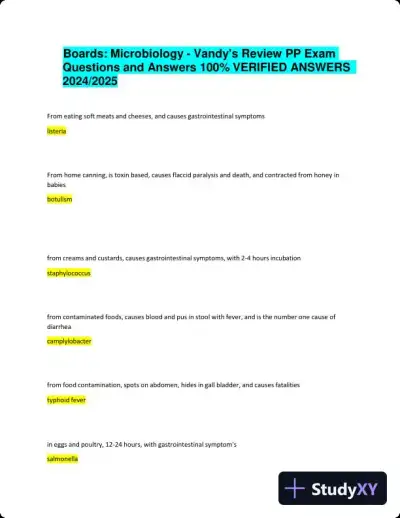 Past Exams
2024-2025 Boards: Microbiology - Vandy's Review PP Exam with Answers (55 Solved Questions)
Microbiology
22 pages171downloadsFeb 2025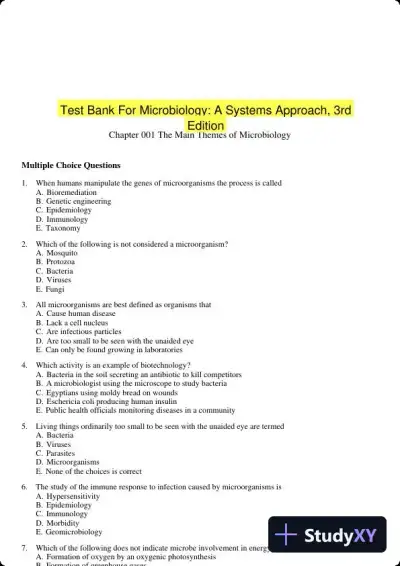 Exam Guides
Test Bank For Microbiology: A Systems Approach, 3rd Edition
Microbiology
546 pages124downloadsFeb 2025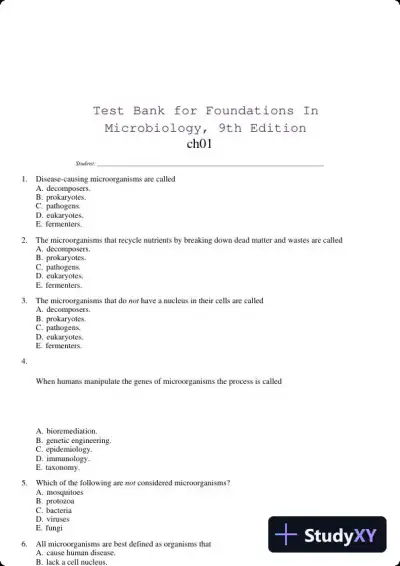 Exam Guides
Test Bank for Foundations In Microbiology, 9th Edition
Microbiology
338 pages120downloadsFeb 2025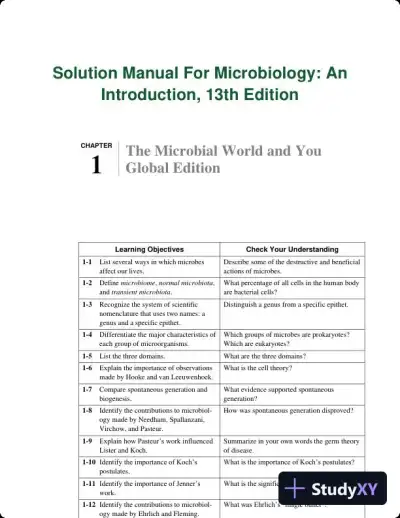 Textbook Guides
Solution Manual For Microbiology: An Introduction, 13th Edition
Microbiology
298 pages36downloadsFeb 2025 Exam Guides
Test Bank For Microbiology with Diseases by Taxonomy, 6th Edition
Microbiology
532 pagesMay 2025 Quick Guides
Microbiology - DNA and Gene Expression
Microbiology
15 pagesMar 2026 Quick Guides
Microbiology - Microbial Genetics
Microbiology
13 pagesMar 2026 Past Exams
Microbiology Practice Exam With Answers (1000 Solved Questions)
Microbiology
156 pagesMay 2025
Study this document with CramX
Once it is in your library, every tool can work from it.