

Microbiology - The Development of Infectious Disease
- Microbiology
- Texas A&M University
- 7 pages
- Shared March 2026
Preview 3 of 7 pages
See the first 3 pages exactly as they appear in the document.
Page 1 Read page 1 as text
Study Guide Microbiology – The Development of Infectious Disease 1 . Contributing Factors Infectious disease develops as a competition between the parasite (pathogen) and the host (the body) . If the pathogen successfully overcomes the body’s defenses, the normal state of health is disturbed and disease occurs . Whether a microorganism is able to cause disease depends on several contributing factors . These factors influence the ability of the pathogen to enter the body, survive, multiply, and cause damage . 1.1 Portals of Entry For a pathogen to cause infection, it must first enter the body through a portal of entry . The most common portals of entry are: • Mucous membranes , especially those of the: o Respiratory tract o Gastrointestinal tract o Urogenital tract Another important portal of entry is the skin . • Microorganisms can enter through: o Cuts or wounds o Hair follicles When pathogens enter the body beneath the skin , the route is called the parenteral route . 1.2 Dose of the Pathogen The dose refers to the number of microorganisms required to establish an infection. • Some diseases require only a small number of organisms
Page 2 Read page 2 as text
Study Guide o Example: typhoid fever (a few hundred bacteria) • Other diseases require a very large number o Example: cholera (millions of bacteria) The dose is sometimes expressed as LD ₅₀ (lethal dose 50) : • This is the number of microorganisms required to kill 50% of the hosts exposed 1.3 Invasiveness Invasiveness is the ability of a pathogen to penetrate and spread through body tissues . • Highly invasive organisms are more likely to cause disease • For example, organisms that cause intestinal ulcers can penetrate deeply into tissue Tissue invasion usually begins with adherence , which is the ability of a microorganism to attach to host cells . • Adherence is often aided by structures such as pili • Capsules or glycocalyx layers also help because they are sticky , allowing stronger attachment to tissues 1.4 Capsules and Resistance to Host Defenses Some microorganisms are surrounded by a capsule , which greatly increases their ability to cause disease. Capsules help pathogens by: • Preventing phagocytosis • Interfering with the action of white blood cells Normally, white blood cells engulf and destroy invading microorganisms. However: • Toxic substances in the capsule can damage or kill white blood cells • This allows the pathogen to survive and multiply A well - known example is the organism that causes pneumonia , which has a capsule containing toxic materials. Many other disease - causing microorganisms also possess capsules.
Page 3 Read page 3 as text
Study Guide Key Points to Remember • Disease depends on the balance between host defenses and pathogen strength • Pathogens must enter through a portal of entry • The dose of microorganisms affects disease development • Invasiveness allows pathogens to penetrate tissues • Capsules help pathogens avoid destruction by the immune system 2. Enzymes and Toxins Pathogenic microorganisms use special enzymes and toxins to damage body tissues, avoid immune defenses , and establish infection. These substances increase the organism’s ability to cause disease. 2.1 Enzymes – Tools That Help Pathogens Spread Many pathogens produce enzymes that weaken the body’s defenses and help them survive inside the host. Leukocidins • Leukocidins are enzymes that destroy white blood cells • Since white blood cells perform phagocytosis , their destruction reduces the body’s ability to fight infection Hemolysins • Hemolysins are enzymes that destroy red blood cells • They are produced by organisms such as: o Streptococci o Staphylococci o Some Clostridium species
4 more pages in the full document
Unlock it once and it stays in your library, ready to chat with or turn into flashcards.
Unlock the full documentMore Microbiology study materials
See all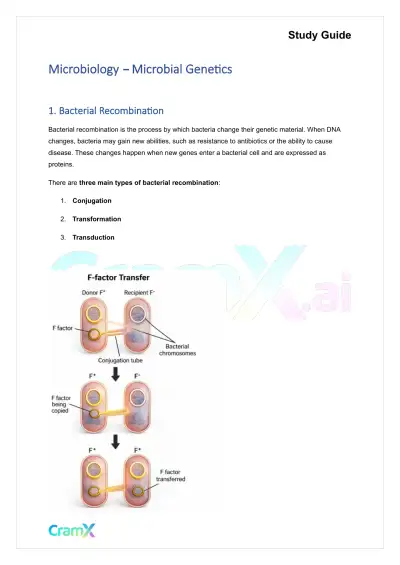 Quick Guides
Microbiology - Microbial Genetics
Microbiology
13 pagesMar 2026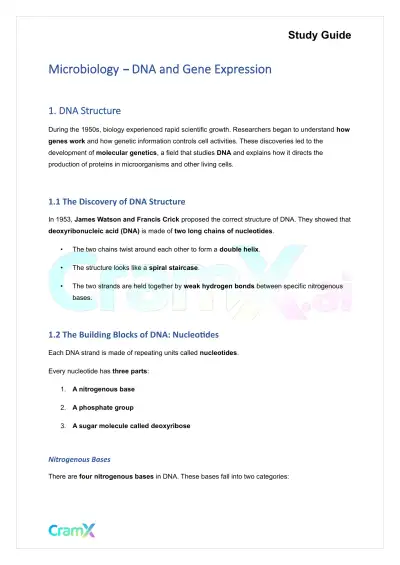 Quick Guides
Microbiology - DNA and Gene Expression
Microbiology
15 pagesMar 2026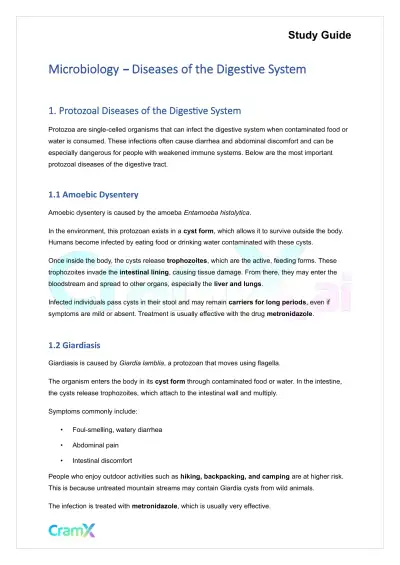 Quick Guides
Microbiology - Diseases of the Digestive System
Microbiology
15 pagesMar 2026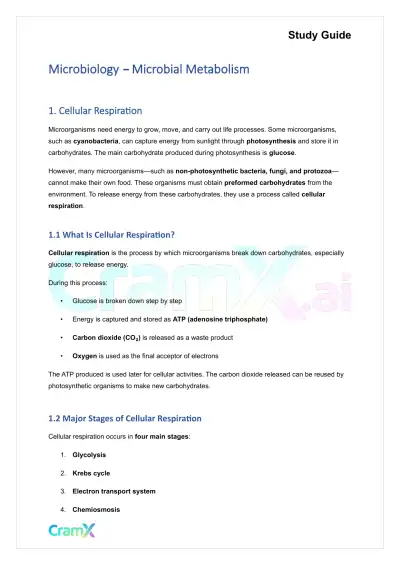 Quick Guides
Microbiology - Microbial Metabolism
Microbiology
16 pagesMar 2026 Quick Guides
Microbiology - Food Microbiology
Microbiology
13 pagesMar 2026 Quick Guides
Microbiology - Prokaryotes and Eukaryotes
Microbiology
13 pagesMar 2026 Quick Guides
Microbiology - Microbial Cultivation and Growth
Microbiology
15 pagesMar 2026 Quick Guides
Microbiology - Control of Microbial Growth
Microbiology
22 pagesMar 2026
Study this document with CramX
Once it is in your library, every tool can work from it.