

Microbiology - The Viruses
- Microbiology
- Texas A&M University
- 13 pages
- Shared March 2026
Preview 4 of 13 pages
See the first 4 pages exactly as they appear in the document.
Page 1 Read page 1 as text
Study Guide Microbiology – The Viruses 1. Viral Cultivation and Physiology Viruses are not living cells , so they cannot grow on their own. To multiply, they must infect a living host cell . Because of this, special methods are used to grow and study viruses in the laboratory. 1.1 Cultivation of Viruses Cultivating Bacteriophages Bacteriophages are viruses that infect bacteria . To study them: 1. Bacteria are grown in a suitable nutrient medium. 2. Bacteriophages are added to the culture. 3. The viruses infect the bacteria, multiply inside them, and increase rapidly in number. 1.2 Cultivating Animal and Plant Viruses Animal and plant viruses are usually grown in cell cultures . A cell culture is prepared by growing living cells outside their original plant or animal source. These cells are kept alive in a nutrient - rich solution inside a Petri dish . When the cells spread out and form a thin layer, called a monolayer , viruses are added. The viruses then infect the cells and replicate. Viruses can also be grown using: • Fertilized eggs • Living animals These methods are especially useful for studying viruses that do not grow well in cell cultures. 1.3 Large - Scale Virus Production For research purposes, viruses can be grown in large tissue culture systems . After viral replication:
Page 2 Read page 2 as text
Study Guide • The host cells break down • Viruses are collected (harvested) • Viral particles are concentrated using precipitation • Further purification is done using repeated centrifugation In some cases, viruses can be highly purified by crystallization and concentration under controlled conditions. Viral Measurements Viruses are too small to be seen with a light microscope , so an electron microscope is usually required. Instead of counting viruses directly, scientists measure them using virus infectious units . A virus infectious unit is the smallest amount of virus that produces a detectable effect in a susceptible host. These units are expressed per volume of fluid . Plaque Assay One common way to measure virus numbers is the plaque assay . • Viruses are spread over a lawn of host cells • As viruses infect and destroy cells, clear areas called plaques appear • Each plaque represents viral replication and cell destruction • By counting plaques, scientists can estimate the number of infectious viral units Animal - Based Measurement Another method involves infecting living animals with different virus dilutions. Scientists determine: • Which dilution causes death • The end - point dilution , which indicates viral concentration
Page 3 Read page 3 as text
Study Guide Antiviral Agents Antibiotics cannot treat viral infections because they target bacterial structures and processes that viruses do not have. For example, penicillin disrupts bacterial cell wall synthesis, but viruses have no cell wall . However, some drugs can block viral replication : • Acyclovir interferes with DNA synthesis in herpes viruses • Azidothymidine (AZT) blocks DNA synthesis in HIV • Ganciclovir is used against cytomegaloviruses • Amantadine is effective against influenza viruses Interferons Interferons are natural antiviral proteins produced by host cells after viral infection. • They do not protect the infected cell • They protect nearby cells by preventing viral replication • Interferons can be produced using genetic engineering techniques Viral Vaccines Vaccines provide protection by preparing the immune system to recognize viruses. Inactivated (Killed) Vaccines These vaccines contain viruses that cannot replicate because they have been chemically or physically treated. • Example: Salk polio vaccine • Example: Yellow fever vaccine Attenuated (Live) Vaccines Attenuated viruses are weakened forms of the virus.
Page 4 Read page 4 as text
Study Guide • They replicate very slowly • They usually do not cause disease • Examples include: o Sabin polio vaccine o Vaccines for measles and rubella Recombinant Vaccines Modern vaccines often contain viral proteins produced by genetic engineering rather than whole viruses. • Example: Hepatitis B vaccine Viral Inactivation Viruses are made of nucleic acid , protein , and sometimes a lipid envelope . Because of this, they can be inactivated by substances that damage these components. Viruses can be destroyed by: • Chemical agents such as chlorine, iodine, phenol, detergents, and heavy metals • Heat , similar to methods used for other microbes • Ultraviolet (UV) light • Filtration , if the filter pores are small enough to trap virus particles Key Points to Remember • Viruses must grow inside living cells • Cell cultures, eggs, and animals are used for cultivation • Viral numbers are measured using infectious units • Antibiotics do not work against viruses • Vaccines and antiviral drugs are key tools in viral control
9 more pages in the full document
Unlock it once and it stays in your library, ready to chat with or turn into flashcards.
Unlock the full documentMore Microbiology study materials
See all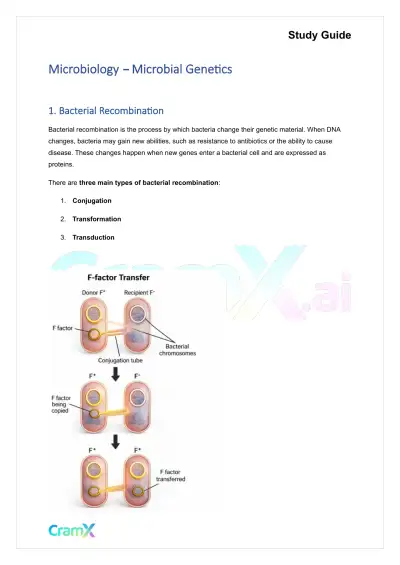 Quick Guides
Microbiology - Microbial Genetics
Microbiology
13 pagesMar 2026 Quick Guides
Microbiology - DNA and Gene Expression
Microbiology
15 pagesMar 2026 Quick Guides
Microbiology - Diseases of the Digestive System
Microbiology
15 pagesMar 2026 Quick Guides
Microbiology - Microbial Metabolism
Microbiology
16 pagesMar 2026 Quick Guides
Microbiology - Food Microbiology
Microbiology
13 pagesMar 2026 Quick Guides
Microbiology - Prokaryotes and Eukaryotes
Microbiology
13 pagesMar 2026 Quick Guides
Microbiology - Microbial Cultivation and Growth
Microbiology
15 pagesMar 2026 Quick Guides
Microbiology - Control of Microbial Growth
Microbiology
22 pagesMar 2026
Study this document with CramX
Once it is in your library, every tool can work from it.