

Microbiology - The Bacteria
- Microbiology
- Texas A&M University
- 14 pages
- Shared March 2026
Preview 5 of 14 pages
See the first 5 pages exactly as they appear in the document.
Page 1 Read page 1 as text
Study Guide Microbiology – The Bacteria 1. Gram - Negative Rods and Cocci Gram - negative bacteria include many different shapes and lifestyles. Some live freely in nature, some help plants and animals, and others can cause disease. Let’s explore the major groups step by step. 1.1 Bdellovibrios – Bacteria That Hunt Other Bacteria Bdellovibrios are aerobic, Gram - negative, curved rod - shaped bacteria with a very unusual lifestyle. Instead of living on nutrients in the environment, they prey on other bacteria . The bdellovibrio attaches to another bacterium, spins, and drills a hole through the host’s cell wall . It then enters the space between the cell wall and the plasma membrane. Once inside, it takes control of the host’s cell machinery and grows. This process eventually kills the host bacterium . The best - studied species in this group is Bdellovibrio bacteriovorus , which has a distinctive comma - like shape. 1.2 Pseudomonads – Common and Versatile Bacteria Pseudomonads are aerobic, Gram - negative rods that move using polar flagella . There are more than 30 species in this group. One well - known species, Pseudomonas fluorescens , produces a yellow - green pigment . Another important species, Pseudomonas aeruginosa , is medically significant because it can cause urinary tract infections and infections in burned tissue . 1.3 Azotobacter and Rhizobium – Nitrogen Fixers Species of Azotobacter and Rhizobium are extremely important because they can fix nitrogen from the atmosphere. • Azotobacter lives freely in the soil. • Rhizobium lives on the roots of legume plants .
Page 2 Read page 2 as text
Study Guide These bacteria use special enzymes to convert atmospheric nitrogen into organic nitrogen compounds that plants can use. Plants then use these compounds to make amino acids and proteins , which become an important food source for animals and humans. Azotobacter species can also form a resting structure called a cyst , which helps them survive drying and harsh environmental conditions. 1.4 Enterobacteria – Intestinal Bacteria Enterobacteria are facultatively anaerobic, Gram - negative rods that normally live in the human intestine . They belong to the family Enterobacteriaceae . More than 25 genera are included in this group, and many are medically important. Examples include: • Salmonella species, which cause salmonellosis • Yersinia pestis , the cause of plague • Klebsiella species, which cause pneumonia and intestinal infections • Serratia and Proteus species • Escherichia coli , a well - known member of this group All enterobacteria have peritrichous flagella , meaning flagella are spread over the entire surface of the cell. 1.5 Vibrios – Curved Rods of Medical Importance Vibrios are curved, Gram - negative, facultatively anaerobic rods that belong to the family Vibrionaceae . One very important species is Vibrio cholerae , which causes cholera in humans. Other related genera, such as Aeromonas and Plesiomonas , are also associated with intestinal diseases . Some marine vibrios, especially Photobacterium species, can produce light through a chemical reaction involving the enzyme luciferase . This light production is called bioluminescence .
Page 3 Read page 3 as text
Study Guide 1.6 Pasteurellas – Small and Non - Motile Bacteria Pasteurellas belong to the family Pasteurellaceae . These bacteria are small in size and non - motile , which helps distinguish them from vibrios and enterobacteria. Important members include Pasteurella , Haemophilus , and Actinobacillus . • Haemophilus influenzae can cause meningitis in children • Pasteurella multocida causes cholera in birds 1.7 Sulfur Bacteria – Recyclers of Sulfur Sulfur bacteria use sulfur or sulfur compounds as electron acceptors in their metabolism. During growth, they produce hydrogen sulfide , which causes strong, unpleasant odors in water and mud. Species of Desulfovibrio are especially important in the sulfur cycle . They convert sulfur into forms that plants can use to make sulfur - containing amino acids . 1.8 Bacteroides – Important Anaerobes Bacteroides are anaerobic, Gram - negative bacteria with unique movement and flagella patterns. Some species help digest cellulose in the rumen of cows , allowing plant material to be broken down. Large numbers of Bacteroides are also found in human feces , where they may aid digestion. However, one species, Bacteroides fragilis , can cause serious blood infections in humans. 1.9 Veillonella – Gram - Negative Cocci Veillonella species are anaerobic, Gram - negative diplococci . They are part of the normal flora of the mouth and digestive tract and are commonly found in dental plaque . Although usually harmless, these bacteria can sometimes cause infections of the female reproductive tract . 1.10 Gliding Bacteria – Movement Without Flagella Some bacteria move by gliding rather than using flagella. They secrete a slimy layer and move using wave - like contractions of their outer membranes.
Page 4 Read page 4 as text
Study Guide Examples include Cytophaga and Simonsiella . Two important gliding bacteria, Beggiatoa and Thiothrix , live in sulfur - rich environments. They break down hydrogen sulfide and release sulfur as visible sulfur granules , playing a key role in sulfur recycling in soil and water. These bacteria are Gram - negative . 1.11 Myxobacteria – Bacteria With a Life Cycle Myxobacteria are Gram - negative, aerobic, gliding rods with a unique developmental process. When nutrients become scarce, the cells gather together and form a fruiting body . A stalk develops, and cells at the top change into resistant, cyst - like structures that can survive harsh conditions. 1.12 Sheathed Bacteria – Protected Filaments Sheathed bacteria are filamentous bacteria surrounded by a protective sheath made of polysaccharides and lipoproteins . This sheath helps the bacteria attach to surfaces and protects them from environmental damage. The genus Sphaerotilus is an example of this group. 1.13 Photoautotrophic Bacteria – Using Sunlight for Energy Photoautotrophic bacteria are Gram - negative rods that obtain energy from sunlight through photosynthesis. • Anoxygenic photoautotrophs grow only in anaerobic conditions and do not produce oxygen • Oxygenic photoautotrophs , called cyanobacteria , use water as a hydrogen source and release oxygen Cyanobacteria contain chlorophyll and carry out photosynthesis similar to plants and algae. Their cells contain thylakoids , which are flat membranes holding photosynthetic pigments. They also form heterocysts , specialized cells that help in nitrogen fixation .
Page 5 Read page 5 as text
Study Guide 1.14 Chemoautotrophic Bacteria – Energy From Chemicals Chemoautotrophic (or chemolithotrophic ) bacteria obtain energy from inorganic chemical reactions instead of sunlight. • Some use carbon dioxide as a carbon source • Thiobacillus species metabolize sulfur compounds • Nitrosomonas and Nitrobacter use nitrogen compounds • Others use hydrogen gas , iron , or manganese These bacteria are commonly found in soil and water , not inside the human body, and are known for their unusual biochemical processes . 2. Gram - Positive Bacteria Gram - positive bacteria have a thick cell wall that helps them retain the purple stain during Gram staining. They come in different shapes and have important roles in health, disease, and industry. 2.1 Streptococci – Chain - Forming Cocci Streptococci are spherical (coccus - shaped) bacteria that divide in one direction, forming chains . They are Gram - positive , and some species require oxygen (aerobic), while others grow without oxygen (anaerobic). When grown on blood agar , streptococci are classified by how they affect red blood cells: • Alpha - hemolytic : partially destroy red blood cells • Beta - hemolytic : completely destroy red blood cells • Gamma - hemolytic : do not destroy red blood cells Different species cause different effects: • Streptococcus pneumoniae causes secondary bacterial pneumonia • Streptococcus pyogenes causes strep throat and rheumatic fever • Some species contribute to dental cavities Not all streptococci are harmful. Certain harmless strains are used to make yogurt, buttermilk, and cheese .
9 more pages in the full document
Unlock it once and it stays in your library, ready to chat with or turn into flashcards.
Unlock the full documentMore Microbiology study materials
See all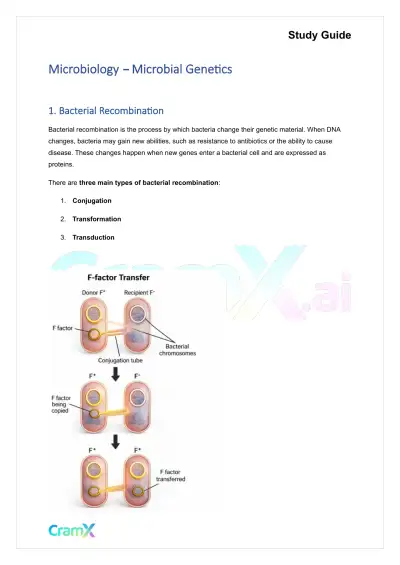 Quick Guides
Microbiology - Microbial Genetics
Microbiology
13 pagesMar 2026 Quick Guides
Microbiology - DNA and Gene Expression
Microbiology
15 pagesMar 2026 Quick Guides
Microbiology - Diseases of the Digestive System
Microbiology
15 pagesMar 2026 Quick Guides
Microbiology - Microbial Metabolism
Microbiology
16 pagesMar 2026 Quick Guides
Microbiology - Food Microbiology
Microbiology
13 pagesMar 2026 Quick Guides
Microbiology - Prokaryotes and Eukaryotes
Microbiology
13 pagesMar 2026 Quick Guides
Microbiology - Microbial Cultivation and Growth
Microbiology
15 pagesMar 2026 Quick Guides
Microbiology - Control of Microbial Growth
Microbiology
22 pagesMar 2026
Study this document with CramX
Once it is in your library, every tool can work from it.