

Microbiology - The Immune System
- Microbiology
- Texas A&M University
- 22 pages
- Shared March 2026
Preview 7 of 22 pages
See the first 7 pages exactly as they appear in the document.
Page 1 Read page 1 as text
Study Guide Microbiology – The Immune System 1. Antigens: The Targets of the Immune System Our immune system is designed to recognize and respond to foreign substances that enter the body. These substances are called antigens , also known as immunogens . 1.1 What Are Antigens? Antigens are substances that can trigger an immune response. Most antigens are large molecules , such as proteins or complex carbohydrates. However, small molecules can also act as antigens if they first attach to proteins in the body. • These small molecules are called haptens . • By themselves, haptens cannot cause an immune response. • When a hapten binds to a body protein, the combined structure (called a conjugate ) can trigger the immune system. So, size matters — but attachment matters even more. 1.2 How Antigens Start an Immune Response For most immune responses to begin, antigens must be taken up and processed by macrophages (a type of immune cell found in tissues). Here’s what happens: 1. A foreign substance enters the body. 2. A macrophage engulfs and processes it. 3. This processing helps activate other immune cells. However, not every foreign substance causes an immune response . Some substances may be broken down or destroyed before macrophages can process them, so no immune reaction occurs.
Page 2 Read page 2 as text
Study Guide 1.3 Antigenic Determinants (Epitopes) Antigens do not trigger immune responses as a whole. Instead, the immune system recognizes specific parts of the antigen. These specific regions are called: • Antigenic determinants • or epitopes What are epitopes made of? • A few amino acids in a protein • Or a few sugar units in a polysaccharide Each species has unique proteins and carbohydrates. This chemical uniqueness is why organisms are antigenically different from one another — and why the immune system can tell “self” from “non - self.” 1.4 Types of Antigens Not all antigens come from outside the body. Based on their source, antigens can be classified into several types: 1. Autoantigens • These are self antigens . • They belong to a person’s own body. • Normally, the immune system does not attack them. 2. Alloantigens • These are antigens found in other individuals of the same species . • A common example is blood group antigens like A and B on red blood cells. 3. Heterophile Antigens • These are identical antigens found in different species . • They can cause cross - reactions between unrelated organisms.
Page 3 Read page 3 as text
Study Guide 1.5 Antigens in Microorganisms A single microorganism, such as a bacterium, can have many different antigens that stimulate immune responses. Common types include: • Somatic antigens – found on the bacterial cell body • Capsular antigens – located in the bacterial capsule • Flagellar antigens (H antigens) – present on flagella • Exotoxins – toxic proteins released by bacteria that are strongly antigenic Each of these components can be recognized by the immune system and contribute to immunity. Key Takeaway Antigens are the signals that alert the immune system to danger. Their structure, location, and type determine how the immune system responds. 2. Cells of the Immune System The immune system works closely with the lymphatic system to protect the body from disease. Its main working cells are called lymphocytes , and they all begin their life in the bone marrow . 2.1 Origin of Immune Cells All immune cells develop from stem cells in the bone marrow. These stem cells are undifferentiated , meaning they are not specialized at first. Throughout life, they keep dividing and replacing old immune cells, ensuring the immune system remains active and effective. 2.2 B - Lymphocytes and T - Lymphocytes There are two main types of lymphocytes involved in specific immunity:
Page 4 Read page 4 as text
Study Guide B - Lymphocytes (B cells) • B cells are named after the bursa of Fabricius , where they mature in birds. • In humans, this exact organ does not exist. • Instead, B cells are believed to mature in the bone marrow . T - Lymphocytes (T cells) • T cells leave the bone marrow and mature in the thymus gland . • The thymus is located in the neck, near the trachea and thyroid gland . Both B cells and T cells start in the bone marrow but develop in different organs before becoming fully functional. 2.3 Overview of the Human Immune System After maturation: • B cells and T cells move to lymphoid organs such as the lymph nodes, spleen, tonsils, adenoids, and other tissues of the lymphatic system. • These cells form the foundation of the body’s two main immune responses .
Page 5 Read page 5 as text
Study Guide Figure 1 An overview of the human immune system. T ‐ lymphocytes and B ‐ lymphocytes originate in the bone marrow and then are processed in different body organs before proceeding to the lymph nodes, where they provide the underpinnings of the two types of immune responses . 2.4 Development Timeline of Lymphocytes • The transformation of stem cells into B cells and T cells begins around the fifth month after fertilization . • A complete set of these immune cells is formed a few months after birth . • After this, lymphocytes continuously circulate and populate lymphoid organs throughout life.
Page 6 Read page 6 as text
Study Guide 2.5 How an Immune Response Begins An immune response does not start on its own. It requires antigen presentation : 1. Microorganisms enter the body. 2. They are phagocytized (engulfed) by phagocytic cells such as macrophages . 3. The macrophages process the antigens. 4. Antigenic determinants are displayed on the macrophage surface. 5. These are presented to specific B cells and T cells. 6. This presentation triggers a targeted immune response. 2.6 Clonal Selection Theory The clonal selection theory explains how lymphocytes recognize and respond to antigens. Key ideas of the theory: • Each lymphocyte has specific receptors on its surface. • These receptors are genetically determined . • B - cell receptors are antibody molecules . • T - cell receptors are made of clusters of amino acids . When a lymphocyte encounters a matching antigenic determinant: • The receptor fits the antigen like a lock and key . • The lymphocyte becomes activated. • A proper match also occurs between MHC molecules and their receptors. 2.7 Expansion and Self - Tolerance According to the clonal selection theory: • Lymphocytes for all possible antigenic determinants already exist , even before exposure to antigens. • Once activated, a lymphocyte produces many identical cells (a clone ) with the same specificity. • Lymphocytes that could react against the body’s own cells are destroyed or inactivated . • This prevents harmful autoimmune reactions .
Page 7 Read page 7 as text
Study Guide 2.8 Two Main Types of Specific Immunity The immune system provides specific resistance to disease in two major ways : 1. Antibody - Mediated (Humoral) Immunity • Centered in B - lymphocytes . • B cells differentiate into plasma cells . • Plasma cells produce antibodies that circulate in body fluids. 2. Cell - Mediated Immunity • Centered in T - lymphocytes . • T cells directly attack infected or abnormal cells. • This type of immunity is especially important against viruses, cancer cells, and transplanted tissues . Key Takeaway The immune system relies on carefully developed B cells and T cells that originate from bone marrow stem cells. Through antigen presentation and clonal selection, these cells work together to provide powerful, specific, and well - controlled protection again st disease. 3. Antibody - Mediated (Humoral) Immunity (AMI) Antibody - mediated immunity is one of the body’s main ways of fighting infection. It is carried out by B - lymphocytes and the antibodies they produce. Let’s walk through this process step by step in a clear and student - friendly way. 3.1 Activation of B - Lymphocytes When antigenic determinants enter the body and reach the lymphatic organs (such as lymph nodes and spleen), they activate B - lymphocytes. After activation, B - cells follow two main paths: • Plasma cells These are fully differentiated cells that produce and release antibodies specific to the antigen.
15 more pages in the full document
Unlock it once and it stays in your library, ready to chat with or turn into flashcards.
Unlock the full documentMore Microbiology study materials
See all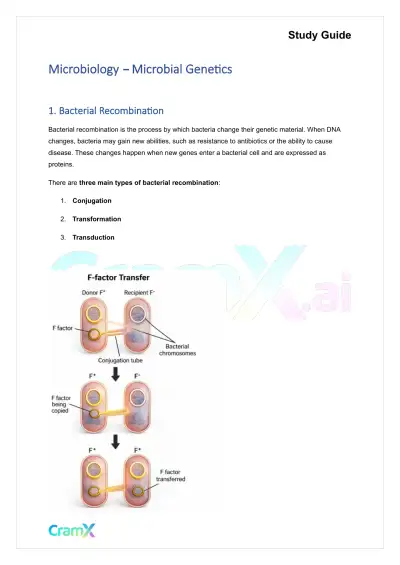 Quick Guides
Microbiology - Microbial Genetics
Microbiology
13 pagesMar 2026 Quick Guides
Microbiology - DNA and Gene Expression
Microbiology
15 pagesMar 2026 Quick Guides
Microbiology - Diseases of the Digestive System
Microbiology
15 pagesMar 2026 Quick Guides
Microbiology - Microbial Metabolism
Microbiology
16 pagesMar 2026 Quick Guides
Microbiology - Food Microbiology
Microbiology
13 pagesMar 2026 Quick Guides
Microbiology - Prokaryotes and Eukaryotes
Microbiology
13 pagesMar 2026 Quick Guides
Microbiology - Microbial Cultivation and Growth
Microbiology
15 pagesMar 2026 Quick Guides
Microbiology - Control of Microbial Growth
Microbiology
22 pagesMar 2026
Study this document with CramX
Once it is in your library, every tool can work from it.