

Microbiology - The Chemical Basis of Microbiology
- Microbiology
- Texas A&M University
- 13 pages
- Shared March 2026
Preview 4 of 13 pages
See the first 4 pages exactly as they appear in the document.
Page 1 Read page 1 as text
Study Guide Microbiology – The Chemical Basis of Microbiology 1. Chemical Principles Living organisms may look very different from one another, but at a chemical level they are surprisingly similar. In the 1700s, scientists discovered that all living things share the same basic chemical and physical foundation . Microorganisms are no exception. Their structure, growth, and metabolism are all based on chemical principles. Understanding these chemical basics helps us understand how microorganisms live and function. 1.1 Elements and Atoms All living things on Earth, including microorganisms, are made of elements . More than 100 elements are known, although only some are common in living systems. An element is a pure substance that cannot be broken down into simpler substances by chemical means . Examples of important elements in biology include: • Oxygen • Hydrogen • Carbon • Nitrogen • Calcium • Iron • Sodium Each element is made up of only one kind of atom . An atom is the smallest unit of an element that can take part in chemical reactions. 1.2 Structure of an Atom Atoms are made of three main particles:
Page 2 Read page 2 as text
Study Guide • Protons – positively charged • Electrons – negatively charged • Neutrons – no electrical charge Protons and neutrons are packed tightly together in the center of the atom, forming the nucleus . Electrons move around the nucleus in paths called shells . The number and arrangement of electrons — especially in the outer shell — determine how an atom behaves chemically. 1.3 Electron Arrangement and Stability Atoms are most stable when their outer electron shell is full . A full shell usually contains: • 2 electrons , or • 8 electrons If an atom’s outer shell is not full, the atom may: • Gain electrons , or • Lose electrons This gain or loss of electrons allows atoms to react with other atoms, forming chemical bonds. These reactions are the basis of all biological processes. 1.4 Molecules and Compounds Most substances in microorganisms are made of molecules . • A molecule is a specific arrangement of atoms bonded together. • A compound is a substance made of many identical molecules. The properties of a compound depend on how its atoms are arranged. Each molecule also has a molecular weight , which is the sum of the atomic weights of all its atoms. For example: • Water (H ₂ O) has a molecular weight of 18 .
Page 3 Read page 3 as text
Study Guide 1.5 Chemical Bonds in Molecules Atoms in molecules are held together by chemical bonds . Two important types of bonds are ionic bonds and covalent bonds . 1.6 Ionic Bonds An ionic bond forms when one atom transfers electrons to another atom. • The atom that loses electrons becomes a positively charged ion . • The atom that gains electrons becomes a negatively charged ion . • Opposite charges attract, holding the ions together. Example: Sodium chloride (NaCl) forms when sodium transfers an electron to chlorine.
Page 4 Read page 4 as text
Study Guide 1.7 Covalent Bonds A covalent bond forms when two atoms share electrons . • Sharing one pair of electrons forms a single bond . • Sharing two pairs of electrons forms a double bond . Covalent bonds are very common in living organisms. Examples: • Methane (CH ₄ ): carbon shares electrons with four hydrogen atoms • Water (H ₂ O): oxygen shares electrons with hydrogen atoms Covalent bonds are found in important biological molecules such as: • Proteins • Lipids • Carbohydrates 1.8 Synthesis of Organic Molecules Large biological molecules are formed by joining smaller molecules together. Fat Formation • Fatty acids bond to glycerol • Water is released during the process • This is called dehydration synthesis Protein Formation • Amino acids join together • A peptide bond forms between them • Water is released
9 more pages in the full document
Unlock it once and it stays in your library, ready to chat with or turn into flashcards.
Unlock the full documentMore Microbiology study materials
See all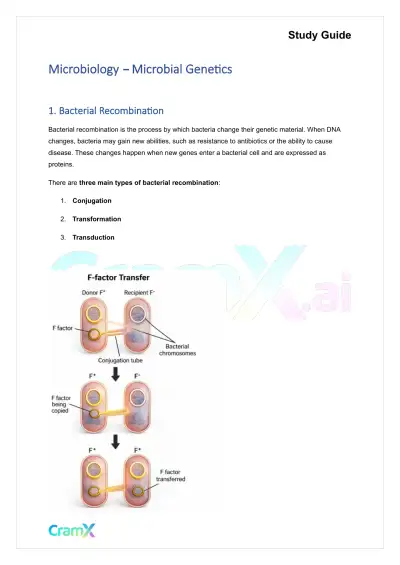 Quick Guides
Microbiology - Microbial Genetics
Microbiology
13 pagesMar 2026 Quick Guides
Microbiology - DNA and Gene Expression
Microbiology
15 pagesMar 2026 Quick Guides
Microbiology - Diseases of the Digestive System
Microbiology
15 pagesMar 2026 Quick Guides
Microbiology - Microbial Metabolism
Microbiology
16 pagesMar 2026 Quick Guides
Microbiology - Food Microbiology
Microbiology
13 pagesMar 2026 Quick Guides
Microbiology - Prokaryotes and Eukaryotes
Microbiology
13 pagesMar 2026 Quick Guides
Microbiology - Microbial Cultivation and Growth
Microbiology
15 pagesMar 2026 Quick Guides
Microbiology - Control of Microbial Growth
Microbiology
22 pagesMar 2026
Study this document with CramX
Once it is in your library, every tool can work from it.