

Microbiology - Diseases of the Nervous System
- Microbiology
- Texas A&M University
- 7 pages
- Shared March 2026
Preview 3 of 7 pages
See the first 3 pages exactly as they appear in the document.
Page 1 Read page 1 as text
Study Guide Microbiology – Diseases of the Nervous System 1. Other Diseases of the Nervous System Some nervous system diseases are caused by protozoa or unusual infectious agents that affect the brain and nerves over time. These diseases often develop slowly and can be difficult to treat. 1.1 Sleeping Sickness (Trypanosomiasis) Sleeping sickness , also called trypanosomiasis , is caused by a protozoan parasite from the genus Trypanosoma . African Sleeping Sickness The African form of the disease is caused by Trypanosoma brucei . It is transmitted to humans through the bite of the tsetse fly . Once inside the body, the parasite infects the blood and later spreads to the nervous system . Common symptoms include: • Headache • Extreme tiredness (lassitude) • Tremors • Poor coordination and unsteady movements Doctors can diagnose the disease by examining blood smears , where the parasites can be seen. Treatment is available, and commonly used drugs include pentamidine and suramin . 1.2 South American Sleeping Sickness (Chagas’ Disease) The South American form of sleeping sickness is known as Chagas’ disease . It is caused by Trypanosoma cruzi and is transmitted by triatomid bugs (sometimes called kissing bugs).
Page 2 Read page 2 as text
Study Guide This parasite affects: • The nervous system • The heart muscle In many cases, the parasites destroy the nerve ganglia of the heart , leading to serious heart disease , which can be life - threatening. 1.3 Slow - Developing Diseases of the Nervous System Some nervous system diseases develop very slowly and are believed to be caused by infectious agents that were difficult to identify for many years. Kuru Kuru is a rare disease that was observed among people in the South Pacific . It is called a slow virus disease because symptoms may take more than a year to appear. Typical symptoms include: • Nervous tremors • Loss of muscle control • Progressive neurological damage Other Related Diseases Several other diseases show similar slow progression, including: • Creutzfeldt - Jakob disease • Scrapie (in sheep and goats) • Bovine spongiform encephalopathy (also called mad cow disease ) These diseases are now believed to be caused by prions . Prions Prions are unusual infectious agents made only of protein . Unlike bacteria and viruses: • They do not contain nucleic acids (DNA or RNA) • They damage the nervous system by causing normal brain proteins to fold incorrectly Prion diseases lead to severe brain damage and are usually fatal .
Page 3 Read page 3 as text
Study Guide 2. Bacterial Diseases of the Nervous System Diseases that affect the nervous system are often very serious. This is because the brain, spinal cord, and nerves control vital body functions. Even small damage can have major effects. Infections may occur: • Directly in nervous tissue • Or in the meninges , the protective membranes around the brain and spinal cord Doctors often diagnose nervous system infections by examining the cerebrospinal fluid (CSF) . Treatment is challenging because antibiotics must be able to cross the blood – brain barrier to reach the infected area. 2.1 Meningococcal Meningitis Meningococcal meningitis is caused by the Gram - negative diplococcus Neisseria meningitidis , also known as the meningococcus . Key points: • Spread through respiratory droplets • Often lives harmlessly in the nasopharynx • Disease symptoms are mainly due to endotoxins Common symptoms include: • Severe headache • Fever and chills • Blue - black skin spots • Stiff neck • Possible seizures CSF examination reveals Gram - negative diplococci . In some cases, the adrenal glands are affected, leading to Waterhouse - Friderichsen syndrome . This condition requires rapid and aggressive treatment , usually with penicillin and other antibiotics .
4 more pages in the full document
Unlock it once and it stays in your library, ready to chat with or turn into flashcards.
Unlock the full documentMore Microbiology study materials
See all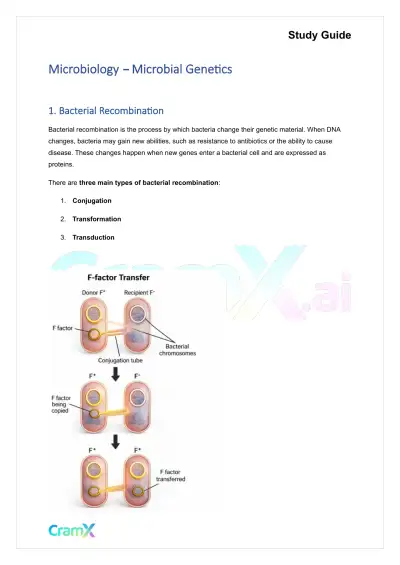 Quick Guides
Microbiology - Microbial Genetics
Microbiology
13 pagesMar 2026 Quick Guides
Microbiology - DNA and Gene Expression
Microbiology
15 pagesMar 2026 Quick Guides
Microbiology - Diseases of the Digestive System
Microbiology
15 pagesMar 2026 Quick Guides
Microbiology - Microbial Metabolism
Microbiology
16 pagesMar 2026 Quick Guides
Microbiology - Food Microbiology
Microbiology
13 pagesMar 2026 Quick Guides
Microbiology - Prokaryotes and Eukaryotes
Microbiology
13 pagesMar 2026 Quick Guides
Microbiology - Microbial Cultivation and Growth
Microbiology
15 pagesMar 2026 Quick Guides
Microbiology - Control of Microbial Growth
Microbiology
22 pagesMar 2026
Study this document with CramX
Once it is in your library, every tool can work from it.