

Microbiology - Disorders of the Immune System
- Microbiology
- Texas A&M University
- 10 pages
- Shared March 2026
Preview 3 of 10 pages
See the first 3 pages exactly as they appear in the document.
Page 1 Read page 1 as text
Study Guide Microbiology – Disorders of the Immune System 1. Hypersensitivity Reactions Not all immune system activity is helpful. In some cases, immune responses themselves cause disease. These conditions are called hypersensitivity reactions — states in which the immune system reacts too strongly or inappropriately . Hypersensitivities may be caused by antibodies or immune cells , and they can lead to tissue injury or even death. Some immune disorders also involve immunodeficiency , where parts of the immune system fail to function properly. 1.1 When Protection Turns Harmful Under normal conditions, the immune system protects the body from microorganisms and other foreign substances. However, if the immune response becomes excessive or misdirected , a hypersensitivity reaction occurs. • Damage usually happens after antigens interact with: o Antibodies, or o Sensitized T - lymphocytes • The type of immune component involved determines the nature and timing of the reaction. 1.2 Two Major Types of Hypersensitivity Hypersensitivity reactions are grouped into immediate and delayed forms. Immediate Hypersensitivity • Involves antibodies • Develops within minutes • Includes: o Anaphylaxis o Allergic reactions o Cytotoxic reactions o Immune complex reactions
Page 2 Read page 2 as text
Study Guide Delayed Hypersensitivity • Involves sensitized T - lymphocytes • Takes 24 hours or more to develop • Includes: o Contact dermatitis o Infection - related allergies Immediate Hypersensitivity Reactions Immediate hypersensitivity depends on: • The type of antigen • How often and how it enters the body • The class of antibody involved The first exposure to an antigen is called the sensitizing dose . This is followed by a latent period , during which antibodies are formed. A later exposure to the same antigen, called the eliciting (or shocking) dose , triggers the reaction and causes tissue damage. 1.3 Allergens Antigens that trigger immediate hypersensitivity are called allergens , especially when they cause localized reactions. Common allergens include: • Foods • Pollen • Feathers • Animal dander • Dust • Bee and wasp venoms • Animal sera • Some drugs (e.g., penicillin, acting as a hapten when bound to proteins)
Page 3 Read page 3 as text
Study Guide 1.4 Anaphylaxis (Type I Hypersensitivity) Anaphylaxis is a severe, whole - body immediate hypersensitivity reaction, also called anaphylactic shock . Figure 1 The process of anaphylaxis. (a) Allergens stimulate the production IgE antibodies, which (b) fix themselves to the surfaces of mast cells. (c) On second exposure to the allergens, a reaction occurs on the mast cell surface, and (d) the cellular granules re lease histamine and other stimulators of smooth muscle contraction .
7 more pages in the full document
Unlock it once and it stays in your library, ready to chat with or turn into flashcards.
Unlock the full documentMore Microbiology study materials
See all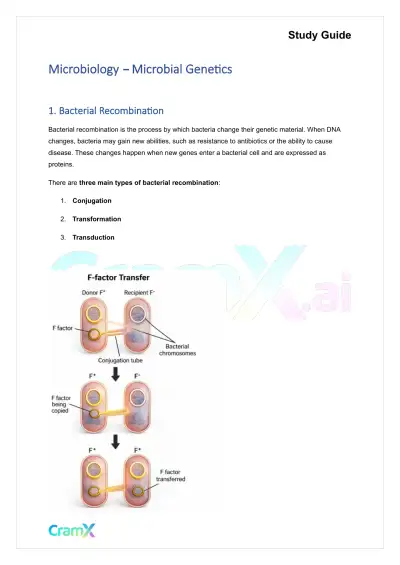 Quick Guides
Microbiology - Microbial Genetics
Microbiology
13 pagesMar 2026 Quick Guides
Microbiology - DNA and Gene Expression
Microbiology
15 pagesMar 2026 Quick Guides
Microbiology - Diseases of the Digestive System
Microbiology
15 pagesMar 2026 Quick Guides
Microbiology - Microbial Metabolism
Microbiology
16 pagesMar 2026 Quick Guides
Microbiology - Food Microbiology
Microbiology
13 pagesMar 2026 Quick Guides
Microbiology - Prokaryotes and Eukaryotes
Microbiology
13 pagesMar 2026 Quick Guides
Microbiology - Microbial Cultivation and Growth
Microbiology
15 pagesMar 2026 Quick Guides
Microbiology - Control of Microbial Growth
Microbiology
22 pagesMar 2026
Study this document with CramX
Once it is in your library, every tool can work from it.