

Microbiology - Introduction to Microbiology
- Microbiology
- Texas A&M University
- 11 pages
- Shared March 2026
Preview 4 of 11 pages
See the first 4 pages exactly as they appear in the document.
Page 1 Read page 1 as text
Study Guide Microbiology – Introduction to Microbiology 1. A Brief History of Microbiology Microbiology is the study of tiny living things called microorganisms , such as bacteria, fungi, protozoa, and viruses. Although these organisms are too small to see with the naked eye, they have a huge impact on our lives. Over time, microbiology has grown from simply explaining diseases to helping us create medicines, food s, and many useful products. 1.1 Early Beginnings: Discovering the Invisible World Scientists are not sure who first noticed microorganisms. However, by the mid - 1600s, microscopes had been invented, making it possible to see tiny structures for the first time. One of the earliest contributors was Robert Hooke , an English scientist. Using a microscope, he observed cells and reported seeing thread - like structures that were probably fungi. A few years later, a Dutch merchant named Anton van Leeuwenhoek made major discoveries. In the 1670s, he carefully observed microscopic organisms in water, saliva, and other materials. He called them animalcules . His detailed descriptions of bacteria, fungi, and protozoa were the first accurate records of microbial life. Because of this work, he is often called the father of microbiology . 1.2 The Debate Over Spontaneous Generation After van Leeuwenhoek’s death in 1723, progress in microbiology slowed. Microscopes were rare, and many scientists believed in spontaneous generation — the idea that life could arise from nonliving matter, such as microbes appearing in spoiled broth. Several scientists challenged this belief: • Francesco Redi showed that maggots only appeared on meat when flies could reach it. • John Needham supported spontaneous generation, claiming microbes grew in boiled broth. • Lazzaro Spallanzani later proved that when broth was boiled and sealed properly, no microorganisms appeared. These experiments suggested that microorganisms come from existing life, not from nonliving material.
Page 2 Read page 2 as text
Study Guide 1.3 Louis Pasteur and the Germ Theory of Disease In the mid - 1800s, Louis Pasteur made discoveries that transformed microbiology. While studying why wine and dairy products spoiled, he found that bacteria were responsible. This led him to ask an important question: If microorganisms can spoil food, could they also cause disease? To answer this, Pasteur designed the famous swan - neck flask experiment . He filled flasks with broth and left them open to air, but the curved necks trapped microorganisms before they could reach the liquid. The broth stayed clear, proving that microbes come from the environment, not from the broth itself. This experiment finally disproved spontaneous generation. Pasteur then proposed the germ theory of disease , which states that microorganisms cause infectious diseases . 1.4 Proving the Germ Theory: Koch’s Postulates Although Pasteur suggested the germ theory, he could not fully prove it. That proof came from a German scientist named Robert Koch . Koch studied anthrax and developed a systematic method to link a specific microorganism to a specific disease. This method is known as Koch’s postulates . The Steps of Koch’s Postulates 1. The microorganism is found in a sick animal. 2. The microorganism is isolated and grown in the laboratory. 3. The cultured microorganism is injected into a healthy animal. 4. The healthy animal develops the same disease. 5. The microorganism is then re - isolated from the newly sick animal. These steps helped scientists clearly connect microbes with diseases and became a foundation for medical microbiology. 1.5 The Golden Age of Microbiology From the late 1800s to the early 1900s, microbiology advanced rapidly. This period is known as the Golden Age of Microbiology . During this time, scientists identified many disease - causing microorganisms, called etiologic agents .
Page 3 Read page 3 as text
Study Guide Understanding how diseases spread made it possible to control outbreaks and prevent epidemics by interrupting the transmission of microbes. 1.6 Antibiotics and Life - Saving Treatments Even with these discoveries, doctors initially had few ways to treat infections. This changed after World War II, when antibiotics were introduced. Antibiotics dramatically reduced deaths from diseases such as pneumonia, tuberculosis, meningitis, and syphilis. For the first time, doctors could reliably treat many bacterial infections. 1.7 Studying Viruses and the Role of Vaccines Viruses are much smaller than bacteria, so scientists could not study them easily at first. In the 1940s, the invention of the electron microscope made viruses visible for the first time. Around the same time, scientists developed methods to grow viruses in the lab. These advances led to rapid progress in virology. In the 1950s and 1960s, vaccines were developed, bringing serious viral diseases like polio, measles, mumps, and rubella under control. 1.8 Modern Microbiology and Biotechnology Today, microbiology affects many parts of daily life. It plays a key role in: • Producing medicines and vaccines • Ensuring food and water safety • Manufacturing industrial and medical products Microorganisms are used to make vitamins, amino acids, enzymes, and many foods. These include yogurt, cheese, bread, pickles, sauerkraut, and alcoholic beverages. One of the most important modern fields is biotechnology . In biotechnology, microorganisms act as living factories . They are engineered to produce substances such as insulin, interferon, blood - clotting factors, clot - dissolving enzymes, and vaccines. Scientists also modify bacteria to help crops resist insects and frost.
Page 4 Read page 4 as text
Study Guide The steps of Koch's postulates used to relate a specific microorganism to a specific disease. (a) Microorganisms are observed in a sick animal and (b) cultivated in the lab. (c) The organisms are injected into a healthy animal, and (d) the animal develops the disease. (e) The organisms are observed in the sick animal and (f) reisolated in the lab . In Summary Microbiology has grown from simple observations through a microscope to a powerful science that saves lives and improves the quality of life worldwide. From early discoveries to modern biotechnology, microorganisms continue to shape medicine, industry, and the future of science.
7 more pages in the full document
Unlock it once and it stays in your library, ready to chat with or turn into flashcards.
Unlock the full documentMore Microbiology study materials
See all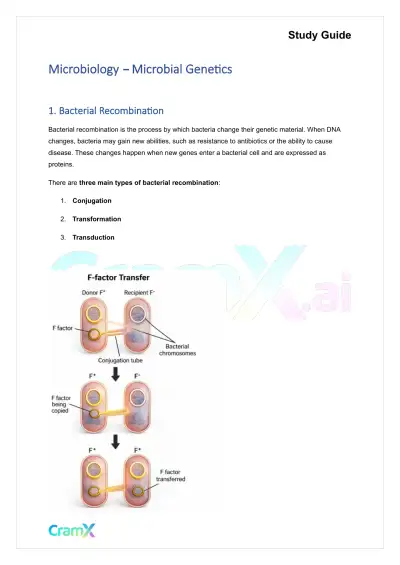 Quick Guides
Microbiology - Microbial Genetics
Microbiology
13 pagesMar 2026 Quick Guides
Microbiology - DNA and Gene Expression
Microbiology
15 pagesMar 2026 Quick Guides
Microbiology - Diseases of the Digestive System
Microbiology
15 pagesMar 2026 Quick Guides
Microbiology - Microbial Metabolism
Microbiology
16 pagesMar 2026 Quick Guides
Microbiology - Food Microbiology
Microbiology
13 pagesMar 2026 Quick Guides
Microbiology - Prokaryotes and Eukaryotes
Microbiology
13 pagesMar 2026 Quick Guides
Microbiology - Microbial Cultivation and Growth
Microbiology
15 pagesMar 2026 Quick Guides
Microbiology - Control of Microbial Growth
Microbiology
22 pagesMar 2026
Study this document with CramX
Once it is in your library, every tool can work from it.