

Microbiology - Nonspecific Body Defense
- Microbiology
- Texas A&M University
- 8 pages
- Shared March 2026
Preview 3 of 8 pages
See the first 3 pages exactly as they appear in the document.
Page 1 Read page 1 as text
Study Guide Microbiology – Nonspecific Body Defense 1. Nonspecific Mechanisms of Defense The human body has several nonspecific defense mechanisms that protect against many different microorganisms. These defenses are called nonspecific because they act against all types of pathogens , not just one particular organism. Their main goals are: • To prevent microorganisms from entering the body • To destroy pathogens if they reach deeper tissues 1.1 Mechanical Barriers – The First Line of Defense Mechanical barriers are part of the body’s normal structure and function . They act as the first line of defense at portals of entry. Skin The skin is one of the strongest mechanical barriers. • The outer layer consists of tightly packed cells • These cells are filled with keratin , an insoluble protective protein • This thick layer is waterproof and resistant to infection • When intact, skin is usually impenetrable to pathogens Mucous Membranes Mucous membranes line the: • Respiratory tract • Digestive tract • Urinary tract
Page 2 Read page 2 as text
Study Guide Although these membranes are moist and permeable , they are protected by fluids such as: • Tears • Saliva • Mucus These fluids wash away microorganisms and irritants. Additional protective actions include: • Nasal hairs , which trap particles • Cilia in the respiratory tract, which sweep trapped particles away • Coughing , which forcefully removes irritants Chemical Defenses The body also produces chemical substances that help destroy microorganisms. Examples include: • Lysozyme in tears and saliva o Breaks down peptidoglycan in Gram - positive bacterial cell walls • Lactic acid in the vagina o Creates an acidic environment that inhibits microbial growth • Hydrochloric acid in the stomach o A powerful barrier that kills many swallowed microorganisms • Spermine in semen o Inhibits bacterial growth in the male urogenital tract Genetic Barriers An individual’s genetic makeup can influence susceptibility to disease. • Humans can become infected with HIV because human T - lymphocytes have the required receptor sites • Animals such as dogs and cats cannot get HIV because they lack these receptors • Conversely, humans do not get canine distemper because they lack the necessary viral receptor sites Thus, genetic factors can act as a natural barrier to infection .
Page 3 Read page 3 as text
Study Guide Inflammation Inflammation is a nonspecific response to any type of tissue injury , including infection. It is characterized by four classic signs: • Redness • Heat • Swelling • Pain Inflammation helps the body by: • Bringing immune cells to the injured area • Activating repair mechanisms • Encouraging phagocytes to destroy invading microorganisms Chemical Control of Inflammation Inflammation is regulated by: • Nervous system signals • Cytokines , which are chemical messengers released by tissue and blood cells Loss of fluid from blood vessels causes edema (localized swelling). In some infections, dead cells, bacteria, and phagocytes collect as pus . Fever Fever is another nonspecific defense response. • It is triggered by substances called pyrogens • Pyrogens act on the hypothalamus in the brain • The hypothalamus raises the body’s temperature Although very high fever can be harmful, moderate fever is beneficial because: • It slows the growth of temperature - sensitive microorganisms • It increases cellular metabolism • It enhances immune responses and phagocytosis
5 more pages in the full document
Unlock it once and it stays in your library, ready to chat with or turn into flashcards.
Unlock the full documentMore Microbiology study materials
See all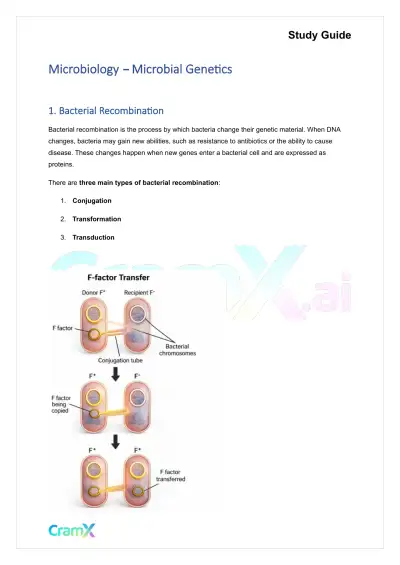 Quick Guides
Microbiology - Microbial Genetics
Microbiology
13 pagesMar 2026 Quick Guides
Microbiology - DNA and Gene Expression
Microbiology
15 pagesMar 2026 Quick Guides
Microbiology - Diseases of the Digestive System
Microbiology
15 pagesMar 2026 Quick Guides
Microbiology - Microbial Metabolism
Microbiology
16 pagesMar 2026 Quick Guides
Microbiology - Food Microbiology
Microbiology
13 pagesMar 2026 Quick Guides
Microbiology - Prokaryotes and Eukaryotes
Microbiology
13 pagesMar 2026 Quick Guides
Microbiology - Microbial Cultivation and Growth
Microbiology
15 pagesMar 2026 Quick Guides
Microbiology - Control of Microbial Growth
Microbiology
22 pagesMar 2026
Study this document with CramX
Once it is in your library, every tool can work from it.