

French I - Adjectives
- World Languages
- Texas A&M University
- 21 pages
- Shared March 2026
Preview 7 of 21 pages
See the first 7 pages exactly as they appear in the document.
Page 1 Read page 1 as text
Study Guide French I – Adjectives 1. Adjective Placement within Sentences In French, adjectives usually come after the noun they describe. However, some adjectives appear before the noun . 1. Most Adjectives Come After the Noun This is the standard rule in French. Structure: noun + adjective Examples: • la maison blanche → the white house • une voiture rouge → a red car • un livre intéressant → an interesting book 2. Adjectives That Come Before the Noun (BAGS Rule) Some short, common adjectives usually come before the noun . These are remembered with the acronym BAGS . Category Examples Beauty beau, joli
Page 2 Read page 2 as text
Study Guide Age nouveau, vieux, jeune Goodness bon, mauvais, gentil Size grand, petit, gros, long, court Examples • une jolie robe → a pretty dress • un gros livre → a thick book • un grand chien → a big dog 3. Other Adjectives That Come Before the Noun Some adjectives also precede the noun even though they are not part of BAGS. Adjective Meaning autre other chaque each / every dernier last plusieurs several quelques a few tel such tout all / whole
Page 3 Read page 3 as text
Study Guide Examples: • une autre histoire → another story • plusieurs idées → several ideas • une telle aventure → such an adventure 4. Using tout tout comes before both the noun and the article . Examples: • tous les hommes → all the men • toutes les femmes → all the women 5. Using Multiple Adjectives When a noun has two adjectives , place each adjective according to its rule. Examples • une petite voiture rouge → a small red car • un grand et mauvais loup → a big bad wolf • une femme forte et athlétique → a strong, athletic woman If two adjectives are in the same position , they are connected with et (and) .
Page 4 Read page 4 as text
Study Guide 6. Past Participles as Adjectives Past participles can also act as adjectives and must agree in gender and number with the noun . Examples: • un plaisir inattendu → an unexpected pleasure • cette table est réservée → this table is reserved 7. Irregular Plural Adjectives Some adjectives change in special ways.
Page 5 Read page 5 as text
Study Guide Singular Plural beau / bel beaux nouveau / nouvel nouveaux vieux / vieil vieux Examples: • un beau garçon → de beaux garçons • un nouvel hôtel → de nouveaux hôtels • un vieil artiste → de vieux artistes Key Takeaway • Most adjectives come after the noun . • BAGS adjectives come before the noun . • Some common adjectives like autre, chaque, plusieurs also come before. • Adjectives must agree in gender and number with the noun. 2. Changing Masculine Adjectives to Feminine In French, adjectives must agree with the noun they describe in: • Gender (masculine / feminine) • Number (singular / plural) Example: • un garçon intelligent → a smart boy • une fille intelligente → a smart girl The adjective changes to match the noun.
Page 6 Read page 6 as text
Study Guide
Page 7 Read page 7 as text
Study Guide 1. Most Common Rule Most adjectives form the feminine by adding - e . Masculine Feminine Meaning petit petite small grand grande big poli polie polite ouvert ouverte open
14 more pages in the full document
Unlock it once and it stays in your library, ready to chat with or turn into flashcards.
Unlock the full documentMore World Languages study materials
See all Quick Guides
French I - Nouns
World Languages
16 pagesMar 2026 Quick Guides
French I - Possession
World Languages
8 pagesMar 2026 Quick Guides
French I - Interrogatives Exclamations
World Languages
12 pagesMar 2026 Quick Guides
French I - Prepositions
World Languages
24 pagesMar 2026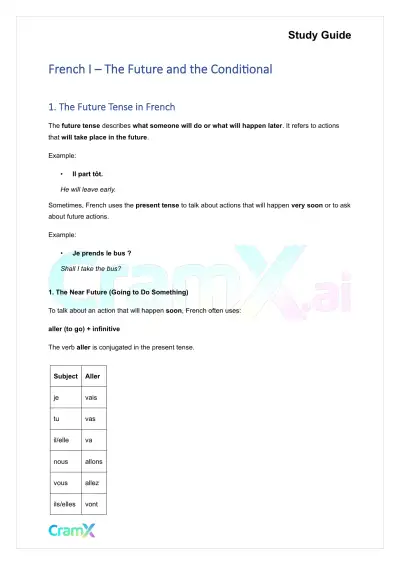 Quick Guides
French I - The Future and the Conditional
World Languages
13 pagesMar 2026 Quick Guides
French I - Present Tense of Verbs
World Languages
25 pagesMar 2026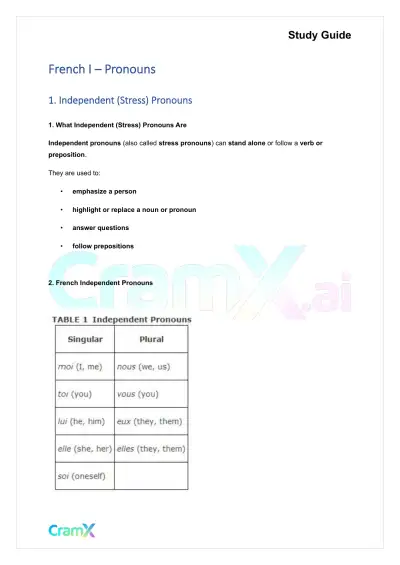 Quick Guides
French I - Pronouns
World Languages
22 pagesMar 2026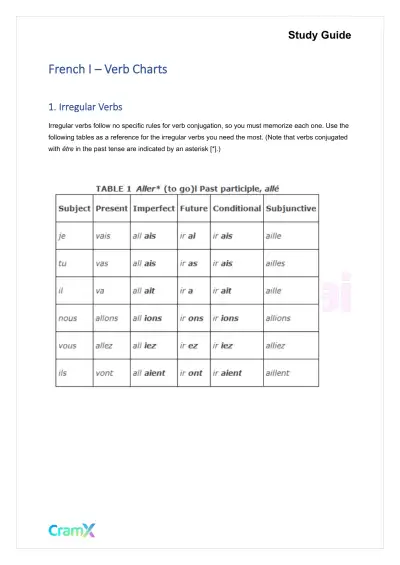 Quick Guides
French I - Verb Charts
World Languages
20 pagesMar 2026
Study this document with CramX
Once it is in your library, every tool can work from it.