

French I - Articles
- World Languages
- Texas A&M University
- 24 pages
- Shared March 2026
Preview 8 of 24 pages
See the first 8 pages exactly as they appear in the document.
Page 1 Read page 1 as text
Study Guide French I – Articles 1. Definite Articles in French A definite article corresponds to the English word “the.” It refers to a specific person, object, or idea . Example: • the boy • the family In French, definite articles change depending on the gender (masculine or feminine) and number (singular or plural) of the noun. 1. Forms of the Definite Article
Page 2 Read page 2 as text
Study Guide Important Rule When a word begins with a vowel or silent h , le and la become l’ . Examples: • l’homme (the man) • l’actrice (the actress) Because l’ is used for both genders, the gender of the noun cannot be identified by the article in these cases. 2. Plural Definite Articles All plural nouns use the same article: les Examples: • les garçons — the boys • les filles — the girls • les hommes — the men Because the article is the same, you cannot determine the gender of a plural noun from the article alone . 3. Uses of the Definite Article French uses definite articles more often than English . They appear in several situations. A. With Nouns in a General or Abstract Sense Used when talking about something in general . Example: • J’adore les chiens. I love dogs.
Page 3 Read page 3 as text
Study Guide B. With Names of Languages Used with languages except directly after certain expressions such as parler, en, and de . Examples: • Le français est facile. French is easy. • J’adore le français. I love French. But: • Je parle français. I speak French. • C’est en français. It’s in French. • Une classe de français a French class C. With Parts of the Body (When the Possessor Is Clear) Example: • Ouvre les yeux. Open your eyes. French uses the article instead of a possessive adjective . D. With Titles of Rank or Profession Example: • Le docteur Jean. Dr. John.
Page 4 Read page 4 as text
Study Guide But when directly addressing someone , the article is not used: • Bonjour, docteur Jean. Hello, Dr. John. E. With Days of the Week in a Habitual Sense Example: • Le lundi je travaille. On Mondays, I work. F. With Seasons and Colors Used with seasons and colors except after certain prepositions like au or en . Examples: • Tu aimes l’hiver ? Do you like winter? • Il préfère le bleu. He prefers blue. But: • Au printemps il pleut. It rains in spring. • Je peins la maison en blanc. I’m painting the house white. G. With Dates Example: • C’est le dix août. It’s August 10.
Page 5 Read page 5 as text
Study Guide H. With Geographical Names Example: • La France est superbe. France is wonderful. I. With Weights, Measures, and Prices Used to express “a,” “an,” or “per.” Example: • Il paie six dollars la douzaine. He pays $6 per dozen. J. In Common Time or Place Expressions Examples: • le soir — in the evening • la semaine prochaine — next week • à la maison — at home Key Takeaway French definite articles correspond to “the” in English but are used more frequently . Article Use le masculine singular la feminine singular l’ before vowel or silent h les plural
Page 6 Read page 6 as text
Study Guide They are commonly used: • with general ideas • with languages • with body parts • with days of the week • with seasons and colors • with dates • with geographical names • in expressions of time and place 2. Indefinite Articles in French Indefinite articles refer to non - specific people or things . In English, they correspond to “a,” “an,” or “some.” Examples: • a girl • an apple • some boys In French, the form of the indefinite article depends on the gender (masculine or feminine) and number (singular or plural) of the noun. 1. Forms of Indefinite Articles
Page 7 Read page 7 as text
Study Guide Examples • un ami — a friend (masculine) • une amie — a friend (feminine) • des amis — friends / some friends • des amies — friends / some friends 2. Pronunciation Note The e at the end of une is never dropped . It also changes the pronunciation: • un → nasal sound • une → clearly pronounced “oon” 3. When the Indefinite Article Is Omitted Sometimes French does not use an indefinite article , even though English might.
Page 8 Read page 8 as text
Study Guide A. After être or devenir with Professions When être (to be) or devenir (to become) is followed by a profession , the article is usually omitted. Examples: • Anne est docteur. Anne is a doctor. • Luc devient avocat. Luc is becoming a lawyer. Exceptions The article is used : After c’est • C’est une actrice. She’s an actress. • C’est un dentiste. He’s a dentist. When the profession is modified by an adjective • M. Leconte est un patron populaire. Mr. Leconte is a popular boss. B. After Exclamatory quel After quel , quelle, quels, quelles , the article is not used. Examples: • Quel garçon curieux ! What a curious boy! • Quelles maisons luxueuses ! What luxurious houses!
16 more pages in the full document
Unlock it once and it stays in your library, ready to chat with or turn into flashcards.
Unlock the full documentMore World Languages study materials
See all Quick Guides
French I - Nouns
World Languages
16 pagesMar 2026 Quick Guides
French I - Possession
World Languages
8 pagesMar 2026 Quick Guides
French I - Interrogatives Exclamations
World Languages
12 pagesMar 2026 Quick Guides
French I - Prepositions
World Languages
24 pagesMar 2026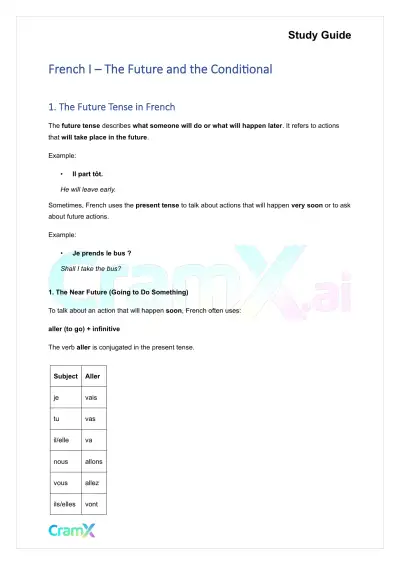 Quick Guides
French I - The Future and the Conditional
World Languages
13 pagesMar 2026 Quick Guides
French I - Present Tense of Verbs
World Languages
25 pagesMar 2026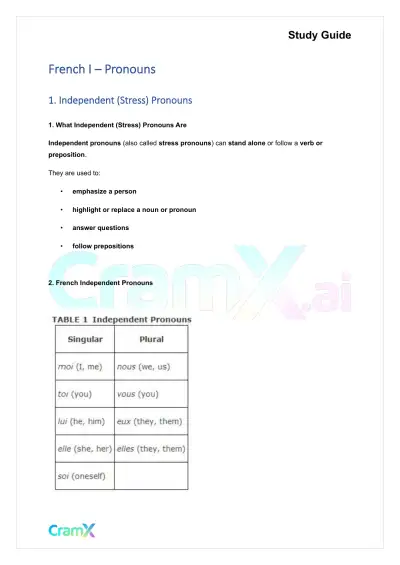 Quick Guides
French I - Pronouns
World Languages
22 pagesMar 2026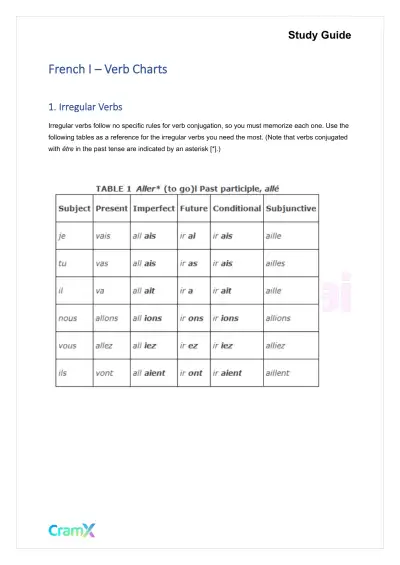 Quick Guides
French I - Verb Charts
World Languages
20 pagesMar 2026
Study this document with CramX
Once it is in your library, every tool can work from it.