

Accounting Principles I – Adjustments and Financial Statements
- Accounting
- Texas A&M University
- 34 pages
- Shared March 2026
Preview 10 of 34 pages
See the first 10 pages exactly as they appear in the document.
Page 1 Read page 1 as text
Study Guide Accounting Principles I – Adjustments and Financial Statements 1. Accrued Revenues Sometimes a business earns revenue before it records it . When this happens, the company must make an adjusting entry at the end of the accounting period. This type of adjusting entry is called an accrual for revenues . What are accrued revenues? Accrued revenues are revenues that have been: • earned (the work is done or the time has passed), but • not yet recorded , and often • not yet billed to the customer. This commonly happens with: • Interest revenue • Completed services or delivered goods that haven’t been billed yet Example 1: Accrued Interest Revenue A company has a $10,000 note receivable that earns 6% annual interest for 3 years . The customer has not made any payments yet. Even though no cash has been received, the company still earns interest as time passes . So, at the end of each accounting period, the company must record the interest revenue that has built up. About the number of days Most textbooks use a 360 - day year to simplify interest calculations (that’s what we use here). In real life, many lenders use a more accurate 365 - day year .
Page 2 Read page 2 as text
Study Guide Calculating the interest for one month For April (30 days): So the company earns $50 interest revenue during the month. Adjusting entry for accrued interest Because interest has been earned but not recorded, the company must: • Increase (debit) Interest Receivable → an asset (because the company will receive the interest later) • Increase (credit) Interest Revenue → a revenue account Adjusting Entry: • Debit Interest Receivable $50 • Credit Interest Revenue $50 This makes sure revenue is recorded in the correct period, even if the cash comes later.
Page 3 Read page 3 as text
Study Guide Example 2: Accrued Service Revenue (Unbilled Work) Imagine a plumber does $90 of work on April 30 , but doesn’t send the bill until May 4 . Even though the customer hasn’t been billed yet, the work was completed in April , so the revenue must be recorded in April’s records . Adjusting entry for unbilled service revenue The plumber should: • Increase (debit) Accounts Receivable → an asset (money owed by the customer) • Increase (credit) Service Revenue → revenue earned Adjusting Entry: • Debit Accounts Receivable $90 • Credit Service Revenue $90 This keeps revenue in the period when it was earned.
Page 4 Read page 4 as text
Study Guide 2. Accrued Expenses Sometimes a business uses something or receives a service , but has not paid for it yet . Even though no cash has gone out, the expense still belongs to the current accounting period. That’s why we record accrued expenses at the end of the period using an adjusting entry . What are accrued expenses? Accrued expenses are expenses that have: • already happened (the business has received the benefit), but • have not been recorded yet , and • have not been paid yet So, the company must record: 1. the expense , and 2. the liability (money it still owes) Common examples of accrued expenses Accrued expenses often include: 1) Unpaid Wages Employees may work near the end of the period, but the company might pay them later (in the next period). 2) Interest on Notes Payable Interest builds up over time, even if the company hasn’t paid it yet. Example 1: Accrued Wages (Unpaid Salaries) Suppose at the end of the accounting period, a company owes employees $2,000 in wages , but hasn’t paid them yet.
Page 5 Read page 5 as text
Study Guide Even though the cash hasn’t been paid, the employees already worked , so the expense must be recorded now. Adjusting entry for unpaid wages To record this properly, the company will: • Increase (debit) Wages Expense → this shows the cost of labor for the period • Increase (credit) Wages Payable → this shows a liability (money owed) Adjusting Entry: • Debit Wages Expense $2,000 • Credit Wages Payable $2,000 This way, the expense is matched to the correct accounting period. Example 2: Accrued Interest Expense Now imagine the company has a $10,000 long - term note payable with 12% annual interest .
Page 6 Read page 6 as text
Study Guide Adjusting entry for accrued interest The company will: • Increase (debit) Interest Expense $100 • Increase (credit) Interest Payable $100 Adjusting Entry: • Debit Interest Expense $100 • Credit Interest Payable $100 3. Unearned Revenues Sometimes a business receives money before it actually does the work or delivers the product. When that happens, the money is not revenue yet — because it hasn’t been earned. That type of payment is called unearned revenue . What are unearned revenues? Unearned revenues are payments received in advance for: • services that will be performed later, or • goods that will be delivered later
Page 7 Read page 7 as text
Study Guide In other words, the customer has paid, but the company still owes something . Simple examples • Newspaper subscription paid ahead of time • Extended warranty purchased at the time of sale At the time the customer pays, the company has a responsibility to provide future service. So it records the payment as a liability , not revenue. Why do we adjust unearned revenue? As time passes, the company begins to earn the revenue by delivering the service (or product). So at the end of each accounting period, the company must record an adjusting entry to show: how much has been earned, and how much is still unearned. Example: Unearned Insurance Revenue A customer pays $1,800 for an insurance policy that covers her delivery vehicles for 6 months . Adjusting entry after one month To record earned revenue, the insurance company must:
Page 8 Read page 8 as text
Study Guide • Decrease (debit) Unearned Revenue $300 • Increase (credit) Revenue $300 This reduces the liability because the company now owes less service in the future. It also increases revenue because part of the service has been completed. 4. Prepaid Expenses Sometimes a business pays for something before it actually uses it. At first, that payment is not an expense — it is an asset because the business will benefit from it in the future. These are called prepaid expenses . What are prepaid expenses? Prepaid expenses are assets that eventually become expenses as they: • expire over time , or • get used up Easy example: Office supplies When a business buys office supplies, it records them as an asset at first. But once the supplies are used in daily business work, they turn into an expense . Why do prepaid expenses need adjusting entries? Prepaid expenses change over time. Each accounting period, some part of the prepaid amount is used up or expires . So at the end of the accounting period, the company must record an adjusting entry to: show the amount that has become an expense, and
Page 9 Read page 9 as text
Study Guide reduce the asset balance to match what is left. This helps keep financial statements accurate. Example: Prepaid Insurance (Customer’s Point of View) Now let’s look at the same insurance example , but this time from the customer’s side. The customer pays $1,800 for 6 months of insurance coverage. Adjusting entry after one month She records: • Debit Insurance Expense $300 • Credit Prepaid Insurance $300 Insurance Expense increases because the cost has been used this month. Prepaid Insurance decreases because there is less future coverage left. Important idea to remember
Page 10 Read page 10 as text
Study Guide A prepaid expense on one company’s books is often (but not always) an unearned revenue on another company’s books. Example: • The customer records Prepaid Insurance (asset) • The insurance company records Unearned Insurance Revenue (liability) But this is not always true. For example, office supplies are prepaid expenses for one business, but they usually don’t appear as unearned revenue for another company. 5. Depreciation Depreciation is how a business spreads the cost of a long - term asset over time . Instead of recording the full cost as an expense right away, the business records part of that cost as an expense each period the asset is used. Important note: Land is never depreciated. What depreciation really means Depreciation is the process of allocating the depreciable cost of a long - lived asset to expense over the asset’s estimated service life (how long the business expects to use it). This helps match: • the cost of using the asset with • the revenue the asset helps earn Depreciable cost (the amount we actually depreciate) Before calculating depreciation, we need to find the depreciable cost . Depreciable cost includes: • All costs needed to buy the asset and get it ready to use minus • the asset’s salvage value
24 more pages in the full document
Unlock it once and it stays in your library, ready to chat with or turn into flashcards.
Unlock the full documentMore Accounting study materials
See all Quick Guides
Accounting Principles I – Cash
Accounting
20 pagesMar 2026 Quick Guides
Accounting Principles I – Analyzing and Recording Transactions
Accounting
42 pagesMar 2026 Quick Guides
Accounting Principles I – Completion of the Accounting Cycle
Accounting
25 pagesMar 2026 Quick Guides
Accounting Principles I – Subsidiary Ledgers and Special Journals
Accounting
17 pagesMar 2026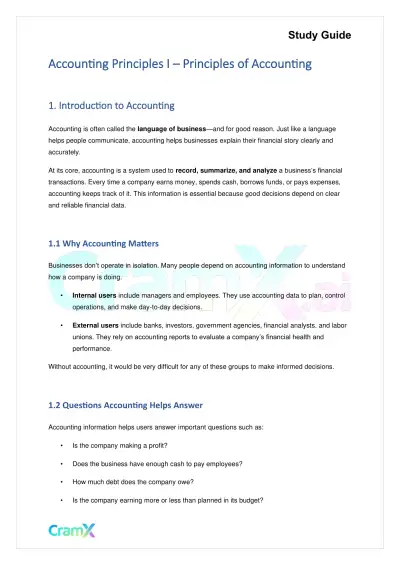 Quick Guides
Accounting Principles I – Principles of Accounting
Accounting
27 pagesMar 2026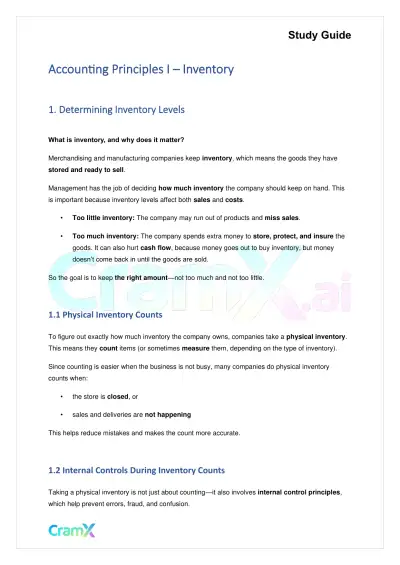 Quick Guides
Accounting Principles I – Inventory
Accounting
29 pagesMar 2026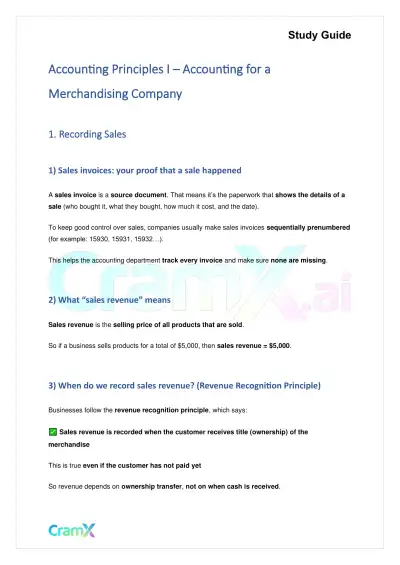 Quick Guides
Accounting Principles I – Accounting for a Merchandising Company
Accounting
36 pagesMar 2026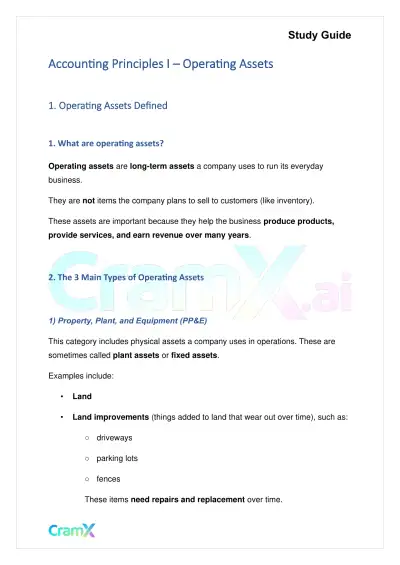 Quick Guides
Accounting Principles I – Operating Assets
Accounting
32 pagesMar 2026
Study this document with CramX
Once it is in your library, every tool can work from it.