

Accounting Principles I – Subsidiary Ledgers and Special Journals
- Accounting
- Texas A&M University
- 17 pages
- Shared March 2026
Preview 6 of 17 pages
See the first 6 pages exactly as they appear in the document.
Page 1 Read page 1 as text
Study Guide Accounting Principles I – Subsidiary Ledgers and Special Journals 1. Subsidiary Ledgers A subsidiary ledger is a set (group) of related accounts that all belong to one main account in the general ledger. Think of it like this: • The general ledger shows the big total . • The subsidiary ledger shows the full breakdown of that total. What is a Control (Master) Account? A control account (also called a master account ) is the general ledger account that summarizes everything inside the subsidiary ledger. Important rule: The total of all subsidiary ledger account balances = the balance of the control account in the general ledger. 1.1 Accounts Receivable Subsidiary Ledger (Customers) An Accounts Receivable (A/R) subsidiary ledger is also called a customers’ subsidiary ledger . It contains: one separate account for each customer who buys on credit. So, instead of keeping all customer credit activity in one big mess, the company can track each customer separately.
Page 2 Read page 2 as text
Study Guide Why is this so important? Most businesses have hundreds or thousands of customers who: • buy on credit • make payments (sometimes more than once) • return items • buy again before paying off old balances If all those customer transactions were recorded in one Accounts Receivable account , it would be extremely difficult to know: “How much does this customer still owe?” “What payments did they make?” “Did they return anything?” The subsidiary ledger solves this problem by giving:
Page 3 Read page 3 as text
Study Guide quick access to each customer’s balance a clear history of each customer’s activity 1.2 Does Posting to Both Ledgers Break the Debit/Credit Rule? No, it does not violate the rule that: Total debits must equal total credits. Even though the same transaction is posted to: • a subsidiary ledger account , and also • the general ledger control account …it still works because: Subsidiary ledger accounts are NOT part of the general ledger . They are extra detail records that support the control account. So the control account stays correct, and the detailed customer/vendor/product records stay correct too.
Page 4 Read page 4 as text
Study Guide 1.3 When Do Businesses Use Subsidiary Ledgers? Companies create subsidiary ledgers whenever they need to track the individual parts of a general ledger account. Besides Accounts Receivable, common subsidiary ledgers include: 1) Accounts Payable Subsidiary Ledger (Creditors) • Separate account for each supplier/creditor • Tracks how much the company owes each one 2) Inventory Subsidiary Ledger • Separate account for each product • Helps monitor inventory items individually 3) Property, Plant, and Equipment (PPE) Subsidiary Ledger • Separate account for each long - lived asset • Example: buildings, machinery, vehicles, equipment 2. Special Journals Recording every transaction in the general journal and then posting it to the general ledger can take a lot of time. Even a simple transaction usually needs three lines in the general journal (two account lines + one explanation). Then, the transaction must be posted to the correct ledger accounts. And if the transaction affects a control account (like Accounts Receivable or Accounts Payable), the posting must happen twice : • once in the subsidiary ledger
Page 5 Read page 5 as text
Study Guide • once in the general ledger control account To make this faster, businesses use special journals . Why companies use special journals Special journals are used to record repetitive transactions that: • happen again and again, • use the same accounts, • and have a similar description each time. Instead of writing long journal entries, the transaction can be recorded in one line . Then, instead of posting every entry separately to the general ledger, the business posts the total of each column at the end of the accounting period . Most merchandising businesses use special journals for: • Sales • Purchases • Cash Receipts • Cash Disbursements
Page 6 Read page 6 as text
Study Guide 2.1 Sales Journal The Sales Journal is used to record credit sales to customers . It does NOT include: • cash sales • sales returns A typical sales journal entry includes: • date • invoice number • customer name • amount The invoice is the source document used for this journal. In a basic sales journal:
11 more pages in the full document
Unlock it once and it stays in your library, ready to chat with or turn into flashcards.
Unlock the full documentMore Accounting study materials
See all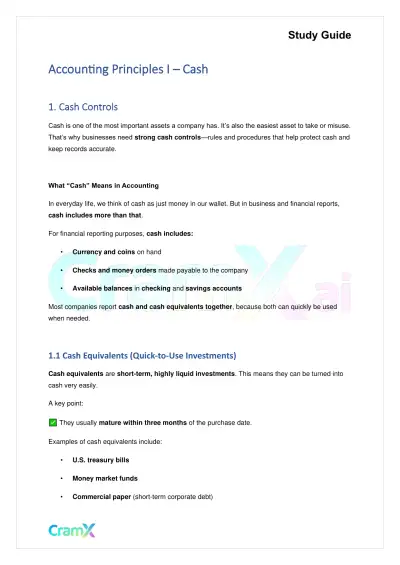 Quick Guides
Accounting Principles I – Cash
Accounting
20 pagesMar 2026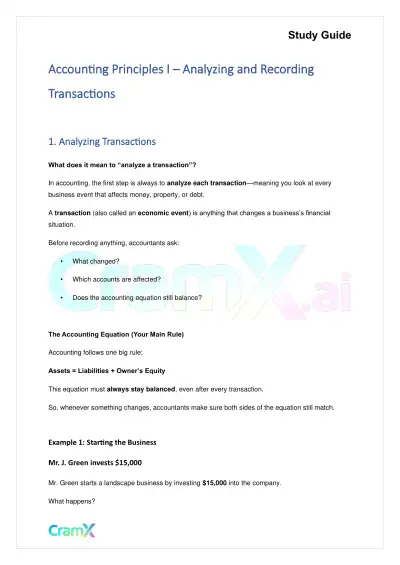 Quick Guides
Accounting Principles I – Analyzing and Recording Transactions
Accounting
42 pagesMar 2026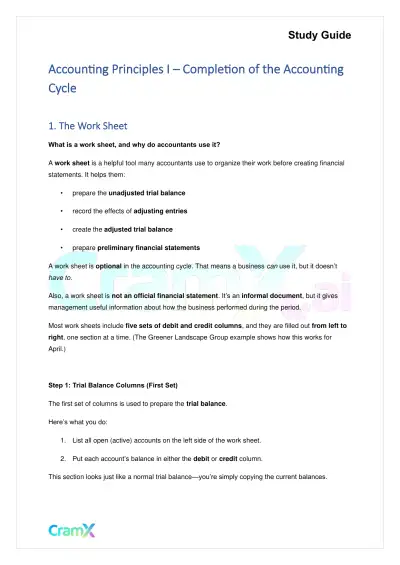 Quick Guides
Accounting Principles I – Completion of the Accounting Cycle
Accounting
25 pagesMar 2026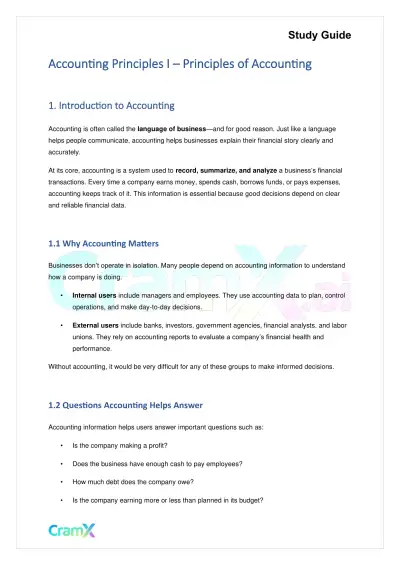 Quick Guides
Accounting Principles I – Principles of Accounting
Accounting
27 pagesMar 2026 Quick Guides
Accounting Principles I – Inventory
Accounting
29 pagesMar 2026 Quick Guides
Accounting Principles I – Accounting for a Merchandising Company
Accounting
36 pagesMar 2026 Quick Guides
Accounting Principles I – Adjustments and Financial Statements
Accounting
34 pagesMar 2026 Quick Guides
Accounting Principles I – Operating Assets
Accounting
32 pagesMar 2026
Study this document with CramX
Once it is in your library, every tool can work from it.