

Accounting Principles I – Receivables
- Accounting
- Texas A&M University
- 24 pages
- Shared March 2026
Preview 8 of 24 pages
See the first 8 pages exactly as they appear in the document.
Page 1 Read page 1 as text
Study Guide Accounting Principles I – Receivables 1. Receivables Defined When a company sells something but doesn’t get paid right away, it creates a receivable . A receivable is money the company expects to collect in the future. Think of it like this: the company has earned the revenue, but the cash hasn’t arrived yet. Accounts Receivable (A/R) Accounts receivable are amounts that customers owe the company from normal credit sales . Example: A customer buys goods today and promises to pay later. Because most accounts receivable are collected within two months , they are considered a current asset . Where do accounts receivable appear on the balance sheet? Accounts receivable usually show up under current assets: • Below short - term investments • Above inventory Notes Receivable Notes receivable are amounts owed to the company by customers (or others) who have signed a formal promissory note . A promissory note is a written promise to pay a specific amount of money, usually on a certain date. Why are promissory notes important? Promissory notes make the debt more official and strengthen the company’s legal claim if someone doesn’t pay as promised. Current vs. Long - Term Notes Receivable
Page 2 Read page 2 as text
Study Guide Where a note receivable appears on the balance sheet depends on its maturity date (when it must be paid): • Due in 1 year or less → Current asset • Due in more than 1 year → Long - term asset Trade Receivables vs. Other Receivables Receivables that come from sales to customers are called trade receivables . This includes: • Accounts receivable • Notes receivable (when they come from sales) But not all receivables come from selling products or services. Companies can also have nontrade receivables . Examples of Nontrade Receivables Here are some common nontrade receivables: Interest Receivable If the company earns interest (from notes or other interest - bearing assets), it may not receive the cash right away. So at the end of the accounting period, the company records the interest it has earned but not collected yet as interest receivable . Other Nontrade Receivables These can include: • Wage advances (money given to employees that they must repay) • Formal loans to employees • Loans to other companies Why list them separately? If nontrade receivables are important (significant in amount), they are usually shown in separate balance sheet categories because:
Page 3 Read page 3 as text
Study Guide • Each type has different risks • Each type has different liquidity (how quickly it can be turned into cash) Net Realizable Value (How Receivables Are Reported) Receivables are usually reported on the balance sheet at their net realizable value . Net realizable value means: the amount of cash the company expects to actually collect In other words, it’s not always the full amount owed — it's the amount the company realistically believes it will receive. 2. Evaluating Accounts Receivable When a business sells products or services on credit, it creates accounts receivable — money customers promise to pay later. But here’s the reality: not every customer pays . Some customers end up never paying what they owe. These unpaid amounts are called uncollectible accounts , or more commonly, bad debts . To account for bad debts, companies use two methods : 1. Direct Write - Off Method 2. Allowance Method 1. Direct Write - Off Method What it means Under the direct write - off method , a business records bad debts only when it is sure the customer will not pay. This usually happens after multiple attempts to collect the money. How the journal entry works When the company finally decides an account won’t be collected:
Page 4 Read page 4 as text
Study Guide • Bad Debts Expense increases (because the company lost money) • Accounts Receivable decreases (because the customer no longer owes it on the books) Example: J. Smith owes $225 and never pays. Why companies use it for taxes The Internal Revenue Service (IRS) allows a business to deduct bad debts for tax purposes only after specific accounts are identified as uncollectible . So for taxes, companies must follow this method. Why it’s not usually allowed for financial reporting Most companies cannot use the direct write - off method on their financial statements unless bad debts are insignificant . Why? Because it can break the matching principle . Matching principle: expenses should be recorded in the same period as the revenue they helped generate. The problem with direct write - off is that the bad debt expense might be recorded months after the sale happened , so the expense and revenue don’t match. That’s why most companies: • Use direct write - off on tax returns • Use the allowance method on financial statements
Page 5 Read page 5 as text
Study Guide 2. Allowance Method (Most Common for Financial Statements) What it means Under the allowance method , the company estimates bad debts at the end of each accounting period , based on the business activity during that period. This means bad debt expense is recorded before the company knows exactly which customers won’t pay . How companies estimate bad debts • Established companies use their past experience • New companies may rely on industry averages until they have enough history Why Accounts Receivable is NOT reduced directly Companies do not credit Accounts Receivable when estimating bad debts. That’s because Accounts Receivable is a control account . A control account must always equal the total of all individual customer balances in the accounts receivable subsidiary ledger . Since the company doesn’t know which specific customers will fail to pay yet, it can’t reduce individual accounts. So instead, the company uses a special contra - asset account called: Allowance for Bad Debts (also called Allowance for Doubtful Accounts ) This account is subtracted from Accounts Receivable to show how much the company expects to collect . That expected amount is called the: Net realizable value of Accounts Receivable Adjusting Entry to Estimate Bad Debts
Study Guide Suppose at the end of the company’s first accounting period, it estimates that $5,000 of receivables will become uncollectible. Adjusting entry: • Debit Bad Debts Expense … 5,000 • Credit Allowance for Bad Debts … 5,000 What this accomplishes After this entry: • The subsidiary ledger still shows each customer’s full balance • The Accounts Receivable control account still matches the subsidiary ledger total • Allowance for Bad Debts now has a credit balance • The company can report receivables at net realizable value • Bad debts expense is recorded in the correct period 3. Writing Off a Specific Customer (Using the Allowance Method) Once the company identifies a customer who definitely won’t pay, it removes that customer’s balance from the books. Example: J. Smith’s balance of $225 is uncollectible.
Page 6 Study Guide Important idea: Net realizable value does NOT change Under the allowance method, writing off an account does not change the net realizable value of Accounts Receivable. It simply reduces both accounts by the same amount. Posting reminder Any general journal entry that affects the control account (Accounts Receivable) must also be posted to: • The general ledger Accounts Receivable
Page 7 Study Guide • The correct customer account in the subsidiary ledger (like J. Smith) What If a Customer Pays After Being Written Off? This happens more often than you might think! If a customer’s debt was written off and they later decide to pay, the company must record it properly. That requires two entries .
Page 8
16 more pages in the full document
Unlock it once and it stays in your library, ready to chat with or turn into flashcards.
Unlock the full documentMore Accounting study materials
See all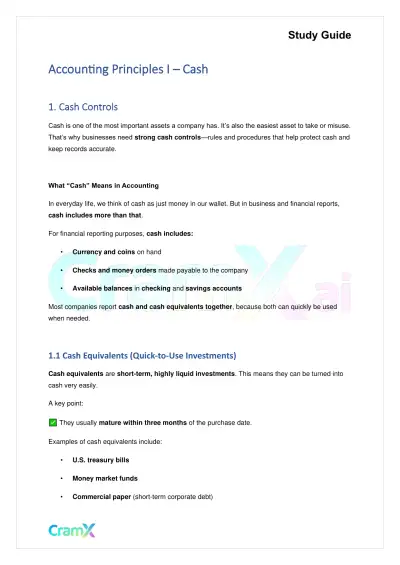 Quick Guides
Accounting Principles I – Cash
Accounting
20 pagesMar 2026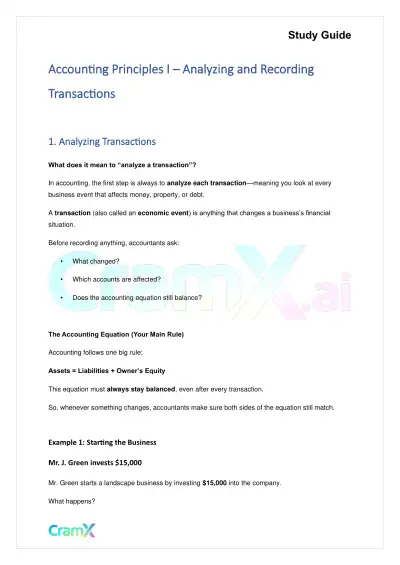 Quick Guides
Accounting Principles I – Analyzing and Recording Transactions
Accounting
42 pagesMar 2026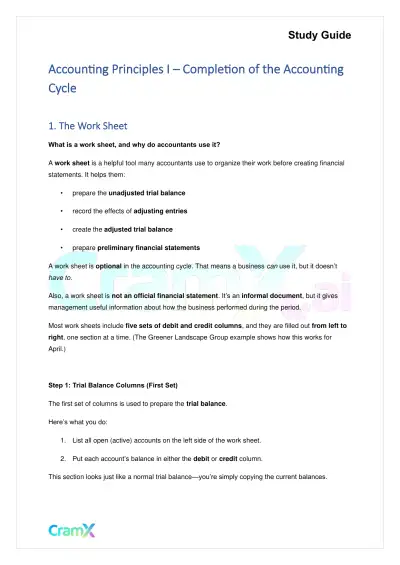 Quick Guides
Accounting Principles I – Completion of the Accounting Cycle
Accounting
25 pagesMar 2026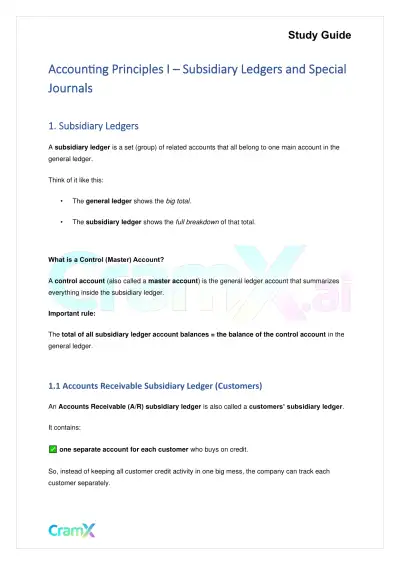 Quick Guides
Accounting Principles I – Subsidiary Ledgers and Special Journals
Accounting
17 pagesMar 2026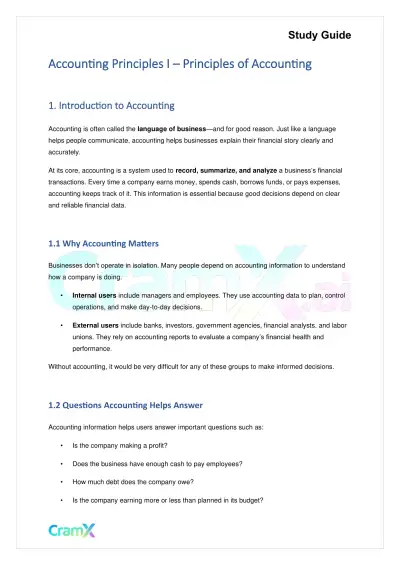 Quick Guides
Accounting Principles I – Principles of Accounting
Accounting
27 pagesMar 2026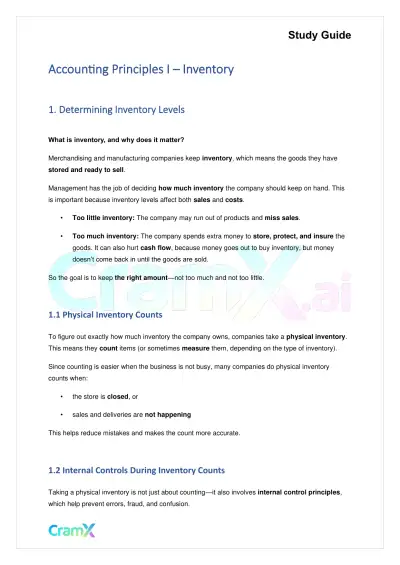 Quick Guides
Accounting Principles I – Inventory
Accounting
29 pagesMar 2026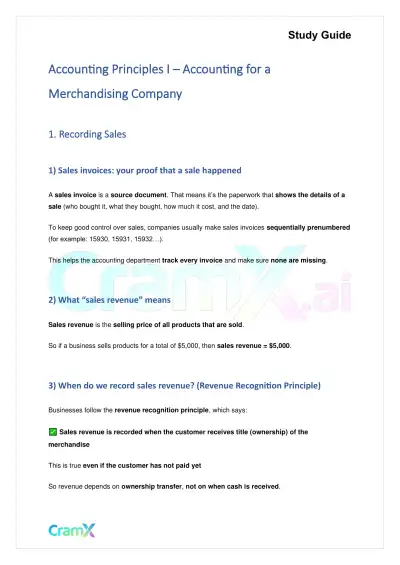 Quick Guides
Accounting Principles I – Accounting for a Merchandising Company
Accounting
36 pagesMar 2026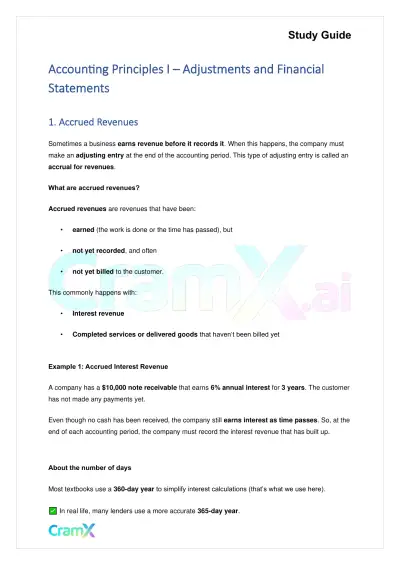 Quick Guides
Accounting Principles I – Adjustments and Financial Statements
Accounting
34 pagesMar 2026
Study this document with CramX
Once it is in your library, every tool can work from it.