

Accounting Principles I – Principles of Accounting
- Accounting
- Texas A&M University
- 27 pages
- Shared March 2026
Preview 9 of 27 pages
See the first 9 pages exactly as they appear in the document.
Page 1 Read page 1 as text
Study Guide Accounting Principles I – Principles of Accounting 1. Introduction to Accounting Accounting is often called the language of business — and for good reason. Just like a language helps people communicate, accounting helps businesses explain their financial story clearly and accurately. At its core, accounting is a system used to record, summarize, and analyze a business’s financial transactions. Every time a company earns money, spends cash, borrows funds, or pays expenses, accounting keeps track of it. This information is essential because good decisions depend on clear and reliable financial data. 1.1 Why Accounting Matters Businesses don’t operate in isolation. Many people depend on accounting information to understand how a company is doing. • Internal users include managers and employees. They use accounting data to plan, control operations, and make day - to - day decisions. • External users include banks, investors, government agencies, financial analysts, and labor unions. They rely on accounting reports to evaluate a company’s financial health and performance. Without accounting, it would be very difficult for any of these groups to make informed decisions. 1.2 Questions Accounting Helps Answer Accounting information helps users answer important questions such as: • Is the company making a profit? • Does the business have enough cash to pay employees? • How much debt does the company owe? • Is the company earning more or less than planned in its budget?
Page 2 Read page 2 as text
Study Guide • How much money do customers still owe the company? • Has the company regularly paid cash dividends? • How much income does each department or division generate? • Should the company invest money to grow or expand? Each of these questions plays a role in deciding the future direction of a business. 1.3 The Role of Accountants Accountants are responsible for turning financial data into clear and useful information . They prepare reports that are easy to understand and designed to help users make sound decisions. The most important and commonly used reports prepared by accountants are called financial statements . These statements summarize a company’s financial activities and provide a snapshot of its overall financial condition. In short, accounting helps businesses communicate their financial results — and that communication is key to success. 2. Understanding Financial Statements Financial statements are formal reports that show how a business is performing and what its financial position looks like. The examples shown here belong to a sole proprietorship , which is a business owned by one person. Financial statements for corporations are similar, but they include a few additional details. There are four basic financial statements , and each one has a specific purpose: 1. Income Statement 2. Statement of Owner’s Equity 3. Balance Sheet 4. Statement of Cash Flows Together, these statements give a complete picture of a business’s financial health.
Page 3 Read page 3 as text
Study Guide 2.1 The Three - Line Heading (Used in All Financial Statements) Every financial statement begins with a three - line heading . This heading tells the reader exactly what the report is about. The heading always includes: • Name of the company • Name of the financial statement • Time period or specific date covered This format helps users quickly understand what information they are looking at. 2.2 Income Statement The income statement is usually prepared first . It is sometimes called the statement of earnings or statement of operations . This statement shows: • Revenues earned during a period • Expenses incurred during the same period • The resulting net income or net loss If total revenues are greater than total expenses , the business has net income . If total expenses are greater than total revenues , the business has a net loss . The income statement covers a specific period of time , such as a month, quarter, or year.
Page 4 Read page 4 as text
Study Guide 2.3 Statement of Owner’s Equity The statement of owner’s equity is prepared after the income statement . This statement explains how the owner’s equity changed during the period. It shows: • Beginning owner’s equity • Owner investments • Net income or net loss (from the income statement) • Owner withdrawals • Ending owner’s equity Only the total net income or loss appears on this statement because the detailed revenues and expenses are already shown on the income statement. Amounts shown in parentheses represent values that are subtracted , such as withdrawals.
Page 5 Read page 5 as text
Study Guide 2.4 Balance Sheet The balance sheet shows what a business owns and owes at a specific point in time . Unlike the other statements, it does not cover a period of time — it shows balances on a single date. The balance sheet lists: • Assets (what the business owns) • Liabilities (what the business owes) • Owner’s equity It proves that the accounting equation is in balance: Assets = Liabilities + Owner’s Equity The ending owner’s equity amount from the statement of owner’s equity is used directly on the balance sheet.
Page 6 Read page 6 as text
Study Guide 2.5 Statement of Cash Flows The statement of cash flows tracks how cash moves in and out of the business during a specific accounting period.
Page 7 Read page 7 as text
Study Guide All cash activities are grouped into three categories: 1. Operating activities – cash from daily business operations 2. Investing activities – cash related to buying or selling long - term assets 3. Financing activities – cash from owner investments, withdrawals, or borrowing This statement calculates the net increase or decrease in cash and explains the difference between beginning and ending cash balances. Only items that affect actual cash appear in the main body of the statement. However, significant non - cash activities must still be disclosed separately. 2.6 Direct vs. Indirect Method Current accounting standards allow operating cash flows to be reported using either: • The direct method , or • The indirect method
Page 8 Read page 8 as text
Study Guide The direct method lists actual cash received and cash paid by category. This method is used in the example provided because it is easier for students to understand and clearly shows how cash moves through the business. 3. The Accounting Equation To understand financial statements, you first need to know what kinds of items appear in them and how those items are grouped. One of the most important ideas in accounting is the accounting equation . It shows the basic relationship between the main parts of a business. A business is built on three key elements: • Assets • Liabilities • Owner’s Equity (or Stockholders’ Equity in a corporation) These parts are connected through the accounting equation, which explains how a company’s resources are financed. 3. 1 Assets: What the Company Owns An asset is anything valuable that a company owns. Assets can be: • Tangible assets (physical items you can touch) • Intangible assets (valuable rights or ideas that you can’t physically touch) 3.1.1 Tangible Assets (Physical Assets) Tangible assets are usually grouped into three major categories: 1. Current assets 2. Property, plant, and equipment 3. Long - term investments
Page 9 Read page 9 as text
Study Guide A. Current Assets (Short - Term Assets) Current assets are cash or items the company expects to turn into cash, sell, or use up within one year . On the balance sheet , current assets are listed from most liquid to least liquid . Liquid assets are assets that are easy to convert into cash. They are also commonly accepted when paying debts. Here are the common types of current assets: 1. Cash This includes: • Cash on hand (like petty cash ) • Bank balances (checking, savings, or money - market accounts) • Cash equivalents Cash equivalents are super short - term investments that are almost as good as cash. Examples include: • Certificates of deposit (CDs) • U.S. treasury bills To count as cash equivalents, they must have a maturity of 90 days or less at the time of purchase . 2. Marketable Securities These are short - term investments such as: • Stocks • Bonds (debt) • Certificates of deposit • Other securities
18 more pages in the full document
Unlock it once and it stays in your library, ready to chat with or turn into flashcards.
Unlock the full documentMore Accounting study materials
See all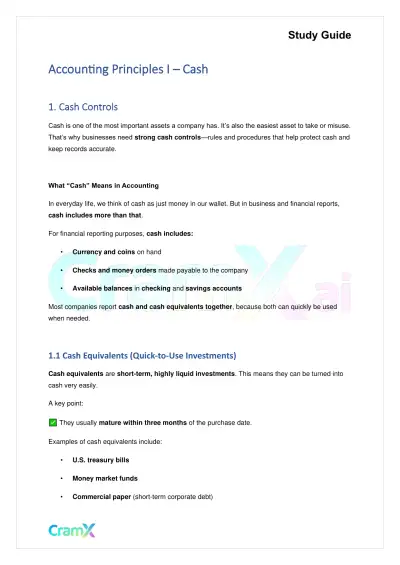 Quick Guides
Accounting Principles I – Cash
Accounting
20 pagesMar 2026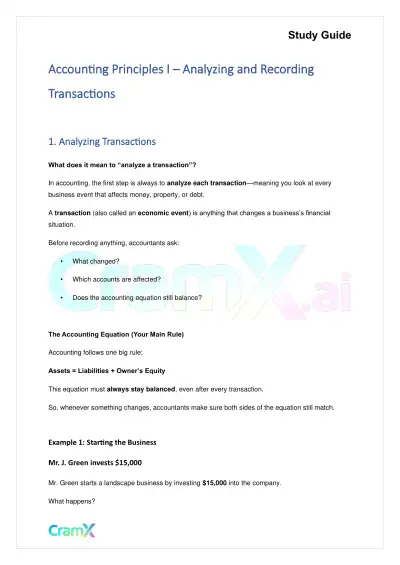 Quick Guides
Accounting Principles I – Analyzing and Recording Transactions
Accounting
42 pagesMar 2026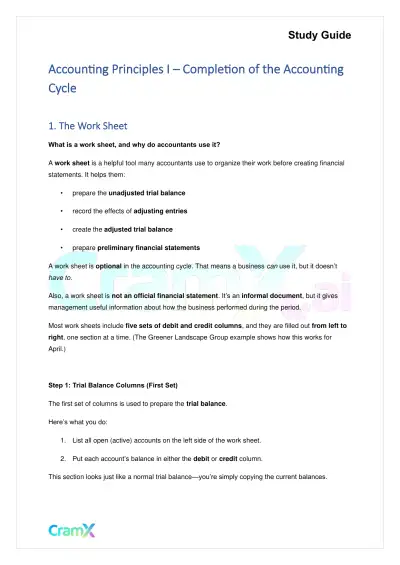 Quick Guides
Accounting Principles I – Completion of the Accounting Cycle
Accounting
25 pagesMar 2026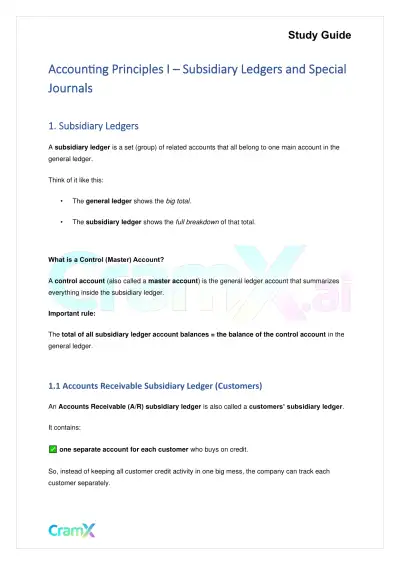 Quick Guides
Accounting Principles I – Subsidiary Ledgers and Special Journals
Accounting
17 pagesMar 2026 Quick Guides
Accounting Principles I – Inventory
Accounting
29 pagesMar 2026 Quick Guides
Accounting Principles I – Accounting for a Merchandising Company
Accounting
36 pagesMar 2026 Quick Guides
Accounting Principles I – Adjustments and Financial Statements
Accounting
34 pagesMar 2026 Quick Guides
Accounting Principles I – Operating Assets
Accounting
32 pagesMar 2026
Study this document with CramX
Once it is in your library, every tool can work from it.