

Accounting Principles I – Inventory
- Accounting
- Texas A&M University
- 29 pages
- Shared March 2026
Preview 9 of 29 pages
See the first 9 pages exactly as they appear in the document.
Page 1 Read page 1 as text
Study Guide Accounting Principles I – Inventory 1. Determining Inventory Levels What is inventory, and why does it matter? Merchandising and manufacturing companies keep inventory , which means the goods they have stored and ready to sell . Management has the job of deciding how much inventory the company should keep on hand. This is important because inventory levels affect both sales and costs . • Too little inventory: The company may run out of products and miss sales . • Too much inventory: The company spends extra money to store, protect, and insure the goods. It can also hurt cash flow , because money goes out to buy inventory, but money doesn’t come back in until the goods are sold. So the goal is to keep the right amount — not too much and not too little. 1.1 Physical Inventory Counts To figure out exactly how much inventory the company owns, companies take a physical inventory . This means they count items (or sometimes measure them, depending on the type of inventory). Since counting is easier when the business is not busy, many companies do physical inventory counts when: • the store is closed , or • sales and deliveries are not happening This helps reduce mistakes and makes the count more accurate. 1.2 Internal Controls During Inventory Counts Taking a physical inventory is not just about counting — it also involves internal control principles , which help prevent errors, fraud, and confusion.
Page 2 Read page 2 as text
Study Guide Here are the key internal control practices companies follow: 1. Segregation of Duties Inventory should be counted by employees who do not have custody of the items. In simple terms: The person who handles or stores inventory should not be the same person who counts and reports it. This reduces the chance of dishonest reporting or accidental mistakes. 2. Proper Authorization Managers must assign each employee specific inventory tasks. Also, employees helping with inventory must verify what’s inside containers like: • boxes • barrels • other packaging This makes sure items are not guessed or assumed — they are actually confirmed. 3. Adequate Documents and Records Companies use prenumbered count sheets during physical inventory. These count sheets are important because they: • provide proof of what was counted • support the inventory amount that gets reported • show responsibility when employees sign them The prenumbered system also helps make sure no count sheets are missing.
Page 3 Read page 3 as text
Study Guide 4. Physical Controls Access to inventory should be limited until the count is done. This prevents items from being moved around during counting, which could cause errors. If shipping or receiving must still happen during the inventory count: • Items being shipped should be placed in a separate area • Items being received should go into a designated area and be counted separately This keeps the count clean and organized. 5. Independent Checks on Performance After counting is finished, a supervisor should check to make sure: • every item was counted • no item was counted twice Some companies even use a second counter to double - check the first person’s results. This helps catch mistakes early. 1.3 Special Inventory Situations Some inventory situations can easily cause confusion, so companies must pay close attention to them. 1.4 Consigned Merchandise Consigned merchandise means goods that are being sold for someone else . Here’s the key idea: • The company selling the items is the consignee • The actual owner is the consignor , and the consignor keeps legal title (ownership)
Page 4 Read page 4 as text
Study Guide Even though the consignee displays and sells the items, only the consignor includes them in inventory . So, companies that sell consignment goods must be careful to exclude those items from their own inventory records. 1.5 Goods in Transit Goods in transit are items that have been shipped but are not yet received by the buyer. These goods must be counted in either : • the seller’s inventory or • the buyer’s inventory Which one depends on the shipping terms. FOB Shipping Point When goods are shipped FOB shipping point : • the buyer pays shipping costs • the buyer gains ownership as soon as the goods are shipped So even if the buyer hasn’t received the goods yet, they must still be included in the buyer’s inventory . FOB Destination When goods are shipped FOB destination : • the seller pays shipping costs • the seller keeps ownership until the goods reach the buyer’s business So the goods stay in the seller’s inventory until the buyer actually receives them.
Page 5 Read page 5 as text
Study Guide 2. The Cost of Inventory What counts as the “cost” of inventory? When a company buys inventory to sell later, the cost of inventory is more than just the price on the invoice. It includes all the costs needed to get the goods ready to sell . Think of it like this: Inventory cost = what it takes to buy it + what it takes to bring it in + what it takes to prepare it 1. Cost of Purchased Merchandise The starting point is the purchase price of the merchandise. But there’s an important detail: If the company receives a discount and actually takes it, the inventory cost is recorded after subtracting the discount . So the inventory cost includes: • purchase price • minus discounts taken 2. Extra Costs Added to Inventory Companies often pay additional costs to get merchandise into the business. These costs are also included in inventory cost, such as: • Duties (taxes on imported goods) • Transportation costs paid by the purchaser (like freight charges) These costs are included because they are necessary to bring the merchandise into the company’s possession.
Page 6 Read page 6 as text
Study Guide 3. Costs to Prepare Inventory for Sale Sometimes products can’t be sold immediately when they arrive. They might need to be: • assembled • packaged • labeled • prepared in some other way If that work is required to make the product ready for customers, then the cost of doing it is considered part of inventory cost . 4. What About Warehousing and Insurance? Technically, inventory costs can include expenses like: • warehouse storage • insurance for unsold goods These are real costs of having inventory, so it makes sense that they relate to inventory. However, tracking these costs for each individual unit of inventory can be expensive and time - consuming. Many companies decide it’s not worth the effort. So instead, they often record these costs as part of: cost of goods sold (COGS) as the expenses happen, rather than attaching them to inventory units. 3. The Valuation of Merchandise 1) Why inventory value matters In accounting, we try to match expenses with the revenues they help produce . That means if inventory loses value this year , we must record that loss this year — even if the goods will be sold later.
Page 7 Read page 7 as text
Study Guide Inventory can lose value because of things like: • Damage (broken, spoiled, storm damage) • Deterioration (wear and tear over time) • Obsolescence (old models replaced by new ones) • Other declines in usefulness or selling price 2) Inventory should not be overstated A key rule is: Inventory should never be reported at more than its Net Realizable Value (NRV). Net Realizable Value (NRV) means: Expected selling price − selling expenses So NRV is basically: “How much money will we actually end up with after selling it?” 3) Example: inventory damaged by a storm Imagine a car dealer has a car that originally cost $25,000 . A storm damages the car, and now it can only be sold for $23,000 . That means the inventory value must be reduced to $23,000 , and the $2,000 loss must be recorded right away. To record the write - down: • Debit: Loss on Inventory Write - Down (expense) • Credit: Inventory (asset decreases) This shows that the company suffered a loss because inventory became less valuable.
Page 8 Read page 8 as text
Study Guide 4) Write - downs may appear under different accounts Not every company uses the exact same expense account name. Some businesses record inventory write - downs directly in: • Cost of Goods Sold (COGS) or they may use another expense account. So, write - downs are often not shown separately on the financial statements. 5) Understanding “Market Value” in inventory In inventory topics, market value usually means replacement cost . That means: Market value = the cost to buy the same item again today Sometimes products become cheaper over time, so their market value drops . 6) The Lower - of - Cost - or - Market (LCM) rule To avoid overstating inventory, accountants use the:
Page 9 Read page 9 as text
Study Guide Lower - of - Cost - or - Market (LCM) Rule This rule says: Inventory should be reported at the lower of its original cost OR its current market value. 7) Example: computers drop in price A computer store buys 100 computers , each costing $3,000 . 8) LCM can be applied in different ways The LCM rule can be applied to: 1. Individual inventory items 2. Groups of similar items 3. The entire inventory (if items are related) Important idea: Applying LCM to individual items gives the most conservative (lowest) inventory value. Why?
20 more pages in the full document
Unlock it once and it stays in your library, ready to chat with or turn into flashcards.
Unlock the full documentMore Accounting study materials
See all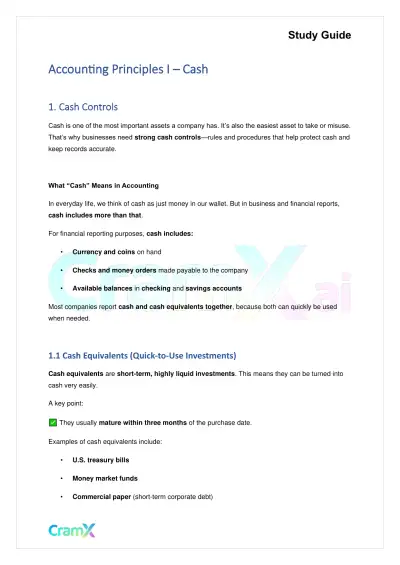 Quick Guides
Accounting Principles I – Cash
Accounting
20 pagesMar 2026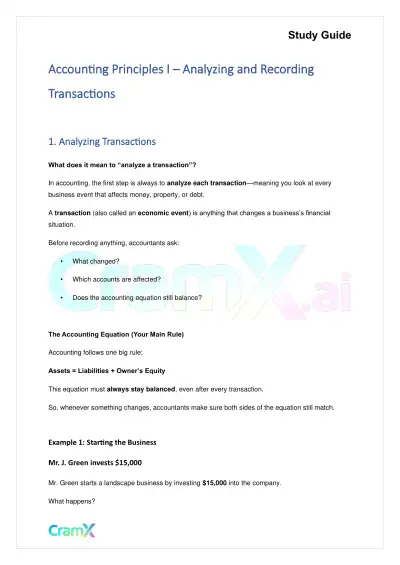 Quick Guides
Accounting Principles I – Analyzing and Recording Transactions
Accounting
42 pagesMar 2026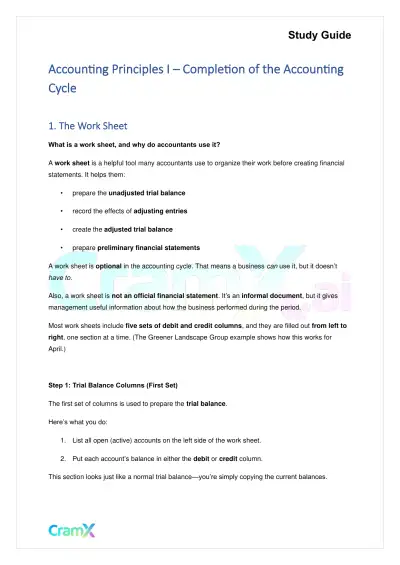 Quick Guides
Accounting Principles I – Completion of the Accounting Cycle
Accounting
25 pagesMar 2026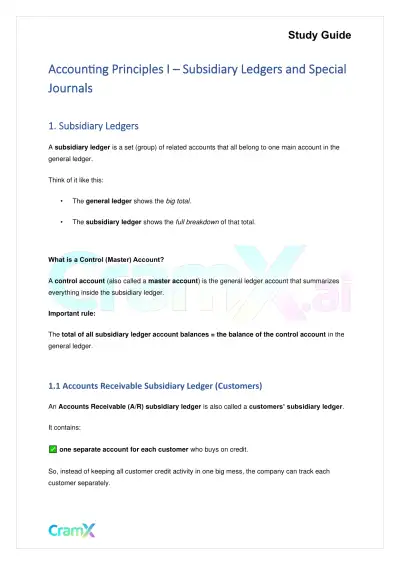 Quick Guides
Accounting Principles I – Subsidiary Ledgers and Special Journals
Accounting
17 pagesMar 2026 Quick Guides
Accounting Principles I – Principles of Accounting
Accounting
27 pagesMar 2026 Quick Guides
Accounting Principles I – Accounting for a Merchandising Company
Accounting
36 pagesMar 2026 Quick Guides
Accounting Principles I – Adjustments and Financial Statements
Accounting
34 pagesMar 2026 Quick Guides
Accounting Principles I – Operating Assets
Accounting
32 pagesMar 2026
Study this document with CramX
Once it is in your library, every tool can work from it.