

Accounting Principles I – Analyzing and Recording Transactions
- Accounting
- Texas A&M University
- 42 pages
- Shared March 2026
Preview 10 of 42 pages
See the first 10 pages exactly as they appear in the document.
Page 1 Read page 1 as text
Study Guide Accounting Principles I – Analyzing and Recording Transactions 1. Analyzing Transactions What does it mean to “analyze a transaction”? In accounting, the first step is always to analyze each transaction — meaning you look at every business event that affects money, property, or debt. A transaction (also called an economic event ) is anything that changes a business’s financial situation. Before recording anything, accountants ask: • What changed? • Which accounts are affected? • Does the accounting equation still balance? The Accounting Equation (Your Main Rule) Accounting follows one big rule: Assets = Liabilities + Owner’s Equity This equation must always stay balanced , even after every transaction. So, whenever something changes, accountants make sure both sides of the equation still match. Example 1: Starting the Business Mr. J. Green invests $15,000 Mr. Green starts a landscape business by investing $15,000 into the company. What happens?
Page 2 Read page 2 as text
Study Guide • Assets (Cash) increase by $15,000 • Owner’s Equity increases by $15,000 So the equation still balances: Assets (+15,000) = Liabilities (0) + Owner’s Equity (+15,000) This makes sense because the business now has more cash, and Mr. Green’s ownership value in the business increases by the same amount. Example 2: Buying a Truck with Cash + a Loan Mr. Green buys a used truck for $15,000 He pays $5,000 in cash as a down payment and agrees to pay the remaining $10,000 later by signing a note payable (a written promise to pay back the money in 18 months). What changes? Assets • Cash decreases by $5,000 • Vehicles (truck) increase by $15,000 Liabilities • Notes Payable increases by $10,000 Owner’s equity does not change here because this wasn’t an investment or withdrawal — it was a purchase. So after this transaction, the business now has:
Page 3 Read page 3 as text
Study Guide • Cash: $15,000 − $5,000 = $10,000 • Vehicle: $15,000 • Liability (Notes Payable): $10,000 • Owner’s Equity: $15,000 And the equation still balances: Why Businesses Need a Better Recording System Real businesses don’t just have two transactions — they can have hundreds or thousands . So accountants need a system that keeps everything organized and accurate. That’s why businesses use double - entry bookkeeping . Double - Entry Bookkeeping (The Smart System) Double - entry bookkeeping helps: • keep the accounting equation balanced • check accuracy (since each transaction affects at least two accounts) The key idea: Every transaction is recorded in at least two accounts. What Is an Account? An account is a record that tracks all the changes for one specific item.
Page 4 Read page 4 as text
Study Guide For example: • Cash account → tracks cash increases and decreases • Notes Payable account → tracks how much the business owes • Revenue and Expense accounts → track business performance Types of Accounts Businesses Use Companies keep separate accounts for: Assets (things the business owns) Examples: • Cash • Accounts Receivable • Inventory Liabilities (money the business owes) Examples: • Accounts Payable • Wages Payable • Notes Payable Owner’s Equity accounts Examples: • Owner investments (usually called the capital account in a sole proprietorship) • Owner drawings (withdrawals the owner takes out of the business) Revenue accounts (money coming in from business activities) Examples: • Sales Revenue • Service Revenue
Page 5 Read page 5 as text
Study Guide Expense accounts (costs of running the business) Examples: • Rent Expense • Wages Expense The General Ledger (The Full Collection) All of the accounts together form the general ledger . Think of the general ledger like a big organized “accounting binder” that contains every account the company uses. Chart of Accounts (The Business’s Account List) To stay organized, each account is given a number. Businesses keep a chart of accounts , which is simply: a list of all accounts along with their account numbers Account Numbers Can Be Simple or Very Detailed Account numbers depend on how big and complex the company is. • A sole proprietorship might have only a few accounts. • A multinational corporation might have thousands of accounts and use 10 - digit or even 20 - digit account numbers to track things like: ○ location ○ department ○ project code ○ other categories
Page 6 Read page 6 as text
Study Guide Common Numbering System (Easy to Recognize) Most companies separate accounts by number ranges. A typical small business might use: • 100 – 199 → Asset accounts • 200 – 299 → Liability accounts • 300 – 399 → Owner’s Equity accounts • 400 – 499 → Revenue accounts • 500 – 599 → Expense accounts This numbering system makes it quicker to find and organize accounts. 2. T Accounts What is a T Account? A T account is the simplest way to show how an account changes over time. It’s called a T account because it looks like the letter T . • The account title and account number are written at the top. • The left side is for Debits (Dr.) • The right side is for Credits (Cr.) Easy rule to remember: Debit = Left Credit = Right Where Do Increases Go? This is where accounting feels a little tricky at first, but it becomes easier with practice.
Page 7 Read page 7 as text
Study Guide Accountants record increases like this: Debit side (left) increases: • Assets • Expenses • Owner’s Drawing Credit side (right) increases: • Liabilities • Revenues • Owner’s Capital
Page 8 Read page 8 as text
Study Guide So, if you ever forget what to do, ask yourself: 1. What account is changing? 2. What type of account is it? (asset, liability, etc.) 3. Is it increasing or decreasing? Then you’ll know whether to debit or credit. 2.1 Normal Balance (What “Usually” Happens) Each account type has a normal balance , which means the side where the account normally increases . Why is it called “normal”? Because most accounts increase more often than they decrease, so the balance usually ends up on that side. Accounts with a normal debit balance: • Assets • Expenses • Owner’s Drawing Accounts with a normal credit balance: • Liabilities • Revenues • Owner’s Capital 2.2 But Sometimes an Account Can Have an “Unusual” Balance Most of the time, accounts follow their normal balance side. However, sometimes something unusual happens. Example: Overdrawn Checking Account
Page 9 Read page 9 as text
Study Guide A checking account is normally an asset , so it normally has a debit balance . But if the account is overdrawn (meaning the business spent more money than it had available), the checking account could actually show a credit balance . So yes — an account can end up on the “wrong” side sometimes. 2.3 Debit and Credit Don’t Mean “Good” or “Bad” In everyday life, the words debit and credit can sound like they have certain meanings. For example: • In school, you get credit for completing a course. • A great athlete might be “a credit to the team.” • Someone might deserve credit for trying. So when students start accounting, they often assume: credit = good debit = bad But accounting does not work like that. In accounting, debit and credit only mean: • Debit = left side • Credit = right side That’s it. 2.4 Example: Losing Cash (Yes, Even in a Bad Situation) Let’s say a business owner loses $5,000 of company cash while gambling. Cash is an asset . Assets increase with debits , and decrease with credits . So losing cash means cash decreases , which means you must: Credit the Cash account for $5,000
Page 10 Read page 10 as text
Study Guide Even though the situation is negative, the word “credit” does not mean something positive in accounting — it just means the right side . 3. Double - Entry Bookkeeping What is Double - Entry Bookkeeping? Double - entry bookkeeping is the main system businesses use to record transactions correctly. The big rule is simple: Every transaction is recorded in at least two places • Debits go into one or more accounts • Credits go into one or more accounts And the total value recorded must match on both sides: Total Debits = Total Credits Because of this, the business stays balanced and organized, and accountants can quickly check for mistakes. Why It Works So Well In double - entry bookkeeping: • The full value of every transaction shows up on the debit side of one or more accounts • And the same full value also shows up on the credit side of one or more accounts That’s why the combined debit balances of all accounts always equal the combined credit balances of all accounts. Example 1: Getting a Long - Term Loan August 1 — The company borrows $50,000 A new company takes out a long - term loan for $50,000 .
32 more pages in the full document
Unlock it once and it stays in your library, ready to chat with or turn into flashcards.
Unlock the full documentMore Accounting study materials
See all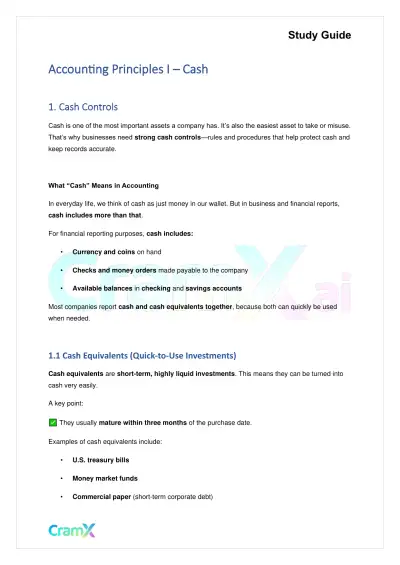 Quick Guides
Accounting Principles I – Cash
Accounting
20 pagesMar 2026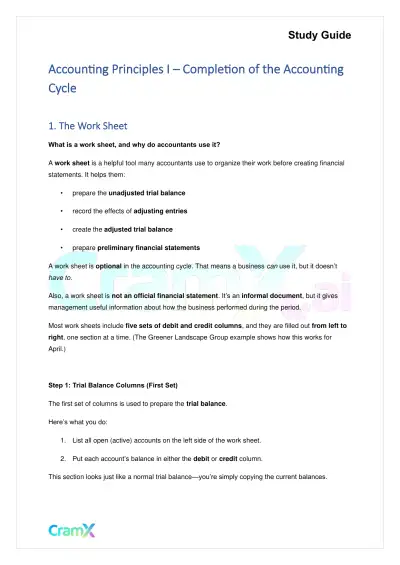 Quick Guides
Accounting Principles I – Completion of the Accounting Cycle
Accounting
25 pagesMar 2026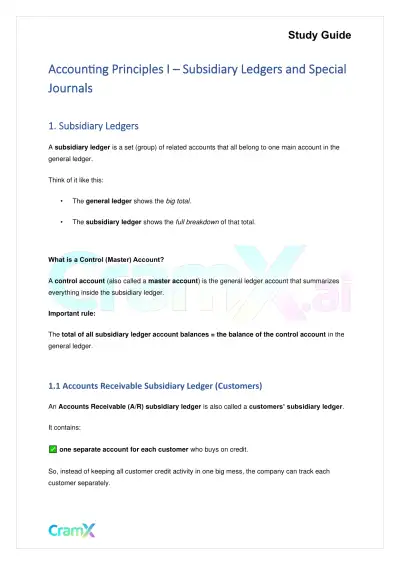 Quick Guides
Accounting Principles I – Subsidiary Ledgers and Special Journals
Accounting
17 pagesMar 2026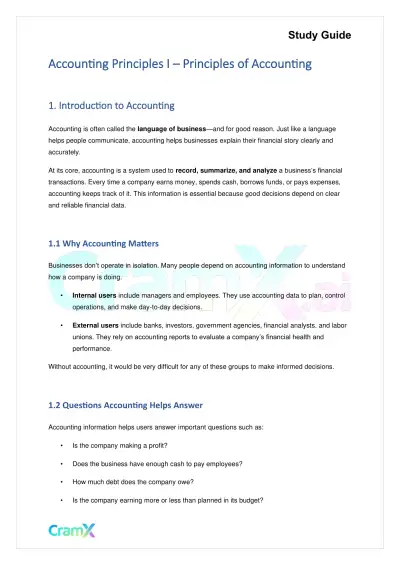 Quick Guides
Accounting Principles I – Principles of Accounting
Accounting
27 pagesMar 2026 Quick Guides
Accounting Principles I – Inventory
Accounting
29 pagesMar 2026 Quick Guides
Accounting Principles I – Accounting for a Merchandising Company
Accounting
36 pagesMar 2026 Quick Guides
Accounting Principles I – Adjustments and Financial Statements
Accounting
34 pagesMar 2026 Quick Guides
Accounting Principles I – Operating Assets
Accounting
32 pagesMar 2026
Study this document with CramX
Once it is in your library, every tool can work from it.