

Accounting Principles I – Operating Assets
- Accounting
- Texas A&M University
- 32 pages
- Shared March 2026
Preview 10 of 32 pages
See the first 10 pages exactly as they appear in the document.
Page 1 Read page 1 as text
Study Guide Accounting Principles I – Operating Assets 1. Operating Assets Defined 1. What are operating assets? Operating assets are long - term assets a company uses to run its everyday business. They are not items the company plans to sell to customers (like inventory). These assets are important because they help the business produce products, provide services, and earn revenue over many years . 2. The 3 Main Types of Operating Assets 1) Property, Plant, and Equipment (PP&E) This category includes physical assets a company uses in operations. These are sometimes called plant assets or fixed assets . Examples include: • Land • Land improvements (things added to land that wear out over time), such as: ○ driveways ○ parking lots ○ fences These items need repairs and replacement over time.
Page 2 Read page 2 as text
Study Guide • Buildings • Equipment • Vehicles • Furniture 2) Natural Resources (Wasting Assets) Natural resources are assets created by nature over very long periods of time — sometimes thousands or even millions of years . Examples include: • timber • fossil fuels • mineral deposits Companies use natural resources by cutting them down or extracting them , meaning the supply gets used up. That’s why natural resources are often called wasting assets . 3) Intangible Assets Intangible assets are valuable assets that do not have physical form , but they can still be extremely important to a company. Examples include: • Patents • Copyrights • Trademarks
Page 3 Read page 3 as text
Study Guide Even though you can’t touch them, they can help a business earn money and stay competitive. 3. Matching Costs with Revenue (Matching Principle) Businesses follow the matching principle , which means: The cost of an asset should be recorded as an expense over the years it helps the company earn revenue. Since most operating assets last a long time, their costs are spread out over their useful lives instead of being expensed all at once. 4. How the Cost is Spread Out Over Time Different asset types use different expense terms: Depreciation (for plant assets) Used for property, plant, and equipment (like buildings and equipment). Depletion (for natural resources) Used when the company uses up natural resources (like mining minerals or drilling oil). Amortization (for intangible assets) Used for intangible assets (like patents and trademarks). 5. Why Land Is Special Land is never depreciated.
Page 4 Read page 4 as text
Study Guide That’s because land is considered to have an unlimited useful life , meaning it does not “wear out” the same way buildings or equipment do. 6. Where These Appear on the Balance Sheet • Natural resources are usually listed within the Property, Plant, and Equipment (PP&E) section. • Intangible assets are shown in their own separate category on the balance sheet. 2. The Cost of Property, Plant, and Equipment (PP&E) When a business buys property, plant, and equipment (PP&E) , the total cost is more than just the sticker price. PP&E cost includes: the purchase price plus every cost needed to get the asset ready for its intended use In other words, if the asset is not usable yet, any reasonable spending to make it usable becomes part of the asset’s cost. 1) Cost of Land Buying land usually comes with extra fees beyond the price of the land itself. Costs included in the cost of land: • real estate commissions • legal fees • bank fees
Page 5 Read page 5 as text
Study Guide • title search fees • similar closing costs Also, land often needs work before it can be used. Land preparation costs include: • clearing trees • draining and filling land • grading (removing small hills and filling dips) • landscaping What about tearing down an old building? If there is an old building on the land and it must be removed, demolition costs are added to the cost of the land . Example: A company buys land for $100,000 , pays $3,000 in closing costs, and pays $22,000 to demolish an old warehouse. So, the recorded cost of land is: $100,000 + $3,000 + $22,000 = $125,000 2) Cost of Land Improvements Land improvements are things added to land that make it more useful, like a parking lot . Land improvements cost includes:
Page 6 Read page 6 as text
Study Guide All spending needed to make the improvement ready to use. • If a company hires another business to build a parking lot, the cost is simply the contract price . • If a company builds its own parking lot, the cost includes: ○ materials used ○ employee wages for construction So, whether the company builds it or pays someone else, the goal is the same: record the total cost needed to create the improvement. 3) Cost of Buildings The cost of a building includes the amount paid for the building and the extra costs required to officially obtain it and make it usable. Building cost includes: • purchase price • closing costs • back taxes owed (if the buyer pays them) • remodeling needed to prepare the building for use • repairs necessary for it to be used If the company constructs a building over time… Sometimes a building is built over a long period, and the company borrows money to finance it. Important rule about interest: • Interest during construction is included in the building’s cost
Page 7 Read page 7 as text
Study Guide • Interest after construction is complete is recorded as interest expense So once the building is ready for productive use, future interest is not added to the building anymore. 4) Cost of Equipment, Vehicles, and Furniture For items like equipment and vehicles, companies include all costs needed to get the item delivered, installed, and ready to operate . Cost includes: • purchase price • sales taxes • transportation fees • insurance paid during shipping • assembly • installation • any other costs needed to prepare the item for use Costs NOT included: Some costs may happen at the same time as a purchase, but they are not considered part of the asset cost. For example, motor vehicle licensing and insurance are not included , even if paid when the vehicle is bought. Why? Because these are normal, recurring operating expenses and they do not add lasting value to the vehicle.
Page 8 Read page 8 as text
Study Guide 3. Depreciation of Operating Assets Key Definitions • Useful life : The estimated productive life of an asset (in years or in units such as miles, hours, items produced). • Salvage value : The amount the company expects to receive when the asset is sold/exchanged at the end of its useful life. 1) Straight - Line Depreciation The following table summarizes the application of straight ‐ line depreciation during the truck's five ‐ year useful life.
Page 9 Read page 9 as text
Study Guide If another depreciation method had been used, the accounts that appear in the entry would be the same, but the amounts would be different. Companies use separate accumulated depreciation accounts for buildings, equipment, and other types of depreciable assets. Companies with a large number of depreciable assets may even create subsidiary ledger accounts to track the individual assets and the accumulated depreciation on each asset.
Page 10 Read page 10 as text
Study Guide 2) Units - of - Activity (Units - of - Production) Depreciation The useful life of some assets, particularly vehicles and equipment, is frequently determined by usage. For example, a toy manufacturer may expect a certain machine to produce one million dolls, or an airline may expect an airplane to provide ten thousand hours of flight time. Example (Truck with miles) • Depreciable cost = $80,000 • Expected miles in life = 400,000 miles
22 more pages in the full document
Unlock it once and it stays in your library, ready to chat with or turn into flashcards.
Unlock the full documentMore Accounting study materials
See all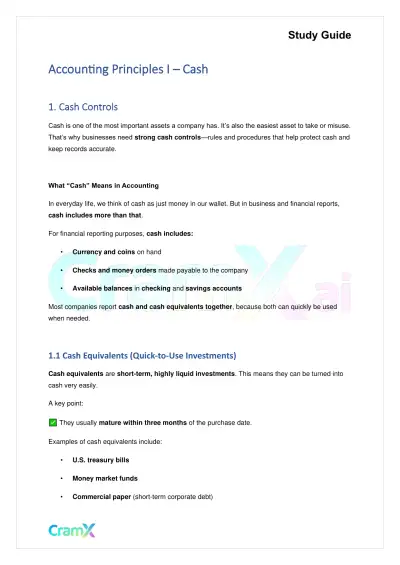 Quick Guides
Accounting Principles I – Cash
Accounting
20 pagesMar 2026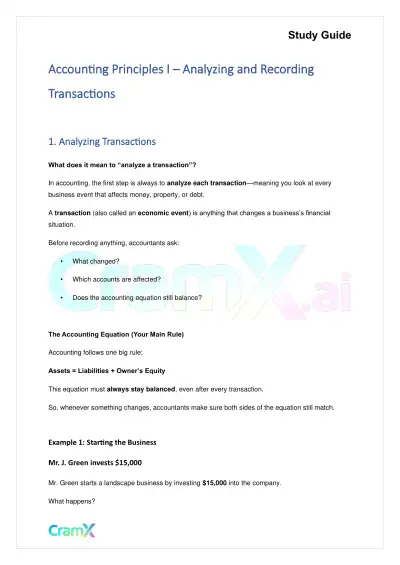 Quick Guides
Accounting Principles I – Analyzing and Recording Transactions
Accounting
42 pagesMar 2026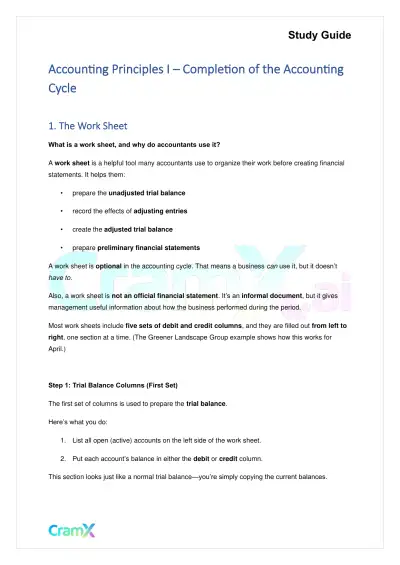 Quick Guides
Accounting Principles I – Completion of the Accounting Cycle
Accounting
25 pagesMar 2026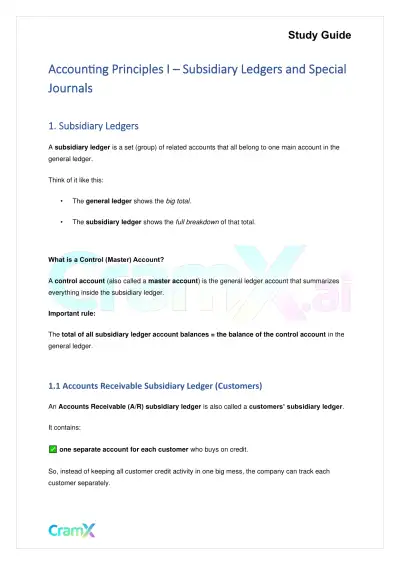 Quick Guides
Accounting Principles I – Subsidiary Ledgers and Special Journals
Accounting
17 pagesMar 2026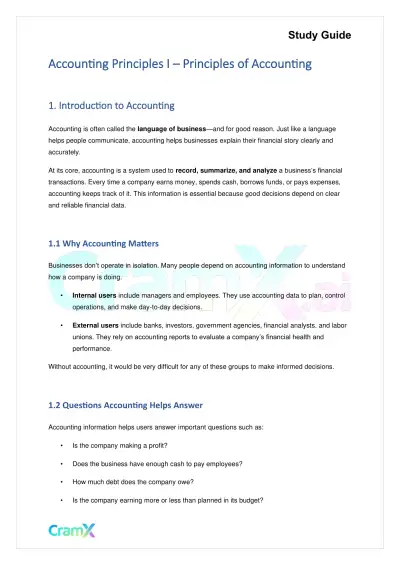 Quick Guides
Accounting Principles I – Principles of Accounting
Accounting
27 pagesMar 2026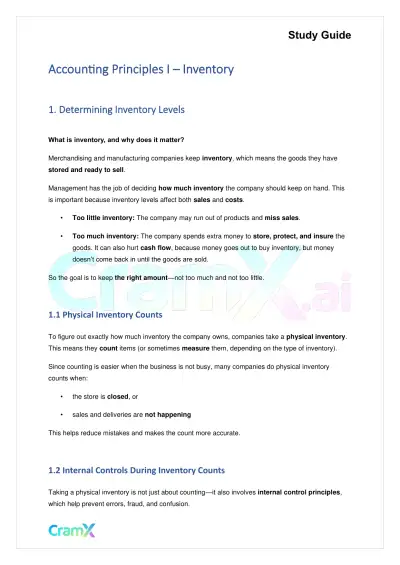 Quick Guides
Accounting Principles I – Inventory
Accounting
29 pagesMar 2026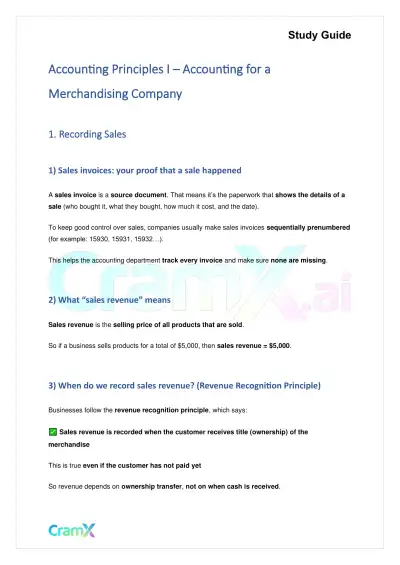 Quick Guides
Accounting Principles I – Accounting for a Merchandising Company
Accounting
36 pagesMar 2026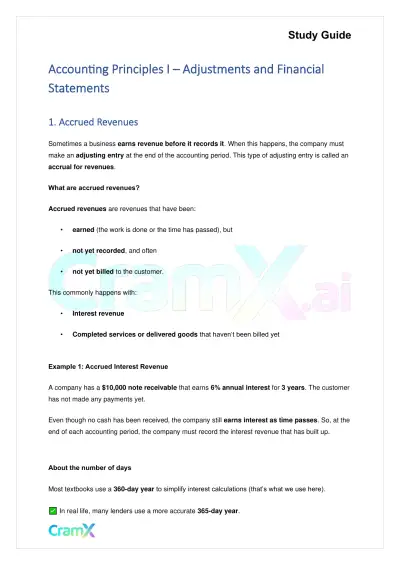 Quick Guides
Accounting Principles I – Adjustments and Financial Statements
Accounting
34 pagesMar 2026
Study this document with CramX
Once it is in your library, every tool can work from it.