
CramX Logo
2023 CCDS IBHRE Physiology Practice Exam With Answers (241 Solved Questions) - Document preview page 1

2023 CCDS IBHRE Physiology Practice Exam With Answers (241 Solved Questions) - Page 1

Document preview content for 2023 CCDS IBHRE Physiology Practice Exam With Answers (241 Solved Questions)

2023 CCDS IBHRE Physiology Practice Exam With Answers (241 Solved Questions)

2023 CCDS IBHRE Physiology Practice Exam With Answers boosts your confidence by providing real exam experience.

Scarlett Carter
Contributor
4.4
0
12 months ago
Preview (8 of 25 Pages)
100%
Log in to unlock
Page 1 of 8
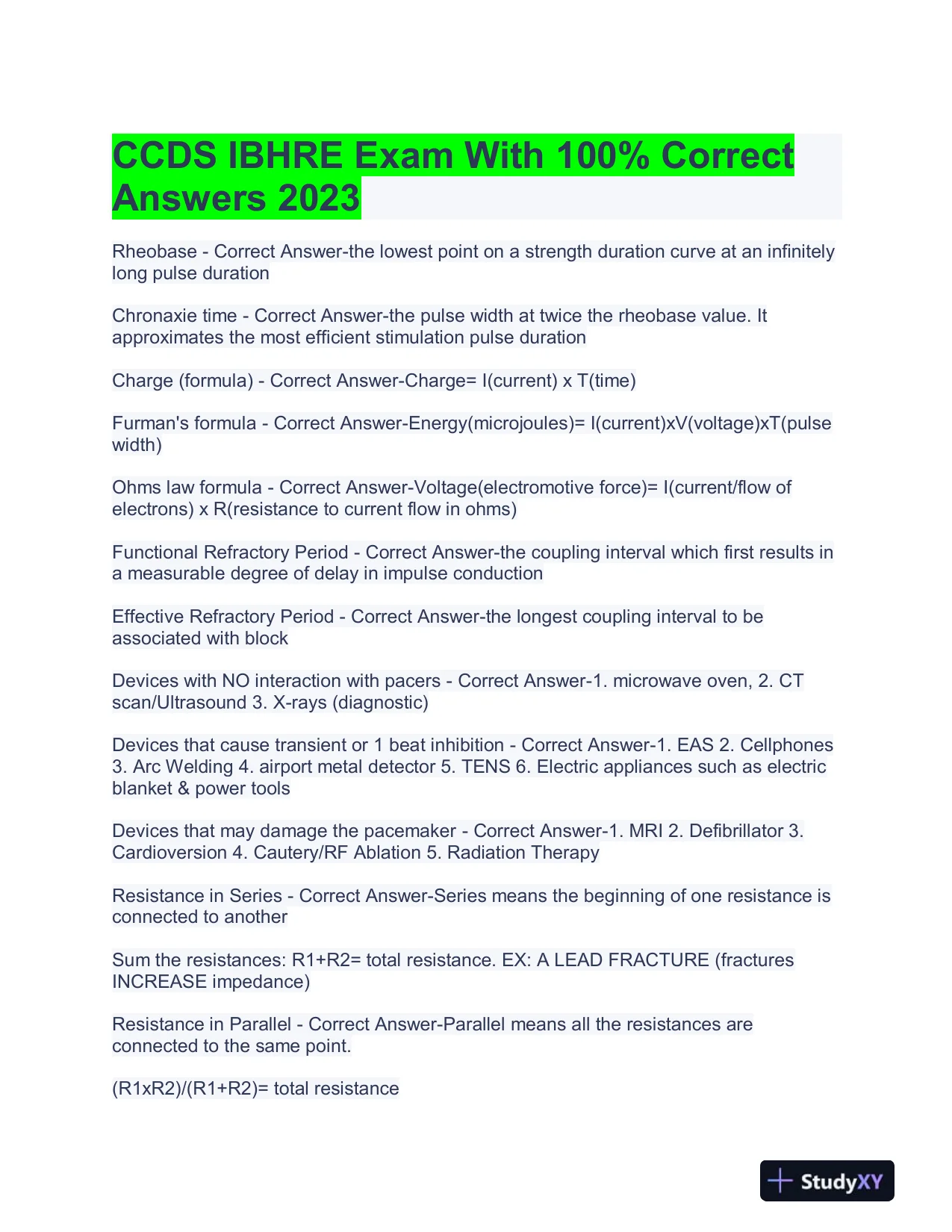
2023 CCDS IBHRE Physiology Practice Exam With Answers (241 Solved Questions) - Page 1 preview imageCCDS IBHRE Exam With 100% CorrectAnswers 2023Rheobase-Correct Answer-the lowest point on a strength duration curve at an infinitelylong pulse durationChronaxie time-Correct Answer-the pulse width at twice the rheobasevalue. Itapproximates the most efficient stimulation pulse durationCharge (formula)-Correct Answer-Charge= I(current) x T(time)Furman's formula-Correct Answer-Energy(microjoules)= I(current)xV(voltage)xT(pulsewidth)Ohms law formula-Correct Answer-Voltage(electromotive force)= I(current/flow ofelectrons) x R(resistance to current flow in ohms)Functional Refractory Period-Correct Answer-the coupling interval which first results ina measurable degree of delay in impulse conductionEffective Refractory Period-Correct Answer-the longest coupling interval to beassociated with blockDevices with NO interaction with pacers-Correct Answer-1. microwave oven, 2. CTscan/Ultrasound 3. X-rays (diagnostic)Devices that cause transient or 1 beat inhibition-Correct Answer-1. EAS 2. Cellphones3. Arc Welding 4. airport metal detector 5. TENS 6. Electric appliances such as electricblanket & power toolsDevices that may damage the pacemaker-Correct Answer-1. MRI 2. Defibrillator 3.Cardioversion 4. Cautery/RF Ablation 5. Radiation TherapyResistance in Series-Correct Answer-Series means the beginning of one resistance isconnected to anotherSum the resistances: R1+R2= total resistance. EX: A LEAD FRACTURE (fracturesINCREASE impedance)Resistance in Parallel-Correct Answer-Parallel means all the resistances areconnected to the same point.(R1xR2)/(R1+R2)= total resistance
Page 2 of 8
2023 CCDS IBHRE Physiology Practice Exam With Answers (241 Solved Questions) - Page 2 preview image
Page 3 of 8
2023 CCDS IBHRE Physiology Practice Exam With Answers (241 Solved Questions) - Page 3 preview imageEX: LEAD INSULATION DEFECTS (insulation defects DECREASE impedance)Permanent pacemakers are constant voltage or constant current?-Correct Answer-ALLpermanent pacemakers are constant voltage devices.SOME temp pacemakers are constant voltage, most are constant current.LOAD-Correct Answer-Load refers to impedance (or resistance) applied to a circuit.A system with a SMALL load (low impedance) applied to the circuit is said to be aconstant current deviceA system with LARGE load is said to be a constant voltage deviceGuidelines for Permanent Pacing-Correct Answer-1. Patient is symptomatic2. The heartrate is less than 40 bpm3. Asystole of greater than 3 seconds is documentedNOTE: Pt may be asymptomatic with 2 or 3Slew Rate-Correct Answer-Slew rate = peak slope of an electrogramslew rate= change in voltage/ change in timeNormal slew rate in atrium-Correct Answer->.3 V/sNormal slew rate in ventricle-Correct Answer->.5V/sSteroid used in electrodes-Correct Answer-dexamethasone sodium phosphate in thesilicone core(a corticosteriod)Steroid-Eluting Electrodes-Correct Answer-1. Theacute threshold is relatively flatcompared to non-steroid electrodes2. The initial capture threshold is similar to non-steroid leadsSilicone Rubber lead insulation Pros-Correct Answer-1. Can easily be repaired2. Flexible3. Proven performance history4. Easy to makeSilicone Rubber lead insulation cons-Correct Answer-1. high friction coefficient2. Absorbs lipids3. More thrombogenic and fibrotic4. Cuts easily5. Tears easily if suture tied too tightly
Page 4 of 8
2023 CCDS IBHRE Physiology Practice Exam With Answers (241 Solved Questions) - Page 4 preview image6. Large diameterPolyurethane 80A-Correct Answer-BADPolyurethane 55D-Correct Answer-GOODpolyurethane lead insulation pros-Correct Answer-1. relativelynonthrombogenic/fibrotic2. thin walls3. high tear friction4. resists cutting5. low friction coefficientpolyurethanelead insulation cons-Correct Answer-1. cannot be repaired2. relatively stiff3. hard to makePacemaker Syndrome Causes-Correct Answer-1. Loss of AV synchrony2. Sustained retrograde conduction3. A single ventricular rate when rate modulation is required for exerciseApprox 25% of patients only paced from the ventricle may have some level of severityrelated to pacemaker syndromePacemaker syndrome diagnosis-Correct Answer-1. Observe fluctuation in theperipheral blood pressure2. Cannon "A" wave in the neck3. History alonePacemaker syndrome management-Correct Answer-Restore AV synchronyin ventricular only PM-->lower the pacing rate to minimize ventricular only pacingDO NOT increase the pacing rateFallback-Correct Answer-1. Decouplesatrial & ventricular events at the upper rate limit2. The ventricular inhibited pacing rate then gradually decrements to a programmedlower or "fallback" rate over a programmed duration3. When the fallback rate is reached, atrial synchrony is restoredRate smoothing-Correct Answer-1. Eliminated large cycle to cycle variations bypreventing paced rate from changing more than a certain percentage (3%, 6%, 12%,etc) from one V-V interval to the next2. Eliminates large fluctuations in rate during fixed-ratio or psuedo-Wenckebach blockFOUND IN GDT devices
Page 5 of 8
2023 CCDS IBHRE Physiology Practice Exam With Answers (241 Solved Questions) - Page 5 preview imagesensor upper rate behavior-Correct Answer-if the sinus rate is faster than the sensorindicated rate, P synchronous pacing occursifthe sensor indicated rate is faster, AV pacing at the sensor indicated rate occursmixed scenario: when the device is sensor driven AV pacing for a few cycles and asinus rate sudden emerges faster than the sensor indicated rate. The sensor drivenatrialoutput will be inhibited, a PR interval started, and a ventricular output will occur atthe end of the sensor AV interval. That is, the ventricular rate will be equal to the sensorindicated rate, but the PV interval may be longer than expectedMedtronicRate Drop Response-Correct Answer-1. Increase in HR (Pacer isprogrammed to a top rate)2. Rise in HR is immediately followed by a fall in HR. (pacer is programmed to a"bottom" rate3.The HR drop must be identified, therefore a number of "Width" beats must beprogrammed the HR must fall to the bottom rate in fewer than the programmed "width"beats4. To confirm the rate drop, a small number of confirmation beats must be programmed.The HR must remain below the bottom rate for this number of confirmationbeats inorder for the algorithm to activateTilt Testing Results for RDR-Correct Answer-1. An initial rise in the HR to a value at orabove the "Top Rate" must occur2. A rapid fall in HR must then follow3. A fall in BP resulting in symptoms must occur next4. Syncope should not occur until the HR has dropped by 20-30 bpmX-ray Exposure (formula)-Correct Answer-Exposure= exposure rate x timeLongevity calculation-Correct Answer-longevity is usable battery in Amp HoursPacer current drain = in micro ampshours in one year = 8760 hoursUsable battery capacity/pacer current drain = # of hoursBattery longevity (in yrs)= 114x(Ahr battery capacity)/(current drain in uA)=cBisping Coaxial Lead-Correct Answer-Bisping is an extendable/retractable helix typelead. MDT owns the patentChagas disease-Correct Answer-Vector: kissing bug in central & south AmericaSymptoms: acute heart infection & symptoms subside within 4 to 8 weeksIf goes unrecognized, the disease can surface 10-20 yrslater in the form of chronicheart disease. Infected heart muscle fibers are replaced by scar tissue, thinning thewalls of the heart.
Page 6 of 8
2023 CCDS IBHRE Physiology Practice Exam With Answers (241 Solved Questions) - Page 6 preview imageThe nervous system may also be affectedPersistent SVC-Correct Answer-SVC connects to RA via CS (90%)Lyme's Disease-Correct Answer-Varying degrees of AV blockUpper Limit of Vulnerability-Correct Answer-the weakest shock strength at or abovewhich VF is not induced when the shock is delivered at any time during the vulnerableperiod.AVNRT-Correct Answer--AVnode can be thought of as divided into two conductionpathways-premature impulse is blocked in the fast pathway-impulse travels down the slow pathway-impulse again reaches the fast pathway in retrograde fashion-impulse then reenter the slowpathywayrule of thumb for AVNRT ablation, which pathway should you ablate? (slow vs fast)-Correct Answer-slow pathway because ablation of fast pathway will significantlyincrease the risk of complete heart blocka successful ablation of slow pathway in AVNRT is indicated by:-Correct Answer-1. anaccelerated junctional rhythm with 1:1 VA conduction during the burn2. an increase in refractoriness of the anterograde AV node3. elimination or alteration in dual AV nodal physiologyComplication of fast pathway ablation in AVNRT-Correct Answer-1. high grade heartblock2. marked first degree heart block3. pseudo-pacemaker syndrome caused by prolonged AV conduction times resulting inatrial contraction during AV valve closure4. persistenceof atypical AV nodal reentry implying slow pathways as both theantegrade and retrograde limbs of the tachycardiap wave characteristics in AVNRT-Correct Answer--negative in inferior leads-positive in V1Resting (transmembrane) potential-CorrectAnswer-the voltage difference between theinside and the outside of the cell fiberAction potential-Correct Answer-5 phases, the cellular characteristics of depolarizationand repolarizationAction potential phase 0-Correct Answer-The depolarizationphase
Page 7 of 8
2023 CCDS IBHRE Physiology Practice Exam With Answers (241 Solved Questions) - Page 7 preview imageThe rapid sodium channels are stimulated to open causing the resting transmembranefrom above-90mV to about 0mVAction potential phase 1-Correct Answer-early repolarizationAction potential phase 2-Correct Answer-The plateau phasemediated bythe slow calcium channels essentially disrupts and delays therepolarization started in phase 1 and prolonged the refractory periodAction potential phase 3-Correct Answer-the end of repolarizationAction potential phase 4-Correct Answer-the restingphaseions leak back and forth between the membranes and cause a gradual increase in thetransmembrane potentialwhen the potential reaches the threshold voltage, the cell depolarizes.This spontaneous depolarization is called automaticityindication for single chamber ventricular pacing-Correct Answer-chronic atrialfibrillationIncrease level of ANP or BNP in a pacemaker patient may be related to-CorrectAnswer-VVI pacing or loss of atrial capture/synchronyminimalpacing rate on VDD mode-Correct Answer-base interval in ms plus PV intervaldivided by 60000VDD pacing-using unipolar lead, bipolar lead(wide spacing and narrow spacing), andorthogonal-Correct Answer-Unipolar-oversensing extraneous signals suchasmyopotentialsBipolar-eliminates the likelihood for myopotential oversensing, the wide spacing hasthe lowest and widest signal deflection while the narrow spacing has the highest andfastest deflectionOrthogonal-half rings located directly opposite each other on the lead body withelectrically opposite plateindication of VDD pacing-Correct Answer-complete heart block without evidence ofchronotropic incompetence, sinus node disease, retrograde conduction, or atrialarrhythmiasBrugada syndrome-Correct Answer-1. right bundle branch block2. ST elevation in V1 to V33. morphology of the QRS complex resembling J point elevation4. related to sudden death5. structurally normal heart6. based on phase 2 of the action potential retry due to Nachannel involvement
Page 8 of 8
2023 CCDS IBHRE Physiology Practice Exam With Answers (241 Solved Questions) - Page 8 preview imageBrugada syndrome presentation-Correct Answer-1. syncope and sudden death causedby fast, POLYMORPHIC ventricular tachycardia or ventricular fibrillation2. no warning3. no prolongation of the QT interval during sinus rhythm4.only in very few cases there is alternation of long-short sequences before thepolymorphic VT5. no preceding acceleration in the heart rate as the case of catecholamine-dependentpolymorphic VTBrugada syndrome EP findings-Correct Answer-1. majority ofthe patients with normalsinus node2. 10% with afib3. inducibility of VF-easily induced by 1 or 2 ventricular pacing, or 3.4. sustained VF, cause hemodynamic collapse, and requires external DC5. HV interval is prolonged in about half of the patients, but rarely exceeding 70msDrugs that are primarily eliminated by liver-Correct Answer--quinidine-mexiletine-propafenone-verapamil-procainamide-flecainide-moricizine-diltiazem-lidocaine-encainide-amiodaroneDrugs that are primarily eliminated by kidneys-Correct Answer--disopyramide-tocainide-bretylium-sotalol-digoxinAAD eliminates through the vascular endothelium, erythrocytes-Correct Answer-adenosinedrugs that increase the digoxin level-Correct Answer--quinidine-flecainide-propafenone-amiodarone-verapamillidocaine and beta blockers-Correct Answer-beta blocker increases lidocaine level
Preview Mode

This document has 25 pages. Sign in to access the full document!