

Anatomy and Physiology - The Cardiovascular System
- Anatomy and Physiology
- Texas A&M University
- 113 pages
- Shared March 2026
Preview 10 of 113 pages
See the first 10 pages exactly as they appear in the document.
Page 1 Read page 1 as text
Study Guide Anatomy and Physiology – The Cardiovascular System 1. Quiz: The Blood 1. Question The major element of whole blood is __________. Answer Choices • plasma • platelets • leukocytes Correct Answer plasma Why This Is Correct Plasma is the liquid part of blood and makes up about 55% of whole blood. It carries nutrients, hormones, wastes, and proteins. 2. Question Leukocytes make up less than 0.5% of whole blood. Of that amount, approximately __________ are lymphocytes. Answer Choices • 3 – 8% • 20 – 25% • 60 – 70%
Page 2 Read page 2 as text
Study Guide Correct Answer 20 – 25% Why This Is Correct Lymphocytes typically make up about 20 – 25% of white blood cells in a normal WBC count. 3. Question Which leukocyte is the rarest when a person is not sick? Answer Choices • basophils • eosinophils • monocytes Correct Answer basophils Why This Is Correct Basophils are the least common type of leukocyte in normal blood. 4. Question Which leukocytes typically do NOT contain granules? Answer Choices • basophils • neutrophils • lymphocytes
Page 3 Read page 3 as text
Study Guide Correct Answer lymphocytes Why This Is Correct Lymphocytes are agranulocytes , meaning they do not have obvious granules like basophils and neutrophils do. 5. Question Which leukocyte does NOT have a multi - lobed nucleus? Answer Choices • basophil • eosinophil • lymphocyte Correct Answer lymphocyte Why This Is Correct Lymphocytes have a large round nucleus and are not multi - lobed . Basophils and eosinophils have lobed nuclei. 6. Question Which leukocyte releases the most histamine? Answer Choices • basophils • neutrophils • eosinophils
Page 4 Read page 4 as text
Study Guide Correct Answer basophils Why This Is Correct Basophils release histamine , which causes vasodilation and helps immune cells reach the infected area faster. 7. Question Which leukocytes do not have multi - lobed nuclei? Answer Choices • lymphocytes and monocytes • neutrophils and basophils • basophils and eosinophils Correct Answer lymphocytes and monocytes Why This Is Correct Lymphocytes and monocytes are agranulocytes with non - lobed nuclei , unlike granulocytes. 8. Question Which leukocytes can leave the bloodstream and return back into it? Answer Choices • monocytes • lymphocytes • neutrophils
Page 5 Read page 5 as text
Study Guide Correct Answer lymphocytes Why This Is Correct Lymphocytes can move between blood and tissues and return to circulation , unlike most neutrophils. 9. Question Which leukocytes can produce antibodies? Answer Choices • monocytes • neutrophils • B lymphocytes Correct Answer B lymphocytes Why This Is Correct B lymphocytes produce antibodies (especially when they become plasma cells). 10. Question Neutrophils are called polymorphonuclear leukocytes because __________. Answer Choices • they have many nuclei • their nucleus can take on a variety of shapes • some have a single nucleus and some have many nuclei
Page 6 Read page 6 as text
Study Guide Correct Answer their nucleus can take on a variety of shapes Why This Is Correct Neutrophils have a nucleus with multiple lobes , giving it different shapes — so they are “polymorphonuclear.” 11. Question Neutrophils are attracted to the site of infection by __________. Answer Choices • chemotaxis • phototaxis • hemotaxis Correct Answer chemotaxis Why This Is Correct Chemotaxis means movement toward chemicals released by damaged tissues or bacteria. 12. Question Phagocytosis is when leukocytes can __________. Answer Choices • engulf and kill bacteria • enter and exit the bloodstream to go to the infected site • kill bacteria by releasing toxins only
Page 7 Read page 7 as text
Study Guide Correct Answer engulf and kill bacteria Why This Is Correct Phagocytosis is the process of a cell engulfing and digesting pathogens like bacteria. 13. Question Which leukocytes respond strongly during allergies? Answer Choices • eosinophils • neutrophils • lymphocytes Correct Answer eosinophils Why This Is Correct Eosinophils often increase during allergic reactions and also fight parasites. 14. Question Which erythrocyte characteristic allows easy exchange of oxygen and carbon dioxide? Answer Choices • flattened shape • lack of a nucleus • lack of organelles
Page 8 Read page 8 as text
Study Guide Correct Answer flattened shape Why This Is Correct Red blood cells have a biconcave (flattened) shape , giving them a large surface area for quick gas exchange. 15. Question How many oxygen atoms can one erythrocyte transport? Answer Choices • 4 • 250 million • 1 billion Correct Answer 1 billion Why This Is Correct One red blood cell contains about 250 million hemoglobin molecules , and each hemoglobin can carry 4 oxygen atoms . That equals about 1 billion oxygen atoms total . 16. Question Oxygen binds to which portion of hemoglobin? Answer Choices • iron • protein • globin
Page 9 Read page 9 as text
Study Guide Correct Answer iron Why This Is Correct Oxygen binds to the iron (Fe² ⁺ ) inside the heme group of hemoglobin. 17. Question Carbon dioxide binds to the __________ portion of hemoglobin. Answer Choices • iron • heme • amino acid Correct Answer amino acid Why This Is Correct CO ₂ binds to the amino acid (globin) portion of hemoglobin, not the iron. 18. Question Carbon monoxide competes with oxygen by binding to the same site. What is the binding site? Answer Choices • iron • globin • amino acid
Page 10 Read page 10 as text
Study Guide Correct Answer iron Why This Is Correct Carbon monoxide binds strongly to the iron site in hemoglobin, blocking oxygen from attaching. 19. Question Fragments of megakaryocytes are called __________. Answer Choices • platelets • plasma proteins • circulating antigens Correct Answer platelets Why This Is Correct Platelets are cell fragments from megakaryocytes and are essential for blood clotting. 20. Question The process of blood clotting is called __________. Answer Choices • hemostasis • agglutination • homeostasis
103 more pages in the full document
Unlock it once and it stays in your library, ready to chat with or turn into flashcards.
Unlock the full documentMore Anatomy and Physiology study materials
See all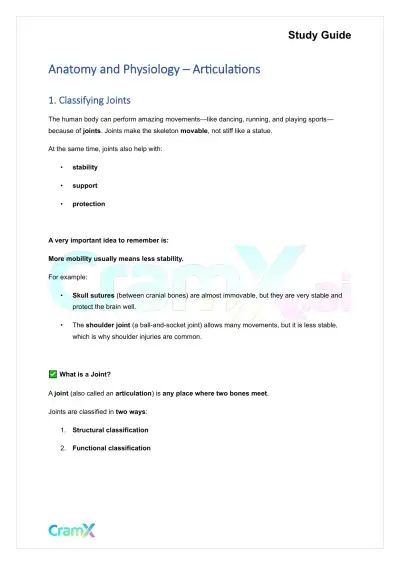 Quick Guides
Anatomy and Physiology - Articulations
Anatomy and Physiology
16 pagesMar 2026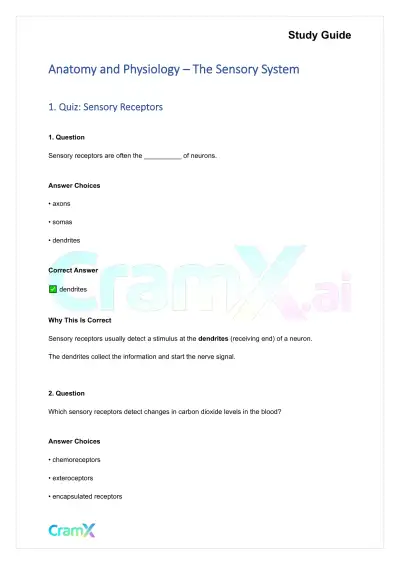 Quick Guides
Anatomy and Physiology - The Sensory System
Anatomy and Physiology
55 pagesMar 2026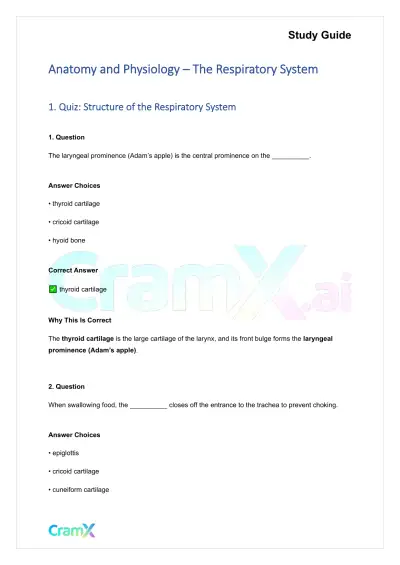 Quick Guides
Anatomy and Physiology - The Respiratory System
Anatomy and Physiology
50 pagesMar 2026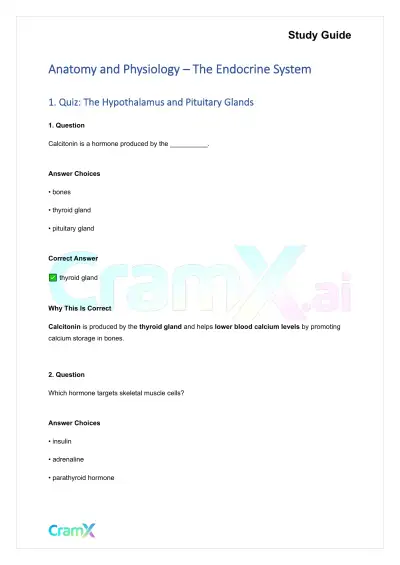 Quick Guides
Anatomy and Physiology - The Endocrine System
Anatomy and Physiology
32 pagesMar 2026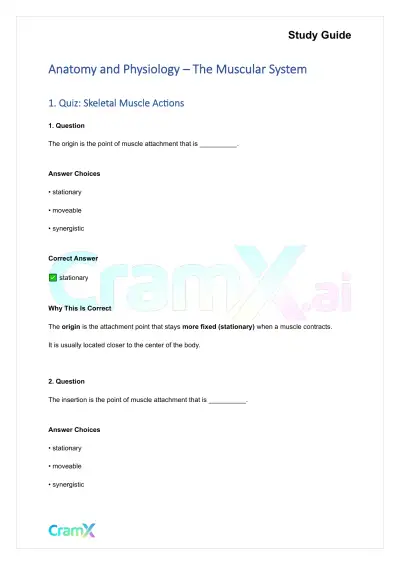 Quick Guides
Anatomy and Physiology - The Muscular System
Anatomy and Physiology
39 pagesMar 2026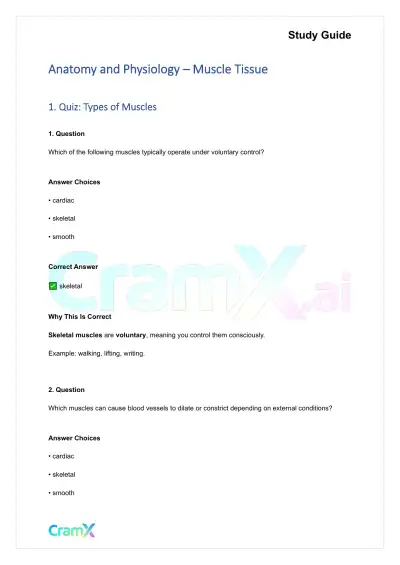 Quick Guides
Anatomy and Physiology - Muscle Tissue
Anatomy and Physiology
37 pagesMar 2026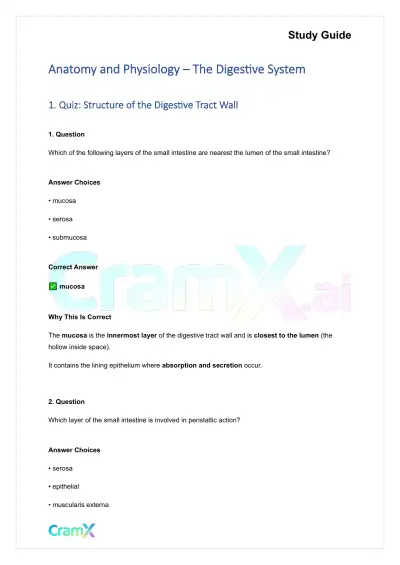 Quick Guides
Anatomy and Physiology - The Digestive System
Anatomy and Physiology
81 pagesMar 2026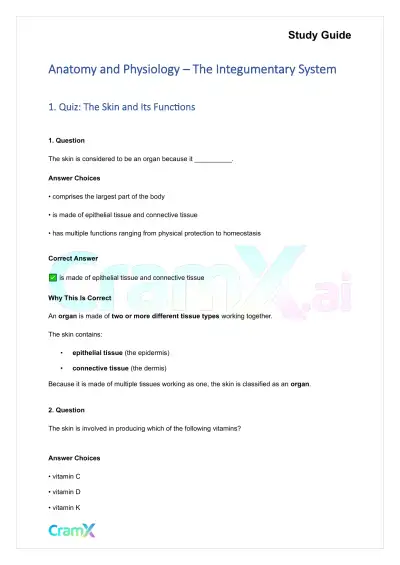 Quick Guides
Anatomy and Physiology - The Integumentary System
Anatomy and Physiology
24 pagesMar 2026
Study this document with CramX
Once it is in your library, every tool can work from it.