
CramX Logo
HONDROS BIO117 Anatomy and Physiology Practice Exam With Answers (400 Solved Questions) - Document preview page 1

HONDROS BIO117 Anatomy and Physiology Practice Exam With Answers (400 Solved Questions) - Page 1

Document preview content for HONDROS BIO117 Anatomy and Physiology Practice Exam With Answers (400 Solved Questions)

HONDROS BIO117 Anatomy and Physiology Practice Exam With Answers (400 Solved Questions)

Prepare for success with HONDROS BIO117 Anatomy and Physiology Practice Exam With Answers, a well-organized set of past test papers.

Zoe Jordan
Contributor
4.1
0
12 months ago
Preview (10 of 33 Pages)
100%
Log in to unlock
Page 1 of 10
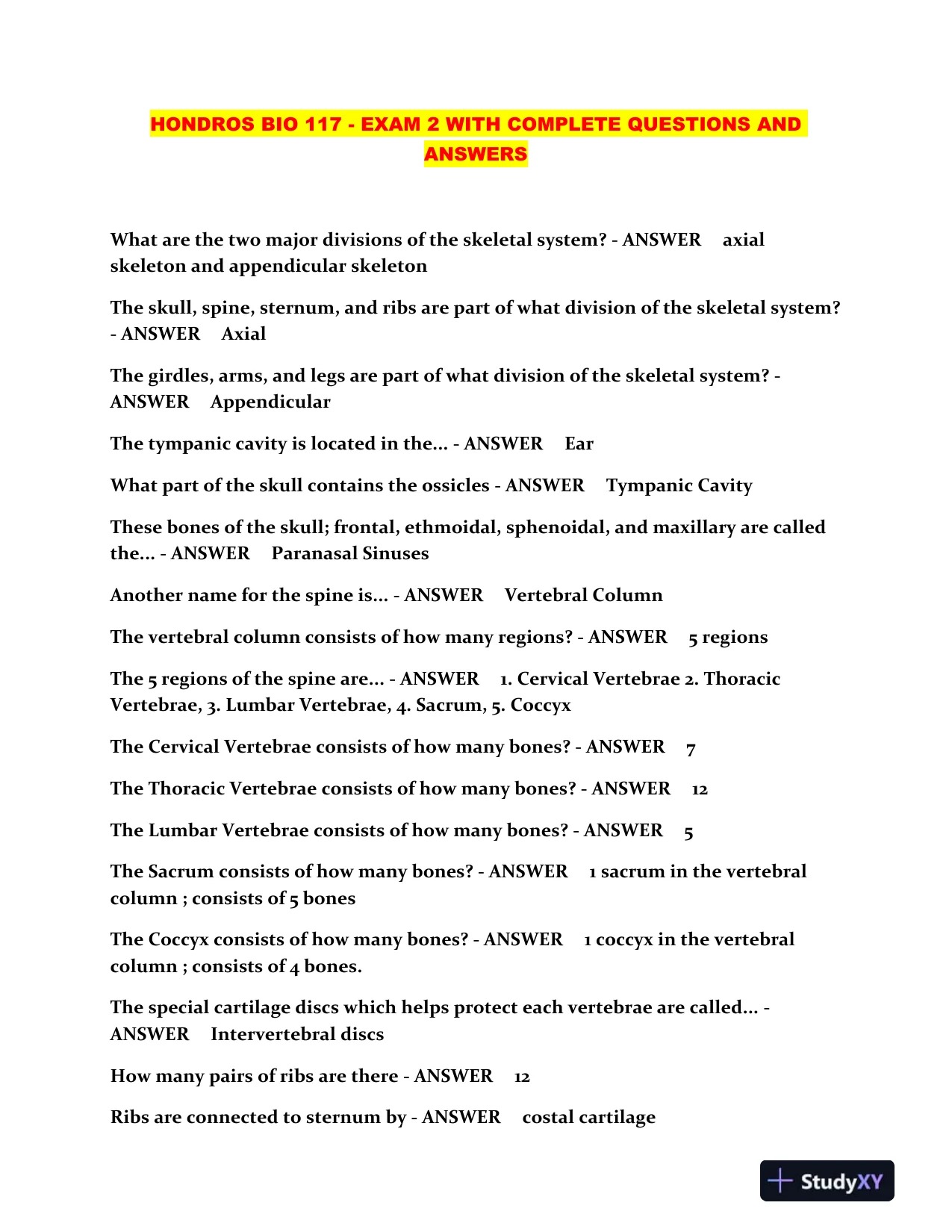
HONDROS BIO117 Anatomy and Physiology Practice Exam With Answers (400 Solved Questions) - Page 1 preview imageHONDROS BIO 117 - EXAM 2 WITH COMPLETE QUESTIONS ANDANSWERSWhat are the two major divisions of the skeletal system? - ANSWERaxialskeleton and appendicular skeletonThe skull, spine, sternum, and ribs are part of what division of the skeletal system?- ANSWERAxialThe girdles, arms, and legs are part of what division of the skeletal system? -ANSWERAppendicularThe tympanic cavity is located in the... - ANSWEREarWhat part of the skull contains the ossicles - ANSWERTympanic CavityThese bones of the skull; frontal, ethmoidal, sphenoidal, and maxillary are calledthe... - ANSWERParanasal SinusesAnother name for the spine is... - ANSWERVertebral ColumnThe vertebral column consists of how many regions? - ANSWER5 regionsThe 5 regions of the spine are... - ANSWER1. Cervical Vertebrae 2. ThoracicVertebrae, 3. Lumbar Vertebrae, 4. Sacrum, 5. CoccyxThe Cervical Vertebrae consists of how many bones? - ANSWER7The Thoracic Vertebrae consists of how many bones? - ANSWER12The Lumbar Vertebrae consists of how many bones? - ANSWER5The Sacrum consists of how many bones? - ANSWER1 sacrum in the vertebralcolumn ; consists of 5 bonesThe Coccyx consists of how many bones? - ANSWER1 coccyx in the vertebralcolumn ; consists of 4 bones.The special cartilage discs which helps protect each vertebrae are called... -ANSWERIntervertebral discsHow many pairs of ribs are there - ANSWER12Ribs are connected to sternum by - ANSWERcostal cartilage
Page 2 of 10
HONDROS BIO117 Anatomy and Physiology Practice Exam With Answers (400 Solved Questions) - Page 2 preview image
Page 3 of 10
HONDROS BIO117 Anatomy and Physiology Practice Exam With Answers (400 Solved Questions) - Page 3 preview imageThe ribs are connected to what part of the vertebral column? - ANSWERThoracicWhat are the four regions of the sternum? - ANSWER1. Manubrium 2. Body 3.Sternomanubrial joint 4. Xiphoid processRibs 1-7 are called - ANSWERtrue ribsRibs 8-10 are called - ANSWERfalse ribsRibs 11 and 12 are called - ANSWERfloating ribsWhat are the two Girdles of the appendicular skeleton that are responsible forattachment of the arms and legs? - ANSWERPectoral and PelvicWhich bones make up the pectoral girdle? - ANSWERclavicle and scapulaIs the sacrum part of the pelvic girdle or the vertebral column? - ANSWERVertebral columnWhat bones make up the pelvic girdle? - ANSWERilium, ischium, pubisWhere do you find long bones? - ANSWERIn the appendicular skeleton / armsand legsBone is a form of connective tissue, specifically ____________________ tissue ? -ANSWEROsseous tissueThe process of bone formations is called - ANSWEROssificationThe matrix of osseous tissue is made up of 3 main things: - ANSWER1. Calcium 2.Phosphate 3. CollagenOsteo means? - ANSWERBoneWhat matures bone cells? - ANSWERosteocytesWhat build up bone? - ANSWERosteoblastsWhat breaks down bone? - ANSWERosteoclastsWhere do we find bone marrow - ANSWERInside the bonesRed bone marrow makes - ANSWERred blood cellsRed bone marrow in the ____________________ part of the bone. - ANSWEREpiphysis
Page 4 of 10
HONDROS BIO117 Anatomy and Physiology Practice Exam With Answers (400 Solved Questions) - Page 4 preview imageThe epiphysis (part of the long bone) is protected by... - ANSWERSpongy boneYellow bone marrow stores... - ANSWERadipose tissue (fat)Yellow bone marrow is found in the _______________________ part of the bone -ANSWERDiaphysisDiaphysis (part of long bone) is protected by... - ANSWERCompact boneTwo main types of freely movable joints - ANSWER1. Ball-and-socket joints 2.Hing jointsExamples of ball-and-socket joints are - ANSWERshoulder and hipExamples of hinge joints are - ANSWERelbow and kneeThe immovable joints of the skull are called - ANSWERsutures_______________ are where two bones come together - ANSWERJointsJoints can be classified by - ANSWERImmovable and freely movableThis fluid lubricates the bones in the joints, decreasing friction. - ANSWERSynovial fluidWhat did the sutures in the skull used to be - ANSWERFontanellesWhat tissue is found filling the epiphysis of long bones? - ANSWERRed BoneMarrowWhat is the tube called that connects our throat to the middle ear? - ANSWEREustachian TubeCarpals are to wrist as tarsals are to: - ANSWERAnkleRibs 8, 9, and 10 are classified as? - ANSWERFalse RibsIntercostal means: - ANSWERIn between the ribsWhich bone refers to our "lower jaw"? - ANSWERMandibleWhich bone refers to our "cheek bones" - ANSWERZygomaticRibs 11 and 12 are classified as? - ANSWERFloating RibsThe zygomatic is considered what type of bone? - ANSWERFacial boneWhat bone is located on the posterior part of the skull? - ANSWEROccipital
Page 5 of 10
HONDROS BIO117 Anatomy and Physiology Practice Exam With Answers (400 Solved Questions) - Page 5 preview imageWhat makes our bones strong and sturdy? - ANSWERCollagenAdipose tissue is located in which region on the long bone? - ANSWERDiaphysisWhich region of the coxa is most anterior? - ANSWERPubisWhere would I find the fibula? - ANSWERShin (lower leg)The cell that "breaks down" bone, putting calcium into the blood is an: - ANSWEROsteoclastWhen our long bones "ossify their epiphyseal plates", this means what? - ANSWERWe are finished growingImmovable joints are found where - ANSWERIn the SkullWhere do we find articular cartilage? - ANSWERAt the ends of our bonesIs synovial fluid found at all joints? - ANSWERNo.Actions of Ball-and-socket joints can do - ANSWERExtension, abduction, andcircumductionHinge and ball-and-socket joints can BOTH do which motions? - ANSWERFlexion and ExtensionIs the mandible part of the axial or appendicular skeleton? - ANSWERAxialIs the humerus part of the axial or appendicular skeleton? - ANSWERappendicular skeletonIs the femur part of the axial or appendicular skeleton? - ANSWERAppendicularIs the sacrum part of the axial or appendicular skeleton? - ANSWERAxialIs the radius part of the axial or appendicular skeleton? - ANSWERAppendicularIs the clavicle part of the axial or appendicular skeleton? - ANSWERAppendicularIs the tibia part of the axial or appendicular skeleton? - ANSWERAppendicular
Page 6 of 10
HONDROS BIO117 Anatomy and Physiology Practice Exam With Answers (400 Solved Questions) - Page 6 preview imageIs the temporal part of the axial or appendicular skeleton? - ANSWERAxialIs the Maxilla part of the axial or appendicular skeleton? - ANSWERAxialIs the fibula part of the axial or appendicular skeleton? - ANSWERAppendicularIs the ulna part of the axial or appendicular skeleton? - ANSWERAppendicularIs the sternum part of the axial or appendicular skeleton? - ANSWERAxialIs the occipital part of the axial or appendicular skeleton? - ANSWERAxialIs the cervical vertebrae part of the axial or appendicular skeleton? - ANSWERAxialIs the zygomatic part of the axial or appendicular skeleton? - ANSWERAxialIs the frontal part of the axial or appendicular skeleton? - ANSWERAxialIs the scapula part of the axial or appendicular skeleton? - ANSWERAppendicularIs the humerus part of the axial or appendicular skeleton? - ANSWERAppendicularWhat girdle is the clavical found? - ANSWERShoulder / Pectoral GirdleThe humerus is found in what region? - ANSWERBrachialCarpals are bones located where? - ANSWERThe wristThe connective tissue that connects bone to bone is called what? - ANSWERLigamentsWhich muscle raises the eyebrows and wrinkles the forehead? - ANSWERfrontalisWhich muscle assists in winking and blinking - ANSWEROrbicularis OculliWhich muscle assists with smiling, raising the corners of the mouth) - ANSWERZygomaticusWhich muscle allows you to pucker and kiss? - ANSWEROrbicularis OrisWhich muscles assist with chewing? - ANSWERTemporalis and MasseterWhich muscle flattens the cheek? - ANSWERBuccinator
Page 7 of 10
HONDROS BIO117 Anatomy and Physiology Practice Exam With Answers (400 Solved Questions) - Page 7 preview imageThe frontalis muscle is located where? - ANSWERForeheadThe temporalis muscles are located where? - ANSWERSides of the headThe orbicularis oculi muscles are located where? - ANSWERAround the eyesThe orbicularis oris muscle is located where? - ANSWERAround the mouthThe buccinator muscles are ____________ to the masseter muscles - ANSWERDeepWhat muscle of the head aids in flexion of the head? - ANSWERSternocliedomastoidWhat muscle of the head allows extension of the head? - ANSWERTrapeziusExternal intercostal, Internal intercostal, and the diaphragm are what type ofmuscles? - ANSWERBreathing musclesThe diaphragm is located where? - ANSWERUnder the ribsThe internal intercostal muscles are located where? - ANSWERBetween the ribsThe external intercostal muscles are located where? - ANSWERAbove the ribsThe rectus abdominus, external oblique, internal oblique, and transverseabdominus are what type of muscles? - ANSWERAbdominal musclesThe connective tissue that connects muscle to bone is called? - ANSWERtendon
Page 8 of 10
HONDROS BIO117 Anatomy and Physiology Practice Exam With Answers (400 Solved Questions) - Page 8 preview imageThe connective tissue that connects muscle to muscle is called? - ANSWERAponeurosisIs skeletal muscle voluntary or involuntary? - ANSWERvoluntaryWhat covers and wraps around skeletal muscle? - ANSWERFasciaFascia is what type of tissue? - ANSWERconnectiveThese abdominal muscles allow lateral flexion of the body - ANSWERTheinternal and external obliqueWhich muscle does both flexion of the head and lateral rotation of the head? -ANSWERSternocleidomastoidThe action of the deltoid muscles is to... - ANSWERAbduct the armsWhich part of our forearm "flexes fingers"? - ANSWERAnterior compartmentThe action of the biceps brachii muscles is to... - ANSWERFlex the arm (at theelbow)The function of BOTH the pectorals major and lattimus dorsi - ANSWERAdductsthe armsWhich part of our forearm "extend fingers"? - ANSWERPosterior compartment
Page 9 of 10
HONDROS BIO117 Anatomy and Physiology Practice Exam With Answers (400 Solved Questions) - Page 9 preview imageThe rectus femoris, vastus lateralis, vastus medialis, and vastus medialis composethe - ANSWERquadricep muscles of the legActions of the hamstring muscles - ANSWERFlexes the leg at the kneeThe quadriceps consists of how many muscles? - ANSWER4The action of the gracilis muscle is to - ANSWERAdducts the leg / thighWhich muscles are involuntary? - ANSWERSmooth and Cardiac musclesThe endocrine system consists of internal glands that make and secrete what? -ANSWERChemical HormonesHormones use the _____________________ to get to their target cell or tissue -ANSWERblood streamHormones use the bloodstream to get to their ______________ or _____________ -ANSWERtarget cell or tissueWhat makes and releases hormones? - ANSWEREndocrine Glandstarget cells / tissues will bind the hormone and elicit a response only if it haswhat? - ANSWERreceptorsHormones are composed of what? - ANSWERprotein or steroid (lipids)
Page 10 of 10
HONDROS BIO117 Anatomy and Physiology Practice Exam With Answers (400 Solved Questions) - Page 10 preview imageGonads are identified as what on the body? - ANSWERTestes or OvariesSteroid hormones are only made where? - ANSWERAdrenal Cortex and theGonadsreceptors are made of what? - ANSWERproteinWhat makes steroid hormones different from protein hormones? - ANSWERThey can diffuse across the cell membraneWhy do protein hormones need "second messengers"? - ANSWERBecause theycan't cross the membrane and must use the 2nd messengerIf the receptor is found inside the cell, what kind of hormone will bind to it? -ANSWERSteroidWhat determines if a hormone will act on a cell? - ANSWERIf a cell has areceptor for that hormoneWhich hormone is our only hormone that elicits positive feedback? - ANSWEROxytocinMost hormones use _______________ feedback to regulate their secretion. -ANSWERnegativeWe use the mnemonic "FLAT PG" to help us remember the hormones from where?- ANSWERThe anterior pituitary
Preview Mode

This document has 33 pages. Sign in to access the full document!