
Test Bank For Anatomy and Physiology: The Unity of Form and Function 6th Edition Test Bank

Test Bank For Anatomy and Physiology: The Unity of Form and Function 6th Edition Test Bank helps you test your knowledge with real exam-style questions. Download now to boost your confidence!

William Chen
Contributor
4.9
95
about 1 year ago
Preview (31 of 600 Pages)
100%
Log in to unlock

Page 1

Test Bank For Anatomy and Physiology: The Unity of Form and Function 6th Edition Test Bank - Page 1 preview image

Loading page ...

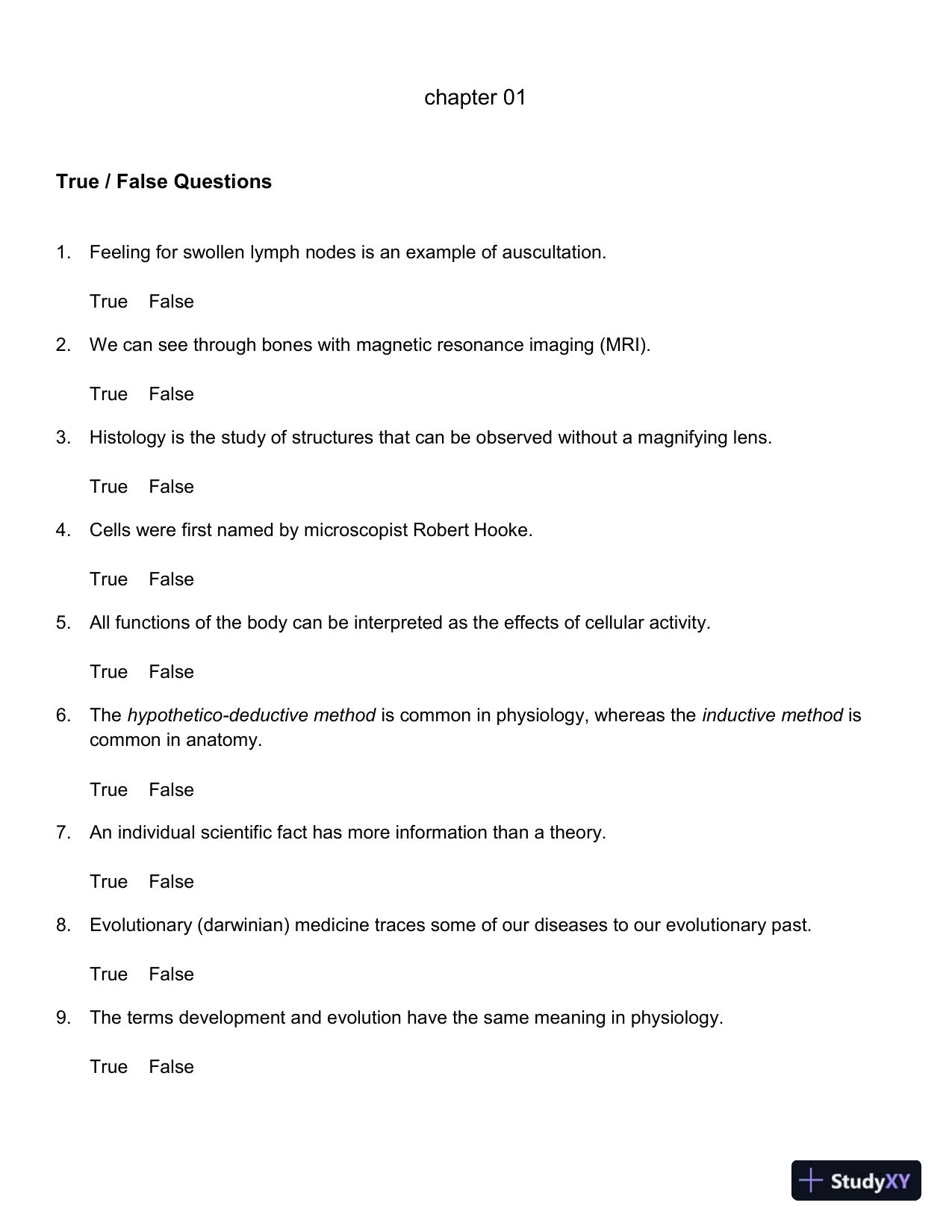
chapter 01True / False Questions1.Feeling for swollen lymph nodes is an example of auscultation.TrueFalse2.We can see through bones with magnetic resonance imaging (MRI).TrueFalse3.Histology is the study of structures that can be observed without a magnifying lens.TrueFalse4.Cells were first named by microscopist Robert Hooke.TrueFalse5.All functions of the body can be interpreted as the effects of cellular activity.TrueFalse6.Thehypothetico-deductive methodis common in physiology, whereas theinductivemethodiscommon in anatomy.TrueFalse7.An individual scientific fact has more information than a theory.TrueFalse8.Evolutionary (darwinian) medicine traces some of our diseases to our evolutionary past.TrueFalse9.The terms development and evolution have the same meaning in physiology.TrueFalse

Page 2

Test Bank For Anatomy and Physiology: The Unity of Form and Function 6th Edition Test Bank - Page 2 preview image

Loading page ...

Page 3

Test Bank For Anatomy and Physiology: The Unity of Form and Function 6th Edition Test Bank - Page 3 preview image

Loading page ...

10.Organs are made of tissues.TrueFalse11.A molecule of water is more complex than a mitochondrion (organelle).TrueFalse12.Homeostasis and occupying space are both unique characteristics of living things.TrueFalse13.Positive feedback helps to restore normal function when one of the body's physiological variablesgets out of balance.TrueFalse14.Negative feedback is a self-amplifying chain of events that tend to produce rapid change in thebody.TrueFalse15.Anatomists over the world adhere to a lexicon of standard international terms, which stipulatesboth Latin names and accepted English equivalents.TrueFalseMultiple Choice Questions16.Feeling structures with your fingertips is called _________, whereas tapping on the body andlistening for sounds of abnormalities is called ____________A.palpation; auscultation.B.auscultation; percussion.C. percussion; auscultation.D. palpation; percussion.E.percussion; palpation.

Page 4

Test Bank For Anatomy and Physiology: The Unity of Form and Function 6th Edition Test Bank - Page 4 preview image

Loading page ...

17.___________________ was the first to publish accurate drawings of the body, and is thusregarded as "the father of modern anatomy."A.VesaliusB.MaimonidesC. HarveyD. AristotleE.van Leeuwenhoek18.________________ wrote the most influential medical textbook of the ancient era.A.HippocratesB.AristotleC. GalenD. VesaliusE.Avicenna19.Which of these is the best imaging technique for routinely examining the anatomical developmentof a fetus?A.auscultationB.PET scanC. MRID. sonographyE.radiography20.The terms physics, physiology, and physician come from a term that ___ proposed to distinguishnatural causes from supernatural causes.A.HippocratesB.PlatoC. SchwannD. AristotleE.Avicenna

Page 5

Test Bank For Anatomy and Physiology: The Unity of Form and Function 6th Edition Test Bank - Page 5 preview image

Loading page ...

21.The process of using numerous observations to develop general principles and predictions abouta specific subject is calledA.experimental design.B.deductive method.C. inductive method.D. hypothesis.E.statistical testing.22.Most people think that ulcers are caused by psychological stress. It was discovered that an acid-resistant bacterium,Heliobacter pylori, lives in the lining of the stomach. If these bacteria causeulcers, then treatment with an antibiotic should reduce ulcers. This line of investigation is anexample ofA.hypothetical reasoning.B.hypothetico-deductive reasoning.C. the inductive method.D. experimental design.E.statistical analysis.23.An educated speculation or a possible answer to a question is called a(n)A.scientific method.B.theory.C. law.D. hypothesis.E.fact.24.The use of controls and statistical testing are two aspects of experimental design that help toensureA.an adequate sample size.B.objective and reliable results.C. experimental bias.D. psychosomatic effects.E.treatment groups.

Page 6

Test Bank For Anatomy and Physiology: The Unity of Form and Function 6th Edition Test Bank - Page 6 preview image

Loading page ...

25.______________ is a process that submits a scientist's ideas to the critical judgment of otherspecialists in the field before the research is funded or published.A.AdjudicationB.Statistical testingC. FalsificationD. Peer reviewE.Hypothetico-deductive testing26.Which of the following would contain the greatest amount of information that scientists consider tobe true to the best of their knowledge?A.a factB.a law of natureC. a hypothesisD. an equationE.a theory27.The study of structure and function of cells is calledA.cytology.B.gross anatomy.C. exploratory physiology.D. comparative physiology.E.radiology.28.________________ established a code of ethics for physicians. He is considered the "father ofmedicine."A.AristotleB.HippocratesC. GalenD. VesaliusE.Hooke

Page 7

Test Bank For Anatomy and Physiology: The Unity of Form and Function 6th Edition Test Bank - Page 7 preview image

Loading page ...

29.A new drug apparently increases short-term memory. Students were divided randomly into twogroups at the beginning of the semester. One group was given the memory pill once a day for thesemester, and the other group was given a same-looking pill, but it was just sugar. The sugar pillis termed a(n)A.controlled pill.B.placebo.C. treatment pill.D. variable.E.effective dose.30.Two groups of people were tested to determine whether garlic lowers blood cholesterol levels.One group was given 800 mg of garlic powder daily for four months and exhibited an average12% reduction in the blood cholesterol. The other group was not given any garlic and after fourmonths averaged a 3% reduction in cholesterol. The group that was not given the garlic was theA.peer group.B.test group.C. treatment group.D. control group.E.double-blind group.31.A change in the genetic composition of a population over time is calledA.mutation.B.natural selection.C. selection pressure.D. evolution.E.adaptation.32.The constant appearance of new strains of influenza virus is an example ofA.a model.B.evolution.C. selection pressure.D. survivorship.E.success.

Page 8

Test Bank For Anatomy and Physiology: The Unity of Form and Function 6th Edition Test Bank - Page 8 preview image

Loading page ...

33.The principal theory of how evolution works is calledA.natural pressure.B.selective pressure.C. darwinian pressure.D. natural adaptation.E.natural selection.34.Which of the following was an adaptation evolved in connection with human upright walking?A.hairB.thumbs fully opposableC. stereoscopic visionD. color visionE.spinal and pelvic anatomy35.Stereoscopic vision providesA.opposable perception.B.color perception.C. depth perception.D. bipedalism.E.walking upright.36.Humans are born before their nervous system have matured, which is traceable toA.their inability to regulate body temperature.B.skeletal adaptations to bipedalism.C. the arboreal habits of early primates.D. the conditions of modern civilization.E.the diet of early species of Homo.37.Our own species is calledA.Homo erectus.B.Homo sapiens.C.Homo habilis.D. earlyHomo.E.Australopithecus.

Page 9

Test Bank For Anatomy and Physiology: The Unity of Form and Function 6th Edition Test Bank - Page 9 preview image

Loading page ...

38.Most primates are ________________, meaning they live in trees.A.prehensileB.bipedalC. cursorialD. troglodyticE.arboreal39.An _______________ is composed of two or more tissues types, whereas ____________ aremicroscopic structures in a cell.A.organ system, organsB.organ system, organellesC. organ, organellesD. organ, moleculesE.organelle, molecules40.Which of the following lists levels of human structure from the most complex to the simplest?A.organelle, cell, tissue, organ, organ systemB.organ system, organ, cell, tissue, organelleC. organ system, organelle, tissue, cell, organD. organ system, organ, tissue, cell, organelleE.organ, organ system, tissue, cell, organelle41.Which of the following lists examples of body structures from the simplest to the most complex?A.mitochondrion, connective tissue, protein, stomach, adipocyte (fat cell)B.protein, mitochondrion, adipocyte (fat cell), connective tissue, stomachC. mitochondrion, connective tissue, stomach, protein, adipocyte (fat cell)D. protein, adipocyte (fat cell), stomach, connective tissue, mitochondrionE.protein, stomach, connective tissue, adipocyte (fat cell), mitochondrion

Page 10

Test Bank For Anatomy and Physiology: The Unity of Form and Function 6th Edition Test Bank - Page 10 preview image

Loading page ...

42.A(n) _____________ is a group of similar cells and their intercellular materials in a discreteregion of an organ performing a specific function.A.macromoleculeB.organ systemC. organelleD. organismE.tissue43.Taking apart a clock to see how it works is similar to ____________ thinking about humanphysiology.A.comparativeB.evolutionaryC. holisticD. inductiveE.reductionist44._______________ approaches understanding of the human body by studying interactions of itsparts.A.NaturalismB.ReductionismC. VitalismD. HolismE.Rationalism45._____________ is the view that not everything about an organism can be understood orpredicted from the knowledge of its components; that is, the whole is greater than the sum of itsparts.A.NaturalismB.ReductionismC. HolismD. MaterialismE.Science

Page 11

Test Bank For Anatomy and Physiology: The Unity of Form and Function 6th Edition Test Bank - Page 11 preview image

Loading page ...

46.The fact that most of us have five lumbar vertebrae, but some people have six and some havefour is an example of ____________ variation among organisms.A.cellularB.holisticC. physiologicalD. anatomicalE.reductionist47._________________ are the simplest body structures considered alive.A.Organ systemsB.OrgansC. CellsD. OrganellesE.Molecules48.All of the following are human organ systemsexceptA.skeletal.B.endocrine.C. epidermal.D. reproductive.E.lymphatic.49.All of the following are organsexceptA.teeth.B.skin.C. nails.D. liver.E.digestive system.

Page 12

Test Bank For Anatomy and Physiology: The Unity of Form and Function 6th Edition Test Bank - Page 12 preview image

Loading page ...

50.Metabolism is the sum ofA.inhalation and exhalation.B.growth and differentiation.C. anabolism and catabolism.D. positive and negative feedback.E.responsiveness and movement.51.We live in an ever-changing environment outside of our body, yet our internal conditions remainrelatively stable. This is calledA.homeostasis.B.metastasis.C. responsiveness.D. adaptation.E.evolution.52.When you exercise you generate excess heat and your body temperature rises. Blood vesselsdilate in the skin, warm blood flows closer to the body surface, and you lose heat. ThisexemplifiesA.negative feedback.B.positive feedback.C. dynamic equilibrium.D. integration control.E.set point adjustment.53.When a woman is giving birth, the head of the baby pushes against her cervix and stimulatesrelease of the hormone oxytocin. Oxytocin travels in the blood and stimulates the uterus tocontract. Labor contractions become more and more intense until the baby is expelled. This is anexample ofA.negative feedback.B.positive feedback.C. dynamic equilibrium.D. integration control.E.set point adjustment.

Page 13

Test Bank For Anatomy and Physiology: The Unity of Form and Function 6th Edition Test Bank - Page 13 preview image

Loading page ...

54.Which of the following is most likely to cause disease?A.positive feedbackB.negative feedbackC. homeostasisD. equilibriumE.irritability55.Blood glucose concentration rises after a meal and stimulates release of the hormone insulin.Insulin travels in the blood and stimulates body cells to uptake glucose from the bloodstream.This reduces blood glucose concentration. This is an example ofA.negative feedback.B.positive feedback.C. dynamic equilibrium.D. integration control.E.set point adjustment.56.The ____________ is defined as a healthy male 22 years old, weighing 70 kg (154 lb), under noenvironmental stress, and consuming 2,800 kilocalories (kcal) per day; whereas the ________ isthe same except for a weight of 58 kg (128 lb) and an intake of 2,000 kcal/day.A.normal man, normal womanB.normal male, normal femaleC. average man, average womanD. average male, average womanE.reference man, reference woman57.The change in size of the bone marrow (where blood cells are produced) as an infant matures isan example of __________, whereas the transformation of blood stem cells into white blood cellsis an example of __________________A.development, differentiation.B.growth, development.C. growth, differentiation.D. differentiation, growth.E.differentiation, development.

Page 14

Test Bank For Anatomy and Physiology: The Unity of Form and Function 6th Edition Test Bank - Page 14 preview image

Loading page ...

58.Three common components of a feedback loop areA.a stimulus, an integrating (control) center, and an organ system.B.a stimulus, a receptor, and an integrating (control) center.C. a receptor, an integrating (control) center, and an effector.D. a receptor, an organ, and an organ system.E.a receptor, an integrating (control) center, and an organ system.59.Negative feedback loops areA.homeostatic.B.not homeostatic.C. associated with "vicious circles."D. self-amplifying cycles.E.harmful.60.The prefixhypo-means _______________, whereashyper-means _____________.A.front, backB.right, leftC. inside, outsideD. clear, darkE.below, above61.The termfallopiantube (uterine tube) is an example ofA.a Latin root used in medical terminology.B.the use of prefixes to name an anatomical structure.C. the use of suffixes to name an anatomical structure.D. an eponym.E.an acronym.62.Hypercalcemia meansA.elevated calcium levels in blood.B.lowered calcium levels in bone.C. elevated sodium levels in blood.D. elevated calcium levels in bone.E.lowered calcium levels in the blood.

Page 15

Test Bank For Anatomy and Physiology: The Unity of Form and Function 6th Edition Test Bank - Page 15 preview image

Loading page ...

63.The plural of axilla (armpit) is ____________ whereas the plural of appendix is ___________.A.axillae; appendicesB.axillides; appendagesC. axillies; appendiD. axilli; appendices64.The plural of villus (hair) is ____________ whereas the plural of diagnosis is ____________A.villuses, diagnosises.B.villi, diagnoses.C. villus, diagnosis.D. villi, diagnosis.E.villuses, diagnosis.65.The lexicon of standard international anatomical termsA.is calledTerminologia Anatomica(TA).B.is calledNomina Anatomica(NA).C. is formed from thousands of English word roots.D. is formed from thousands of Italian word roots.E.is formed from thousands of French word roots.

Page 16

Test Bank For Anatomy and Physiology: The Unity of Form and Function 6th Edition Test Bank - Page 16 preview image

Loading page ...

chapter 01 KeyTrue / False Questions1.Feeling for swollen lymph nodes is an example of auscultation.FALSEBloom's Level: 1. RememberLearning Outcome: 01.01.b Describe several ways of studying human anatomy.Section: 01.01Topic: General2.We can see through bones with magnetic resonance imaging (MRI).TRUEBloom's Level: 1. RememberLearning Outcome: 01.01.b Describe several ways of studying human anatomy.Section: 01.01Topic: General3.Histology is the study of structures that can be observed without a magnifying lens.FALSEBloom's Level: 1. RememberLearning Outcome: 01.01.b Describe several ways of studying human anatomy.Section: 01.01Topic: General4.Cells were first named by microscopist Robert Hooke.TRUEBloom's Level: 1. RememberLearning Outcome: 01.02.b Describe the contributions of some key people who helped to bring about this transformation.Section: 01.02Topic: General5.All functions of the body can be interpreted as the effects of cellular activity.TRUEBloom's Level: 3. ApplyLearning Outcome: 01.02.b Describe the contributions of some key people who helped to bring about this transformation.Section: 01.02Topic: General

Page 17

Test Bank For Anatomy and Physiology: The Unity of Form and Function 6th Edition Test Bank - Page 17 preview image

Loading page ...

6.Thehypothetico-deductive methodis common in physiology, whereas theinductivemethodiscommon in anatomy.TRUEBloom's Level: 3. ApplyLearning Outcome: 01.03.a Describe the inductive and hypothetico-deductive methods of obtaining scientific knowledge.Section: 01.03Topic: General7.An individual scientific fact has more information than a theory.FALSEBloom's Level: 2. UnderstandLearning Outcome: 01.03.c Explain what is meant by hypothesis, fact, law, and theory in science.Section: 01.03Topic: General8.Evolutionary (darwinian) medicine traces some of our diseases to our evolutionary past.TRUEBloom's Level: 1. RememberLearning Outcome: 01.04.a Explain why evolution is relevant to understanding human form and function.Section: 01.04Topic: General9.The terms development and evolution have the same meaning in physiology.FALSEBloom's Level: 3. ApplyLearning Outcome: 01.04.a Explain why evolution is relevant to understanding human form and function.Learning Outcome: 01.04.b Define evolution and natural selection.Section: 01.04Topic: General10.Organs are made of tissues.TRUEBloom's Level: 1. RememberLearning Outcome: 01.05.a List the levels of human structure from the most complex to the simplest.Section: 01.05Topic: General11.A molecule of water is more complex than a mitochondrion (organelle).FALSEBloom's Level: 3. ApplyLearning Outcome: 01.05.a List the levels of human structure from the most complex to the simplest.Section: 01.05Topic: General

Page 18

Test Bank For Anatomy and Physiology: The Unity of Form and Function 6th Edition Test Bank - Page 18 preview image

Loading page ...

12.Homeostasis and occupying space are both unique characteristics of living things.FALSEBloom's Level: 3. ApplyLearning Outcome: 01.06.a State the characteristics that distinguish living organisms from nonliving objects.Section: 01.06Topic: General13.Positive feedback helps to restore normal function when one of the body's physiologicalvariables gets out of balance.FALSEBloom's Level: 2. UnderstandLearning Outcome: 01.06.e Define positive feedback and give examples of its beneficial and harmful effects.Section: 01.06Topic: General14.Negative feedback is a self-amplifying chain of events that tend to produce rapid change in thebody.FALSEBloom's Level: 2. UnderstandLearning Outcome: 01.06.d Define negative feedback, given an example of it, and explain its importance to homeostasis.Section: 01.06Topic: General15.Anatomists over the world adhere to a lexicon of standard international terms, which stipulatesboth Latin names and accepted English equivalents.TRUEBloom's Level: 1. RememberLearning Outcome: 01.07.a Explain why modern anatomical terminology is so heavily based on Greek and Latin.Section: 01.07Topic: GeneralMultiple Choice Questions

Page 19

Test Bank For Anatomy and Physiology: The Unity of Form and Function 6th Edition Test Bank - Page 19 preview image

Loading page ...

16.Feeling structures with your fingertips is called _________, whereas tapping on the body andlistening for sounds of abnormalities is called ____________A.palpation; auscultation.B.auscultation; percussion.C. percussion; auscultation.D.palpation; percussion.E.percussion; palpation.Bloom's Level: 1. RememberLearning Outcome: 01.01.b Describe several ways of studying human anatomy.Section: 01.01Topic: General17.___________________ was the first to publish accurate drawings of the body, and is thusregarded as "the father of modern anatomy."A.VesaliusB.MaimonidesC. HarveyD. AristotleE.van LeeuwenhoekBloom's Level: 1. RememberLearning Outcome: 01.02.b Describe the contributions of some key people who helped to bring about this transformation.Section: 01.02Topic: General18.________________ wrote the most influential medical textbook of the ancient era.A.HippocratesB.AristotleC.GalenD. VesaliusE.AvicennaBloom's Level: 1. RememberLearning Outcome: 01.02.b Describe the contributions of some key people who helped to bring about this transformation.Section: 01.02Topic: General

Page 20

Test Bank For Anatomy and Physiology: The Unity of Form and Function 6th Edition Test Bank - Page 20 preview image

Loading page ...

19.Which of these is the best imaging technique for routinely examining the anatomicaldevelopment of a fetus?A.auscultationB.PET scanC. MRID.sonographyE.radiographyBloom's Level: 1. RememberLearning Outcome: 01.01.b Describe several ways of studying human anatomy.Section: 01.01Topic: General20.The terms physics, physiology, and physician come from a term that ___ proposed todistinguish natural causes from supernatural causes.A.HippocratesB.PlatoC. SchwannD.AristotleE.AvicennaBloom's Level: 1. RememberLearning Outcome: 01.02.a Give examples of how modern biomedical science emerged from an era of superstition and authoritarianism.Section: 01.02Topic: General21.The process of using numerous observations to develop general principles and predictionsabout a specific subject is calledA.experimental design.B.deductive method.C.inductive method.D. hypothesis.E.statistical testing.Bloom's Level: 2. UnderstandLearning Outcome: 01.03.a Describe the inductive and hypothetico-deductive methods of obtaining scientific knowledge.Section: 01.03Topic: General

Page 21

Test Bank For Anatomy and Physiology: The Unity of Form and Function 6th Edition Test Bank - Page 21 preview image

Loading page ...

22.Most people think that ulcers are caused by psychological stress. It was discovered that anacid-resistant bacterium,Heliobacter pylori, lives in the lining of the stomach. If these bacteriacause ulcers, then treatment with an antibiotic should reduce ulcers. This line of investigationis an example ofA.hypothetical reasoning.B.hypothetico-deductive reasoning.C. the inductive method.D. experimental design.E.statistical analysis.Bloom's Level: 2. UnderstandLearning Outcome: 01.03.a Describe the inductive and hypothetico-deductive methods of obtaining scientific knowledge.Section: 01.03Topic: General23.An educated speculation or a possible answer to a question is called a(n)A.scientific method.B.theory.C. law.D.hypothesis.E.fact.Bloom's Level: 2. UnderstandLearning Outcome: 01.03.c Explain what is meant by hypothesis, fact, law, and theory in science.Section: 01.03Topic: General24.The use of controls and statistical testing are two aspects of experimental design that help toensureA.an adequate sample size.B.objective and reliable results.C. experimental bias.D. psychosomatic effects.E.treatment groups.Bloom's Level: 3. ApplyLearning Outcome: 01.03.b Describe some aspects of experimental design that help to ensure objective and reliable results.Section: 01.03Topic: General

Page 22

Test Bank For Anatomy and Physiology: The Unity of Form and Function 6th Edition Test Bank - Page 22 preview image

Loading page ...

25.______________ is a process that submits a scientist's ideas to the criticaljudgment of otherspecialists in the field before the research is funded or published.A.AdjudicationB.Statistical testingC. FalsificationD.Peer reviewE.Hypothetico-deductive testingBloom's Level: 1. RememberLearning Outcome: 01.03.b Describe some aspects of experimental design that help to ensure objective and reliable results.Section: 01.03Topic: General26.Which of the following would contain the greatest amount of information that scientistsconsider to be true to the best of their knowledge?A.a factB.a law of natureC. a hypothesisD. an equationE.a theoryBloom's Level: 3. ApplyLearning Outcome: 01.03.c Explain what is meant by hypothesis, fact, law, and theory in science.Section: 01.03Topic: General27.The study of structure and function of cells is calledA.cytology.B.gross anatomy.C. exploratory physiology.D. comparative physiology.E.radiology.Bloom's Level: 1. RememberLearning Outcome: 01.01.b Describe several ways of studying human anatomy.Section: 01.01Topic: General

Page 23

Test Bank For Anatomy and Physiology: The Unity of Form and Function 6th Edition Test Bank - Page 23 preview image

Loading page ...

28.________________ established a code of ethics for physicians. He is considered the "fatherof medicine."A.AristotleB.HippocratesC. GalenD. VesaliusE.HookeBloom's Level: 1. RememberLearning Outcome: 01.02.b Describe the contributions of some key people who helped to bring about this transformation.Section: 01.02Topic: General29.A new drug apparently increases short-term memory. Students were divided randomly into twogroups at the beginning of the semester. One group was given the memory pill once a day forthe semester, and the other group was given a same-looking pill, but it was just sugar. Thesugar pill is termed a(n)A.controlled pill.B.placebo.C. treatment pill.D. variable.E.effective dose.Bloom's Level: 3. ApplyLearning Outcome: 01.03.b Describe some aspects of experimental design that help to ensure objective and reliable results.Section: 01.03Topic: General30.Two groups of people were tested to determine whether garlic lowers blood cholesterol levels.One group was given 800 mg of garlic powder daily for four months and exhibited an average12% reduction in the blood cholesterol. The other group was not given any garlic and after fourmonths averaged a 3% reduction in cholesterol. The group that was not given the garlic wastheA.peer group.B.test group.C. treatment group.D.control group.E.double-blind group.Bloom's Level: 3. ApplyLearning Outcome: 01.03.b Describe some aspects of experimental design that help to ensure objective and reliable results.Section: 01.03Topic: General

Page 24

Test Bank For Anatomy and Physiology: The Unity of Form and Function 6th Edition Test Bank - Page 24 preview image

Loading page ...

31.A change in the genetic composition of a population over time is calledA.mutation.B.natural selection.C. selection pressure.D.evolution.E.adaptation.Bloom's Level: 1. RememberLearning Outcome: 01.04.b Define evolution and natural selection.Section: 01.04Topic: General32.The constant appearance of new strains of influenza virus is an example ofA.a model.B.evolution.C. selection pressure.D. survivorship.E.success.Bloom's Level: 3. ApplyLearning Outcome: 01.04.b Define evolution and natural selection.Section: 01.04Topic: General33.The principal theory of how evolution works is calledA.natural pressure.B.selective pressure.C. darwinian pressure.D. natural adaptation.E.natural selection.Bloom's Level: 1. RememberLearning Outcome: 01.04.b Define evolution and natural selection.Section: 01.04Topic: General

Page 25

Test Bank For Anatomy and Physiology: The Unity of Form and Function 6th Edition Test Bank - Page 25 preview image

Loading page ...

34.Which of the following was an adaptation evolved in connection with human upright walking?A.hairB.thumbs fully opposableC. stereoscopic visionD. color visionE.spinal and pelvic anatomyBloom's Level: 2. UnderstandLearning Outcome: 01.04.d Describe some human characteristics that evolved later in connection with upright walking.Section: 01.04Topic: General35.Stereoscopic vision providesA.opposable perception.B.color perception.C.depth perception.D. bipedalism.E.walking upright.Bloom's Level: 1. RememberLearning Outcome: 01.04.c Describe some human characteristics that can be attributed to the tree-dwelling habits of earlier primates.Section: 01.04Topic: General36.Humans are born before their nervous system have matured, which is traceable toA.their inability to regulate body temperature.B.skeletal adaptations to bipedalism.C. the arboreal habits of early primates.D. the conditions of modern civilization.E.the diet of early species of Homo.Bloom's Level: 2. UnderstandLearning Outcome: 01.04.d Describe some human characteristics that evolved later in connection with upright walking.Section: 01.04Topic: General

Page 26

Test Bank For Anatomy and Physiology: The Unity of Form and Function 6th Edition Test Bank - Page 26 preview image

Loading page ...

37.Our own species is calledA.Homo erectus.B.Homo sapiens.C.Homo habilis.D. earlyHomo.E.Australopithecus.Bloom's Level: 1. RememberLearning Outcome: 01.04.d Describe some human characteristics that evolved later in connection with upright walking.Section: 01.04Topic: General38.Most primates are ________________, meaning they live in trees.A.prehensileB.bipedalC. cursorialD. troglodyticE.arborealBloom's Level: 1. RememberLearning Outcome: 01.04.c Describe some human characteristics that can be attributed to the tree-dwelling habits of earlier primates.Section: 01.04Topic: General39.An _______________ is composed of two or more tissues types, whereas ____________ aremicroscopic structures in a cell.A.organ system, organsB.organ system, organellesC.organ, organellesD. organ, moleculesE.organelle, moleculesBloom's Level: 1. RememberLearning Outcome: 01.05.a List the levels of human structure from the most complex to the simplest.Section: 01.05Topic: General

Page 27

Test Bank For Anatomy and Physiology: The Unity of Form and Function 6th Edition Test Bank - Page 27 preview image

Loading page ...

40.Which of the following lists levels of human structure from the most complex to the simplest?A.organelle, cell, tissue, organ, organ systemB.organ system, organ, cell, tissue, organelleC. organ system, organelle, tissue, cell, organD.organ system, organ, tissue, cell, organelleE.organ, organ system, tissue, cell, organelleBloom's Level: 1. RememberLearning Outcome: 01.05.a List the levels of human structure from the most complex to the simplest.Section: 01.05Topic: General41.Which of the following lists examples of body structures from the simplest to the mostcomplex?A.mitochondrion, connective tissue, protein, stomach, adipocyte (fat cell)B.protein, mitochondrion, adipocyte (fat cell), connective tissue, stomachC. mitochondrion, connective tissue, stomach, protein, adipocyte (fat cell)D. protein, adipocyte (fat cell), stomach, connective tissue, mitochondrionE.protein, stomach, connective tissue, adipocyte (fat cell), mitochondrionBloom's Level: 3. ApplyLearning Outcome: 01.05.a List the levels of human structure from the most complex to the simplest.Section: 01.05Topic: General42.A(n) _____________ is a group of similar cells and their intercellular materials in a discreteregion of an organ performing a specific function.A.macromoleculeB.organ systemC. organelleD. organismE.tissueBloom's Level: 1. RememberLearning Outcome: 01.05.a List the levels of human structure from the most complex to the simplest.Section: 01.05Topic: General

Page 28

Test Bank For Anatomy and Physiology: The Unity of Form and Function 6th Edition Test Bank - Page 28 preview image

Loading page ...

43.Taking apart a clock to see how it works is similar to ____________ thinking about humanphysiology.A.comparativeB.evolutionaryC. holisticD. inductiveE.reductionistBloom's Level: 3. ApplyLearning Outcome: 01.05.b Discuss the value of both reductionistic and holistic viewpoints to understanding human form and function.Section: 01.05Topic: General44._______________ approaches understanding of the human body by studying interactions ofits parts.A.NaturalismB.ReductionismC. VitalismD. HolismE.RationalismBloom's Level: 1. RememberLearning Outcome: 01.05.b Discuss the value of both reductionistic and holistic viewpoints to understanding human form and function.Section: 01.05Topic: General45._____________ is the view that not everything about an organism can be understood orpredicted from the knowledge of its components; that is, the whole is greater than the sum ofits parts.A.NaturalismB.ReductionismC.HolismD. MaterialismE.ScienceBloom's Level: 1. RememberLearning Outcome: 01.05.b Discuss the value of both reductionistic and holistic viewpoints to understanding human form and function.Section: 01.05Topic: General

Page 29

Test Bank For Anatomy and Physiology: The Unity of Form and Function 6th Edition Test Bank - Page 29 preview image

Loading page ...

46.The fact that most of us have five lumbar vertebrae, but some people have six and some havefour is an example of ____________ variation among organisms.A.cellularB.holisticC. physiologicalD.anatomicalE.reductionistBloom's Level: 3. ApplyLearning Outcome: 01.05.c Discuss the clinical significance of anatomical variation among humans.Section: 01.05Topic: General47._________________ are the simplest body structures considered alive.A.Organ systemsB.OrgansC.CellsD. OrganellesE.MoleculesBloom's Level: 1. RememberLearning Outcome: 01.06.a State the characteristics that distinguish living organisms from nonliving objects.Section: 01.05Topic: General48.All of the following are human organ systemsexceptA.skeletal.B.endocrine.C.epidermal.D. reproductive.E.lymphatic.Bloom's Level: 1. RememberLearning Outcome: 01.05.a List the levels of human structure from the most complex to the simplest.Section: 01.05Topic: General

Page 30

Test Bank For Anatomy and Physiology: The Unity of Form and Function 6th Edition Test Bank - Page 30 preview image

Loading page ...

49.All of the following are organsexceptA.teeth.B.skin.C. nails.D. liver.E.digestive system.Bloom's Level: 1. RememberLearning Outcome: 01.05.a List the levels of human structure from the most complex to the simplest.Section: 01.05Topic: General50.Metabolism is the sum ofA.inhalation and exhalation.B.growth and differentiation.C.anabolism and catabolism.D. positive and negative feedback.E.responsiveness and movement.Bloom's Level: 1. RememberLearning Outcome: 01.06.a State the characteristics that distinguish living organisms from nonliving objects.Section: 01.06Topic: General51.We live in an ever-changing environment outside of our body, yet our internal conditionsremain relatively stable. This is calledA.homeostasis.B.metastasis.C. responsiveness.D. adaptation.E.evolution.Bloom's Level: 1. RememberLearning Outcome: 01.06.c Define homeostasis and explain why this concept is central to physiology.Section: 01.06Topic: General

Page 31

Test Bank For Anatomy and Physiology: The Unity of Form and Function 6th Edition Test Bank - Page 31 preview image

Loading page ...

52.When you exercise you generate excess heat and your body temperature rises. Blood vesselsdilate in the skin, warm blood flows closer to the body surface, and you lose heat. ThisexemplifiesA.negative feedback.B.positive feedback.C. dynamic equilibrium.D. integration control.E.set point adjustment.Bloom's Level: 3. ApplyLearning Outcome: 01.06.d Define negative feedback, given an example of it, and explain its importance to homeostasis.Section: 01.06Topic: General53.When a woman is giving birth, the head of the baby pushes against her cervix and stimulatesrelease of the hormone oxytocin. Oxytocin travels in the blood and stimulates the uterus tocontract. Labor contractions become more and more intense until the baby is expelled. This isan example ofA.negative feedback.B.positive feedback.C. dynamic equilibrium.D. integration control.E.set point adjustment.Bloom's Level: 3. ApplyLearning Outcome: 01.06.e Define positive feedback and give examples of its beneficial and harmful effects.Section: 01.06Topic: General54.Which of the following is most likely to cause disease?A.positive feedbackB.negative feedbackC. homeostasisD. equilibriumE.irritabilityBloom's Level: 1. RememberLearning Outcome: 01.06.e Define positive feedback and give examples of its beneficial and harmful effects.Section: 01.06Topic: General
Preview Mode

This document has 600 pages. Sign in to access the full document!