
Test Bank For Human Anatomy and Physiology, 2nd Edition

Boost your study sessions with Test Bank For Human Anatomy and Physiology, 2nd Edition, a practical guide featuring exam questions and answers.

Violet Stevens
Contributor
4.5
56
10 months ago
Preview (16 of 680 Pages)
100%
Log in to unlock

Page 1

Test Bank For Human Anatomy and Physiology, 2nd Edition - Page 1 preview image

Loading page ...

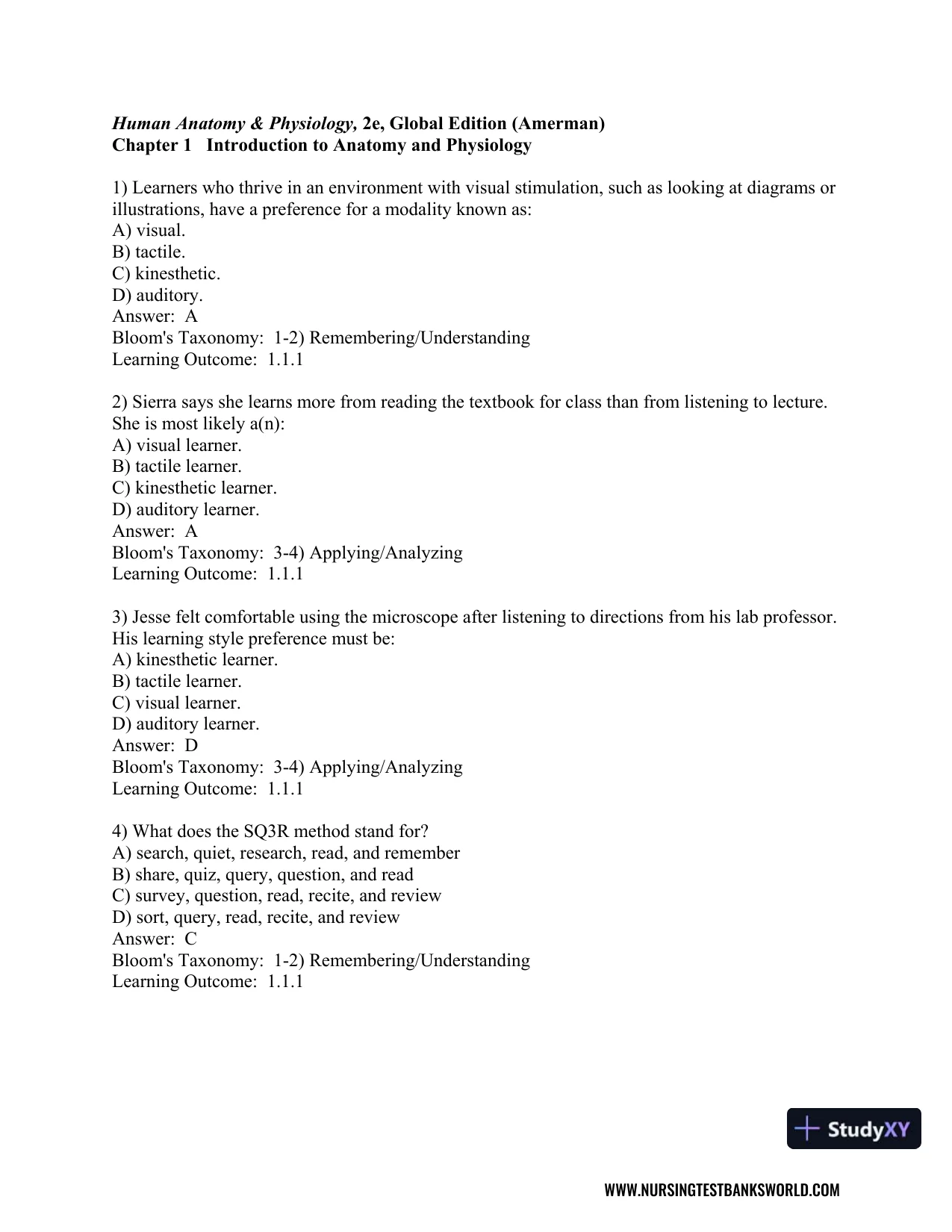
Human Anatomy & Physiology,2e, Global Edition (Amerman)Chapter 1Introduction to Anatomy and Physiology1) Learners who thrive in an environment with visual stimulation, such as looking at diagrams orillustrations, have a preference for a modality known as:A) visual.B) tactile.C) kinesthetic.D) auditory.Answer: ABloom's Taxonomy: 1-2) Remembering/UnderstandingLearning Outcome: 1.1.12) Sierra says she learns more from reading the textbook for class than from listening to lecture.She is most likely a(n):A) visual learner.B) tactile learner.C) kinesthetic learner.D) auditory learner.Answer: ABloom's Taxonomy: 3-4) Applying/AnalyzingLearning Outcome: 1.1.13) Jesse felt comfortable using the microscope after listening to directions from his lab professor.His learning style preference must be:A) kinesthetic learner.B) tactile learner.C) visual learner.D) auditory learner.Answer: DBloom's Taxonomy: 3-4) Applying/AnalyzingLearning Outcome: 1.1.14) What does the SQ3R method stand for?A) search, quiet, research, read, and rememberB) share, quiz, query, question, and readC) survey, question, read, recite, and reviewD) sort, query, read, recite, and reviewAnswer: CBloom's Taxonomy: 1-2) Remembering/UnderstandingLearning Outcome: 1.1.1

Page 2

Test Bank For Human Anatomy and Physiology, 2nd Edition - Page 2 preview image

Loading page ...

Page 3

Test Bank For Human Anatomy and Physiology, 2nd Edition - Page 3 preview image

Loading page ...

5) Why should a student use the SQ3R method?A) The SQ3R method provides a student with a strategy for improving test taking skills.B) The SQ3R method provides a plan for a student to improve textbook reading skills.C) The SQ3R method provides a student with a strategy for taking notes during lecture class.D) The SQ3R method provides a student with ways to improve time management skills.Answer: BBloom's Taxonomy: 1-2) Remembering/UnderstandingLearning Outcome: 1.1.16) What is a good way to manage time in preparation for your anatomy and physiology class?A) I should delay studying until the day or two before the test to best remember the material.B) I should stay up all night the night before the test to maximize what is stored in short-termmemory.C) I study only on the weekends when I have many hours of free time.D) I make a schedule and budget my time.Answer: DBloom's Taxonomy: 1-2) Remembering/UnderstandingLearning Outcome: 1.1.17) What learning modality is engaged when students participate in study groups?A) kinesthetic learnerB) visual learnerC) tactile learnerD) auditory learnerAnswer: ABloom's Taxonomy: 1-2) Remembering/UnderstandingLearning Outcome: 1.1.18) What is a good strategy for class or laboratory preparation?A) Read and prepare notes before attending your class or laboratory.B) Avoid reading before class as you may get confused.C) Only read after you have attended class or laboratory.D) Focus on reading your materials on the weekends when you have hours to spend.Answer: ABloom's Taxonomy: 1-2) Remembering/UnderstandingLearning Outcome: 1.1.29) How could you use the Learning Outcomes in this book to help you study?A) Rewrite each Learning Outcome in your notes.B) Recite the Learning Outcomes until you have them memorized.C) Read through the Learning Outcomes after you have completed a section.D) Write down the answers to the Learning Outcomes.Answer: DBloom's Taxonomy: 3-4) Applying/AnalyzingLearning Outcome: 1.1.3

Page 4

Test Bank For Human Anatomy and Physiology, 2nd Edition - Page 4 preview image

Loading page ...

10) What results when anabolism occurs more than catabolism in an organism?A) growthB) movementC) excretionD) irritabilityAnswer: ABloom's Taxonomy: 1-2) Remembering/UnderstandingLearning Outcome: 1.2.111) What is the smallest level of structural organization in the human body?A) organ levelB) chemical levelC) tissue levelD) cellular levelAnswer: BBloom's Taxonomy: 3-4) Applying/AnalyzingLearning Outcome: 1.2.212) Which of the following is the most complex structural level of organization?A) cellular levelB) tissue levelC) organ levelD) chemical levelAnswer: CBloom's Taxonomy: 3-4) Applying/AnalyzingLearning Outcome: 1.2.213) Which of the following is the correct sequence, from simplest to most complex, in the levelsof structural organization of the human body?A) chemical level, cellular level, tissue level, organ level, organ system level, organismal levelB) chemical level, tissue level, cellular level, organ system level, organ level, organismal levelC) cellular level, chemical level, tissue level, organ level, organ system level, organismal levelD) cellular level, tissue level, chemical level, organ level, organ system level, organismal levelAnswer: ABloom's Taxonomy: 3-4) Applying/AnalyzingLearning Outcome: 1.2.214) In laboratory, you will study the overall structure and shape of the femur bone without theaid of a microscope. This is a study known as:A) regional anatomy.B) microscopic anatomy.C) systemic anatomy.D) gross anatomy.Answer: DBloom's Taxonomy: 1-2) Remembering/UnderstandingLearning Outcome: 1.2.3

Page 5

Test Bank For Human Anatomy and Physiology, 2nd Edition - Page 5 preview image

Loading page ...

15) In laboratory, you will study tissues. This area of study is known as:A) gross anatomy.B) physiology.C) histology.D) cytology.Answer: CBloom's Taxonomy: 1-2) Remembering/UnderstandingLearning Outcome: 1.2.316) Which organ system supports the body and protects internal organs?A) muscular systemB) endocrine systemC) skeletal systemD) digestive systemAnswer: CBloom's Taxonomy: 1-2) Remembering/UnderstandingLearning Outcome: 1.2.517) Which organ system includes blood vessels and the heart?A) cardiovascular systemB) endocrine systemC) respiratory systemD) lymphatic systemAnswer: ABloom's Taxonomy: 1-2) Remembering/UnderstandingLearning Outcome: 1.2.418) Which two organ systems include the pancreas as a component?A) digestive and urinary systemsB) endocrine and lymphatic systemsC) digestive and endocrine systemsD) respiratory and cardiovascular systemsAnswer: CBloom's Taxonomy: 1-2) Remembering/UnderstandingLearning Outcome: 1.2.419) What is a major function of the respiratory system?A) return excess tissue fluid to the cardiovascular systemB) deliver oxygen to the blood and remove carbon dioxide from the bodyC) produce vitamin D and retain waterD) digest food and absorb nutrients into the bloodAnswer: BBloom's Taxonomy: 1-2) Remembering/UnderstandingLearning Outcome: 1.2.5

Page 6

Test Bank For Human Anatomy and Physiology, 2nd Edition - Page 6 preview image

Loading page ...

20) When we imagine a person exhibiting the anatomical position, the palms of the hands areassumed to be facing:A) forward.B) backward.C) to the side.D) down.Answer: ABloom's Taxonomy: 1-2) Remembering/UnderstandingLearning Outcome: 1.3.121) A person who is standing facing forward with hands at the sides, palms facing forward, is inthe:A) supine position.B) anatomical position.C) frontal position.D) sagittal position.Answer: BBloom's Taxonomy: 1-2) Remembering/UnderstandingLearning Outcome: 1.3.122) A person in the anatomical position is visualized to be:A) laying down on his or her back.B) standing upright.C) sitting down.D) laying down on the stomach.Answer: BBloom's Taxonomy: 1-2) Remembering/UnderstandingLearning Outcome: 1.3.123) Which directional term indicates the front side of the body?A) medialB) anterior (ventral)C) posterior (dorsal)D) superior (cranial)Answer: BBloom's Taxonomy: 1-2) Remembering/UnderstandingLearning Outcome: 1.3.224) A directional term that means the same as posterior is:A) dorsal.B) anterior.C) ventral.D) sagittal.Answer: ABloom's Taxonomy: 1-2) Remembering/UnderstandingLearning Outcome: 1.3.2

Page 7

Test Bank For Human Anatomy and Physiology, 2nd Edition - Page 7 preview image

Loading page ...

25) Body parts that are described as medial are considered to be:A) toward the head.B) toward the front.C) closer to the point of origin.D) closer to the midline of the body.Answer: DBloom's Taxonomy: 1-2) Remembering/UnderstandingLearning Outcome: 1.3.226) Select the appropriate directional term to complete this sentence: The mouth is ________ tothe nose.A) posterior (dorsal)B) inferior (caudal)C) superior (cranial)D) distalAnswer: BBloom's Taxonomy: 1-2) Remembering/UnderstandingLearning Outcome: 1.3.327) Select the appropriate directional term to complete this sentence: The skeletal muscles are________ to the skin.A) inferior (caudal)B) deepC) posteriorD) superficialAnswer: DBloom's Taxonomy: 1-2) Remembering/UnderstandingLearning Outcome: 1.3.328) In the anatomical position, the palms are on the:A) anterior (ventral) surface.B) posterior (dorsal) surface.C) lateral surface.D) superior (cranial) surface.Answer: ABloom's Taxonomy: 1-2) Remembering/UnderstandingLearning Outcome: 1.3.329) The point of the shoulder is also known as the:A) acromial region.B) digital region.C) antebrachial region.D) brachial region.Answer: ABloom's Taxonomy: 1-2) Remembering/UnderstandingLearning Outcome: 1.3.4

Page 8

Test Bank For Human Anatomy and Physiology, 2nd Edition - Page 8 preview image

Loading page ...

30) James sustained a cut to his mental region, also known as his:A) nose.B) chin.C) cheek.D) mouth.Answer: BBloom's Taxonomy: 1-2) Remembering/UnderstandingLearning Outcome: 1.3.331) The vertebral region is superior to the:A) sacral region.B) cervical region.C) occipital region.D) cephalic region.Answer: ABloom's Taxonomy: 3-4) Applying/AnalyzingLearning Outcome: 1.3.3, 1.3.432) The hand is also known as the:A) plantar region.B) pedal region.C) manual region.D) acromial region.Answer: CBloom's Taxonomy: 1-2) Remembering/UnderstandingLearning Outcome: 1.3.433) A plane that divides the body into superior and inferior parts is known as a:A) sagittal plane.B) midsagittal (median) plane.C) transverse (horizontal, or cross) plane.D) frontal (coronal) plane.Answer: CBloom's Taxonomy: 1-2) Remembering/UnderstandingLearning Outcome: 1.3.534) Dr. Mitchell performs open heart surgery. The incision he makes through the sternal regionof his patient divides the thoracic cavity into equal left and right parts. This incision must bemade along a:A) sagittal plane.B) midsagittal (median) plane.C) transverse (horizontal) plane.D) frontal (coronal) plane.Answer: BBloom's Taxonomy: 3-4) Applying/AnalyzingLearning Outcome: 1.3.5

Page 9

Test Bank For Human Anatomy and Physiology, 2nd Edition - Page 9 preview image

Loading page ...

35) What are the two subcavities of the dorsal body cavity?A) cranial and vertebral (spinal) cavitiesB) thoracic and abdominopelvic cavitiesC) abdominal and pelvic cavitiesD) pleural and pericardial cavitiesAnswer: ABloom's Taxonomy: 1-2) Remembering/UnderstandingLearning Outcome: 1.4.136) What major organs are housed in the thoracic cavity?A) lungs, heart, esophagus, tracheaB) stomach, intestines, liver, pancreasC) urinary bladder, reproductive organsD) brain and spinal cordAnswer: ABloom's Taxonomy: 1-2) Remembering/UnderstandingLearning Outcome: 1.4.137) What separates the thoracic cavity from the abdominopelvic cavity?A) pericardiumB) pleuraC) diaphragmD) mediastinumAnswer: CBloom's Taxonomy: 1-2) Remembering/UnderstandingLearning Outcome: 1.4.138) The thoracic cavity is situated superior to the abdominopelvic cavity and separated by thediaphragm. Therefore, the diaphragm creates a:A) transverse (horizontal) plane, or cross section.B) midsagittal (median) plane.C) parasagittal plane.D) frontal (coronal) plane.Answer: ABloom's Taxonomy: 3-4) Applying/AnalyzingLearning Outcome: 1.3.5, 1.4.139) What smaller cavity within the thoracic cavity houses the heart, great blood vessels,esophagus, and trachea?A) mediastinumB) diaphragmC) peritoneal cavityD) abdominal cavityAnswer: ABloom's Taxonomy: 1-2) Remembering/UnderstandingLearning Outcome: 1.4.1

Page 10

Test Bank For Human Anatomy and Physiology, 2nd Edition - Page 10 preview image

Loading page ...

40) Which regions of the abdominopelvic cavity are situated medially?A) right and left hypochondriac regions, and the epigastric regionB) right hypochondriac, right lumbar, and right iliac (inguinal) regionsC) right and left lumbar regions and the umbilical regionD) epigastric, umbilical, hypogastric regionsAnswer: DBloom's Taxonomy: 3-4) Applying/AnalyzingLearning Outcome: 1.4.241) Select the letter that represents the left iliac (inguinal) region.A) AB) BC) CD) DAnswer: CBloom's Taxonomy: 1-2) Remembering/UnderstandingLearning Outcome: 1.4.2

Page 11

Test Bank For Human Anatomy and Physiology, 2nd Edition - Page 11 preview image

Loading page ...

42) Which region of the abdominopelvic cavity lies between the right and left lumbar regions?A) hypogastric regionB) right lumbar regionC) epigastric regionD) umbilical regionAnswer: DBloom's Taxonomy: 1-2) Remembering/UnderstandingLearning Outcome: 1.4.243) Serous membranes line certain cavities within the:A) ventral cavities.B) cranial cavity.C) dorsal cavities.D) vertebral (spinal) cavity.Answer: ABloom's Taxonomy: 1-2) Remembering/UnderstandingLearning Outcome: 1.4.344) What is deep to the visceral pericardium?A) visceral peritoneumB) heart muscleC) pericardial cavityD) parietal pericardiumAnswer: BBloom's Taxonomy: 1-2) Remembering/UnderstandingLearning Outcome: 1.4.345) What would a needle travel through as it enters the right lung?A) parietal pleura, serous fluid, visceral pleura, right lungB) parietal pleura, serous fluid, right lung, visceral pleuraC) visceral pleura, serous fluid, parietal pleura, right lungD) visceral pericardium, serous fluid, parietal pericardium, right lungAnswer: ABloom's Taxonomy: 5-6) Evaluating/CreatingLearning Outcome: 1.4.346) What organ(s) is/are covered by the pleura?A) heartB) digestive organsC) brain and spinal cordD) lungsAnswer: DBloom's Taxonomy: 1-2) Remembering/UnderstandingLearning Outcome: 1.4.3

Page 12

Test Bank For Human Anatomy and Physiology, 2nd Edition - Page 12 preview image

Loading page ...

47) The maintenance of a relatively constant internal environment is termed:A) homeostasis.B) integration.C) effector control.D) positive feedback.Answer: ABloom's Taxonomy: 1-2) Remembering/UnderstandingLearning Outcome: 1.5.148) What part of a feedback loop causes physiological responses to return the variable to thenormal homeostatic range?A) receptor (sensor)B) stimulusC) effectorD) control centerAnswer: CBloom's Taxonomy: 1-2) Remembering/UnderstandingLearning Outcome: 1.5.249) A cell or organ that responds to the directions of the control center in a negative feedbackloop is termed a(n):A) stimulus.B) effector.C) receptor.D) regulator.Answer: BBloom's Taxonomy: 1-2) Remembering/UnderstandingLearning Outcome: 1.5.250) When you go outside on a hot summer day, your body temperature heats up above thenormal range. Receptors in your brain detect the change in body temperature. The brain activatesnerve cells that send messages to sweat glands, causing the body temperature to fall as the sweatevaporates from the skin. What part of this feedback loop is the stimulus?A) increased body temperatureB) brainC) nerve cellsD) sweat glandsAnswer: ABloom's Taxonomy: 5-6) Evaluating/CreatingLearning Outcome: 1.5.2

Page 13

Test Bank For Human Anatomy and Physiology, 2nd Edition - Page 13 preview image

Loading page ...

51) When you go outside on a hot summer day, your body temperature heats up above thenormal range. Receptors in your brain detect the change in body temperature. The brain activatesnerve cells that send messages to sweat glands, causing the body temperature to fall as the sweatevaporates from the skin. What part of this feedback loop is the effector?A) increased body temperatureB) brainC) nerve cellsD) sweat glandsAnswer: DBloom's Taxonomy: 5-6) Evaluating/CreatingLearning Outcome: 1.5.252) How does the effector restore homeostasis in a negative feedback loop?A) The effector opposes the initial stimulus and shuts off when conditions return to the normalrange.B) The effector amplifies the response, but does not continue indefinitely.C) The effector increases and reinforces the initial stimulus.D) The effector causes a rapid change in a variable.Answer: ABloom's Taxonomy: 3-4) Applying/AnalyzingLearning Outcome: 1.5.353) A mother breastfeeds her infant. As long as the baby suckles his mother's breast, the mother'smammary glands produce milk. Suckling, the stimulus, increases milk production, the response.This scenario is best described as:A) anatomical position.B) principle of complementarity of structure and function.C) a negative feedback loop.D) a positive feedback loop.Answer: DBloom's Taxonomy: 5-6) Evaluating/CreatingLearning Outcome: 1.5.354) The type of feedback that increases or enhances the effects of the variable is:A) neutral.B) negative.C) positive.D) responsive.Answer: CBloom's Taxonomy: 1-2) Remembering/UnderstandingLearning Outcome: 1.5.3

Page 14

Test Bank For Human Anatomy and Physiology, 2nd Edition - Page 14 preview image

Loading page ...

55) Which of the following best summarizes the principle of complementarity of structure andfunction?A) maintenance of a stable internal environmentB) structure drives functionC) function follows structureD) form follows functionAnswer: DBloom's Taxonomy: 3-4) Applying/AnalyzingLearning Outcome: 1.5.456) Which of the following illustrates a gradient?A) equilibrium or balance between two unconnected areasB) more of something exists in one area than another and the two areas are connectedC) maintenance of a relatively stable internal environmentD) equal amounts of something exist in areas that are connectedAnswer: BBloom's Taxonomy: 1-2) Remembering/UnderstandingLearning Outcome: 1.5.557) Blood pressure in arteries is higher than the blood pressure in capillaries. Blood flows fromarteries to capillaries due to the presence of a:A) negative feedback loop.B) pressure gradient.C) homeostatic imbalance.D) positive feedback loop.Answer: BBloom's Taxonomy: 3-4) Applying/AnalyzingLearning Outcome: 1.5.558) What are the two major methods by which cells communicate to coordinate their functions?A) effectors and responsesB) temperature gradients and pressure gradientsC) chemical messengers and/or electrical signalsD) positive feedback loops and negative feedback loopsAnswer: CBloom's Taxonomy: 1-2) Remembering/UnderstandingLearning Outcome: 1.5.659) A nerve cell releases chemical messengers to trigger changes in a nearby muscle cell. This isexample of a core principle known as:A) feedback loops.B) cell-cell communication.C) principle of complementarity of structure and function.D) gradients.Answer: BBloom's Taxonomy: 3-4) Applying/AnalyzingLearning Outcome: 1.5.6

Page 15

Test Bank For Human Anatomy and Physiology, 2nd Edition - Page 15 preview image

Loading page ...

60) What is NOT one of the four core principles related to homeostasis?A) metabolismB) cell-cell communicationC) feedback loopsD) gradientsAnswer: ABloom's Taxonomy: 1-2) Remembering/UnderstandingLearning Outcome: 1.5.1, 1.5.4, 1.5.5, 1.5.661) When studying, you should actively read the textbook by taking notes and making diagrams.Answer: TRUEBloom's Taxonomy: 1-2) Remembering/UnderstandingLearning Outcome: 1.1.162) You should wait to read the textbook until you have heard the material presented in lectureor laboratory.Answer: FALSEBloom's Taxonomy: 1-2) Remembering/UnderstandingLearning Outcome: 1.1.263) The smallest level of organization in the human body is the cellular level.Answer: FALSEBloom's Taxonomy: 3-4) Applying/AnalyzingLearning Outcome: 1.2.264) The endocrine system is responsible for generating heat.Answer: TRUEBloom's Taxonomy: 1-2) Remembering/UnderstandingLearning Outcome: 1.2.565) Patients are always examined while they are standing in the anatomical position.Answer: FALSEBloom's Taxonomy: 3-4) Applying/AnalyzingLearning Outcome: 1.3.166) The crural region is posterior (dorsal) to the sural region.Answer: FALSEBloom's Taxonomy: 1-2) Remembering/UnderstandingLearning Outcome: 1.3.3, 1.3.467) The transverse (horizontal plane or cross section) plane divides the body into anterior andposterior parts.Answer: FALSEBloom's Taxonomy: 1-2) Remembering/UnderstandingLearning Outcome: 1.3.5

Page 16

Test Bank For Human Anatomy and Physiology, 2nd Edition - Page 16 preview image

Loading page ...

68) Serous fluid lubricates around organs and reduces friction as the organ moves againstadjacent structures.Answer: TRUEBloom's Taxonomy: 1-2) Remembering/UnderstandingLearning Outcome: 1.4.369) Negative feedback loops produce responses in the opposite direction of the initial stimuluswhile positive feedback loops produce responses in the same direction of the initial stimulus.Answer: TRUEBloom's Taxonomy: 3-4) Applying/AnalyzingLearning Outcome: 1.5.370) According to the principle of complementarity of structure and function, structure andfunction are related only at the cellular level.Answer: FALSEBloom's Taxonomy: 1-2) Remembering/UnderstandingLearning Outcome: 1.5.4
Preview Mode

This document has 680 pages. Sign in to access the full document!