
Test Bank For Wheeler's Dental Anatomy, Physiology and Occlusion: Expert Consult, 10th Edition

Test Bank For Wheeler's Dental Anatomy, Physiology and Occlusion: Expert Consult, 10th Edition prepares you for success with a mix of theoretical knowledge, problem-solving techniques, and exam strategies.

Daniel Mitchell
Contributor
4.8
47
10 months ago
Preview (16 of 270 Pages)
100%
Log in to unlock

Page 1

Test Bank For Wheeler's Dental Anatomy, Physiology and Occlusion: Expert Consult, 10th Edition - Page 1 preview image

Loading page ...

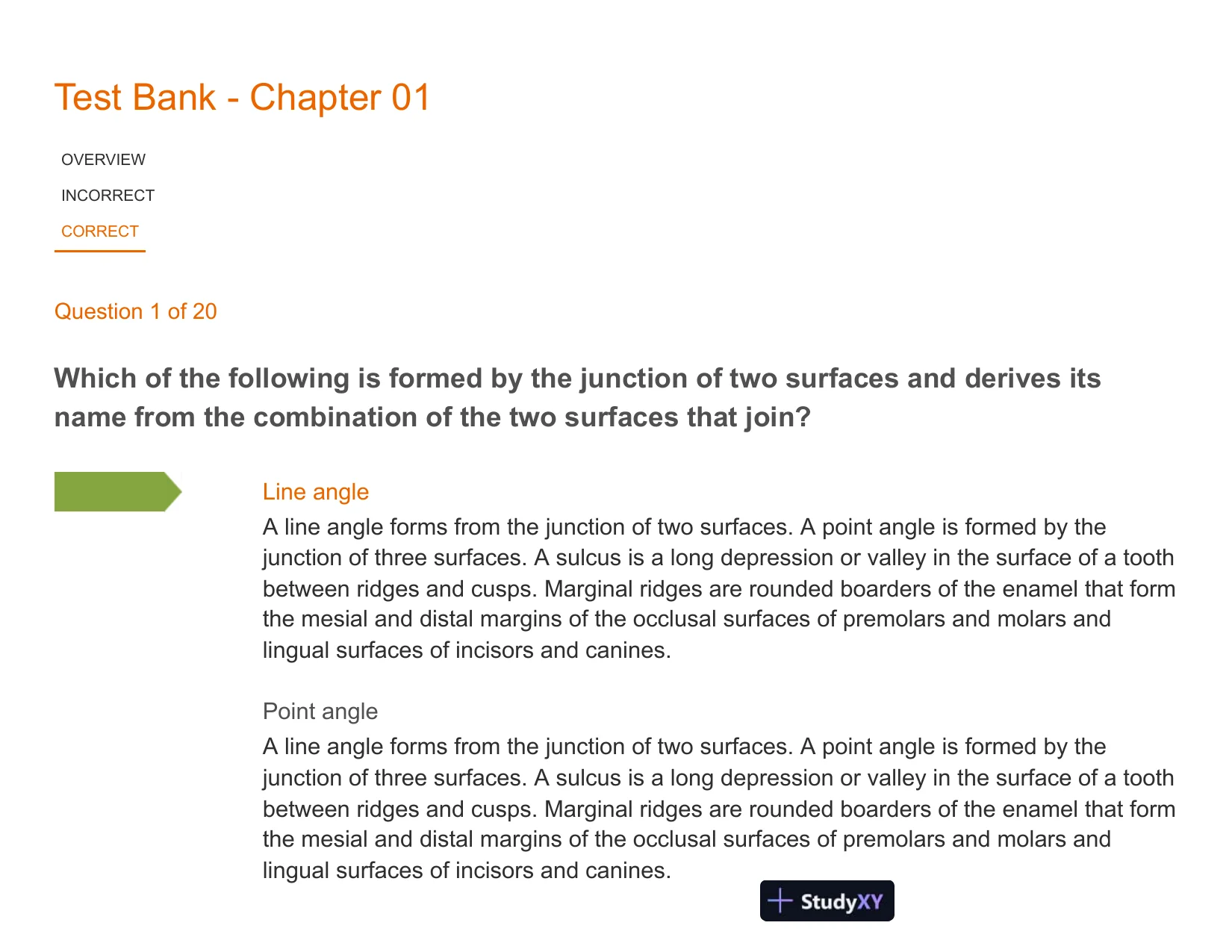
Test Bank - Chapter 01Question1 of 20Which of the following is formed by the junction of two surfaces and derives itsname from the combination of the two surfaces that join?OVERVIEWINCORRECTCORRECTA line angle forms from the junction of two surfaces. A point angle is formed by thejunction of three surfaces. A sulcus is a long depression or valley in the surface of a toothbetween ridges and cusps. Marginal ridges are rounded boarders of the enamel that formthe mesial and distal margins of the occlusal surfaces of premolars and molars andlingual surfaces of incisors and canines.A line angle forms from the junction of two surfaces. A point angle is formed by thejunction of three surfaces. A sulcus is a long depression or valley in the surface of a toothbetween ridges and cusps. Marginal ridges are rounded boarders of the enamel that formthe mesial and distal margins of the occlusal surfaces of premolars and molars andlingual surfaces of incisors and canines.Line anglePoint angle

Page 2

Test Bank For Wheeler's Dental Anatomy, Physiology and Occlusion: Expert Consult, 10th Edition - Page 2 preview image

Loading page ...

Page 3

Test Bank For Wheeler's Dental Anatomy, Physiology and Occlusion: Expert Consult, 10th Edition - Page 3 preview image

Loading page ...

Question2 of 20A __ is a pinpoint depression located at the junction of developmental grooves.A line angle forms from the junction of two surfaces. A point angle is formed by thejunction of three surfaces. A sulcus is a long depression or valley in the surface of a toothbetween ridges and cusps. Marginal ridges are rounded boarders of the enamel that formthe mesial and distal margins of the occlusal surfaces of premolars and molars andlingual surfaces of incisors and canines.A line angle forms from the junction of two surfaces. A point angle is formed by thejunction of three surfaces. A sulcus is a long depression or valley in the surface of a toothbetween ridges and cusps. Marginal ridges are rounded boarders of the enamel that formthe mesial and distal margins of the occlusal surfaces of premolars and molars andlingual surfaces of incisors and canines.Pits are small, pinpoint depressions located at the junction of developmental grooves orat terminals of those grooves. A fossa is an irregular depression or cavity. A sulcus is along depression or valley in the surface of a tooth between ridges and cusps. A cusp isan elevation or mound on the crown portion of a tooth.SulcusMarginal ridgePitFossa

Page 4

Test Bank For Wheeler's Dental Anatomy, Physiology and Occlusion: Expert Consult, 10th Edition - Page 4 preview image

Loading page ...

Question3 of 20The dental formula for the permanent human dentition is which of the following?Pits are small, pinpoint depressions located at the junction of developmental grooves orat terminals of those grooves. A fossa is an irregular depression or cavity. A sulcus is along depression or valley in the surface of a tooth between ridges and cusps. A cusp isan elevation or mound on the crown portion of a tooth.Pits are small, pinpoint depressions located at the junction of developmental grooves orat terminals of those grooves. A fossa is an irregular depression or cavity. A sulcus is along depression or valley in the surface of a tooth between ridges and cusps. A cusp isan elevation or mound on the crown portion of a tooth.Pits are small, pinpoint depressions located at the junction of developmental grooves orat terminals of those grooves. A fossa is an irregular depression or cavity. A sulcus is along depression or valley in the surface of a tooth between ridges and cusps. A cusp isan elevation or mound on the crown portion of a tooth.The formula for the permanent teeth in humans is: Incisors, two maxillary and twomandibular; canines, one maxillary and one mandibular; premolars, two maxillary andtwo mandibular; molars, three maxillary and three mandibular. This makes 16 total teethon each side, left or right.SulcusCuspI 2/2 C 1/1 M 2/2 = 10

Page 5

Test Bank For Wheeler's Dental Anatomy, Physiology and Occlusion: Expert Consult, 10th Edition - Page 5 preview image

Loading page ...

Question4 of 20Which of the following tissues found in teeth is responsible for furnishing blood andnerve supply to the tooth?The formula for the permanent teeth in humans is: Incisors, two maxillary and twomandibular; canines, one maxillary and one mandibular; premolars, two maxillary andtwo mandibular; molars, three maxillary and three mandibular. This makes 16 total teethon each side, left or right.The formula for the permanent teeth in humans is: Incisors, two maxillary and twomandibular; canines, one maxillary and one mandibular; premolars, two maxillary andtwo mandibular; molars, three maxillary and three mandibular. This makes 16 total teethon each side, left or right.The formula for the permanent teeth in humans is: Incisors, two maxillary and twomandibular; canines, one maxillary and one mandibular; premolars, two maxillary andtwo mandibular; molars, three maxillary and three mandibular. This makes 16 total teethon each side, left or right.I 2/2 C 1/1 P 1/1 M 2/2 = 12I 2/2 C 1/1 P 2/2 M 2/2 = 14I 2/2 C 1/1 P 2/2 M 3/3 = 16Enamel

Page 6

Test Bank For Wheeler's Dental Anatomy, Physiology and Occlusion: Expert Consult, 10th Edition - Page 6 preview image

Loading page ...

Question5 of 20Which of the following is a point angle of the posterior teeth?Answers A, B, and C are known as “hard” tissues. Pulp is the only “soft” tissue thatcomprises tooth structure. It is responsible for blood and nerve supply to the tooth.Answers A, B, and C are known as “hard” tissues. Pulp is the only “soft” tissue thatcomprises tooth structure. It is responsible for blood and nerve supply to the tooth.Answers A, B, and C are known as “hard” tissues. Pulp is the only “soft” tissue thatcomprises tooth structure. It is responsible for blood and nerve supply to the tooth.Answers A, B, and C are known as “hard” tissues. Pulp is the only “soft” tissue thatcomprises tooth structure. It is responsible for blood and nerve supply to the tooth.The distobucco-occlusal is a point angle of posterior teeth. Mesiolabioincisal anddistolinguoincisal are point angles of anterior teeth. Disto-occlusal is a line angle ofposterior teeth.CementumDentinPulpMesiolabioincisalDistolinguoincisal

Page 7

Test Bank For Wheeler's Dental Anatomy, Physiology and Occlusion: Expert Consult, 10th Edition - Page 7 preview image

Loading page ...

Question6 of 20The notation for the primary mandibular left canine is which of the followingaccording to the FDI system?The distobucco-occlusal is a point angle of posterior teeth. Mesiolabioincisal anddistolinguoincisal are point angles of anterior teeth. Disto-occlusal is a line angle ofposterior teeth.The distobucco-occlusal is a point angle of posterior teeth. Mesiolabioincisal anddistolinguoincisal are point angles of anterior teeth. Disto-occlusal is a line angle ofposterior teeth.The distobucco-occlusal is a point angle of posterior teeth. Mesiolabioincisal anddistolinguoincisal are point angles of anterior teeth. Disto-occlusal is a line angle ofposterior teeth.The FDI system utilized a two-number system of nomenclature. The following applies inthe primary dentition: for the first of the two digits, numeral 5 indicated the maxillary right,6 the maxillary left, 7 the mandibular left, and 8 the mandibular right. The second digitrepresented the tooth number for each side starting from the central incisors andcontinuing back.Distobucco-occlusalDisto-occlusal53

Page 8

Test Bank For Wheeler's Dental Anatomy, Physiology and Occlusion: Expert Consult, 10th Edition - Page 8 preview image

Loading page ...

Question7 of 20__ cross from the triangular ridge of the distobuccal cusp and the distal cusp ridgeof the mesiolingual cusp of maxillary first molars.The FDI system utilized a two-number system of nomenclature. The following applies inthe primary dentition: for the first of the two digits, numeral 5 indicated the maxillary right,6 the maxillary left, 7 the mandibular left, and 8 the mandibular right. The second digitrepresented the tooth number for each side starting from the central incisors andcontinuing back.The FDI system utilized a two-number system of nomenclature. The following applies inthe primary dentition: for the first of the two digits, numeral 5 indicated the maxillary right,6 the maxillary left, 7 the mandibular left, and 8 the mandibular right. The second digitrepresented the tooth number for each side starting from the central incisors andcontinuing back.The FDI system utilized a two-number system of nomenclature. The following applies inthe primary dentition: for the first of the two digits, numeral 5 indicated the maxillary right,6 the maxillary left, 7 the mandibular left, and 8 the mandibular right. The second digitrepresented the tooth number for each side starting from the central incisors andcontinuing back.637383

Page 9

Test Bank For Wheeler's Dental Anatomy, Physiology and Occlusion: Expert Consult, 10th Edition - Page 9 preview image

Loading page ...

Oblique ridges cross obliquely from the triangular ridge of the distobuccal cusp and thedistal cusp ridge of the mesiolingual cusp of maxillary first molars. Triangular ridgesdescend from the tips of the cusps of molars and premolars toward the central part of theocclusal surfaces. Marginal ridges are rounded boarders of the enamel that form themesial and distal margins of the occlusal surfaces of premolars and molars and lingualsurfaces of incisors and canines. Developmental grooves are shallow grooves or linesbetween the primary parts of the crown or root.Oblique ridges cross obliquely from the triangular ridge of the distobuccal cusp and thedistal cusp ridge of the mesiolingual cusp of maxillary first molars. Triangular ridgesdescend from the tips of the cusps of molars and premolars toward the central part of theocclusal surfaces. Marginal ridges are rounded boarders of the enamel that form themesial and distal margins of the occlusal surfaces of premolars and molars and lingualsurfaces of incisors and canines. Developmental grooves are shallow grooves or linesbetween the primary parts of the crown or root.Oblique ridges cross obliquely from the triangular ridge of the distobuccal cusp and thedistal cusp ridge of the mesiolingual cusp of maxillary first molars. Triangular ridgesdescend from the tips of the cusps of molars and premolars toward the central part of theocclusal surfaces. Marginal ridges are rounded boarders of the enamel that form themesial and distal margins of the occlusal surfaces of premolars and molars and lingualsurfaces of incisors and canines. Developmental grooves are shallow grooves or linesbetween the primary parts of the crown or root.Marginal ridgesTriangular ridgesOblique ridges

Page 10

Test Bank For Wheeler's Dental Anatomy, Physiology and Occlusion: Expert Consult, 10th Edition - Page 10 preview image

Loading page ...

Question8 of 20A __ is any one of the three rounded protuberances found on the incisal ridges ofnewly erupted incisor teeth.Oblique ridges cross obliquely from the triangular ridge of the distobuccal cusp and thedistal cusp ridge of the mesiolingual cusp of maxillary first molars. Triangular ridgesdescend from the tips of the cusps of molars and premolars toward the central part of theocclusal surfaces. Marginal ridges are rounded boarders of the enamel that form themesial and distal margins of the occlusal surfaces of premolars and molars and lingualsurfaces of incisors and canines. Developmental grooves are shallow grooves or linesbetween the primary parts of the crown or root.A mamelon is specifically any one of the three rounded protuberances on a newlyerupted incisor. A lobe is one of the primary sections of formation in the development ofthe crown. Cusps are elevations or mounds on the crown portion of canines or posteriorteeth. A supplemental groove is a shallow linear depression on the surface of a tooth.A mamelon is specifically any one of the three rounded protuberances on a newlyerupted incisor. A lobe is one of the primary sections of formation in the development ofthe crown. Cusps are elevations or mounds on the crown portion of canines or posteriorteeth. A supplemental groove is a shallow linear depression on the surface of a tooth.Developmental groovesLobeMamelon

Page 11

Test Bank For Wheeler's Dental Anatomy, Physiology and Occlusion: Expert Consult, 10th Edition - Page 11 preview image

Loading page ...

Question9 of 20The notation for the primary maxillary left lateral incisor is which of the followingaccording to the Universal system?A mamelon is specifically any one of the three rounded protuberances on a newlyerupted incisor. A lobe is one of the primary sections of formation in the development ofthe crown. Cusps are elevations or mounds on the crown portion of canines or posteriorteeth. A supplemental groove is a shallow linear depression on the surface of a tooth.A mamelon is specifically any one of the three rounded protuberances on a newlyerupted incisor. A lobe is one of the primary sections of formation in the development ofthe crown. Cusps are elevations or mounds on the crown portion of canines or posteriorteeth. A supplemental groove is a shallow linear depression on the surface of a tooth.According to the Universal system of notation, upper case letters are used for each of theprimary teeth. Maxillary teeth start with the right second molar and use letters A throughJ. The mandibular teeth start with the left mandibular second molar and use letters Kthrough T.According to the Universal system of notation, upper case letters are used for each of theprimary teeth. Maxillary teeth start with the right second molar and use letters A throughCuspSupplemental grooveDG

Page 12

Test Bank For Wheeler's Dental Anatomy, Physiology and Occlusion: Expert Consult, 10th Edition - Page 12 preview image

Loading page ...

Question10 of 20The notation for the permanent maxillary right first molar is which of the followingaccording to the FDI system?J. The mandibular teeth start with the left mandibular second molar and use letters Kthrough T.According to the Universal system of notation, upper case letters are used for each of theprimary teeth. Maxillary teeth start with the right second molar and use letters A throughJ. The mandibular teeth start with the left mandibular second molar and use letters Kthrough T.According to the Universal system of notation, upper case letters are used for each of theprimary teeth. Maxillary teeth start with the right second molar and use letters A throughJ. The mandibular teeth start with the left mandibular second molar and use letters Kthrough T.The FDI system utilized a two-number system of nomenclature. The following applies inthe permanent dentition: for the first of the two digits, numeral 1 indicated the maxillaryright, 2 the maxillary left, 3 the mandibular left, and 4 the mandibular right. The seconddigit represented the tooth number for each side starting from the central incisors andcontinuing back.EF16

Page 13

Test Bank For Wheeler's Dental Anatomy, Physiology and Occlusion: Expert Consult, 10th Edition - Page 13 preview image

Loading page ...

Question11 of 20Which of the following pairs of teeth have mesial surfaces that touch each other(Universal system)?The FDI system utilized a two-number system of nomenclature. The following applies inthe permanent dentition: for the first of the two digits, numeral 1 indicated the maxillaryright, 2 the maxillary left, 3 the mandibular left, and 4 the mandibular right. The seconddigit represented the tooth number for each side starting from the central incisors andcontinuing back.The FDI system utilized a two-number system of nomenclature. The following applies inthe permanent dentition: for the first of the two digits, numeral 1 indicated the maxillaryright, 2 the maxillary left, 3 the mandibular left, and 4 the mandibular right. The seconddigit represented the tooth number for each side starting from the central incisors andcontinuing back.The FDI system utilized a two-number system of nomenclature. The following applies inthe permanent dentition: for the first of the two digits, numeral 1 indicated the maxillaryright, 2 the maxillary left, 3 the mandibular left, and 4 the mandibular right. The seconddigit represented the tooth number for each side starting from the central incisors andcontinuing back.263545

Page 14

Test Bank For Wheeler's Dental Anatomy, Physiology and Occlusion: Expert Consult, 10th Edition - Page 14 preview image

Loading page ...

Question12 of 20A __ is the lingual lobe of an anterior tooth.Only four teeth have mesial surfaces that contact each other, the maxillary andmandibular central incisors. Teeth number 8 and 9 are maxillary central incisors.Only four teeth have mesial surfaces that contact each other, the maxillary andmandibular central incisors. Teeth number 8 and 9 are maxillary central incisors.Only four teeth have mesial surfaces that contact each other, the maxillary andmandibular central incisors. Teeth number 8 and 9 are maxillary central incisors.Only four teeth have mesial surfaces that contact each other, the maxillary andmandibular central incisors. Teeth number 8 and 9 are maxillary central incisors.A cingulum is the lingual lobe of an anterior tooth. A cusp is an elevation or mound on thecrown portion of a tooth making up a divisional part of the occlusal surface. A tubercle isa smaller elevation on some portion of the crown produced by an extra formation ofenamel. Marginal ridges are rounded boarders of the enamel that form the mesial and7 and 88 and 922 and 2325 and 26Cingulum

Page 15

Test Bank For Wheeler's Dental Anatomy, Physiology and Occlusion: Expert Consult, 10th Edition - Page 15 preview image

Loading page ...

distal margins of the occlusal surfaces of premolars and molars and lingual surfaces ofincisors and canines.A cingulum is the lingual lobe of an anterior tooth. A cusp is an elevation or mound on thecrown portion of a tooth making up a divisional part of the occlusal surface. A tubercle isa smaller elevation on some portion of the crown produced by an extra formation ofenamel. Marginal ridges are rounded boarders of the enamel that form the mesial anddistal margins of the occlusal surfaces of premolars and molars and lingual surfaces ofincisors and canines.A cingulum is the lingual lobe of an anterior tooth. A cusp is an elevation or mound on thecrown portion of a tooth making up a divisional part of the occlusal surface. A tubercle isa smaller elevation on some portion of the crown produced by an extra formation ofenamel. Marginal ridges are rounded boarders of the enamel that form the mesial anddistal margins of the occlusal surfaces of premolars and molars and lingual surfaces ofincisors and canines.A cingulum is the lingual lobe of an anterior tooth. A cusp is an elevation or mound on thecrown portion of a tooth making up a divisional part of the occlusal surface. A tubercle isa smaller elevation on some portion of the crown produced by an extra formation ofenamel. Marginal ridges are rounded boarders of the enamel that form the mesial anddistal margins of the occlusal surfaces of premolars and molars and lingual surfaces ofincisors and canines.CuspTubercleMarginal ridge

Page 16

Test Bank For Wheeler's Dental Anatomy, Physiology and Occlusion: Expert Consult, 10th Edition - Page 16 preview image

Loading page ...

Question13 of 20The dental formula for the primary/deciduous teeth in humans is which of thefollowing?Question14 of 20The formula for the primary/deciduous teeth in humans is: Incisors, two maxillary and twomandibular; canines, one maxillary and one mandibular; molars, two maxillary and twomandibular. This makes 10 total teeth on each side, left or right.The formula for the primary/deciduous teeth in humans is: Incisors, two maxillary and twomandibular; canines, one maxillary and one mandibular; molars, two maxillary and twomandibular. This makes 10 total teeth on each side, left or right.The formula for the primary/deciduous teeth in humans is: Incisors, two maxillary and twomandibular; canines, one maxillary and one mandibular; molars, two maxillary and twomandibular. This makes 10 total teeth on each side, left or right.The formula for the primary/deciduous teeth in humans is: Incisors, two maxillary and twomandibular; canines, one maxillary and one mandibular; molars, two maxillary and twomandibular. This makes 10 total teeth on each side, left or right.I 2/2 C 1/1 M 2/2 = 10I 2/2 C 1/1 P 1/1 M 2/2 = 12I 2/2 C 2/2 M 2/2 = 12I 2/2 C 1/1 P 1/1 M 1/1 = 10
Preview Mode

This document has 270 pages. Sign in to access the full document!