

Organic Chemistry I - Cyclohydrocarbons
- Chemistry
- Texas A&M University
- 11 pages
- Shared March 2026
Preview 4 of 11 pages
See the first 4 pages exactly as they appear in the document.
Page 1 Read page 1 as text
Study Guide Organic Chemistry I – Cyclohydrocarbons 1. Cyclohydrocarbons: Nomenclature How Are Substituted Cycloalkanes Named? Substituted cycloalkanes are named similarly to open - chain or aliphatic alkanes. The International Union of Pure and Applied Chemistry (IUPAC) nomenclature rules for substituted cycloalkanes follow these steps: Step 1: Number the Carbon Atoms in the Ring and Substituent 1. Determine the number of carbon atoms in both the ring and the largest substituent. o If the ring has more carbons than the substituent, it is named as an alkyl - substituted cycloalkane . o If the substituent has more carbons than the ring, it is named as a cycloalkyl alkane . Step 2: Number the Substituents for the Lowest Sum 2. If an alkyl - substituted cycloalkane has more than one substituent , number the ring so that the substituents have the lowest sum of numbers .
Page 2 Read page 2 as text
Study Guide Step 3: Use Alphabetical Priority for Different Substituents 3. If the molecule has two or more different substituent groups , the number one position is determined by alphabetical priority . Key Takeaway • Number the ring based on the largest substituent or if the substituent has more carbons than the ring. • Lowest sum numbering is used for multiple substituents. • When there are different substituents , alphabetical priority determines the number one position.
Page 3 Read page 3 as text
Study Guide 2. Cyclohydrocarbons: Stereochemistry What is Stereochemistry in Cycloalkanes? Cycloalkanes have restricted rotation around their carbon - carbon single bonds , meaning that they can have cis and trans stereoisomers when they contain two or more substituents. For example, 1,2 - dibromobutane can exist as cis and trans isomers. 2.1 Cycloalkanes with Fewer Carbon Atoms Cycloalkane rings with five or fewer carbon atoms tend to be planar or nearly planar . For such molecules, cis and trans isomerism refers to the location of substituents: • Cis : Substituents are on the same side of the ring plane. • Trans : Substituents are on opposite sides of the ring plane. 2.2 Cycloalkanes with More Carbon Atoms Cycloalkanes containing six or more carbons bend out of the plane, creating pucker in the structure. For example, cyclohexane exists in three forms . 2.3 Chair and Boat Forms of Cyclohexane The two end structures in cyclohexane are called chair forms , while the middle structure is called the boat form . The chair form of cyclohexane is more stable than the boat form.
Page 4 Read page 4 as text
Study Guide • The carbon atoms of cyclohexane form single bonds with each other. Since the bonds must be sp³ hybridized , the shape at each atom is tetrahedral , and the bond angle is about 110° . 2.4 Axial and Equatorial Positions The hydrogen atoms on cyclohexane occupy either axial or equatorial positions : • Axial bonds are roughly parallel to an imaginary axis through the center of the carbon ring. • Equatorial bonds are roughly 110° away from the axial bond on the same carbon. Cis and trans substitution positions are defined based on the location of these axial and equatorial bonds. 2.5 Cis and Trans Isomerism For cis - 1,2 - disubstitution , the substituents are on the same side of the ring plane. For trans - 1,2 - disubstitution , the substituents are on opposite sides of the ring plane.
7 more pages in the full document
Unlock it once and it stays in your library, ready to chat with or turn into flashcards.
Unlock the full documentMore Chemistry study materials
See all Quick Guides
Organic Chemistry I - Reactions of Alkanes
Chemistry
14 pagesMar 2026 Quick Guides
Organic Chemistry I - Alkynes
Chemistry
16 pagesMar 2026 Quick Guides
Organic Chemistry I - Stereochemistry
Chemistry
25 pagesMar 2026 Quick Guides
Organic Chemistry I - Conjugated Dienes
Chemistry
17 pagesMar 2026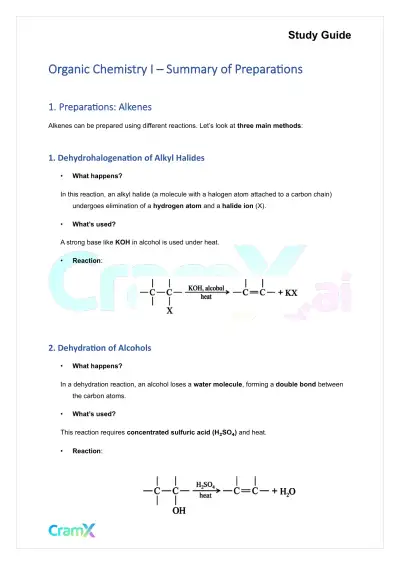 Quick Guides
Organic Chemistry I - Summary of Preparations
Chemistry
9 pagesMar 2026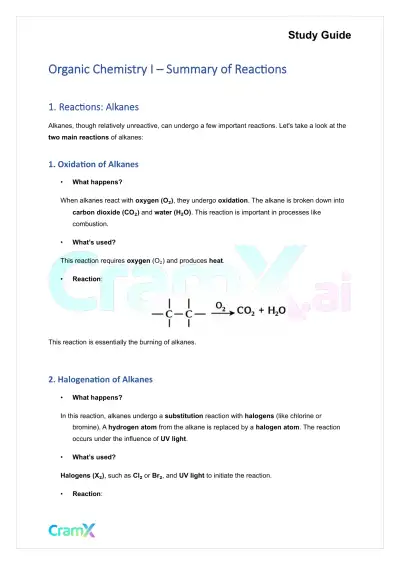 Quick Guides
Organic Chemistry I - Summary of Reactions
Chemistry
14 pagesMar 2026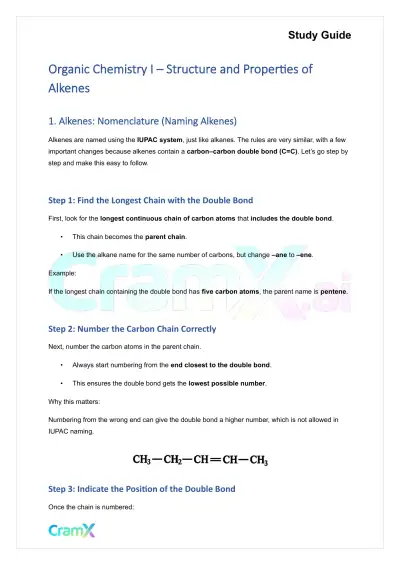 Quick Guides
Organic Chemistry I - Structure and Properties of Alkenes
Chemistry
17 pagesMar 2026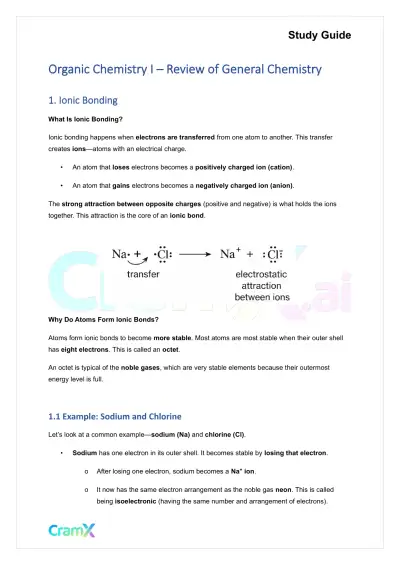 Quick Guides
Organic Chemistry I - Review of General Chemistry
Chemistry
17 pagesMar 2026
Study this document with CramX
Once it is in your library, every tool can work from it.