

Organic Chemistry I - Review of General Chemistry
- Chemistry
- Texas A&M University
- 17 pages
- Shared March 2026
Preview 6 of 17 pages
See the first 6 pages exactly as they appear in the document.
Page 1 Read page 1 as text
Study Guide Organic Chemistry I – Review of General Chemistry 1. Ionic Bonding What Is Ionic Bonding? Ionic bonding happens when electrons are transferred from one atom to another. This transfer creates ions — atoms with an electrical charge. • An atom that loses electrons becomes a positively charged ion (cation) . • An atom that gains electrons becomes a negatively charged ion (anion) . The strong attraction between opposite charges (positive and negative) is what holds the ions together. This attraction is the core of an ionic bond . Why Do Atoms Form Ionic Bonds? Atoms form ionic bonds to become more stable . Most atoms are most stable when their outer shell has eight electrons . This is called an octet . An octet is typical of the noble gases , which are very stable elements because their outermost energy level is full. 1.1 Example: Sodium and Chlorine Let’s look at a common example — sodium (Na) and chlorine (Cl) . • Sodium has one electron in its outer shell. It becomes stable by losing that electron . o After losing one electron, sodium becomes a Na ⁺ ion . o It now has the same electron arrangement as the noble gas neon . This is called being isoelectronic (having the same number and arrangement of electrons).
Page 2 Read page 2 as text
Study Guide • Chlorine has seven electrons in its outer shell. It becomes stable by gaining one electron . o After gaining an electron, chlorine becomes a Cl ⁻ ion . o It now has the same electron arrangement as the noble gas argon , so it is also isoelectronic . 1.2 How the Ionic Bond Forms Once sodium becomes positive and chlorine becomes negative, they attract each other . This electrostatic attraction between the ions forms an ionic bond , creating a stable compound. Where Ionic Bonds Usually Occur Ionic bonds usually form between: • Metals in Group IA and IIA (such as sodium or calcium), and • Nonmetals in Group VIA and VIIA (such as oxygen or chlorine) of the periodic table. These groups are more likely to lose or gain electrons, making ionic bonding common between them. Key Takeaways Ionic bonding is all about electron transfer , opposite charges , and stability . By losing or gaining electrons, atoms achieve a full outer shell and stick together through strong electrostatic attraction. 2. Covalent Bonding and Electronegativity What Is Covalent Bonding? Covalent bonding happens when atoms share electrons instead of transferring them. By sharing electrons, each atom can fill its outer shell and become more stable . This type of bonding is very common in molecules , especially in organic compounds.
Page 3 Read page 3 as text
Study Guide Example: Methane (CH ₄ ) A good example of covalent bonding is methane (CH ₄ ) , the simplest organic compound. • Carbon has four valence electrons and needs four more to complete its outer shell (an octet). • Hydrogen has one valence electron and becomes stable when it has two electrons (this is called a duet ). In methane, carbon shares one electron with each of four hydrogen atoms. • Carbon ends up with eight electrons in its outer shell. • Each hydrogen ends up with two electrons , making it isoelectronic with helium , which has a full shell. As a result, all the atoms involved become more stable. 2.1 Pure Covalent Bonds In a pure covalent bond , the shared electrons are equally shared between the atoms. This only happens when the two bonded atoms are the same element , because they attract electrons equally. • A classic example is the hydrogen molecule (H ₂ ) . • Each hydrogen atom pulls on the shared electrons equally, so the bond is completely nonpolar. 2.2 Unequal Sharing and Bond Polarity Most covalent bonds are not pure. In many cases, one atom attracts the shared electrons more strongly than the other.
Page 4 Read page 4 as text
Study Guide When this happens: • The electrons move closer to the more attractive atom. • That atom becomes slightly negative (partial negative charge) . • The other atom becomes slightly positive (partial positive charge) . This uneven distribution of electrons makes the bond polar , meaning the molecule has a positive end and a negative end . What Is Electronegativity? Electronegativity is the ability of an atom to attract electrons in a chemical bond. It depends on two related properties: • Electron affinity : the energy released when an atom gains an electron. • Ionization energy : the energy required to remove the most loosely held electron from an atom. Atoms with high electronegativity attract electrons strongly. 2 .3 The Pauling Electronegativity Scale Electronegativity is measured using the Pauling scale , developed by Linus Pauling . • Fluorine is the most electronegative element, with a value of 4.0 . • Highly electronegative elements include halogens , oxygen , nitrogen , and sulfur . • The alkali metals and alkaline earth metals have low electronegativity. o Cesium and francium are among the least electronegative, with values around 0.7 . Electronegativity and Type of Bond The difference in electronegativity between two atoms helps predict the type of bond they will form: • Large difference (2 or more) → Ionic bond • Smaller difference (less than 2) → Covalent bond • No difference (same atoms) → Pure covalent bond
Page 5 Read page 5 as text
Study Guide The smaller the electronegativity difference, the less polar the bond is. As the difference approaches zero, the bond becomes more purely covalent. Carbon and Bond Polarity Carbon , with an electronegativity of 2.5 , is very versatile. It can form: • Low - polarity covalent bonds , and • High - polarity covalent bonds , depending on the atom it is bonded to. This flexibility is one reason carbon is so important in organic chemistry. Common Electronegativity Values Key Takeaways Covalent bonding is about sharing electrons , while electronegativity explains how evenly those electrons are shared. Understanding electronegativity helps predict whether a bond will be pure covalent , polar covalent , or ionic — a key idea for mastering chemistry.
Page 6 Read page 6 as text
Study Guide 3. Brønsted – Lowry Theory of Acids and Bases 3.1 Early Ideas: Arrhenius Theory In the early 1900s, Svante Arrhenius explained acids and bases in a simple way: • An acid is a substance that releases hydrogen ions (H ⁺ ) in water. • A base is a substance that releases hydroxide ions (OH ⁻ ) in water. According to this theory, neutralization happens when a hydrogen ion reacts with a hydroxide ion to form water (H ₂ O) . This model works well — but only for reactions that happen in water . Why a New Theory Was Needed The main limitation of the Arrhenius theory is that it applies only to aqueous (water - based) solutions . Chemists needed a broader explanation that could describe acid – base reactions in more situations. This led to the Brønsted – Lowry theory , developed a few decades later. 3.2 Brønsted – Lowry Theory: The Big Idea The Brønsted – Lowry theory defines acids and bases based on proton (H ⁺ ) transfer : • A Brønsted – Lowry acid is any substance that can donate a proton . • A Brønsted – Lowry base is any substance that can accept a proton . This definition is much more general and works in many different environments — not just in water.
11 more pages in the full document
Unlock it once and it stays in your library, ready to chat with or turn into flashcards.
Unlock the full documentMore Chemistry study materials
See all Quick Guides
Organic Chemistry I - Reactions of Alkanes
Chemistry
14 pagesMar 2026 Quick Guides
Organic Chemistry I - Alkynes
Chemistry
16 pagesMar 2026 Quick Guides
Organic Chemistry I - Stereochemistry
Chemistry
25 pagesMar 2026 Quick Guides
Organic Chemistry I - Conjugated Dienes
Chemistry
17 pagesMar 2026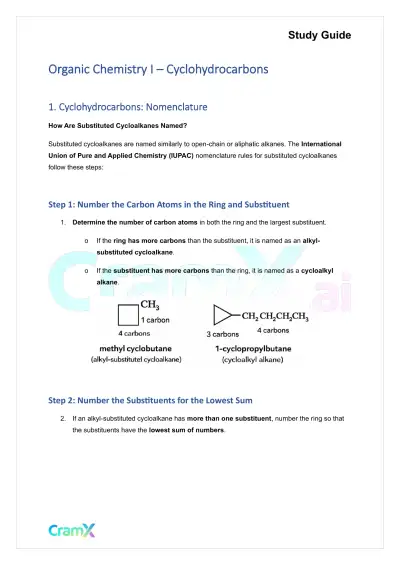 Quick Guides
Organic Chemistry I - Cyclohydrocarbons
Chemistry
11 pagesMar 2026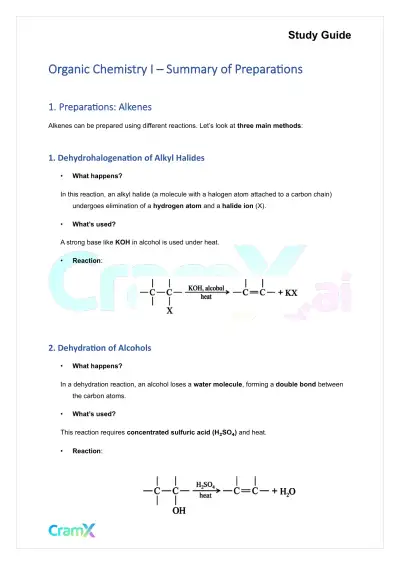 Quick Guides
Organic Chemistry I - Summary of Preparations
Chemistry
9 pagesMar 2026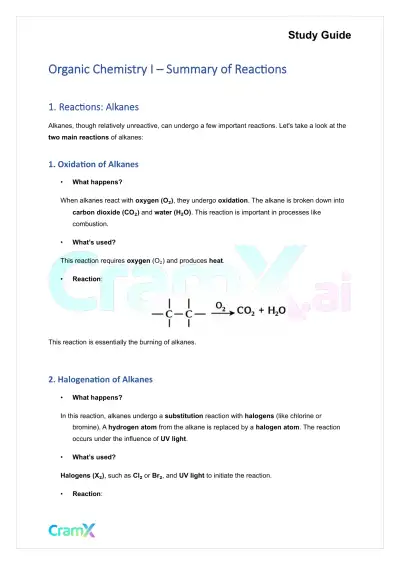 Quick Guides
Organic Chemistry I - Summary of Reactions
Chemistry
14 pagesMar 2026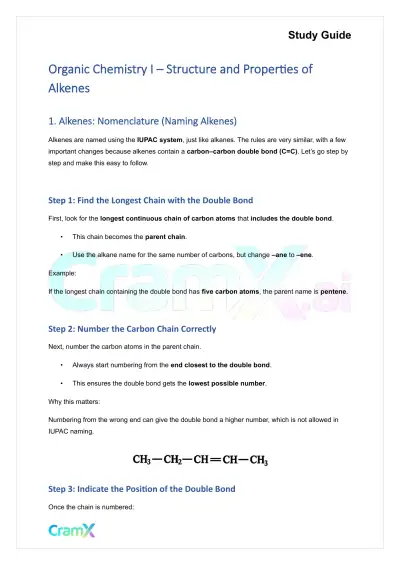 Quick Guides
Organic Chemistry I - Structure and Properties of Alkenes
Chemistry
17 pagesMar 2026
Study this document with CramX
Once it is in your library, every tool can work from it.