

Organic Chemistry I - Reactions of Alkenes
- Chemistry
- Texas A&M University
- 19 pages
- Shared March 2026
Preview 6 of 19 pages
See the first 6 pages exactly as they appear in the document.
Page 1 Read page 1 as text
Study Guide Organic Chemistry I – Reactions of Alkenes 1. Alkenes: Hydration (Direct Addition of Water) The addition of water to an alkene in the presence of a catalytic amount of strong acid leads to the formation of alcohols (hydroxy - alkanes). Mechanism of Hydration (Direct Addition of Water): This reaction proceeds via a standard carbocation mechanism and follows the Markovnikov rule. The mechanism for the addition of water to ethene is as follows: 1. Formation of a Carbocation: The hydrogen ion (H ⁺ ) is attracted to the π bond of the alkene, which breaks to form a σ bond with one of the double - bonded carbons. The second carbon of the original double bond becomes a carbocation. Reaction: (ethene to carbocation) 2. Formation of Oxonium Ion:
Page 2 Read page 2 as text
Study Guide An acid - base reaction occurs between the water molecule and the carbocation, resulting in the formation of an oxonium ion. Reaction: (carbocation reacting with water to form oxonium ion) 3. Formation of Alcohol: The oxonium ion stabilizes by losing a hydrogen ion (H ⁺ ), resulting in the formation of ethanol (or an alcohol). Reaction: (oxonium ion loses H ⁺ to form ethanol) Key Takeaway • Hydration of Alkenes: The addition of water to alkenes in the presence of acid forms alcohols. The reaction proceeds through a carbocation intermediate, following Markovnikov’s rule. • Mechanism: 1. The hydrogen ion adds to the alkene to form a carbocation. 2. Water then reacts with the carbocation to form an oxonium ion. 3. The oxonium ion loses a proton to yield an alcohol.
Page 3 Read page 3 as text
Study Guide 2. Alkenes: Hydroboration - Oxidation Water can be added to an alkene in a special way, where the major product is different from what we might expect using the Markovnikov rule. This reaction is called hydroboration - oxidation . In this process, a special compound with boron is added to the alkene. The boron attaches to one carbon of the double bond, and hydrogen is added to the other carbon. This leads to the formation of a new compound called organoborane . 1 . The Hydroboration Mechanism The first step in this process is the formation of the organoborane from the alkene. This happens very quickly. The boron atom attaches to the less substituted carbon (the one with fewer hydrogen atoms). This step forms a new C - H bond using a unique interaction called a four - center interaction . In this interaction, bonds between four atoms are made and broken at the same time, which allows the reaction to proceed smoothly.
Page 4 Read page 4 as text
Study Guide 2. Oxidation of the Organoborane Once the organoborane is formed, it undergoes a three - step oxidation process. In the first step, a molecule called a hydroperoxide reacts with the organoborane. The hydroperoxide has an oxygen atom that adds to the boron atom. This step is important because it begins the transformation of the organoborane into an alcohol. 3. Formation of a Borate Ester The next step involves the formation of a borate ester . The hydroperoxide group rearranges and loses a hydrogen ion, leading to the creation of the borate ester. This intermediate is not very stable, and it continues to change in the next steps. 4. Final Step: Hydrolysis to Form Alcohol Finally, the borate ester reacts with water in a process called hydrolysis . This is where the ester breaks down using water, splitting into alcohol and borate ions. The alcohol formed is the final product of the reaction.
Page 5 Read page 5 as text
Study Guide By the end of the reaction, we have an alcohol as the major product, and no carbocation intermediate is formed during the process. This is a unique feature of the hydroboration - oxidation reaction compared to other reactions involving alkenes. Key Takeaway • Hydroboration - oxidation adds water to alkenes in a way that doesn’t follow the Markovnikov rule. • The process involves adding a boron - containing compound (organoborane) to the alkene. • The organoborane undergoes a three - step oxidation to form an alcohol. • No carbocation intermediates are involved in this reaction. • The final product is an alcohol, with borate ions as by - products. 3. Alkenes: Catalytic Addition of Hydrogen Hydrogenation is the process of adding hydrogen to an alkene. While this reaction releases energy (exothermic), it happens very slowly on its own. To speed up the process, a metal catalyst such as platinum, palladium, nickel, or rhodium is used. This makes the reaction happen much faster. Although it seems simple, hydrogenation is actually quite complex and happens in four steps . Step 1: Reaction with the Catalyst In the first step, a hydrogen molecule reacts with the metal catalyst. This reaction breaks the σ bond between the hydrogen atoms and forms weak hydrogen - metal bonds .
Page 6 Read page 6 as text
Study Guide Step 2: Contact with the Alkene Next, the π bond of the alkene molecule comes into contact with the metal catalyst. This bond is broken, and two weak carbon - metal single bonds are created. Step 3: Hydrogen Transfer After that, the hydrogen atoms that are attached to the metal catalyst are transferred one by one to the alkene. This results in the formation of a new alkane . Step 4: Alkane Formation Once the two new carbon - hydrogen bonds are formed, the alkane molecule can move away from the catalyst. Because both hydrogen atoms are added to the same side (or face ) of the alkene, the reaction is called a syn addition . Anti Addition In some cases, the hydrogen atoms might approach the alkene molecules from opposite sides, rather than the same side. This is known as an anti addition . Anti addition happens when the double bond of the alkene isomerizes more quickly than the second hydrogen is added in the hydrogenation reaction. 4. Alkenes: Addition of Carbenes Carbenes are very reactive molecules with the general formula R ₂ C: . In this form, the carbon atom has only six electrons in its outer shell, making it highly reactive and electron - seeking (electrophilic).
13 more pages in the full document
Unlock it once and it stays in your library, ready to chat with or turn into flashcards.
Unlock the full documentMore Chemistry study materials
See all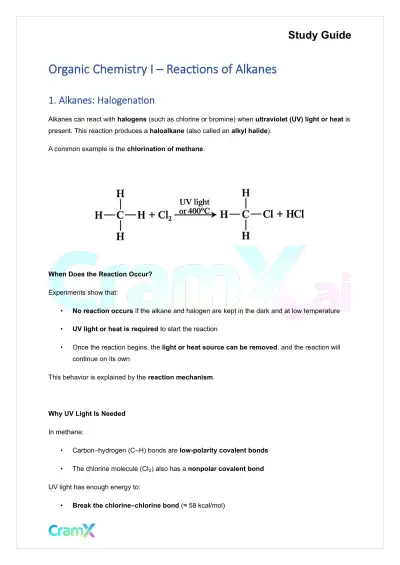 Quick Guides
Organic Chemistry I - Reactions of Alkanes
Chemistry
14 pagesMar 2026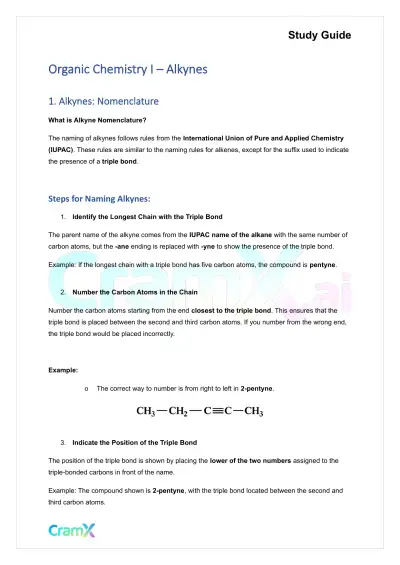 Quick Guides
Organic Chemistry I - Alkynes
Chemistry
16 pagesMar 2026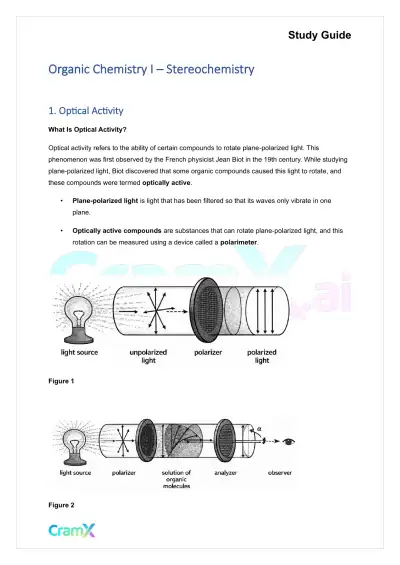 Quick Guides
Organic Chemistry I - Stereochemistry
Chemistry
25 pagesMar 2026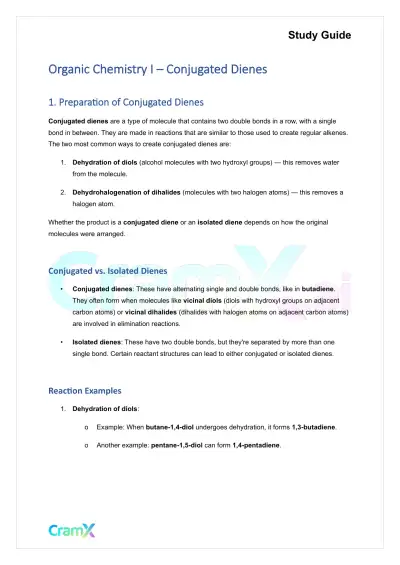 Quick Guides
Organic Chemistry I - Conjugated Dienes
Chemistry
17 pagesMar 2026 Quick Guides
Organic Chemistry I - Cyclohydrocarbons
Chemistry
11 pagesMar 2026 Quick Guides
Organic Chemistry I - Summary of Preparations
Chemistry
9 pagesMar 2026 Quick Guides
Organic Chemistry I - Summary of Reactions
Chemistry
14 pagesMar 2026 Quick Guides
Organic Chemistry I - Structure and Properties of Alkenes
Chemistry
17 pagesMar 2026
Study this document with CramX
Once it is in your library, every tool can work from it.