

Organic Chemistry I - Summary of Reactions
- Chemistry
- Texas A&M University
- 14 pages
- Shared March 2026
Preview 5 of 14 pages
See the first 5 pages exactly as they appear in the document.
Page 1 Read page 1 as text
Study Guide Organic Chemistry I – Summary of Reactions 1. Reactions : Alkanes Alkanes, though relatively unreactive, can undergo a few important reactions. Let's take a look at the two main reactions of alkanes: 1. Oxidation of Alkanes • What happens? When alkanes react with oxygen (O ₂ ) , they undergo oxidation . The alkane is broken down into carbon dioxide (CO ₂ ) and water (H ₂ O) . This reaction is important in processes like combustion. • What’s used? This reaction requires oxygen (O ₂ ) and produces heat . • Reaction : This reaction is essentially the burning of alkanes. 2. Halogenation of Alkanes • What happens? In this reaction, alkanes undergo a substitution reaction with halogens (like chlorine or bromine). A hydrogen atom from the alkane is replaced by a halogen atom . The reaction occurs under the influence of UV light . • What’s used? Halogens (X ₂ ) , such as Cl ₂ or Br ₂ , and UV light to initiate the reaction. • Reaction :
Page 2 Read page 2 as text
Study Guide In this case, X represents a halogen (Cl, Br, etc.), and HX is the hydrogen halide. Key Takeaway • Oxidation : Alkanes react with oxygen to form carbon dioxide and water , commonly occurring in combustion reactions. • Halogenation : Alkanes undergo substitution reactions with halogens (like Cl ₂ or Br ₂ ) under UV light , replacing a hydrogen atom with a halogen atom. 2. Reactions: Alkenes Alkenes undergo various reactions that are key in organic chemistry. Let's explore some of the main reactions: 1. Halogenation of Alkenes • What happens? In this reaction, alkenes react with halogens (like chlorine or bromine) to form a vicinal dihalide. This is a trans - addition product where the halogens add to the opposite sides of the double bond. • What’s used? Halogens such as Cl ₂ or Br ₂ . • Reaction:
Page 3 Read page 3 as text
Study Guide 2. Hydrohalogenation of Alkenes (Markovnikov Addition) • What happens? This reaction follows Markovnikov’s rule, where the halide (X) attaches to the carbon with more hydrogen atoms, leading to the formation of a major product. • What’s used? A hydrohalic acid (HX), such as HCl or HBr. • Reaction: 3. Hydrobromination in the Presence of Peroxide (Anti - Markovnikov Addition) • What happens? This reaction follows an anti - Markovnikov mechanism where the halide (Br) adds to the carbon with fewer hydrogen atoms, producing the opposite outcome to Markovnikov’s rule. • What’s used? Hydrogen bromide (HBr) and peroxide (ROOR).
Page 4 Read page 4 as text
Study Guide • Reaction: 4. Hydration of Alkenes (Direct Addition of Water) • What happens? Alkenes react with water, under acidic conditions, following Markovnikov’s rule, where the - OH group adds to the carbon with the most hydrogen atoms. • What’s used? Water (H ₂ O) and an acid catalyst. • Reaction: 5. Hydroboration - Oxidation of Alkenes (Indirect Addition of Water) • What happens? The alkene undergoes a two - step process where borane (B ₂ H ₆ ) adds to the carbon - carbon double bond, followed by oxidation to form alcohols. This reaction follows an anti - Markovnikov addition. • What’s used? Borane (B ₂ H ₆ ), hydrogen peroxide (H ₂ O ₂ ), and sodium hydroxide (NaOH).
Page 5 Read page 5 as text
Study Guide • Reaction: Followed by oxidation: 6. Hydrogenation of Alkenes • What happens? Alkenes undergo hydrogenation, where the double bond is reduced by adding hydrogen atoms, forming an alkane. • What’s used? Hydrogen (H ₂ ) and a platinum (Pt) catalyst. • Reaction: 7. Epoxide Formation • What happens? Alkenes react with peracid to form an epoxide, a three - membered cyclic ether. • What’s used? Peracetic acid or other peracids.
9 more pages in the full document
Unlock it once and it stays in your library, ready to chat with or turn into flashcards.
Unlock the full documentMore Chemistry study materials
See all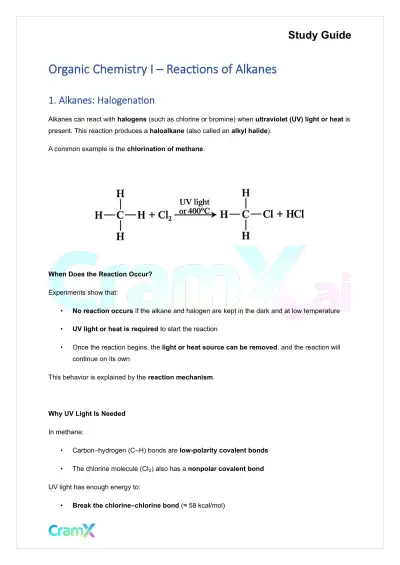 Quick Guides
Organic Chemistry I - Reactions of Alkanes
Chemistry
14 pagesMar 2026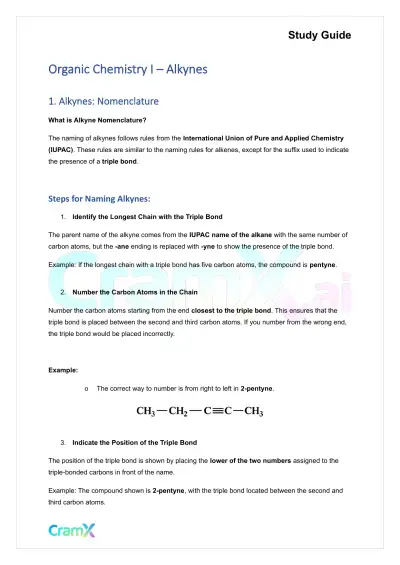 Quick Guides
Organic Chemistry I - Alkynes
Chemistry
16 pagesMar 2026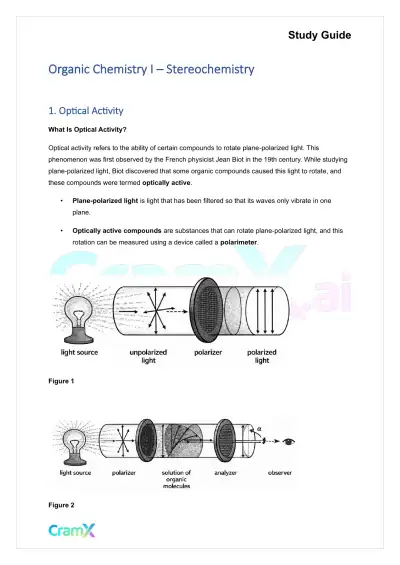 Quick Guides
Organic Chemistry I - Stereochemistry
Chemistry
25 pagesMar 2026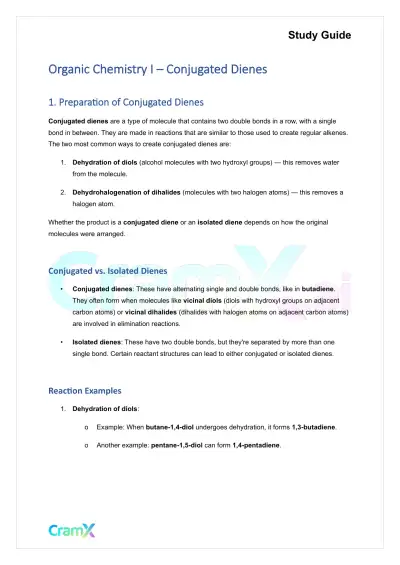 Quick Guides
Organic Chemistry I - Conjugated Dienes
Chemistry
17 pagesMar 2026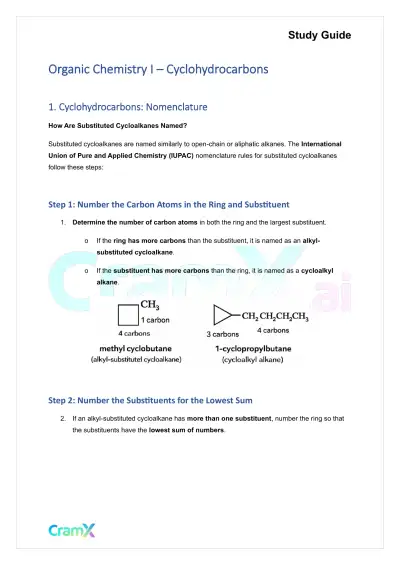 Quick Guides
Organic Chemistry I - Cyclohydrocarbons
Chemistry
11 pagesMar 2026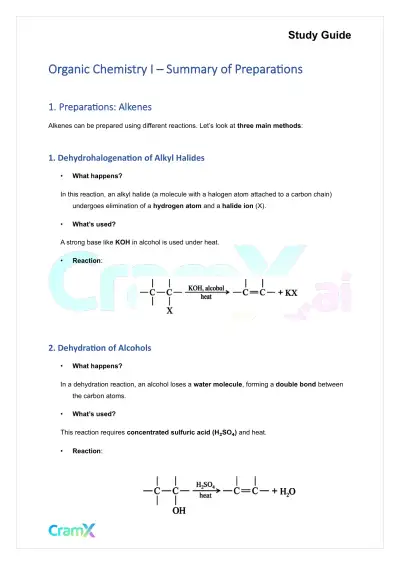 Quick Guides
Organic Chemistry I - Summary of Preparations
Chemistry
9 pagesMar 2026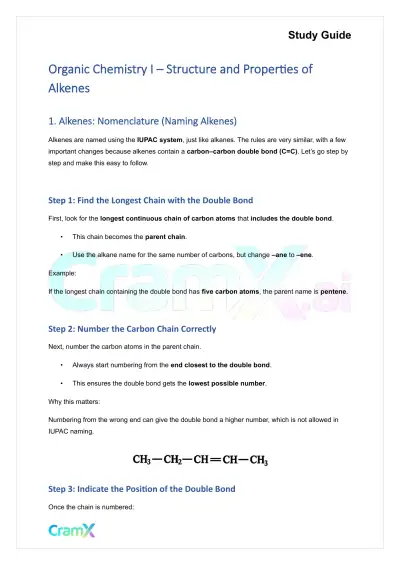 Quick Guides
Organic Chemistry I - Structure and Properties of Alkenes
Chemistry
17 pagesMar 2026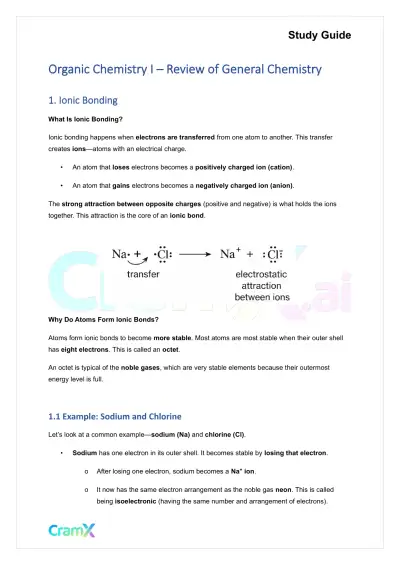 Quick Guides
Organic Chemistry I - Review of General Chemistry
Chemistry
17 pagesMar 2026
Study this document with CramX
Once it is in your library, every tool can work from it.