

Organic Chemistry I - Reactions of Alkanes
- Chemistry
- Texas A&M University
- 14 pages
- Shared March 2026
Preview 5 of 14 pages
See the first 5 pages exactly as they appear in the document.
Page 1 Read page 1 as text
Study Guide Organic Chemistry I – Reactions of Alkanes 1. Alkanes: Halogenation Alkanes can react with halogens (such as chlorine or bromine) when ultraviolet (UV) light or heat is present. This reaction produces a haloalkane (also called an alkyl halide ). A common example is the chlorination of methane . When Does the Reaction Occur? Experiments show that: • No reaction occurs if the alkane and halogen are kept in the dark and at low temperature • UV light or heat is required to start the reaction • Once the reaction begins, the light or heat source can be removed , and the reaction will continue on its own This behavior is explained by the reaction mechanism . Why UV Light Is Needed In methane: • Carbon – hydrogen (C – H) bonds are low - polarity covalent bonds • The chlorine molecule (Cl ₂ ) also has a nonpolar covalent bond UV light has enough energy to: • Break the chlorine – chlorine bond (≈ 58 kcal/mol)
Page 2 Read page 2 as text
Study Guide But it does not have enough energy to: • Break the stronger carbon – hydrogen bond (≈ 104 kcal/mol) 1.1 Formation of Free Radicals When UV light hits a chlorine molecule: • The Cl – Cl bond splits evenly • Each chlorine atom takes one electron • Two chlorine free radicals are formed A free radical is: An atom or group that contains one unshared (unpaired) electron These free radicals are highly reactive . 1 .2 Homolytic Bond Cleavage (Initiation Step) The chlorine – chlorine bond breaks by homolytic fission : • Each atom gets one electron • No ions are formed This first step is called the initiation step , because it starts the chain reaction. Once chlorine radicals form, the energy released in later steps keeps the reaction going — even without UV light. Propagation Steps (Chain - Carrying Steps) Propagation Step 1
Page 3 Read page 3 as text
Study Guide • A chlorine free radical attacks a methane molecule • A C – H bond breaks homolytically • Products formed: o Hydrogen chloride (HCl) o Methyl free radical (·CH ₃ ) This step forms: • One stable product • One new free radical that keeps the reaction going Propagation Step 2 • A methyl free radical reacts with a chlorine molecule • Products formed: o Chloromethane (CH ₃ Cl) o A new chlorine free radical This chlorine radical can now repeat the cycle. These propagation steps explain why the reaction continues once it starts.
Page 4 Read page 4 as text
Study Guide 1.3 Termination Steps (Chain - Stopping Steps) A termination step occurs when two free radicals combine to form a stable molecule. Common termination reactions include: 1. A methyl radical + a chlorine radical → chloromethane 2. Two methyl radicals → ethane 3. Two chlorine radicals → chlorine molecule
Page 5 Read page 5 as text
Study Guide Termination steps remove free radicals , which slows and eventually stops the reaction. Overall Nature of the Reaction This reaction is called a free - radical chain reaction because: • It begins with few free radicals • Propagation steps increase the number of radicals • Toward the end, radicals collide with each other more often • Termination steps become dominant All of these steps occur extremely fast , and product formation typically happens in microseconds . Key Takeaways • Alkanes react with halogens only in the presence of UV light or heat • The reaction forms haloalkanes • UV light breaks the halogen bond to form free radicals • The reaction proceeds by: o Initiation o Propagation o Termination • This is a classic free - radical chain reaction 2. Alkanes: Kinetics and Rate Not all chemical reactions happen easily or quickly. Most reactions need energy before they can begin. This section explains why energy is needed , what controls reaction speed , and how temperature affects reaction rate .
9 more pages in the full document
Unlock it once and it stays in your library, ready to chat with or turn into flashcards.
Unlock the full documentMore Chemistry study materials
See all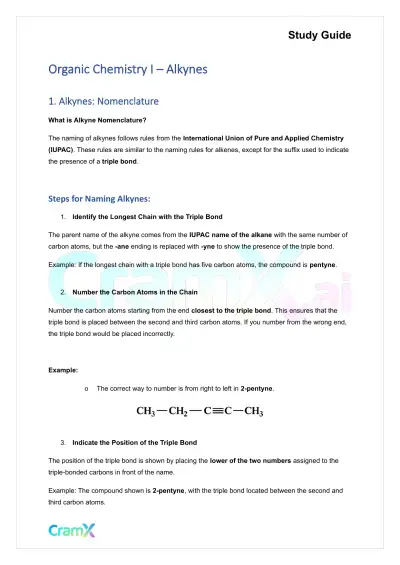 Quick Guides
Organic Chemistry I - Alkynes
Chemistry
16 pagesMar 2026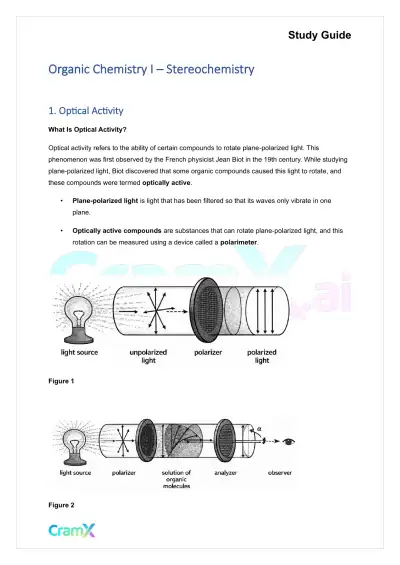 Quick Guides
Organic Chemistry I - Stereochemistry
Chemistry
25 pagesMar 2026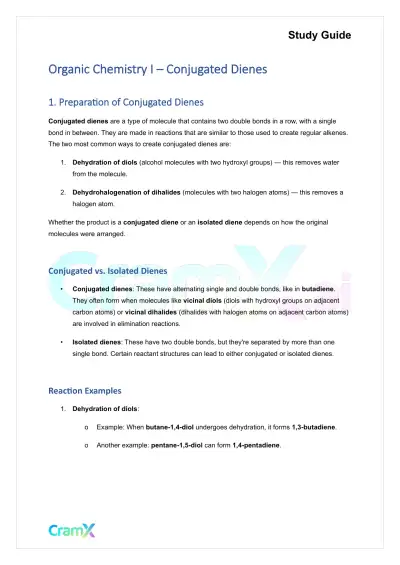 Quick Guides
Organic Chemistry I - Conjugated Dienes
Chemistry
17 pagesMar 2026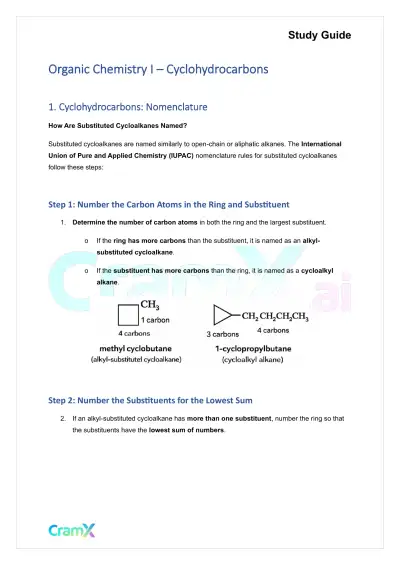 Quick Guides
Organic Chemistry I - Cyclohydrocarbons
Chemistry
11 pagesMar 2026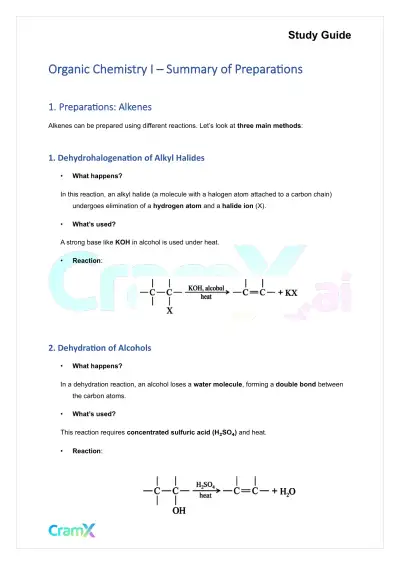 Quick Guides
Organic Chemistry I - Summary of Preparations
Chemistry
9 pagesMar 2026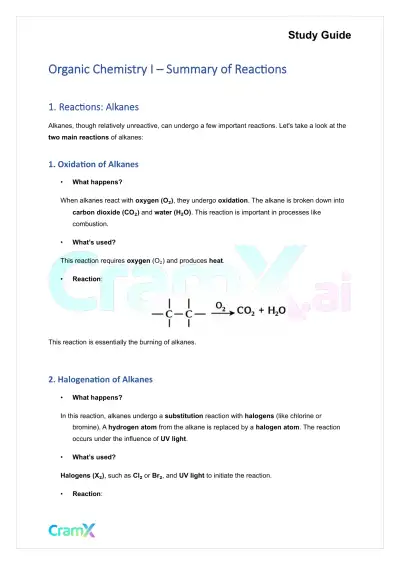 Quick Guides
Organic Chemistry I - Summary of Reactions
Chemistry
14 pagesMar 2026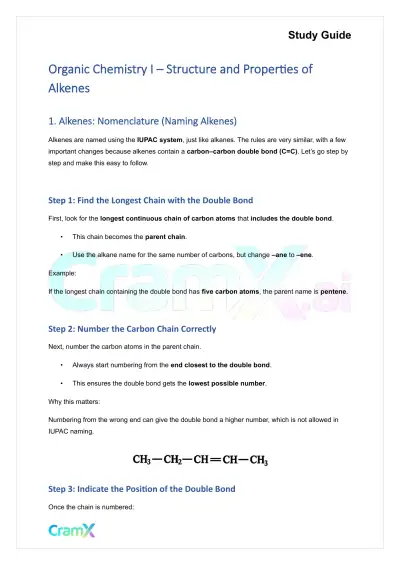 Quick Guides
Organic Chemistry I - Structure and Properties of Alkenes
Chemistry
17 pagesMar 2026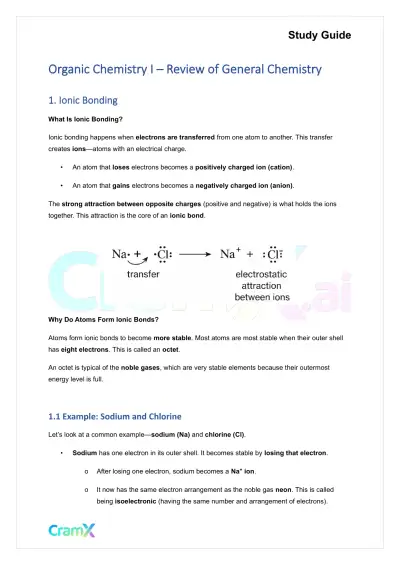 Quick Guides
Organic Chemistry I - Review of General Chemistry
Chemistry
17 pagesMar 2026
Study this document with CramX
Once it is in your library, every tool can work from it.