

Organic Chemistry I - Structure of Organic Molecules
- Chemistry
- Texas A&M University
- 24 pages
- Shared March 2026
Preview 8 of 24 pages
See the first 8 pages exactly as they appear in the document.
Page 1 Read page 1 as text
Study Guide Organic Chemistry I – Structure of Organic Molecules 1. Molecular Orbitals When atoms come together to form a molecule, their electrons don’t just stay in the same atomic orbitals. Instead, the atomic orbitals combine to form molecular orbitals . These new orbitals belong to the entire molecule, not to any single atom. Let’s understand how this works using the hydrogen molecule as an example. How Molecular Orbitals Form When two hydrogen atoms approach each other, their 1s atomic orbitals overlap . From this overlap, two molecular orbitals are created: 1. A bonding molecular orbital 2. An antibonding molecular orbital These two orbitals come from the same atomic orbitals but differ in how the wave functions interact. 1.1 Bonding Molecular Orbital ( σ Bond) In one combination, the wave functions of the two atomic orbitals add together (in phase) . • This causes more electron density between the two nuclei . • More electron density between the nuclei means stronger attraction between the negatively charged electrons and the positively charged nuclei. • This attraction pulls the atoms together and holds the molecule together . This low - energy, stable orbital is called a bonding molecular orbital . Because it forms from end - to - end overlap of atomic orbitals, it is called a σ ( sigma) bonding molecular orbital . Key idea: High electron density between nuclei = strong bond.
Page 2 Read page 2 as text
Study Guide 1.2 Antibonding Molecular Orbital ( σ* Orbital) In the other combination, the wave functions subtract from each other (out of phase) . • This creates a region with no electron density between the nuclei , called a node . • Without electrons between them, the positively charged nuclei repel each other strongly . • This makes the molecule unstable. This higher - energy orbital is called an antibonding molecular orbital , written as σ* . Important note: The plus (+) and minus ( – ) signs shown in diagrams represent wave phase , not electrical charge. Figure 1 1.3 Electron Spin and Stability Just like in atomic orbitals, electrons in molecular orbitals must have opposite spins when they pair up. In a hydrogen molecule: • Both electrons occupy the lower - energy σ bonding orbital . • The σ* antibonding orbital remains empty.
Page 3 Read page 3 as text
Study Guide As long as a molecule has more electrons in bonding orbitals than in antibonding orbitals , the molecule is stable . 1.4 Why Helium Molecules Do Not Exist Helium atoms have two electrons each . If two helium atoms tried to bond: • Electrons would fill both the bonding and antibonding orbitals. • The stabilizing effect of bonding electrons would be cancelled out by antibonding electrons. Because there is no overall energy advantage , helium molecules do not form. Bottom line: Equal bonding and antibonding electrons = no bond. Figure 2
Page 4 Read page 4 as text
Study Guide What Is a σ ( Sigma) Bond? A σ bond has: • High electron density along an imaginary line connecting the nuclei • Electron density that comes from end - to - end overlap of orbitals σ bonds can form from: • Two atomic orbitals • An atomic orbital and a hybrid orbital • Two hybrid orbitals σ bonds are the strongest type of covalent bond because the overlap is very effective. Figure 3 What Is a π ( Pi) Bond? A π bond forms when orbitals overlap side - by - side , instead of head - on. • Electron density is found above and below the line connecting the nuclei • The molecular orbital formed is called a π molecular orbital Because this overlap is less direct: • π bonds are weaker than σ bonds • Repulsion between nuclei reduces the quality of overlap π bonds usually form in addition to a σ bond , such as in double and triple bonds.
Page 5 Read page 5 as text
Study Guide Figure 4 Key Takeaways • Atomic orbitals combine to form bonding and antibonding molecular orbitals • Bonding orbitals increase electron density between nuclei and stabilize molecules • Antibonding orbitals create nodes and destabilize molecules • σ bonds form by end - to - end overlap • π bonds form by side - to - side overlap • Molecules are stable only when bonding electrons outnumber antibonding electrons 2. Hybridization of Atomic Orbitals To understand hybridization, very simple and familiar molecule: methane (CH ₄ ) . Careful experiments on methane show some important facts: • All carbon – hydrogen bond lengths are equal • All H – C – H bond angles are equal • Each bond angle is about 109.5° (roughly 110°) • All the bonds are covalent These observations tell us that all four bonds in methane are identical . But when we look at carbon’s electron configuration, this creates an interesting problem.
Page 6 Read page 6 as text
Study Guide 2.1 The Ground State of Carbon Carbon has an atomic number of 6. In its ground state (the lowest - energy, unexcited state), its electrons are arranged like this: • 1s² • 2s² • 2p² This means carbon has only two half - filled orbitals , which would allow it to form just two covalent bonds . But methane clearly has four bonds . So how does carbon do this? 2.2 The Excited State of Carbon When energy is added to a carbon atom, one electron from the 2s orbital is promoted to a 2p orbital . Now carbon has: • Four half - filled orbitals • Each orbital can form a covalent bond This excited state explains how carbon can form four bonds. However, there’s still a problem: • The 2s orbital is smaller • The 2p orbitals are larger
Page 7 Read page 7 as text
Study Guide If carbon used these orbitals directly, the bonds would have different lengths , which contradicts experimental evidence. Why Hybridization Is Needed To make all four bonds equal , carbon needs four identical orbitals . Nature solves this problem through a process called hybridization . What Is Hybridization? Hybridization is the mixing (linear combination) of atomic orbitals on the same atom to form new, equivalent hybrid orbitals . • The wave functions of s and p orbitals combine • New orbitals form with different shapes and energies • These hybrid orbitals explain equal bond lengths and angles sp³ Hybridization (Methane) In methane: • One s orbital mixes with three p orbitals • This produces four identical sp³ hybrid orbitals Each sp³ orbital has: • 1 part s character • 3 parts p character These four orbitals point toward the corners of a tetrahedron , giving bond angles of 109.5° , exactly what experiments show. This explains why all C – H bonds in methane are equal . 2.3 Bond Angles and VSEPR Theory Bond angles are explained using Valence - Shell Electron - Pair Repulsion (VSEPR) theory .
Page 8 Read page 8 as text
Study Guide According to VSEPR: • Electron pairs repel each other • They arrange themselves as far apart as possible In methane: • Four bonding pairs surround carbon • Maximum separation gives a tetrahedral geometry • Bond angle = 109°28′ (about 110°) sp² Hybridization Carbon can also form sp² hybrid orbitals . In this case: • One s orbital combines with two p orbitals • Three equivalent sp² hybrid orbitals are formed • One p orbital remains unhybridized Key features: • The three sp² orbitals lie in one plane • They are separated by 120° • The unhybridized p orbital is perpendicular to the plane This arrangement allows for the formation of double bonds . sp Hybridization Carbon can also undergo sp hybridization . Here: • One s orbital mixes with one p orbital • Two sp hybrid orbitals are formed • Two p orbitals remain unhybridized
16 more pages in the full document
Unlock it once and it stays in your library, ready to chat with or turn into flashcards.
Unlock the full documentMore Chemistry study materials
See all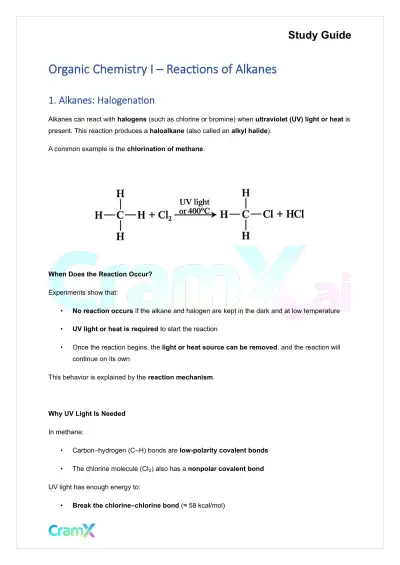 Quick Guides
Organic Chemistry I - Reactions of Alkanes
Chemistry
14 pagesMar 2026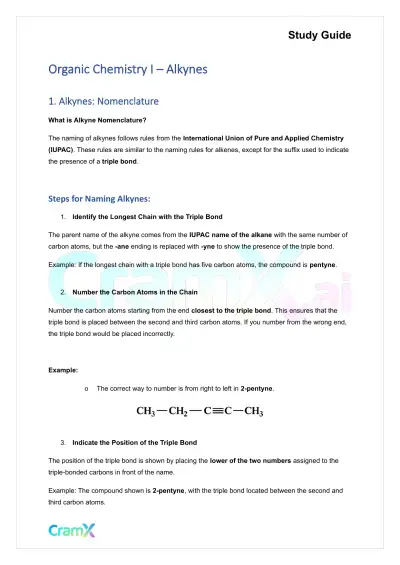 Quick Guides
Organic Chemistry I - Alkynes
Chemistry
16 pagesMar 2026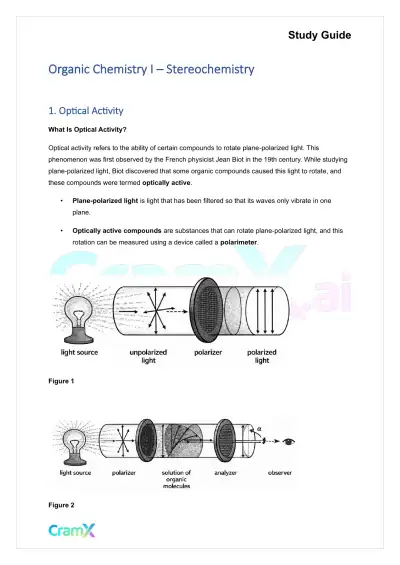 Quick Guides
Organic Chemistry I - Stereochemistry
Chemistry
25 pagesMar 2026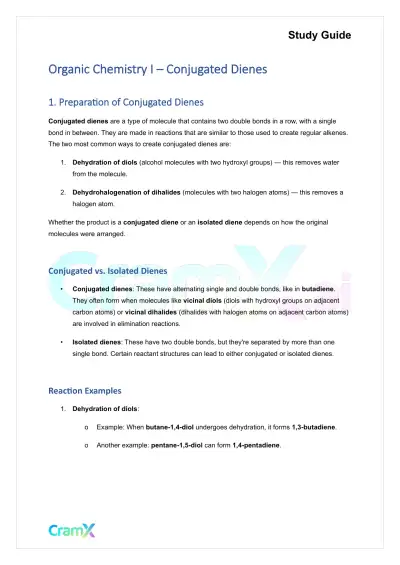 Quick Guides
Organic Chemistry I - Conjugated Dienes
Chemistry
17 pagesMar 2026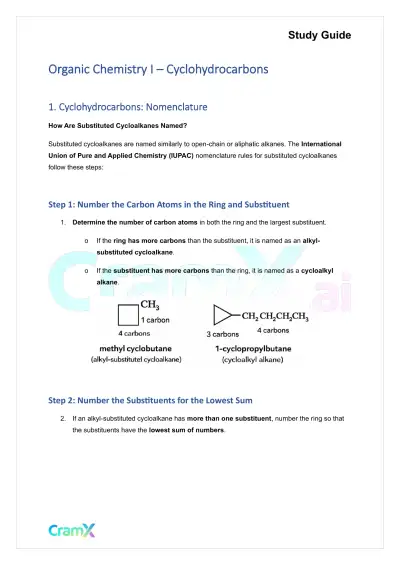 Quick Guides
Organic Chemistry I - Cyclohydrocarbons
Chemistry
11 pagesMar 2026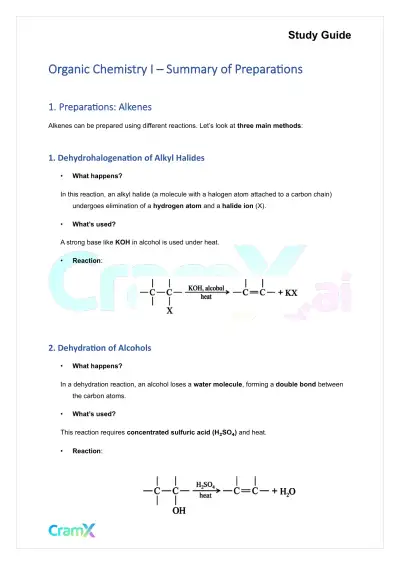 Quick Guides
Organic Chemistry I - Summary of Preparations
Chemistry
9 pagesMar 2026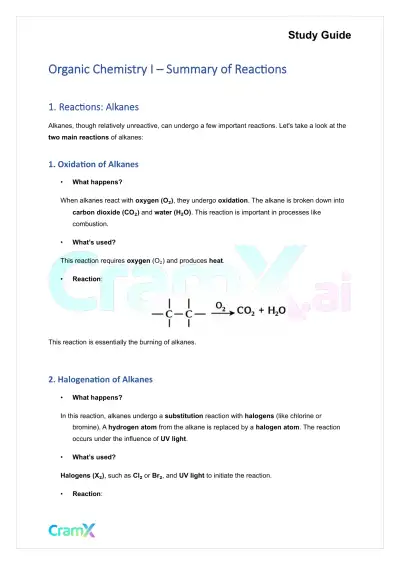 Quick Guides
Organic Chemistry I - Summary of Reactions
Chemistry
14 pagesMar 2026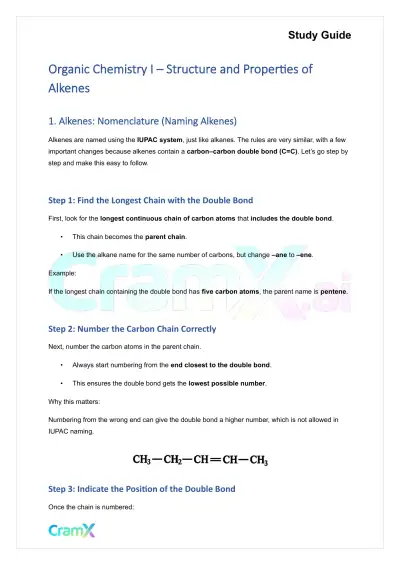 Quick Guides
Organic Chemistry I - Structure and Properties of Alkenes
Chemistry
17 pagesMar 2026
Study this document with CramX
Once it is in your library, every tool can work from it.