

Organic Chemistry I - Structure and Properties of Alkanes
- Chemistry
- Texas A&M University
- 16 pages
- Shared March 2026
Preview 5 of 16 pages
See the first 5 pages exactly as they appear in the document.
Page 1 Read page 1 as text
Study Guide Organic Chemistry I – Structure and Properties of Alkanes 1. Alkanes: Natural Sources Alkanes occur naturally and are mainly obtained from natural gas and petroleum . 1.1 Natural Gas Natural gas is made up mostly of methane (CH ₄ ) . It also contains small amounts of other low - molecular - weight alkanes , such as ethane and propane. Because these alkanes are small and light, they exist mainly as gases under normal conditions. 1.2 Petroleum (Crude Oil) Petroleum is the main source of most alkanes . It is a complex mixture containing many different hydrocarbons. When petroleum is processed by distillation : • Lighter fractions are separated first and form liquid alkanes • The heavier residue left behind contains solid alkanes This separation allows alkanes of different sizes and properties to be collected and used. Key Takeaways • Alkanes come primarily from natural gas and petroleum • Natural gas contains mostly methane • Petroleum supplies liquid and solid alkanes • Distillation separates alkanes based on molecular weight
Page 2 Read page 2 as text
Study Guide 2. Alkanes: Preparations In practice, alkanes are rarely prepared from other compounds because it is usually not economical . Most alkanes are obtained directly from natural gas and petroleum . However, from a theoretical and laboratory point of view , alkanes can be prepared using several chemical methods. Ignoring cost and practicality, the main preparation methods are described below. 1. From Unsaturated Compounds (Catalytic Reduction) Alkenes and alkynes can be converted into alkanes by adding hydrogen in the presence of a catalyst. • Hydrogen gas (H ₂ ) is added across the multiple bond • A metal catalyst such as platinum (Pt), palladium (Pd), or nickel (Ni) is used • The double or triple bond is converted into a single bond This process is called catalytic hydrogenation (or catalytic reduction). Example idea: Alkene + H ₂ → Alkane 2. From Alkyl Halides (Wurtz Reaction) Alkanes can be prepared by coupling alkyl halides using sodium metal. • The reaction is carried out in dry ether • Two alkyl halide molecules join together • A higher alkane is formed
Page 3 Read page 3 as text
Study Guide This reaction is called the Wurtz reaction . Key point: • Best suited for preparing symmetrical alkanes • Less useful for unsymmetrical products due to mixtures 3. From Alkyl Halides via Grignard Reagents Alkyl halides can also be converted into alkanes through Grignard reagents . This happens in two steps: Step 1: Formation of Grignard Reagent • Alkyl halide reacts with magnesium (Mg) in dry ether • This forms an alkyl magnesium halide (Grignard reagent) Step 2: Hydrolysis • The Grignard reagent reacts with water (H ₂ O) • The final product is an alkane Important idea: Grignard reagents act as strong bases and react readily with water.
Page 4 Read page 4 as text
Study Guide 4. From Alkyl Halides by Reduction Alkyl halides can be converted directly into alkanes by reduction . • The halogen atom is replaced by hydrogen • Common reducing agents include zinc in acid or other metal – acid systems This method removes the halogen and forms a C – H bond . Reaction Schemes vs Chemical Equations Although organic chemists often call these drawings “equations” , they are usually not fully balanced . • Not all reactants or by - products are shown • These diagrams mainly show how atoms are rearranged Because of this, they are more accurately called reaction schemes , not true chemical equations.
Page 5 Read page 5 as text
Study Guide Key Takeaways • Alkanes are rarely synthesized due to cost • They can be prepared from: o Unsaturated compounds (hydrogenation) o Alkyl halides (Wurtz reaction) o Grignard reagents o Reduction of alkyl halides • Most textbook reactions are reaction schemes , not balanced equations 3. Alkanes: Molecular and Structural Formulas Alkanes are organic compounds made only of carbon and hydrogen atoms , joined together by single covalent bonds . Because they follow a consistent pattern, alkanes form a homologous series . 3.1 General Formula of Alkanes All alkanes have the same general molecular formula : • n represents the number of carbon atoms • n can be any whole number As the number of carbon atoms increases, the number of hydrogen atoms increases in a predictable way. 3.2 The Simplest Alkane: Methane The simplest alkane is methane . • Molecular formula: CH ₄ • It contains one carbon atom • All bonds are single covalent bonds
11 more pages in the full document
Unlock it once and it stays in your library, ready to chat with or turn into flashcards.
Unlock the full documentMore Chemistry study materials
See all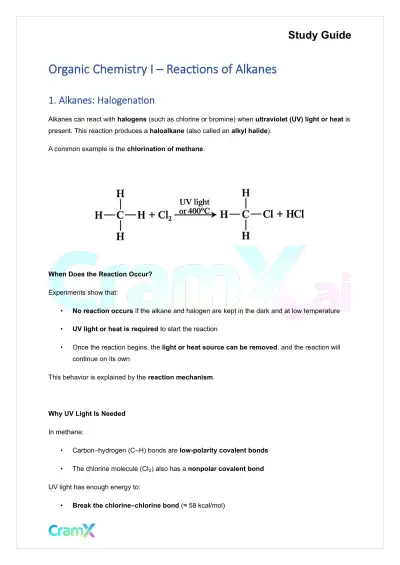 Quick Guides
Organic Chemistry I - Reactions of Alkanes
Chemistry
14 pagesMar 2026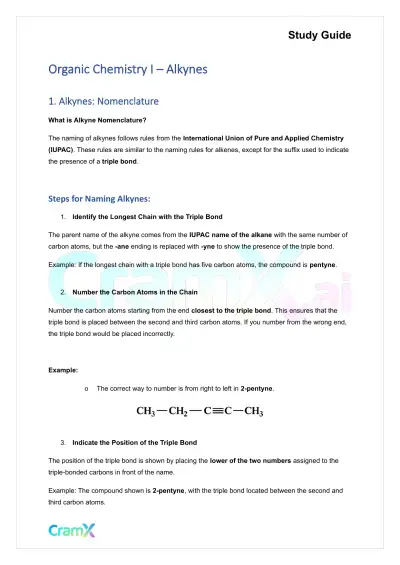 Quick Guides
Organic Chemistry I - Alkynes
Chemistry
16 pagesMar 2026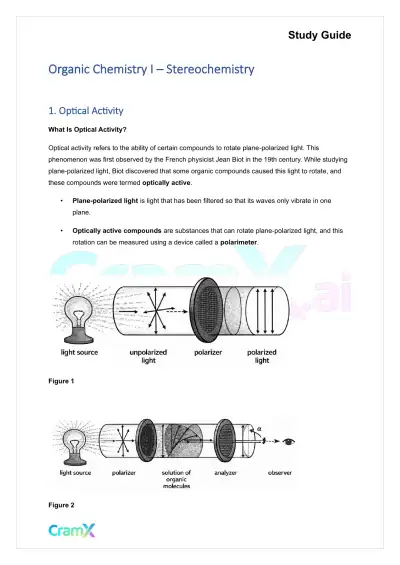 Quick Guides
Organic Chemistry I - Stereochemistry
Chemistry
25 pagesMar 2026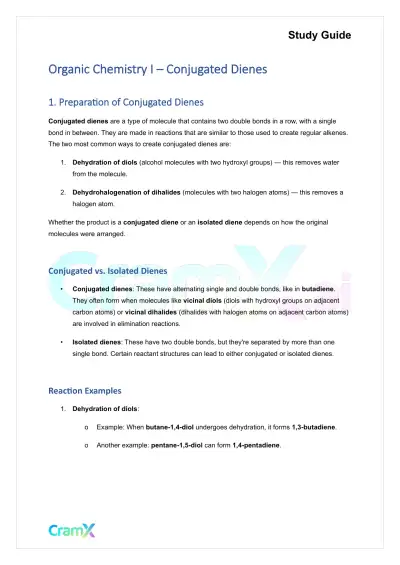 Quick Guides
Organic Chemistry I - Conjugated Dienes
Chemistry
17 pagesMar 2026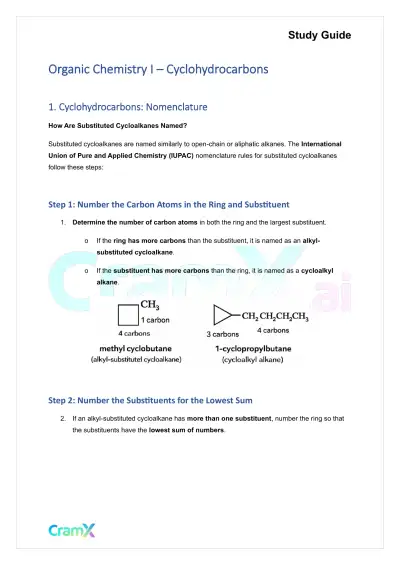 Quick Guides
Organic Chemistry I - Cyclohydrocarbons
Chemistry
11 pagesMar 2026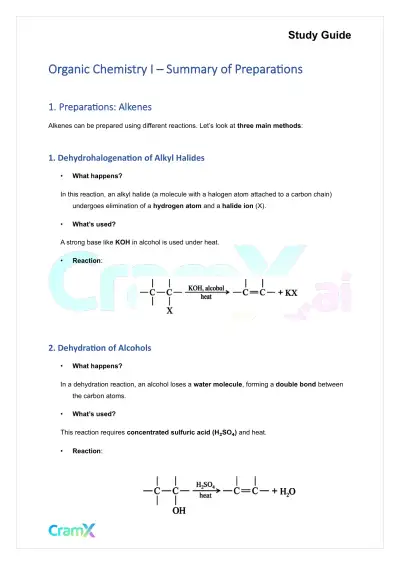 Quick Guides
Organic Chemistry I - Summary of Preparations
Chemistry
9 pagesMar 2026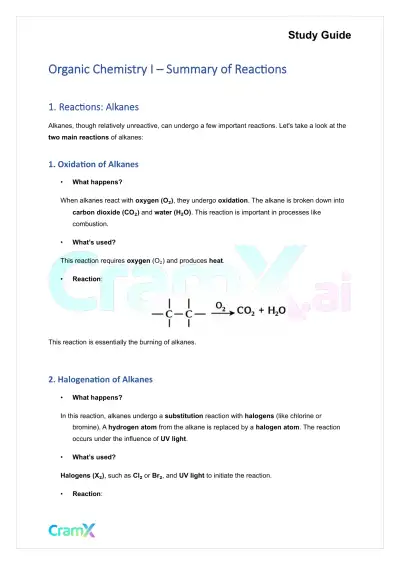 Quick Guides
Organic Chemistry I - Summary of Reactions
Chemistry
14 pagesMar 2026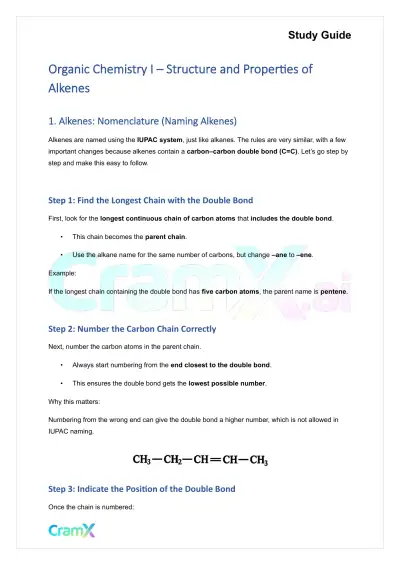 Quick Guides
Organic Chemistry I - Structure and Properties of Alkenes
Chemistry
17 pagesMar 2026
Study this document with CramX
Once it is in your library, every tool can work from it.