

Organic Chemistry I - Summary of Preparations
- Chemistry
- Texas A&M University
- 9 pages
- Shared March 2026
Preview 3 of 9 pages
See the first 3 pages exactly as they appear in the document.
Page 1 Read page 1 as text
Study Guide Organic Chemistry I – Summary of Preparations 1. Preparations : Alkenes Alkenes can be prepared using different reactions. Let’s look at three main methods : 1. Dehydrohalogenation of Alkyl Halides • What happens? In this reaction, an alkyl halide (a molecule with a halogen atom attached to a carbon chain) undergoes elimination of a hydrogen atom and a halide ion (X). • What’s used? A strong base like KOH in alcohol is used under heat. • Reaction : 2. Dehydration of Alcohols • What happens? In a dehydration reaction, an alcohol loses a water molecule , forming a double bond between the carbon atoms. • What’s used? This reaction requires concentrated sulfuric acid (H ₂ SO ₄ ) and heat. • Reaction :
Page 2 Read page 2 as text
Study Guide 3. Dehalogenation of Vicinal Dihalides • What happens? When a vicinal dihalide (a molecule with two halogen atoms on adjacent carbon atoms ) is treated with zinc (Zn), the halogen atoms are removed, and a double bond forms between the two carbon atoms. • What’s used? Zinc (Zn) is the key reagent for this reaction. • Reaction : Key Takeaway s • Dehydrohalogenation : Alkyl halides lose hydrogen and halide to form alkenes, using a strong base like KOH . • Dehydration of alcohols : Alcohols lose water to form a double bond with the help of H ₂ SO ₄ and heat. • Dehalogenation : Vicinal dihalides lose halogens (usually via zinc ) to form alkenes. 2. Preparations : Alkynes Alkynes, like alkenes, can be prepared using a variety of reactions. Below are three common methods for preparing alkynes: 1. Dehydrohalogenation of Vicinal Dihalides • What happens?
Page 3 Read page 3 as text
Study Guide A vicinal dihalide (a molecule with two halogen atoms on adjacent carbon atoms ) undergoes elimination of hydrogen and halide ions to form an alkyne (a molecule with a triple bond between two carbon atoms). • What’s used? A strong base like KOH in alcohol, heated under strong conditions . • Reaction : 2. Dehydrohalogenation of Geminal Dihalides • What happens? In this reaction, a geminal dihalide (where both halogens are on the same carbon ) undergoes elimination of hydrogen and halide ions to form an alkyne. • What’s used? KOH in alcohol, with heat. • Reaction : 3. Dehalogenation of Vicinal Tetrahaloalkanes • What happens? A vicinal tetrahaloalkane (with four halogens on adjacent carbon atoms ) undergoes dehalogenation , where the halogens are replaced by hydrogen atoms, leading to the formation of an alkyne.
6 more pages in the full document
Unlock it once and it stays in your library, ready to chat with or turn into flashcards.
Unlock the full documentMore Chemistry study materials
See all Quick Guides
Organic Chemistry I - Reactions of Alkanes
Chemistry
14 pagesMar 2026 Quick Guides
Organic Chemistry I - Alkynes
Chemistry
16 pagesMar 2026 Quick Guides
Organic Chemistry I - Stereochemistry
Chemistry
25 pagesMar 2026 Quick Guides
Organic Chemistry I - Conjugated Dienes
Chemistry
17 pagesMar 2026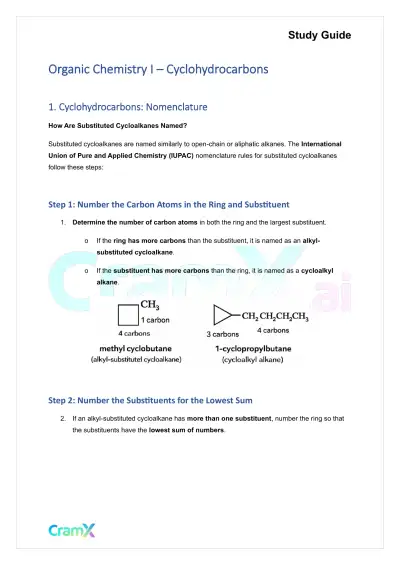 Quick Guides
Organic Chemistry I - Cyclohydrocarbons
Chemistry
11 pagesMar 2026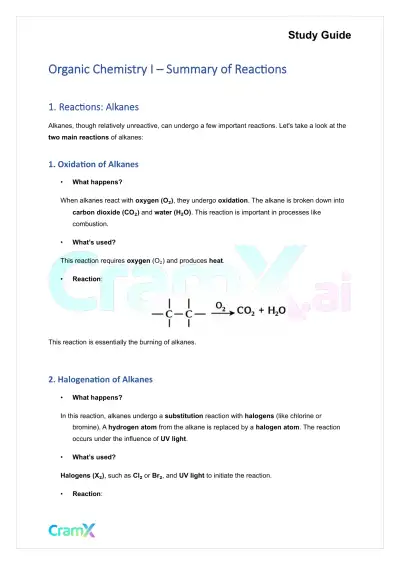 Quick Guides
Organic Chemistry I - Summary of Reactions
Chemistry
14 pagesMar 2026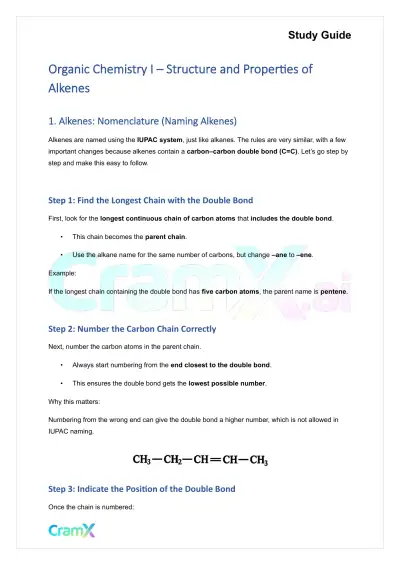 Quick Guides
Organic Chemistry I - Structure and Properties of Alkenes
Chemistry
17 pagesMar 2026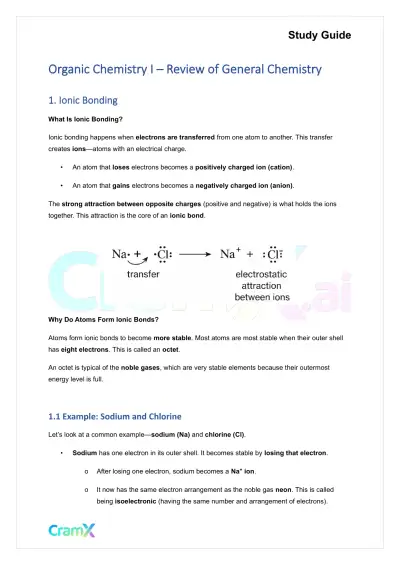 Quick Guides
Organic Chemistry I - Review of General Chemistry
Chemistry
17 pagesMar 2026
Study this document with CramX
Once it is in your library, every tool can work from it.