

Introduction to the Australian Legal System
- History
- 8 pages
- Shared June 2025
This summary covers Australia's legal system: colonization, Indigenous laws, reception of English law, Federation, legal independence, primary and secondary sources of law, legislative process, delegated legislation, court structure.
Preview 3 of 8 pages
See the first 3 pages exactly as they appear in the document.
Page 1 Read page 1 as text
Week 1: Introduction to the Australian Legal System Australia's Colonization & Indigenous Laws □ Australia was colonized by Britain in 1788 and legally classified as "settled." □ Mabo (No. 2) (1992): o High Court ruled that Australia was not "terra nullius." o The British Crown still acquired sovereignty and the right to allocate land without Indigenous consent. o Native title (Indigenous land ownership) recognized but limited in scope. Reception of English Law u NSW was classified as "settled" under legal principles. □ Three branches of government: 1. Legislature 2. Executive 3. Judiciary □ Judicature Acts 1873-1875: Fused common law and equity. □ Law received in three waves: 1. 1788: English law applied to NSW. 2. 1828: Australia Courts Act updated received English law. 3. 1859: QLD separated from NSW, adopting NSW laws. Post-Reception Developments □ Colonial Laws Validity Act 1865: Limited British legislative control. □ Statute of Westminster Adoption Act 1942: Strengthened Australia's legislative independence. u Australia Act 1986: Severed remaining legal ties with the UK. Federation (1901) □ Australia adopted a federal system, sharing power between national and regional governments. □ Inspired by the US federal model.
Page 2 Read page 2 as text
n Commonwealth Constitution Act 1900 (UK): Became law on January 1, 1901. □ First Governor-General: Lord Hopetoun. □ Current Governor-General: Sir Peter Cosgrove. □ Head of State: Queen. Sources of Law in Australia Primary Sources 1. Legislation (Statutes, Acts of Parliament) 2. Delegated Legislation (Rules, regulations, by-laws) 3. Court Judgments (Common law, precedents) Secondary Sources 1. International law (Treaties ratified by Australia) 2. Law reform commission reports 3. Academic commentary (Books, journal articles) Legislation □ Passed by nine parliaments in Australia (one federal, six state, two territory). □ Hierarchy: Federal laws override state laws (Section 109 of the Constitution). □ Invalidation: High Court can strike down laws beyond Parliament's powers. Functions of Legislation □ Create new laws (Override outdated common law). □ Repeal laws (Remove unnecessary laws). □ Codify laws (Consolidate multiple laws into one). Process of Making a Law 1. Bill introduced and passed through both houses of Parliament. 2. Sent to Governor-General for assent.
Page 3 Read page 3 as text
3. Becomes an Act of Parliament. Commencement of Legislation □ Default commencement varies by state: o NSW, WA, VIC: 28 days after assent. o TAS: 14 days after assent. o QLD, SA, NT: On the day of assent. o ACT: The day after notification in the Gazette. Delegated Legislation □ Made by government ministers or executive bodies under authority of a parent Act. □ Examples: Environmental regulations, tax rules. □ Benefits: o Faster and cheaper than passing formal legislation. o Made by subject-matter experts. □ Criticisms: o Less public scrutiny. o Possible violation of separation of powers. Amending & Repealing Legislation □ Amendments: Introduced through new laws (e.g., Native Title Amendment Act 2007). □ Repeals: o Some laws contain sunset clauses (expire after a It looks like the boxes you're referring to might be artifacts from copying and pasting text. Here's your text with those formatting issues removed: Week 1: Introduction to the Australian Legal System n Australia was colonized by Britain in 1788 and was considered "settled" as a matter of law.
5 more pages in the full document
Unlock it once and it stays in your library, ready to chat with or turn into flashcards.
Unlock the full documentMore History study materials
See all Exam Guides
Test Bank For Visions of America: A History of the United States, Combined Volume 2nd Edition Test Bank
History
1084 pages111downloadsFeb 2025 Exam Guides
Cengage Advantage Books: Making America, Volume 1 To 1877: A History Of The United States, 7th Edition Test Bank
History
170 pages60downloadsFeb 2025 Exam Guides
Test Bank for The American Journey: A History of the United States, Combined Volume, 8th Edition
History
447 pagesMay 2025 Exam Guides
Palmer, A History of Europe in the Modern World, 11th Edition Test Bank
History
766 pagesMay 2025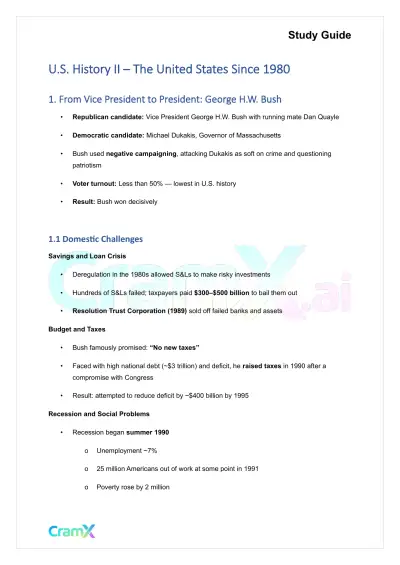 Quick Guides
U.S. History II - The United States Since 1980
History
16 pagesMar 2026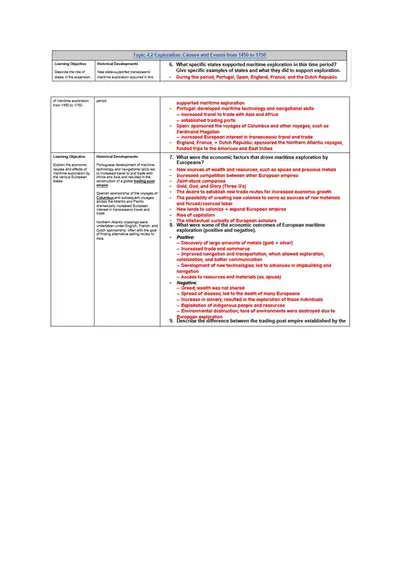 Solved Assignments
AP World History Unit 4 Study Guide (Transoceanic
History
14 pagesJun 2025 Solved Assignments
Liberty University CSTU 101 Quiz 3 Complete Solutions Correct Answers Key Four different versions
History
9 pagesMay 2025 Solved Assignments
Liberty University HIUS 221 Quiz 2 Complete Solutions Correct Answers Key
History
31 pagesMay 2025
Study this document with CramX
Once it is in your library, every tool can work from it.