

U.S. History II - The Progressive Era, 1900–1920
- History
- Texas A&M University
- 10 pages
- Shared March 2026
Preview 3 of 10 pages
See the first 3 pages exactly as they appear in the document.
Page 1 Read page 1 as text
Study Guide U.S. History II – The Progressive Era, 1900 – 1920 1. Political and Social Reforms B etween 1900 and 1920, the United States went through major changes. Factories expanded, cities grew quickly, and more people moved to urban areas. While these changes helped the economy grow, they also created serious problems. Workers faced unsafe conditi ons, cities struggled with corruption, and powerful businesses often acted without limits. To fix these problems, many Americans supported Progressivism . This was a reform movement led mostly by middle - class people living in cities. Progressives believed the government should take a more active role in protecting citizens and controlling big business. Many Progressive ideas were not brand new. They built on earlier reform movements. For example: • The federal income tax and the direct election of senators came from Populist ideas. • Prohibition grew out of anti - alcohol movements that began before the Civil War. Although Progressives created their own political party in 1912, the movement included both Democrats and Republicans. Presidents Theodore Roosevelt and William Howard Taft (Republicans) and Woodrow Wilson (a Democrat) all supported Progressive reforms. 1.1 Muckrakers: Exposing Problems to the Public A major force behind reform was a group of journalists called muckrakers . Their goal was to expose corruption, unsafe conditions, and unfair practices so the public would demand change. Some important muckrakers included: • Lincoln Steffens , whose book The Shame of the Cities (1904) exposed corruption in city governments. • Ida Tarbell , who wrote The History of the Standard Oil Company (1904), revealing how John D. Rockefeller used harsh and unfair business methods. • Upton Sinclair , whose novel The Jungle (1906) described dangerous and unsanitary conditions in Chicago meatpacking plants. These works first appeared in popular magazines like McClure’s and Cosmopolitan . Their impact was strong. In fact, public outrage over The Jungle led directly to new federal laws regulating the meatpacking industry.
Page 2 Read page 2 as text
Study Guide 1.2 Making Government More Democratic Progressives wanted government to listen more closely to the people and reduce the power of political machines and city bosses. To do this, they pushed for several political reforms: • Direct primary : voters chose party candidates themselves instead of party leaders making the decision. • Initiative : citizens could propose new laws by collecting signatures. • Referendum : voters could approve or reject laws directly. • Recall : voters could remove elected officials from office before their terms ended. Governor Robert M. La Follette of Wisconsin strongly supported these reforms. Wisconsin became a model for the nation, known as the Wisconsin Idea . At the national level, the Seventeenth Amendment (1913) made senators elected directly by voters instead of by state legislatures. 1.3 Protecting Workers and Improving Efficiency State governments also began focusing more on workers’ safety and well - being. In 1902 , Maryland became the first state to offer workmen’s compensation , which paid workers or their families if someone was injured or killed on the job. Federal workers received similar protection under the Workmen’s Compensation Act of 1916 . Progressives also believed in efficiency and scientific management . After a devastating hurricane in 1900 , Galveston, Texas replaced its mayor and city council with a commission government run by nonpartisan experts. This system spread to other small and medium - sized cities. After a flood in 1913 , Dayton, Ohio adopted the city - manager system . In this system, a professional city manager ran the city like a business and reported to the mayor and city council. During this time, cities also began taking control of utilities like water, gas, and electricity. Publicly owned utilities usually charged lower prices than private companies. Private utilities, railroads, and urban transportation systems were placed under government regulation to prevent abuse.
Page 3 Read page 3 as text
Study Guide 1.4 Prohibition: The Fight Against Alcohol Efforts to limit alcohol became more successful with the creation of the Anti - Saloon League in 1893 . Unlike earlier groups, this organization focused on banning alcohol entirely instead of convincing people to drink less. The League was supported by Protestant churches and practiced single - issue politics , backing only candidates who supported Prohibition. This approach worked. By 1917 , almost two - thirds of the states had banned alcohol. During World War I, anti - German feelings increased support for Prohibition because many brewers were German American. In December 1917 , Congress passed the Eighteenth Amendment . It was ratified in January 1919 and took effect in 1920 , banning the manufacture, sale, and transportation of alcohol nationwide. 1.5 Ending Child Labor Progressives were also concerned about child labor. The National Child Labor Committee led the fight against the exploitation of children. Photographer Lewis Hine helped by taking powerful photos of children — some as young as eight — working in dangerous factories and mines. By 1910 , many states passed laws that: • Set a minimum working age (usually between 12 and 16) • Limited the number of hours children could work At the same time, states began requiring children to attend school. It is unclear whether child labor laws or school attendance laws had a greater effect, but together they greatly reduced child labor. 1.6 Women’s Rights and Workplace Reform Progressives believed long factory hours harmed women’s health. In Muller v. Oregon (1908) , the Supreme Court upheld a law limiting women laundry workers to ten hours a day. The Court accepted the Brandeis Brief , prepared by attorney Louis Brandeis , which used medical and social evidence to show how long hours hurt women’s health. Sometimes reform followed tragedy. In 1911 , nearly 150 workers — mostly Italian and Jewish immigrant women — died in the Triangle Shirtwaist Factory fire . Afterward, New York passed laws limiting women’s work hours, banning child labor under age 14, and improving factory safety and building regulations.
7 more pages in the full document
Unlock it once and it stays in your library, ready to chat with or turn into flashcards.
Unlock the full documentMore History study materials
See all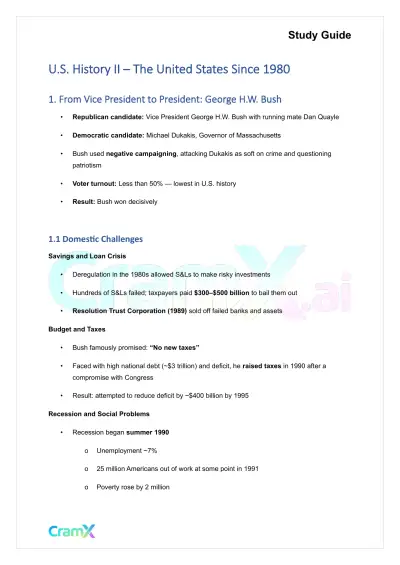 Quick Guides
U.S. History II - The United States Since 1980
History
16 pagesMar 2026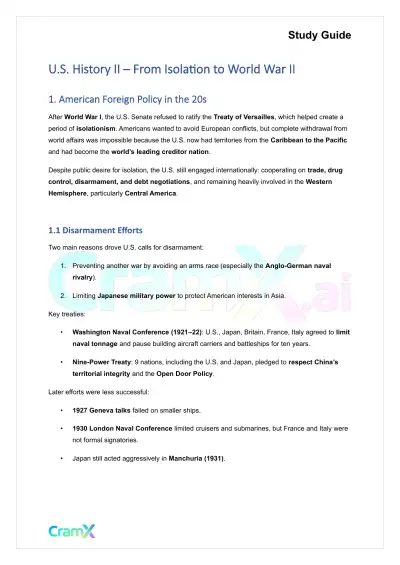 Quick Guides
U.S. History II - From Isolation to World War II
History
9 pagesMar 2026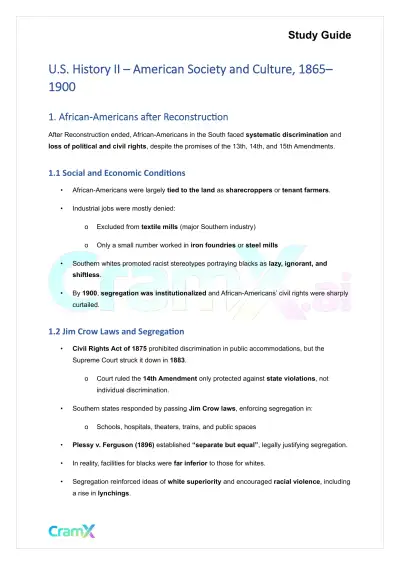 Quick Guides
U.S. History II - American Society and Culture, 1865–1900
History
7 pagesMar 2026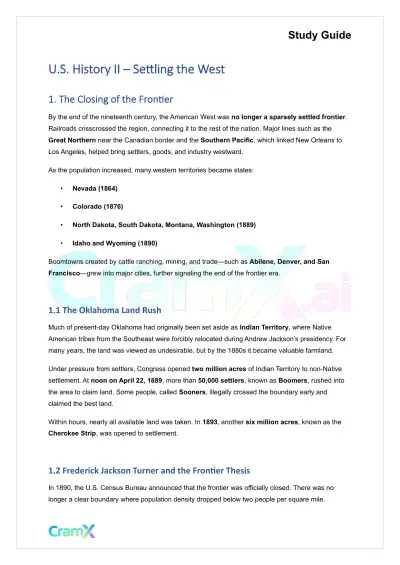 Quick Guides
U.S. History II - Settling the West
History
13 pagesMar 2026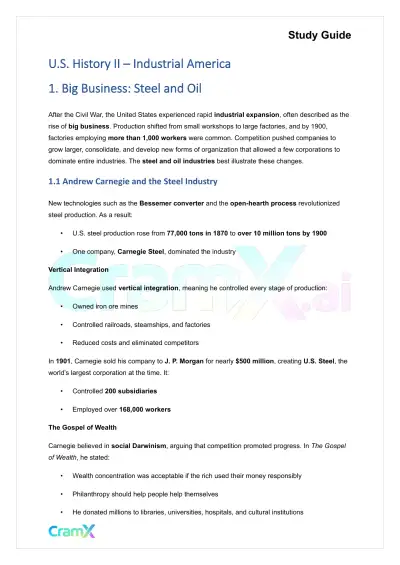 Quick Guides
U.S. History II - Industrial America
History
12 pagesMar 2026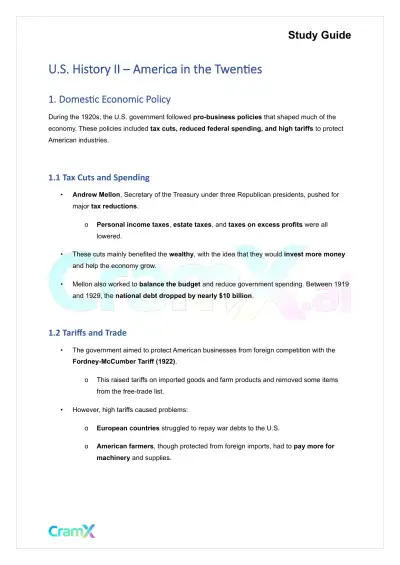 Quick Guides
U.S. History II - America in the Twenties
History
9 pagesMar 2026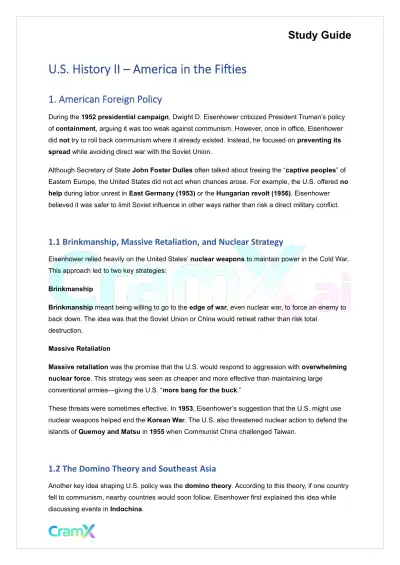 Quick Guides
U.S. History II - America in the Fifties
History
12 pagesMar 2026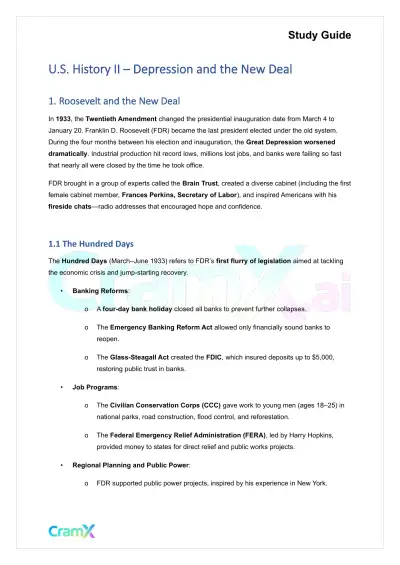 Quick Guides
U.S. History II - Depression and the New Deal
History
10 pagesMar 2026
Study this document with CramX
Once it is in your library, every tool can work from it.