

U.S. History II - The Second World War, 1941–1945
- History
- Texas A&M University
- 8 pages
- Shared March 2026
Preview 3 of 8 pages
See the first 3 pages exactly as they appear in the document.
Page 1 Read page 1 as text
Study Guide U.S. History II – The Second World War, 1941 – 1945 1. The Home Front The U.S. was fully mobilized for World War II after Pearl Harbor in December 1941, but preparations had begun earlier with the draft in 1940 and rearmament . By the end of the war, about 15 million Americans served in the military, and wartime production soared. The gross national product increased from $91 billion in 1939 to $166 billion in 1945, and 17 million new jobs were created. Fighting on Two Fronts • Europe : The Allies initially disagreed on the best way to defeat Nazi Germany , but key decisions from 1942 to 1945 led to the Cold War . • Pacific : After initial losses, the U.S. started going on the offensive against Japan , with major battles like the invasion of Guadalcanal (1942) and eventually dropping the first atomic bombs on Hiroshima and Nagasaki . 1.1 The War’s Impact on the Economy • End of the Great Depression : Unemployment dropped from 17% in 1939 to just 1.2% by 1944 . The issue became too few workers, not too few jobs. • Women in the Workforce : As men went to war, millions of women replaced them in factories, often taking nontraditional jobs . The image of Rosie the Riveter became iconic. • Victory Gardens & Scrap Drives : Citizens grew their own food to help with shortages, and collected rubber, metals, etc., to support the war effort. 1.2 The Wartime Economy & Production • War Production Board (WPB) : This new agency oversaw the conversion of industries from making consumer goods to military supplies like tanks , planes , and ships . • Rationing & Price Controls : The Office of Price Administration (OPA) controlled prices and rationed goods like gasoline , food , and shoes . • Wages & Inflation : With so many workers in high demand, wages increased, and the government kept inflation in check.
Page 2 Read page 2 as text
Study Guide 1.3 Financing the War • The war was funded by tax increases (e.g., the Revenue Act of 1942 ) and war bonds . • Federal income tax was collected through payroll deductions starting in 1943, bringing many Americans into the tax system for the first time. 1.4 Life for Women, African - Americans, and Hispanics • Women in the Military : Over 200,000 women served in auxiliary military roles like the Women’s Army Corps (WACs) and WAVES (Navy) . • African - Americans : Despite segregation and discrimination in the military, over two million African - Americans worked in war plants by 1944. The Tuskegee Airmen , a famous all - black squadron, became heroes. • Hispanics : Many Hispanic soldiers earned prestigious awards, but they also faced discrimination. In Los Angeles , a race riot in 1943 led to violence against Mexican - American youth . 1.5 The Internment of Japanese - Americans • Following the Pearl Harbor attack , fear and prejudice led to Executive Order 9066 , which forced 110,000 Japanese - Americans into internment camps . Many were U.S. citizens, and the evacuation was racially motivated, as there was no real security threat. • The 442nd Regimental Combat Team , a unit made up of Japanese - Americans, became the most decorated unit in WWII. • Supreme Court upheld the internment policy in Korematsu v. U.S. (1944), but in 1988 , the government apologized and compensated survivors. 1.6 Politics During the War • GI Bill of Rights (1944) : This law provided veterans with benefits like education , home loans , and job preferences . • Presidential Election (1944) : Roosevelt, despite his poor health, ran for a fourth term and won against Thomas E. Dewey . • Congressional Elections (1942) : Republicans gained seats, and the government started reducing some New Deal programs.
Page 3 Read page 3 as text
Study Guide 2. The World at War The United States' military strategy during World War II focused on defeating Germany first, while also battling Japan in the Pacific. Although the U.S. faced a two - front war, the initial priority was to defeat Germany, which influenced both the European and Pacific theater strategies. 2.1 Naval War in the Pacific: 1941 – 1945 • Early Japanese Advances (1941 – 42): o Pearl Harbor Attack (December 7, 1941) : Japan's surprise attack prompted the U.S. to enter the war. o Japan quickly seized several territories, including Malaya , Singapore , Guam , Wake Island , and Hong Kong , and invaded the Philippines . o Bataan and Corregidor surrendered in 1942; General Douglas MacArthur fled to Australia. • Doolittle Raid (April 18, 1942) : o U.S. bombers attacked Tokyo. While militarily insignificant, it boosted Allied morale. • Key Naval Battles : o Battle of the Coral Sea (May 1942) : First major naval battle fought entirely by aircraft carriers. Japan’s plans to invade Port Moresby failed. o Battle of Midway (June 1942) : Japan lost four aircraft carriers and almost 300 planes, ending its offensive in the Pacific and protecting Hawaii. • The Pacific Island - Hopping Strategy : o Guadalcanal Campaign (August 1942 – February 1943) : The first major offensive, where Japan was forced to abandon the island. o By 1943, American and Australian forces had gained control of the northern coast of New Guinea . o The B - 29 Superfortress bombing campaign began in June 1944, targeting Japan from newly captured islands in the Mariana Islands . • Liberation of the Philippines : o MacArthur returned to the Philippines (October 1944).
5 more pages in the full document
Unlock it once and it stays in your library, ready to chat with or turn into flashcards.
Unlock the full documentMore History study materials
See all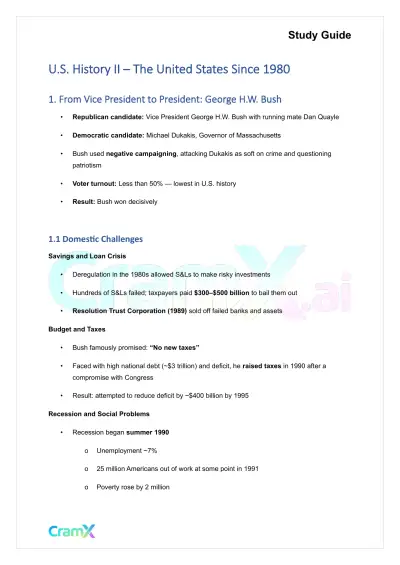 Quick Guides
U.S. History II - The United States Since 1980
History
16 pagesMar 2026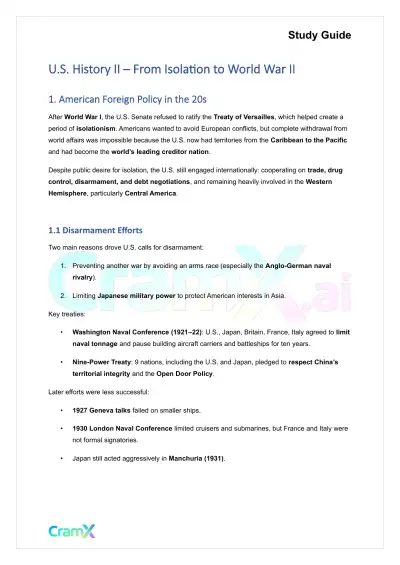 Quick Guides
U.S. History II - From Isolation to World War II
History
9 pagesMar 2026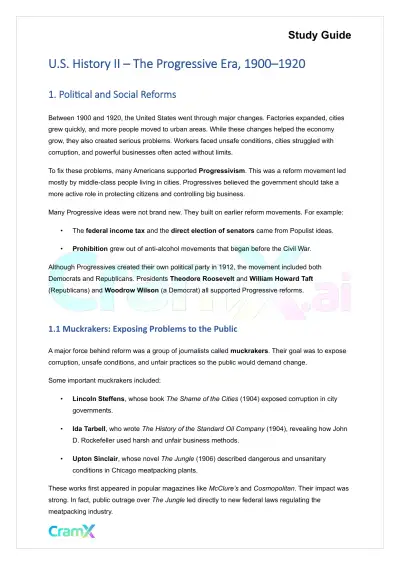 Quick Guides
U.S. History II - The Progressive Era, 1900–1920
History
10 pagesMar 2026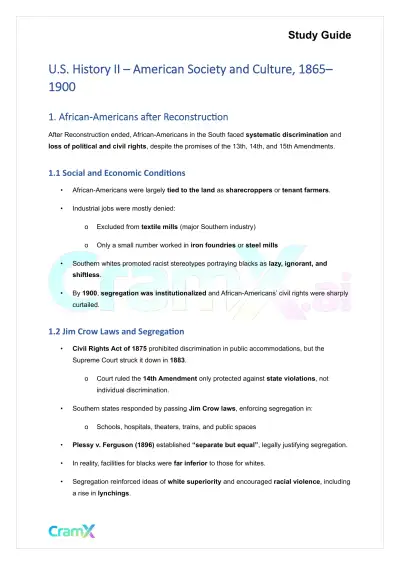 Quick Guides
U.S. History II - American Society and Culture, 1865–1900
History
7 pagesMar 2026 Quick Guides
U.S. History II - Settling the West
History
13 pagesMar 2026 Quick Guides
U.S. History II - Industrial America
History
12 pagesMar 2026 Quick Guides
U.S. History II - America in the Twenties
History
9 pagesMar 2026 Quick Guides
U.S. History II - America in the Fifties
History
12 pagesMar 2026
Study this document with CramX
Once it is in your library, every tool can work from it.