

U.S. History II - Politics, Farming, Empire, 1876–1900
- History
- Texas A&M University
- 10 pages
- Shared March 2026
Preview 3 of 10 pages
See the first 3 pages exactly as they appear in the document.
Page 1 Read page 1 as text
Study Guide U.S. History II – Politics, Farming, Empire, 1876 – 1900 1. Domestic Politics From the end of Reconstruction in the late 1870s to the early 1900s, Republicans and Democrats had very similar goals . Both parties generally supported business interests. Although the government did take some steps to regulate railroads and large corporations (trusts), neither party focused much on the social and economic problems caused by rapid industrial growth and e xpanding cities. Most political debates during this time focused on issues that may seem ordinary today, such as: • Monetary policy (money and currency) • Civil service reform (how government jobs were filled) • Tariffs (taxes on imported goods) One major group that felt ignored was farmers . Because the federal government did little to help agriculture, farmers began organizing and pushing for political change on their own. While domestic issues dominated much of this period, foreign policy became more important in the late 1890s . In just a few years, the United States gained overseas territories in the Pacific and the Caribbean , turning the nation into a major world power. 1.1 A Closely Divided Political System Politics during this era were closely balanced . Republicans controlled the presidency for most of the years between 1876 and 1900 , but elections were usually very close. Winning candidates often received less than 50 percent of the popular vote . Congress was usually divided: • Republicans often controlled the Senate • Democrats often controlled the House of Representatives This balance existed because neither party had nationwide support . • Democrats were strongest in the “ Solid South ” (former Confederate states), parts of the border states, and large northern cities. They were supported by recent immigrants, Catholics, and working - class voters, often mobilized by political machines.
Page 2 Read page 2 as text
Study Guide • Republicans were strongest in small towns, rural areas of the Midwest and New England, and among business leaders, the growing middle class, and African Americans (when they were able to vote). Some states — such as New York, Ohio, Illinois, and Indiana — were swing states , meaning they could vote for either party in a presidential election. 1.2 Greenbacks, Gold, and Silver: The Money Debate After the Civil War, the U.S. monetary system was confusing and unstable . Several forms of money circulated at the same time: • Gold coins (such as double eagles and eagles) • Silver coins (dollars, half - dollars, quarters, dimes) • Greenbacks , paper money issued during the war • Bank notes printed by private banks, often without enough assets to back them up As people looked for economic stability, two opposing views developed: • Supporters of limited money wanted a smaller money supply to keep prices low and stabilize the economy. • Supporters of expanded money wanted more money in circulation to help debtors — especially farmers — pay off loans and raise crop prices. The Fight Over Silver The debate became intense after the Coinage Act of 1873 , which stopped the minting of silver dollars. Supporters of silver called this law the “Crime of ’73.” In response: • The Greenback Labor Party called for unlimited silver coinage. • Congress passed the Bland - Allison Act (1878) , requiring the government to buy silver each month, though officials bought only the minimum amount. • The Sherman Silver Purchase Act (1890) increased silver purchases and allowed treasury notes to be redeemed in gold or silver. Even with these laws, the money issue was not resolved and became the main issue in the 1896 presidential election .
Page 3 Read page 3 as text
Study Guide 1.3 Civil Service Reform: Ending the Spoils System Many Americans were angry about corruption in government, especially during Ulysses S. Grant’s presidency . At the time, government jobs were often filled using the spoils system , where the winning party gave jobs to loyal supporters. Critics argued this system led to: • Inexperienced workers • Corruption • Inefficient government The Republican Party split over reform: • Half - Breeds supported reform and ending the spoils system. • Stalwarts wanted to keep patronage jobs. In 1880 , Republicans nominated James A. Garfield (a Half - Breed) for president and Chester A. Arthur (a Stalwart) for vice president. After Garfield was assassinated by a frustrated office seeker, public outrage led to the Pendleton Civil Service Act (1883) . This law: • Created the Civil Service Commission • Required many government jobs to be filled through competitive exams Although the law initially covered only a small number of jobs, later reforms expanded it and improved the quality of federal employees. 1.4 The Election of 1884 and Grover Cleveland In 1884 , Republicans nominated James G. Blaine , whose reputation was damaged by corruption scandals. Democrats nominated Grover Cleveland , who had quickly risen from mayor of Buffalo to governor of New York. The campaign was harsh: • Republicans accused Cleveland of fathering an illegitimate child; he admitted responsibility and paid child support.
7 more pages in the full document
Unlock it once and it stays in your library, ready to chat with or turn into flashcards.
Unlock the full documentMore History study materials
See all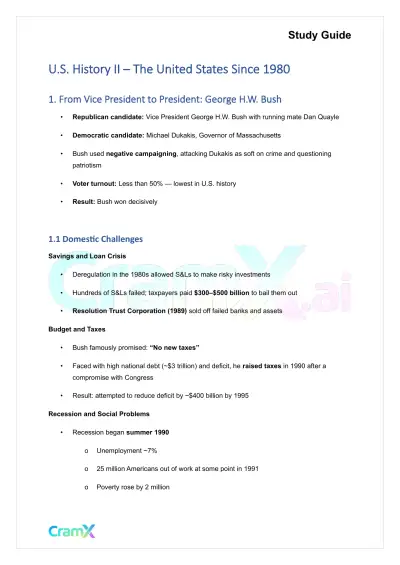 Quick Guides
U.S. History II - The United States Since 1980
History
16 pagesMar 2026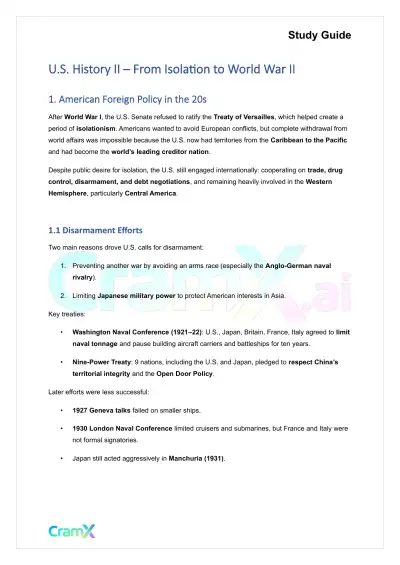 Quick Guides
U.S. History II - From Isolation to World War II
History
9 pagesMar 2026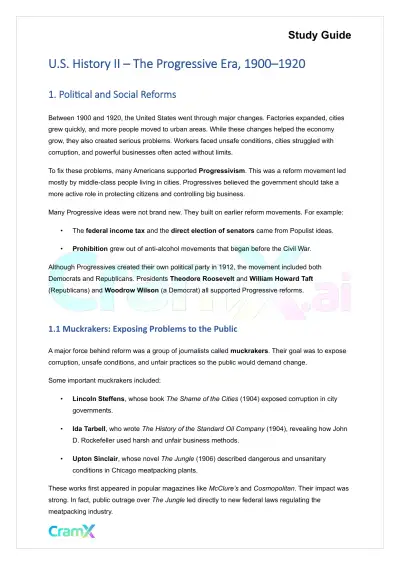 Quick Guides
U.S. History II - The Progressive Era, 1900–1920
History
10 pagesMar 2026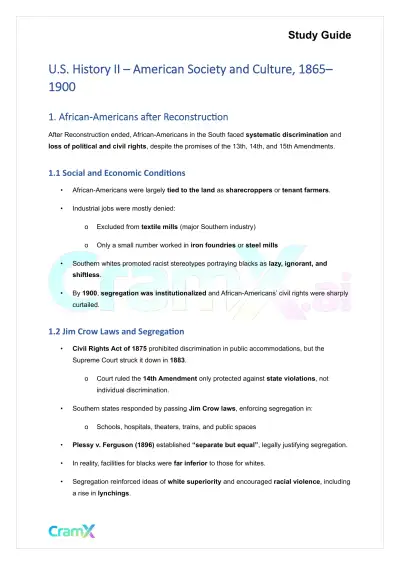 Quick Guides
U.S. History II - American Society and Culture, 1865–1900
History
7 pagesMar 2026 Quick Guides
U.S. History II - Settling the West
History
13 pagesMar 2026 Quick Guides
U.S. History II - Industrial America
History
12 pagesMar 2026 Quick Guides
U.S. History II - America in the Twenties
History
9 pagesMar 2026 Quick Guides
U.S. History II - America in the Fifties
History
12 pagesMar 2026
Study this document with CramX
Once it is in your library, every tool can work from it.