

U.S. History II - The Rise of the Cold War, 1945–1953
- History
- Texas A&M University
- 11 pages
- Shared March 2026
Preview 4 of 11 pages
See the first 4 pages exactly as they appear in the document.
Page 1 Read page 1 as text
Study Guide U.S. History II – The Rise of the Cold War, 1945 – 1953 1. The Cold War at Home The Cold War did not just shape how the United States dealt with other countries — it also deeply affected life inside the country. After World War II, the Soviet Union went from being a wartime ally to being seen as a dangerous enemy. As tensions increased, many Americans began to fear that Communists inside the United States were secretly working to undermine the government. Several events fueled these fears. The Soviet Union took control of Eastern Europe, China became a Communist nation, and in 1949 , the USSR successfully tested an atomic bomb much earlier than expected. Together, these developments created widespread anxiety and suspicion. From the late 1940s through the 1950s, the country experienced a period of intense anticommunist hysteria , often called the Red Scare . 1.1 Loyalty Checks and Internal Security In response to these fears, President Harry Truman took steps to protect national security. In 1947 , he issued Executive Order 9835 , which created the Federal Employee Loyalty Program . This program required background checks for more than three million federal employees to make sure they were loyal to the United States. Although only a little over 200 people were fired , about 2,000 resigned , often under pressure. What made the program controversial was how vague the standards were. Someone could be labeled a security risk simply for being considered “potentially disloyal.” Groups often targeted included homosexuals , alcoholics , and people deeply in debt , even without proof of Communist ties. States and cities soon followed the federal government’s lead. Many required workers — especially teachers — to sign loyalty oaths , promising they had never belonged to the Communist Party or any group seeking to overthrow the government. When the Supreme Court ruled in Tolman v. Underhill (1953) that California could not single out university professors, the state responded by requiring all employees to take loyalty oaths. 1.2 The Internal Security (McCarran) Act Fear of Communist infiltration increased even more in 1950 , when Congress passed the Internal Security Act , also known as the McCarran Act . The law required Communists and Communist - front organizations to register with the attorney general , banned Communists from working in defense industries , and allowed the government to intern suspects during national emergencies .
Page 2 Read page 2 as text
Study Guide President Truman vetoed the bill, arguing it threatened civil liberties, but Congress overrode his veto. At the time, the threat seemed real. In 1950 , Klaus Fuchs , a scientist involved in the atomic bomb project, was convicted in Britain of spying for the Soviets. His case helped lead to the U.S. trial of Julius and Ethel Rosenberg , who were convicted of espionage in 1951 and executed in 1953 . Their case shocked the nation and strengthened fears of internal betrayal. 1.3 The House Committee on Un - American Activities (HUAC) The House Committee on Un - American Activities (HUAC) had existed since 1938, but it became especially active after World War II. In 1947 , HUAC focused on the Hollywood film industry , investigating whether movies were spreading Communist ideas. Many witnesses cooperated and named others, but a group known as the Hollywood Ten refused to testify. They were convicted of contempt of Congress and sent to prison. After the hearings, Hollywood studios created a blacklist , preventing anyone suspected of Communist ties from working, even without solid evidence. HUAC also investigated Alger Hiss , a former New Deal official and assistant secretary of state. In 1948 , Whittaker Chambers , a former Communist, accused Hiss of being a spy. Chambers later produced microfilm of government documents, which he claimed Hiss had passed to him for the Soviets. Although the evidence was weak, Hiss was convicted of perjury for lying to Congress. The case helped launch the political career of Richard Nixon , a young congressman on the committee. His role in the investigation helped him win a Senate seat in 1950 and later become vice president . 1.4 Senator Joseph McCarthy No figure became more closely associated with the Red Scare than Senator Joseph McCarthy of Wisconsin. In 1950 , McCarthy claimed in a speech that he had a list of 205 Communists working in the State Department . He never provided proof and frequently changed the number, but his accusations gained attention. Several events helped McCarthy gain influence, including the Korean War and the Rosenberg trial . Since most of his accusations targeted Democrats , Republican leaders often supported or tolerated him. After Republicans gained control of Congress in 1952 , McCarthy became chair of a powerful investigative subcommittee. Eventually, McCarthy went too far. When he accused the U.S. Army of being soft on Communism, the issue exploded into the Army - McCarthy hearings in 1954 , which were broadcast on national television. Millions of Americans watched McCarthy’s aggressive and bullying behavior, and public support quickly faded. Later that year, the Senate formally censured him. He died in 1957 , his career in ruins.
Page 3 Read page 3 as text
Study Guide 1.5 The Election of 1952 By 1952, President Truman was deeply unpopular due to the ongoing Korean War , corruption scandals, and Communist fears. After losing the New Hampshire primary, he chose not to run again. The Democrats nominated Adlai Stevenson , governor of Illinois, and selected John Sparkman of Alabama as his running mate to appeal to southern voters. The Republicans faced a choice between conservative Senator Robert Taft and war hero General Dwight D. Eisenhower . Eisenhower won the nomination and chose Richard Nixon as his vice - presidential candidate to appeal to anticommunists. The Republican campaign focused on three major issues : ending the war in Korea, fighting corruption, and stopping Communism. Eisenhower’s promise to personally go to Korea resonated with voters. Although Nixon faced a scandal involving a campaign fund, his emotional “Checkers” speech saved his spot on the ticket. 1.6 A Republican Victory The election was a landslide victory for Eisenhower. He defeated Stevenson by more than six million votes and won 442 electoral votes , including several southern states that had long supported Democrats. Eisenhower also attracted voters from groups traditionally aligned with the New Deal coalition, signaling a major shift in American politics. 2. Postwar America When World War II ended in 1945, the United States was in a powerful position. It had the world’s strongest economy and was the only nation with atomic weapons . After years of the Great Depression and wartime sacrifice, Americans were eager to return to normal life and enjoy peace. At the same time, the U.S. did not retreat from world affairs as it had after World War I. Instead, growing tension with the Soviet Union led to the Cold War , shaping both foreign and domestic policy for decades. 2.1 From World War to Cold War Although the fighting ended, peace did not mean global stability. Relations between the United States and the Soviet Union quickly worsened. This rivalry, called the Cold War , involved political, economic, and military competition rather than direct fighting.
Page 4 Read page 4 as text
Study Guide • The U.S. worked to contain communism by: o Forming new military alliances o Giving economic and military aid to democratic nations • At home, fear of communist influence led to anticommunist investigations , especially in government, Hollywood, and the military. • Senator Joseph McCarthy became famous for accusing people of being communists without solid evidence, creating fear and suspicion across the country. 2.2 Demobilization and Economic Transition After Japan surrendered, Americans expected a quick return to normal life — and that is mostly what happened. • The armed forces shrank rapidly: o From 12 million soldiers in 1945 to 1.5 million by 1947 • Factories quickly switched from wartime production to consumer goods . • New cars were already being produced for the 1946 model year . The economy absorbed returning veterans better than expected: • About two million veterans used the GI Bill to attend college or job training. • Many women who had worked during the war left or lost their jobs , making room for returning soldiers. • Strong consumer demand created plenty of jobs , preventing the postwar depression many feared. Still, challenges remained. 2.3 Inflation and Labor Unrest The biggest economic problem after the war was inflation . • When wartime price and wage controls were lifted in 1946: o Prices rose sharply — nearly 25% overall o Food prices increased even more
7 more pages in the full document
Unlock it once and it stays in your library, ready to chat with or turn into flashcards.
Unlock the full documentMore History study materials
See all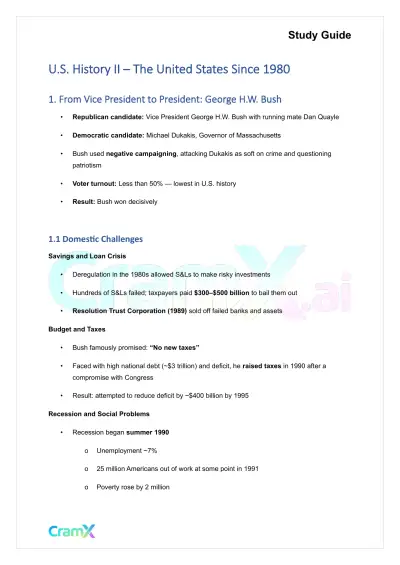 Quick Guides
U.S. History II - The United States Since 1980
History
16 pagesMar 2026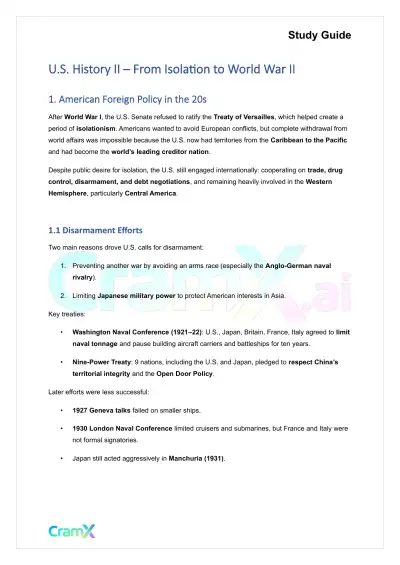 Quick Guides
U.S. History II - From Isolation to World War II
History
9 pagesMar 2026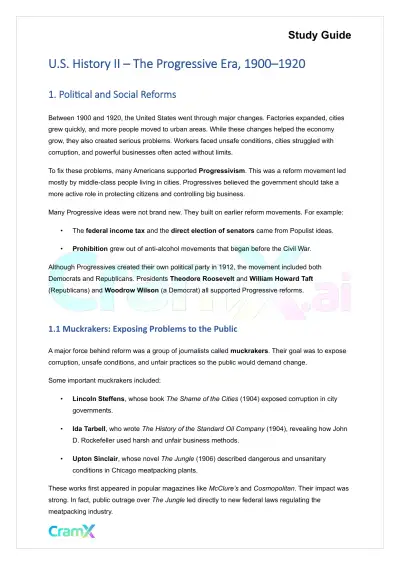 Quick Guides
U.S. History II - The Progressive Era, 1900–1920
History
10 pagesMar 2026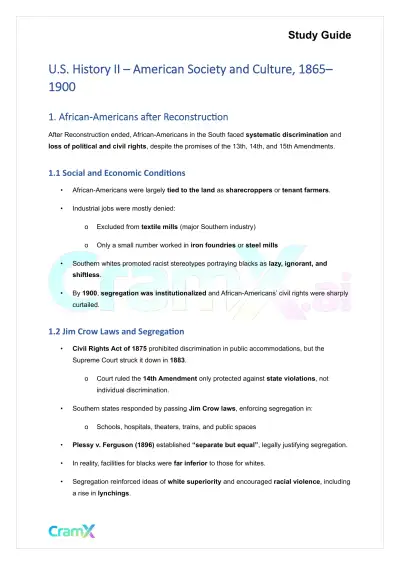 Quick Guides
U.S. History II - American Society and Culture, 1865–1900
History
7 pagesMar 2026 Quick Guides
U.S. History II - Settling the West
History
13 pagesMar 2026 Quick Guides
U.S. History II - Industrial America
History
12 pagesMar 2026 Quick Guides
U.S. History II - America in the Twenties
History
9 pagesMar 2026 Quick Guides
U.S. History II - America in the Fifties
History
12 pagesMar 2026
Study this document with CramX
Once it is in your library, every tool can work from it.