

U.S. History II - Settling the West
- History
- Texas A&M University
- 13 pages
- Shared March 2026
Preview 4 of 13 pages
See the first 4 pages exactly as they appear in the document.
Page 1 Read page 1 as text
Study Guide U.S. History II – Settling the West 1. The Closing of the Frontier By the end of the nineteenth century, the American West was no longer a sparsely settled frontier . Railroads crisscrossed the region, connecting it to the rest of the nation. Major lines such as the Great Northern near the Canadian border and the Southern Pacific , which linked New Orleans to Los Angeles, helped bring settlers, goods, and industry westward. As the population increased, many western territories became states: • Nevada (1864) • Colorado (1876) • North Dakota, South Dakota, Montana, Washington (1889) • Idaho and Wyoming (1890) Boomtowns created by cattle ranching, mining, and trade — such as Abilene, Denver, and San Francisco — grew into major cities, further signaling the end of the frontier era. 1.1 The Oklahoma Land Rush Much of present - day Oklahoma had originally been set aside as Indian Territory , where Native American tribes from the Southeast were forcibly relocated during Andrew Jackson’s presidency. For many years, the land was viewed as undesirable, but by the 1880s it became valuable farmland. Under pressure from settlers, Congress opened two million acres of Indian Territory to non - Native settlement. At noon on April 22, 1889 , more than 50,000 settlers , known as Boomers , rushed into the area to claim land. Some people, called Sooners , illegally crossed the boundary early and claimed the best land. Within hours, nearly all available land was taken. In 1893 , another six million acres , known as the Cherokee Strip , was opened to settlement. 1.2 Frederick Jackson Turner and the Frontier Thesis In 1890, the U.S. Census Bureau announced that the frontier was officially closed. There was no longer a clear boundary where population density dropped below two people per square mile.
Page 2 Read page 2 as text
Study Guide This announcement inspired historian Frederick Jackson Turner , who in 1893 presented his famous paper, “The Significance of the Frontier in American History.” Turner argued that: • The frontier shaped American democracy and culture. • Life on the frontier encouraged individualism, independence, innovation, and self - reliance . • The frontier experience made the United States different from Europe. Turner’s ideas had a lasting influence on American historical thinking, especially the importance of geography in shaping national identity. 1.3 Preservation and the New West Although western settlement continued after 1890, Americans began to see the West not just as land to be used, but as land worth preserving . Key developments included: • Yellowstone National Park (1872), the first national park. • Yosemite National Park (1890), the first park created specifically to protect wilderness. • The Forest Reserve Act of 1891 , which allowed presidents to set aside land as national forests. • President Benjamin Harrison quickly protected 13 million acres of forestland. Naturalist John Muir , a leading advocate for conservation, helped establish Yosemite and founded the Sierra Club in 1892 to protect the western wilderness. 1.4 Looking Ahead to the Twentieth Century Even as conservation efforts expanded, Americans also focused on developing western resources . In the twentieth century, large - scale projects such as: • Dams • Irrigation systems • Aqueducts • Electric power lines would dramatically reshape the region, bringing water and electricity to cities hundreds of miles away and transforming the West beyond anything imagined in 1890.
Page 3 Read page 3 as text
Study Guide 2. Resistance of the Indians in the West 2. 1 Westward Migration After the Civil War • Millions moved west (1860s – 1890s) from the East, Midwest, Europe, and Asia. • Motivations: o Cheap land (Homestead Act) o Gold and mineral wealth o Railroads and new economic opportunities • Travel methods: railroads, wagon trains, sea routes. • Results: new farms, towns, and industries — but many settlers failed economically . 2. 2 Cultural Conflict Between Settlers and Native Americans Major misunderstandings included: • Religion: Native spiritual beliefs (polytheistic, nature - based) were disrespected. • Social structure: Extended kinship systems confused outsiders. • Land ownership: o Indians viewed land as communal hunting territory . o Whites saw land as private property to be surveyed and sold in 160 - acre plots. These differences led settlers to view Native Americans as obstacles to progress. 2. 3 U.S. Indian Policy and the Indian Wars • Federal policy (1860s): o Confine tribes to reservations o Encourage farming and abandonment of nomadic lifestyles
Page 4 Read page 4 as text
Study Guide Tribes that resisted: • Great Plains: Sioux, Cheyenne, Arapaho • Southwest: Apache, Comanche, Navajo • Northwest: Nez Percé Major Conflicts: • Sand Creek Massacre (1864): o Over 300 Cheyenne and Arapaho killed despite peace terms. • Battle of Little Bighorn (1876): o Sioux and Cheyenne defeated Custer’s force. • Apache resistance: o Ended with capture of Geronimo (1886) . 2.4 Destruction of the Bison • Bison were central to Plains Indian survival. • Millions killed by: o Railroad hunters o Commercial hide hunters o “Sportsmen” shooting from trains • By the 1880s, bison were nearly extinct. • Loss of bison forced tribes onto reservations. 2. 5 Dawes Severalty Act (1887) • Ended recognition of tribes as sovereign nations. • Broke up reservations into individual land allotments : o 160 acres for heads of households o 80 acres for single adults • Land held in trust for 25 years → citizenship granted after. Surplus land sold to whites .
9 more pages in the full document
Unlock it once and it stays in your library, ready to chat with or turn into flashcards.
Unlock the full documentMore History study materials
See all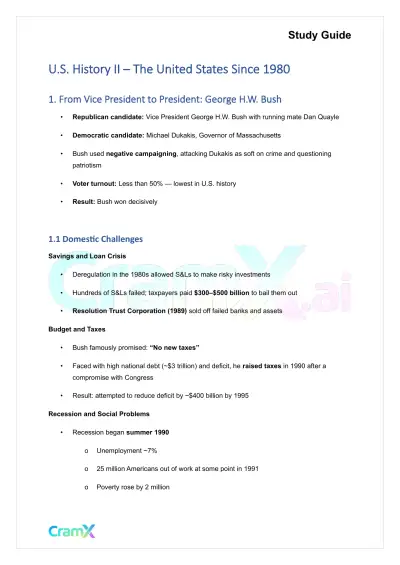 Quick Guides
U.S. History II - The United States Since 1980
History
16 pagesMar 2026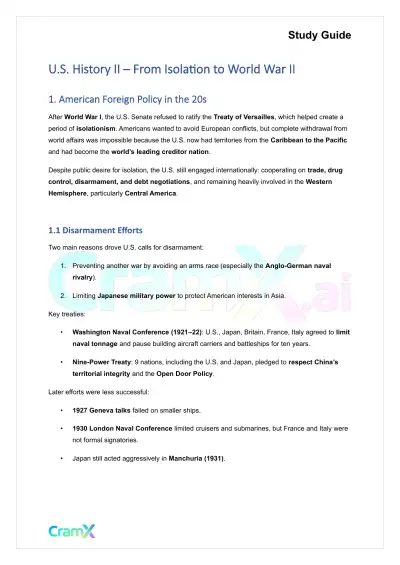 Quick Guides
U.S. History II - From Isolation to World War II
History
9 pagesMar 2026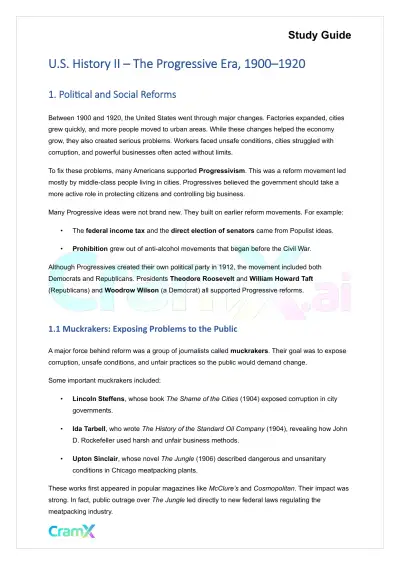 Quick Guides
U.S. History II - The Progressive Era, 1900–1920
History
10 pagesMar 2026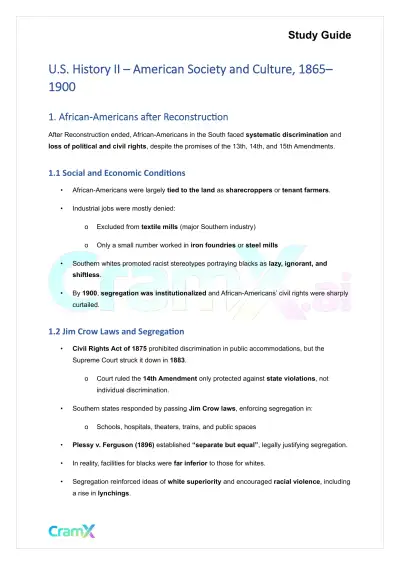 Quick Guides
U.S. History II - American Society and Culture, 1865–1900
History
7 pagesMar 2026 Quick Guides
U.S. History II - Industrial America
History
12 pagesMar 2026 Quick Guides
U.S. History II - America in the Twenties
History
9 pagesMar 2026 Quick Guides
U.S. History II - America in the Fifties
History
12 pagesMar 2026 Quick Guides
U.S. History II - Depression and the New Deal
History
10 pagesMar 2026
Study this document with CramX
Once it is in your library, every tool can work from it.