

U.S. History II - The United States as a World Power
- History
- Texas A&M University
- 8 pages
- Shared March 2026
Preview 3 of 8 pages
See the first 3 pages exactly as they appear in the document.
Page 1 Read page 1 as text
Study Guide U.S. History II – The United States as a World Power 1. Foreign Policy in the Progressive Era After the Spanish - American War (1898) , the United States became one of the world’s imperial powers. America gained overseas territories stretching across the globe — from Puerto Rico in the Caribbean to the Philippines in the Pacific . Leading up to World War I , the U.S. tried to maintain influence in Asia through diplomacy while following a more aggressive approach in the Western Hemisphere . The United States generally stayed out of European conflicts until August 1914 , when World War I began. Even then, the U.S. remained neutral for almost three years . When American troops joined the war in 1917 , they played a key role in the Allied victory and gave President Woodrow Wilson a chance to influence the peace settlement. However, the Senate refused to ratify the Treaty of Versailles , signaling a shift toward isolationism . 1.1 The Panama Canal The Spanish - American War showed the need for a canal connecting the Atlantic and Pacific Oceans . The French had tried to build one in the 1880s but failed. The U.S. took over the project. • The Hay - Herran Treaty (1903) gave the U.S. a 99 - year lease on a six - mile - wide strip of land in Panama for $10 million plus annual payments . • When Columbia refused to approve the treaty , Panamanians revolted with U.S. support . • The Hay - Bunau - Varilla Treaty gave the U.S. full control of the Canal Zone , and construction began in 1904 . The first ship passed through the canal in 1914 . The project was an engineering marvel. It also led to major medical advances , such as controlling yellow fever, malaria , and other tropical diseases. 1.2 American Intervention in the Caribbean and Central America During the Progressive Era and into the 1920s, the U.S. intervened frequently in nearby countries. • Cuba : The Platt Amendment (1901) allowed the U.S. to intervene to maintain stability. It also gave the U.S. a naval base at Guantanamo Bay , prevented Cuba from making foreign treaties that threatened its sovereignty, and limited Cuba’s ability to take on debt. U.S. troops were sent to Cuba in 1906, 1912, and 1917 .
Page 2 Read page 2 as text
Study Guide • Roosevelt Corollary (1904) : This expanded the Monroe Doctrine , stating that chronic wrongdoing in the Western Hemisphere could justify U.S. intervention. o Dominican Republic : U.S. controlled finances and occupied the country in 1916 to maintain stability. o Haiti : U.S. troops and officials were present from 1915 to 1934 . o Nicaragua : U.S. Marines intervened from 1912 to 1925 to protect American interests and ensure control over potential canal routes. Essentially, the U.S. acted as the “police power” of the Western Hemisphere. 1.3 U.S. Policy in Asia At the turn of the century, Japan was the dominant Asian power. • Roosevelt as Peacemaker : When Japan went to war with Russia in 1904 , Roosevelt mediated the conflict. The Treaty of Portsmouth (1905) ended the war, recognized Japan’s influence in Manchuria , and required Russia to give up part of Sakhalin Island . Roosevelt earned the Nobel Peace Prize for this effort. • Taft - Katsura Agreement (1905) : The U.S. recognized Japan’s control of Korea , while Japan recognized U.S. control of the Philippines . • Root - Takahira Agreement (1908) : Both nations agreed to respect each other’s territories and maintain the Open Door Policy in China . Dollar Diplomacy under President Taft aimed to expand U.S. influence through business investments, particularly in Asia . However, it was more successful in Central and South America than in Asia. 1.4 Relations with Mexico During the Mexican Revolution, the U.S. opposed General Victoriano Huerta , who had seized power in 1911 . • President Wilson supported Venustiano Carranza , a revolutionary leader. • U.S. troops attacked Veracruz in 1914 , helping Huerta leave office. Carranza took control of Mexico City. • Conflicts continued between Carranza and Pancho Villa . When Villa raided a town in New Mexico in 1916 , Wilson sent the U.S. Army into Mexico to capture him. The expedition lasted until January 1917 and nearly caused war between the U.S. and Mexico.
Page 3 Read page 3 as text
Study Guide 2. The United States in World War I On June 28, 1914 , Archduke Franz Ferdinand of Austria - Hungary was assassinated by a Serbian nationalist. Austria - Hungary demanded that Serbia pay reparations, but Serbia denied involvement and turned to its ally, Russia , for support. When Russia mobilized its army, the European alliance system quickly pulled multiple countries into war. • Germany (Austria - Hungary’s ally) declared war on Russia on August 1, 1914, and on France two days later. • Great Britain entered the war on August 4 after Germany invaded neutral Belgium. • By the end of August, most of Europe had joined either the Central Powers (Germany, Austria - Hungary, Bulgaria, Ottoman Empire) or the Allied Powers (Britain, France, Russia, Serbia). Other countries also got involved: • Japan joined the Allies to expand influence in Asia, creating tensions with the U.S. • Italy , originally allied with Germany and Austria - Hungary, joined the Allies in 1915 after promises of territorial gains. 2.1 American Neutrality When war broke out, President Woodrow Wilson declared the U.S. neutral, asking Americans to remain “impartial in thought as well as in action.” But staying neutral was tricky: • German Americans generally supported the Central Powers • Irish Americans disliked Britain • Eastern European Jewish immigrants hoped for a Russian defeat Many Americans still sympathized with the Allies because Britain and France represented democracy. U.S. investors also loaned billions of dollars to the Allies, and most American trade was with Britain and France. The biggest threat to neutrality was Germany’s unrestricted submarine warfare . In May 1915, Germany sank the British ship Lusitania , killing almost 1,200 people, including 128 Americans. After further attacks, Germany issued the Sussex Pledge in 1916, promising not to attack passenger ships without warning.
5 more pages in the full document
Unlock it once and it stays in your library, ready to chat with or turn into flashcards.
Unlock the full documentMore History study materials
See all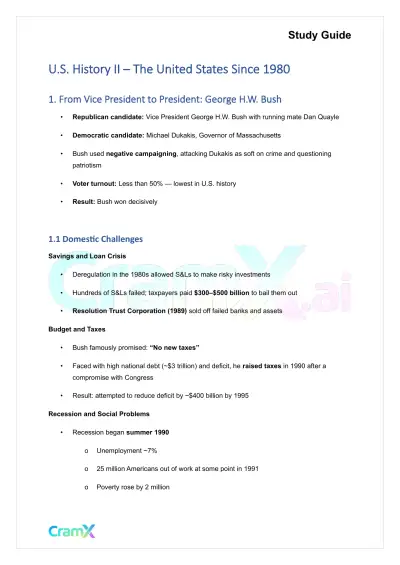 Quick Guides
U.S. History II - The United States Since 1980
History
16 pagesMar 2026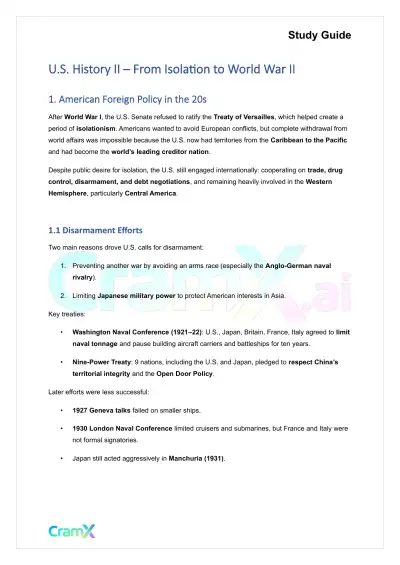 Quick Guides
U.S. History II - From Isolation to World War II
History
9 pagesMar 2026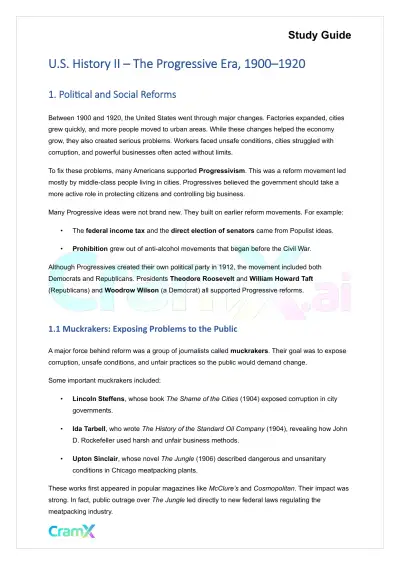 Quick Guides
U.S. History II - The Progressive Era, 1900–1920
History
10 pagesMar 2026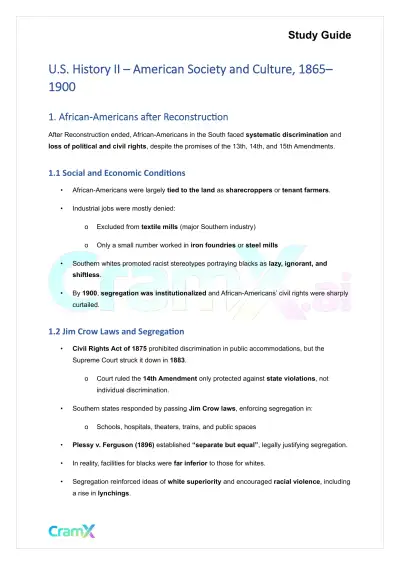 Quick Guides
U.S. History II - American Society and Culture, 1865–1900
History
7 pagesMar 2026 Quick Guides
U.S. History II - Settling the West
History
13 pagesMar 2026 Quick Guides
U.S. History II - Industrial America
History
12 pagesMar 2026 Quick Guides
U.S. History II - America in the Twenties
History
9 pagesMar 2026 Quick Guides
U.S. History II - America in the Fifties
History
12 pagesMar 2026
Study this document with CramX
Once it is in your library, every tool can work from it.