

U.S. History II - Industrial America
- History
- Texas A&M University
- 12 pages
- Shared March 2026
Preview 4 of 12 pages
See the first 4 pages exactly as they appear in the document.
Page 1 Read page 1 as text
Study Guide U.S. History II – Industrial America 1. Big Business: Steel and Oil A fter the Civil War, the United States experienced rapid industrial expansion , often described as the rise of big business . Production shifted from small workshops to large factories, and by 1900, factories employing more than 1,000 workers were common. Competition pushed companies to grow larger, consolidate, and develop new forms of organization that allowed a few corporations to dominate entire industries. The steel and oil industries best illustrate these changes. 1.1 Andrew Carnegie and the Steel Industry New technologies such as the Bessemer converter and the open - hearth process revolutionized steel production. As a result: • U.S. steel production rose from 77,000 tons in 1870 to over 10 million tons by 1900 • One company, Carnegie Steel , dominated the industry Vertical Integration Andrew Carnegie used vertical integration , meaning he controlled every stage of production: • Owned iron ore mines • Controlled railroads, steamships, and factories • Reduced costs and eliminated competitors In 1901 , Carnegie sold his company to J. P. Morgan for nearly $500 million , creating U.S. Steel , the world’s largest corporation at the time. It: • Controlled 200 subsidiaries • Employed over 168,000 workers The Gospel of Wealth Carnegie believed in social Darwinism , arguing that competition promoted progress. In The Gospel of Wealth , he stated: • Wealth concentration was acceptable if the rich used their money responsibly • Philanthropy should help people help themselves • He donated millions to libraries, universities, hospitals, and cultural institutions
Page 2 Read page 2 as text
Study Guide 1.2 John D. Rockefeller and the Oil Industry John D. Rockefeller founded Standard Oil of Ohio in 1870 and soon controlled nearly the entire oil industry. Vertical and Horizontal Integration Rockefeller reduced costs by: • Making his own barrels • Building pipelines and storage facilities • Owning tank cars and refineries ( vertical integration ) He also used horizontal integration by: • Buying out or crushing competitors • Controlling 95% of U.S. oil refining capacity Trusts and Holding Companies In 1882 , Rockefeller created the Standard Oil Trust : • Stockholders gave control to trustees in exchange for higher dividends • Trusts allowed monopolies to operate efficiently 1.3 Government Response: Sherman Antitrust Act The growth of trusts alarmed the public and Congress: • Sherman Antitrust Act (1890) declared monopolies “in restraint of trade” illegal • Law was vague and weakly enforced • From 1890 – 1904, only 18 cases were filed, and four targeted labor unions Although the Standard Oil Trust was dissolved by Ohio in 1892 , Rockefeller reorganized in 1899 as Standard Oil of New Jersey , a holding company that continued to dominate the oil industry.
Page 3 Read page 3 as text
Study Guide 1.4 Big Business Beyond Steel and Oil • Gustavus Swift revolutionized meatpacking using vertical integration • Sugar refining and other industries formed trusts • Retailing also expanded: o John Wanamaker opened the first department store (1876) o Followed by Macy’s and Marshall Field o Department stores sold many products, bought in bulk, advertised heavily, and emphasized customer service 2. Technology and Business In the late 1800s, the United States experienced an incredible burst of invention. Before the Civil War, the U.S. Patent Office approved fewer than 1,000 patents a year. After the war, that number jumped to more than 20,000 patents each year between 1866 and 1900. This explosion of new ideas transformed everyday life and the economy. Even simple inventions could have huge effects. Barbed wire , introduced in 1874, changed farming and cattle ranching in the West by making it easier to fence land and control livestock. Other inventions improved how entire industries worked. For example, George Pullman’s sleeping car (1864) made long railroad trips more comfortable, while George Westinghouse’s air brake (1868) made trains much safer. At the same time, many new consumer products appeared. Items like the typewriter (1867) , carpet sweeper (1876) , adding machine (1888) , and Kodak hand camera (1888) changed how Americans worked, kept records, cleaned their homes, and enjoyed leisure time. 2.1 Thomas Edison and a New Way to Invent Many inventions in the nineteenth century came from individual inventors, but Thomas A. Edison changed how invention itself happened. Instead of working alone, Edison created a team - based approach. After early successes like an electric voting machine (1869) and improvements to the telegraph, Edison opened a research lab in Menlo Park, New Jersey, in 1876 . This was the first industrial
Page 4 Read page 4 as text
Study Guide research laboratory , sometimes called a “factory for inventions.” There, teams of skilled workers collaborated on new ideas. Some of Edison’s most famous inventions came from Menlo Park, including the phonograph (1877) , the first practical incandescent light bulb (1879) , and the first central electric power station (1882) . Later, at a larger lab in West Orange, New Jersey , Edison’s team developed more inventions, such as an improved motion picture projector (1897) and the alkaline storage battery (1900) . Although Edison personally held over 1,000 patents , many were the result of teamwork in his laboratories. 2.2 Edison vs. Westinghouse: The Battle Over Electricity Edison helped launch the electric power industry in 1882 when his Pearl Street Station began supplying electricity to customers in New York City. However, Edison’s system used direct current (DC) , which worked only over short distances. George Westinghouse offered a better solution: alternating current (AC) . Developed in 1886, AC electricity could travel long distances at high voltage and then be safely reduced for homes and businesses using transformers. Edison argued that high - voltage electricity was dangerous, but Westinghouse’s system proved more practic al. Westinghouse ultimately won the “battle of the currents.” Because AC power could be transmitted over long distances, factories no longer needed to be located near water or coal sources. Electricity allowed industry to spread out and grow more efficiently. 2.3 Alexander Graham Bell and the Communication Revolution In 1876, the same year Edison opened his lab, Alexander Graham Bell invented the telephone . At first, it seemed like a novelty, but it quickly became essential for businesses and households. By 1900 , nearly 800,000 telephones were in use across the United States. Bell’s patent was extremely valuable. His company — later known as American Telephone and Telegraph (AT&T) — used it to control the telephone industry by suing competitors for patent violations. Over time, AT&T absorbed hundreds of smaller phone companies and dominated long - distance communication.
8 more pages in the full document
Unlock it once and it stays in your library, ready to chat with or turn into flashcards.
Unlock the full documentMore History study materials
See all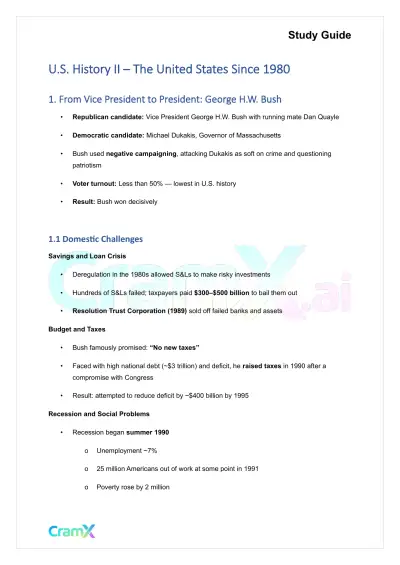 Quick Guides
U.S. History II - The United States Since 1980
History
16 pagesMar 2026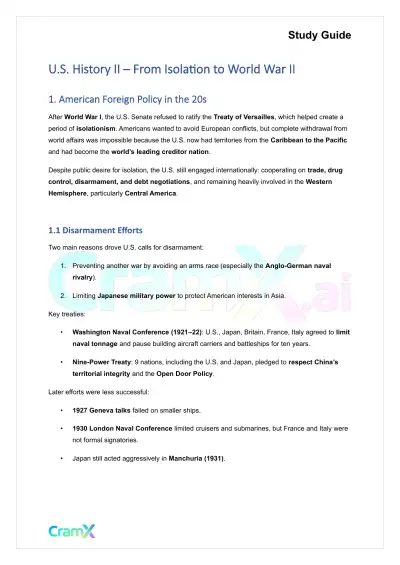 Quick Guides
U.S. History II - From Isolation to World War II
History
9 pagesMar 2026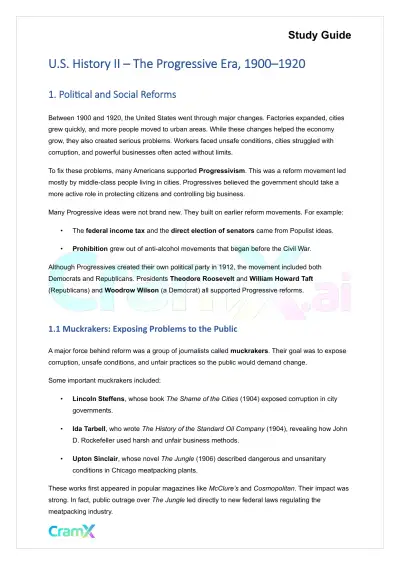 Quick Guides
U.S. History II - The Progressive Era, 1900–1920
History
10 pagesMar 2026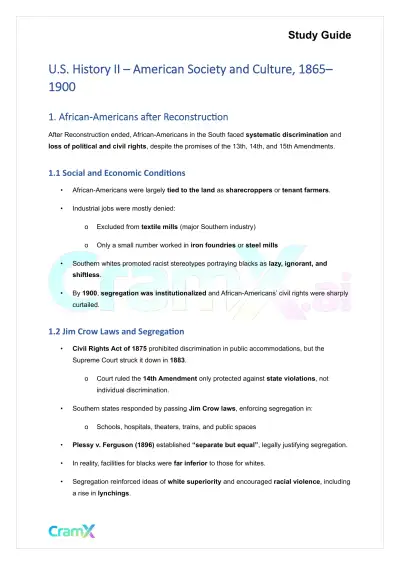 Quick Guides
U.S. History II - American Society and Culture, 1865–1900
History
7 pagesMar 2026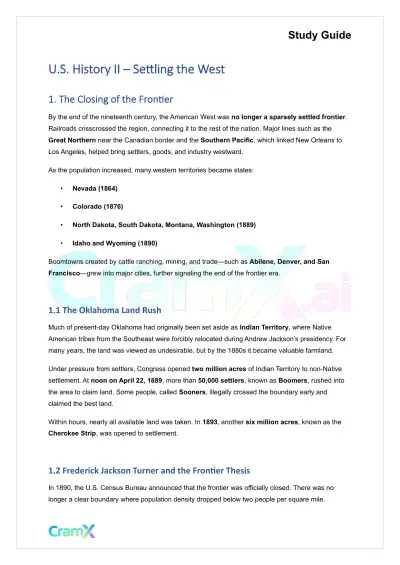 Quick Guides
U.S. History II - Settling the West
History
13 pagesMar 2026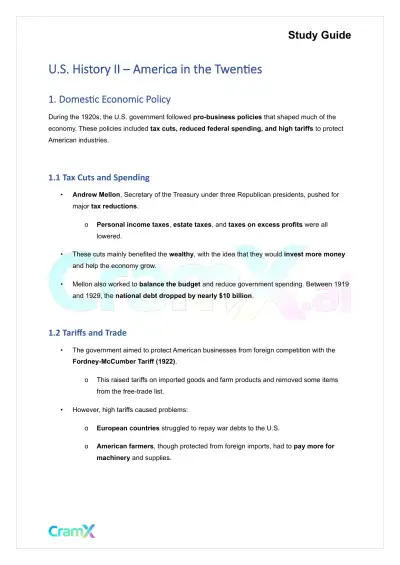 Quick Guides
U.S. History II - America in the Twenties
History
9 pagesMar 2026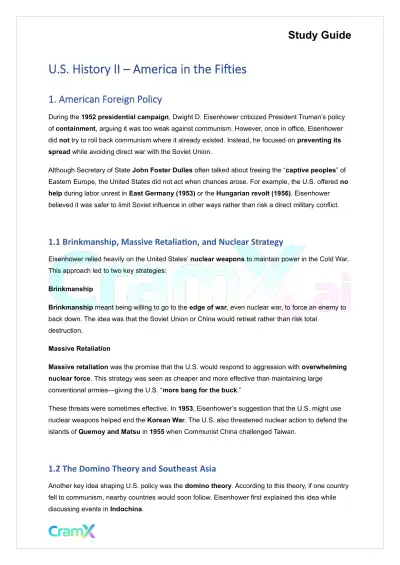 Quick Guides
U.S. History II - America in the Fifties
History
12 pagesMar 2026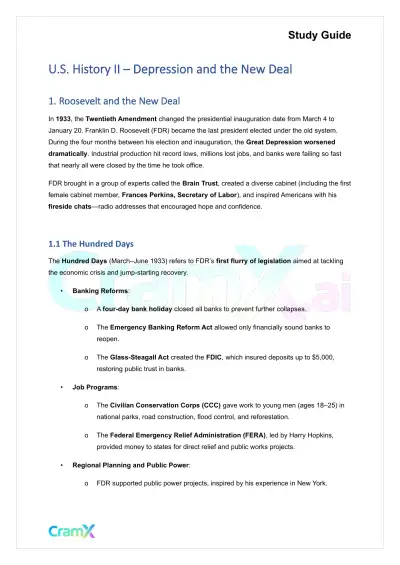 Quick Guides
U.S. History II - Depression and the New Deal
History
10 pagesMar 2026
Study this document with CramX
Once it is in your library, every tool can work from it.