

UGA History Exemption Test With Answers (394 Solved Questions)
- History
- 36 pages
- Shared May 2025
UGA History Exemption Test With Answers helps you achieve top marks with past exam practice.
Preview 11 of 36 pages
See the first 11 pages exactly as they appear in the document.
Page 1 Read page 1 as text
UGA Histor y Exemption Test with 100% Correct Answers 2023 Yazoo Lands - Correct answer - The sparsely - populated central and western areas of the US state of GA, when its western border stretched to the Mississippi River. James Jackson - Correct answer - October 18, 1819 - January 13, 1887. It was a US representative from GA, a judge advocate American Civil War, and a chief justice of the Supreme Court of Georgia. He nullified the yazoo sale and destructed records connected with the state. Later the Yazoo lands was given to the Federal Goverment. Iroquois League - Co rrect answer - Known as the haudenosaunee of the "People of the Longhouse", are a league of several nations and tribes of indigenous people of North America Yazoo Fraud - Correct answer - a massive fraud perpetrated from 1794 - 1803 by several Georgia governers and the state legislature. James Gun - Correct answer - Arranged the distribution of money of the Yazoo fraud and land to legislators, state officials, newspaper editors and cries of bribery and corruption. Trail of Tears - Correct answer - Forced relocatio n and movement of Native American nations from southeastern parts of the US following the Indian Removal Act of 1830. The removal included many members of the Cherokee, Muscogee, Seminole, Chickasaw and Choctaw nations, among others in the US, from their h omelands to Indian territory (From Georgia to Oklahoma.) Hernan Cortes - Correct answer - 1st Marquis of the Valley of Oaxaca (1485 - December 2, 1547) was a Spanish Conquistador who led an expedition that caused the fall of the Aztec Empire and brought lar ge portions of mainland Mexico under the rule of the King of Castile in the early 16th Century The Stono Rebellion - Correct answer - Slave rebellion that commenced on September 9 1739, in the colony of South Carolina. It was the largest slave uprising in t he British mainland colonies prior to the American Revolution. William Penn - Correct answer - October 14, 1644 - July 30 1718. It was an English real estate entrepreneur, philosopher and founder of the Province of Pennsylvania, the English North American c olony and the future Commonwealth of Pennsylvania The Great Awakening - Correct answer - Used to refer to several periods of religions revival in American religious history. Historians and theologians identify three or four waves of increased religious enth usiasm occurring between the early 18th and late 19th
Page 2 Page 3 Read page 3 as text
century. Each of these was characterized by widespread revivals lead by evangelical Protestant ministers, a sharp increase of interest in religion, a profound sense of conviction and redemption on the p art of those affected, an increase in evangelical church membership and the formation of new religious movements and denominations. Indentured Servitude - Correct answer - Historical practice of contracting to work for a fixed period of time, typically 3 to 7 years in exchange for transportation, food, clothing lodging and other necessities during the term of indenture. Quakers - Correct answer - Members of the Religious Society of friends. Came to North America in the early days because they wanted to spread their beliefs to the British colonists there, while others came to escape the persecution that they were experiencing in Europe. First known quakers arrived in 1656. The colony of Rhode Island with its policy of religious freedom was a frequent destionati on as the Friends were persecuted by law in Massachusetts until 1681. Pennsylvania was formed by William Penn in 1681 as a haven for persecuted. Mercantilism - Correct answer - the economic doctrine that government control of foreign trade is of paramount i mportance for ensuring the prosperity and military security of the state. Thomas Paine - Correct answer - English - American political activist, author, political theorist and revolutionary. As the author or two highly influential pamphlets at the start of th e American Revolution, he became one of the Founding Fathers of the United States. He has been called "a corsetmaker by trade, a journalist by profession, and a propagandist by inclination. Alexander Hamilton - Correct answer - (January 11, 1755 or 177 - Ju ly 12, 1804) was a Founding Father, soldier, economist, political philosopher, one of Amrica's first constitutional lawyers and the first US Secretary of the Treasury. Federalist papers - Correct answer - Series of 85 articles of essays promoting the ratification of the United States Constitution written by Alexander Hamilton, James Madison, and john jay French vs. Indian War - Correct answer - The war was fought primarily between the colonies of British America and the New France, with both sides supported by military units from their parent countries of Great Britain and France. In 1756 the war escalated from a regional affair into a world - wide conflict. In Canada some his torians refer to the conflict as the Seven Years War fought for control of eastern north america. British won. American Revolution - Correct answer - Political upheaval during the last half of the 18th century in which thirteen colonies in North America joi ned together to break free from the British Empire, combining to become the USA.
Page 4 Read page 4 as text
Revolutionary War - Correct answer - 1775 - 1783. began as a war between the Kingdom of Great Britain and the New USA, but gradually expanded to a global war between Britain on o ne side and USA, France, Netherlands and Spain on the other. Tories - Correct answer - A traditionalist and conservative political philosophy which grew out of the Cavalier faction in the Wars of the Three Kingdoms. Northwest ordinance - Correct answer - Act of the Congress of the Confederation of the US. Passed July 13, 1787. The primary effect was the creation of the Northwest Territory as the first organized territory of the US out of the region south of the Great Lakes, north and west of the Ohio River, a nd east of the Mississippi River. Kentucky and Virginia Resolves - Correct answer - Political statements drafted in 1798 and 1799 in which the Kentucky and Virginia legislatures took the position that the federal Alien and Sedition Acts were unconstitutiona l. Louisiana purchase - Correct answer - Acquisition by the US in 1803 of France's claim to the territory of Louisiana. Hartford Convention - Correct answer - An event in 1814 - 1815 in the US in which New England Federalists met to discuss their grievances co ncerning the ongoing war of 1812 and the political problems arising from the federal government's increasing power. Trustees dartmouth college vs woodward case - Correct answer - Was a landmark US Supreme Court case dealing with the application of the Contr act Clause of the US constitution to private corportations Frederick Douglass - Correct answer - February 1818 - February 20, 1895. African American social reformer, orator, writer and statesman. Former Slave Nullification Crisis - Correct answer - A sectiona l crisis during the presidency of Andrew Jackson created by South Carolina's 1832 Ordinance of Nullification. Second Party System - Correct answer - Term of periodization used by historians and political scientists to name the political party system existin g in the US from about 1828 - 1854 after the First Party System. The major parties were the Democratic Party, led by Andrew Jackson, and the Whig Party, assembled by Henry Clay from the National Republicans and other opponents of Jackson. First Party System - Correct answer - Model of American politics used by political scientists and historians to periodize the political party system existing in the United States between roughly 1792 and 1824. It featured two national parties competing for control of the pres idency, Congress, and the states: the Federalist Party, created largely by Alexander Hamilton, and the rival Democratic - Republican Party formed by Thomas Jefferson and James Madison.
Page 5 Read page 5 as text
Eli Whitney - Correct answer - December 8, 1765 - January 8, 1825. American inventor best known for inventing the cotton gin. Sectionalism - Correct answer - In national politics, this is often a precursor to separatism. Civil War - Correct answer - 1861 - 1865. war between organized groups within the same nation state or republic, or, less commonly, between two countries created from a formerly united nation state. American Civil War - Correct answer - 1861 - 1865. "War Between the States", was a civil war fought o ver the secession of the Confederate States. Women's Right Movement - Correct answer - rights and entitlements claimed for women and girls of many societies worldwide. Abolition Movement - Correct answer - movement to end slavery, whether formal or informal. In western Europe and the Americas, abolitionism was a historical movement to end the African slave trade and set slaves free. Abolitionism - Correct answer - After the American Revolutionary War established the United States, northern states, beginning wi th Pennsylvania in 1780, passed legislation during the next two decades to abolish slavery, sometimes by gradual emancipation. Massachusetts ratified a constitution that declared all men equal; freedom suits challenging slavery based on this principle brou ght an end to slavery in the state. Similar declarations of rights, as in Virginia, were not taken by the courts to apply to Africans. During the following decades, the abolitionist movement grew in northern states, and Congress limited the expansion of sl avery in new states admitted to the union. Seneca Falls Convention - Correct answer - an early and influential women's rights convention held in Seneca Falls, New York, July 19 - 20, 1848. It was organized by local New York women upon the occasion of a visit by Philadelphia - based Lucretia Mott, a Quaker famous for her orating ability, a skill rarely cultivated by American women at the time. Morrill Act of 1862 - Correct answer - Land - Grant are United States statutes that allowed for the creation of land - grant c olleges, including the Morrill Act of 1862 and the Morrill Act of 1890 (the Agricultural College Act of 1890) New York City Riots - Correct answer - (July 13 to July 16, 1863; known at the time as Draft Week[2]) were violent disturbances in New York City th at were the culmination of working - class discontent with new laws passed by Congress that year to draft men to fight in the ongoing American Civil War. The riots were the largest civil insurrection in American history.
Page 6 Read page 6 as text
New York City Riots Abraham Lincoln - Correct answer - President Abraham Lincoln diverted several regiments of militia and volunteer troops from following up after the Battle of Gettysburg to control the city. The rioters were overwhelmingly working - class men, primarily ethnic Irish, resenting particularly that wealthier men, who could afford to pay a $300 commutation fee to hire a substitute, were spared the draft. Jefferson Davis - Correct answer - (June 3, 1808 - December 6, 1889) was an American statesman and leader of the Confederacy during the American Civil War, serving as President of the Confederate States of America for its entire history. Ku Klux Klan - Correct answer - is the name of three distinct past and present far - right organizations in the United States, which have advocated extr emist reactionary currents such as white supremacy, white nationalism, and anti - immigration, historically expressed through terrorism. Andrew Johnson - Correct answer - (December 29, 1808 July 31, 1875) was the 17th President of the United States (1865 - 1869 ). he succeeded Abraham Lincoln following the latter's assassination. He then presided over the initial and contentious Reconstruction era of the United States following the American Civil War. Johnson's reconstruction policies failed to promote the rights of the Freedmen (newly freed slaves), and he came under vigorous political attack from Republicans, ending in his impeachment by the U.S. House of Representatives; he was acquitted by the U.S. Senate. Reconstruction Era of the United States - Correct answer - the first covers the complete history of the entire U.S. from 1865 - 1877 following the Civil War; the second sense focuses on the transformation of the Southern United States from 1863 to 1877, as dir ected by Washington, with the reconstruction of state and society. Reconstruction Era - Correct answer - From 1863 to 1869, Presidents Abraham Lincoln and Andrew Johnson (who became president on April 14, 1865) took a moderate position designed to bring the South back to normal as soon as possible, while the Radical Republicans (as they called themselves) used Congress to block the moderate approach, impose harsh terms, and upgrade the rights of the Freedmen (former slaves). The views of Lincoln and Johnson prevailed until the election of 1866, which enabled the Radicals to take control of policy, remove former Confederates from power, and enfranchise the Freedmen. A Republican coalition came to power in nearly all the southern states and set out to transform the society by setting up a free labor economy, with support from the Army and the Freedman's Bureau. The Radicals, upset at President Johnson's opposition to Congressional Reconstruction, filed impeachment charges but the action failed by one vote in the Senate. President Ulysses S. Grant supported Radical Reconstruction, using both the U.S. Justice Department and the U.S. military to suppress white insurgency and support Republican reconstructed states. Southern Democrats, alleging widespread corruption, counterattacked and regained
Page 7 Read page 7 as text
power in each state by 1877. President Rutherford B. Hayes blocked efforts to overturn Reconstruction legislation. John Brown's Raid - Correct answer - raid on Harpers Ferry was an attempt by white abolitionist John Brown to st art an armed slave revolt by seizing a United States Arsenal at Harpers Ferry in Virginia in 1859. Brown's raid was defeated by a detachment of U.S. Conscription - Correct answer - Conscription is the compulsory enlistment of people in some sort of national service, most often military service. Populist Party - Correct answer - A U.S. political party that sought to represent the interests of farmers and laborers in the 1890s, advocating increased currency issue, free coinage of gold and silver, public ownersh ip of railroads, and a graduated federal income tax. Also called People's Party. World War I - Correct answer - was a global war centred in Europe that began on 28 July 1914 and lasted until 11 November 1918. It was predominantly called the World War or the Great War from its occurrence until the start of World War II in 1939, and the First World War or World War I thereafter. Jim Crow - Correct answer - were state and local laws in the United States enacted between 1876 and 1965. They mandated de jure racial segregation in all public facilities in Southern states of the former Confederacy, with, starting in 1890, a "separate but equal" status for African Americans. Progressive Movement - Correct answer - a general political philosophy advocating or favoring so cial, political, and economic reform. America Prohibition - Correct answer - was a national ban on the sale, manufacture, and transportation of alcohol, in place from 1920 to 1933.[1] The ban was mandated by the Eighteenth Amendment to the Constitution, and the Volstead Act set down the rules for enforcing the ban and defined the types of alcoholic beverages that were prohibited. Private ownership of consumable alcohol and drinking it was not made illegal. Prohibition ended with the ratification of the Twent y - first Amendment, which repealed the Eighteenth Amendment, on December 5, 1933. Woodrow Wilson - Correct answer - December 28, 1856 - February 3, 1924. was the 28th President of the United States, from 1913 to 1921. A leader of the Progressive Movement, he served as President of Princeton University from 1902 to 1910, and then as the Governor of New Jersey from 1911 to 1913. Running against Republican incumbent William Howard Taft and Progressive ("Bull Moose") Party candidate Theodore Roosevelt, a former P resident, Wilson was elected President as a Democrat in 1912.
Page 8 Read page 8 as text
Treaty of Versailles - Correct answer - one of the peace treaties at the end of World War I. It ended the state of war between Germany and the Allied Powers. It was signed on 28 June 1919, exactl y five years after the assassination of Archduke Franz Ferdinand. League of Nations - Correct answer - was an intergovernmental organization founded as a result of the Paris Peace Conference that ended the First World War. Progressive Movement - Correct an swer - a general political philosophy advocating or favoring social, political, and economic reform. Federalist Party - Correct answer - considered the first American political party. It advocated a strong national government, and prominent Federalists includ ed John Adams and Alexander Hamilton. Whig Party - Correct answer - were a party in the Parliament of England, Parliament of Great Britain, and Parliament of the United Kingdom, who contested power with the rival Tories from the 1680s to the 1850s. Progressive Party - Correct answer - .... Populist Party - Correct answer - was a political party in the United States between 1984 and 1996. It was far - right and often white nationalist in its ideology. Mugwump Party - Correct answer - were Republican politic al activists who bolted from the United States Republican Party by supporting Democratic candidate Grover Cleveland in the United States presidential election of 1884. They switched parties because they rejected the financial corruption associated with Rep ublican candidate James G. Blaine. In a close election, the Mugwumps supposedly made the difference in New York state and swung the election to Cleveland. New Deal - Correct answer - A series of economic programs enacted in the United States between 1933 an d 1936. They involved presidential executive orders or laws passed by Congress during the first term of President Franklin D. Great Depression - Correct answer - Depression varied across nations, but in most countries it started in 1930 after the passage of the United States' Smoot - Hawley Tariff bill (June 17), and lasted until the late 1930s or middle 1940s.[1] It was the longest, most widespread, and deepest depression of the 20th century. World War II - Correct answer - was a global war that was under way by 1939 and ended in 1945. It involved a vast majority of the world's nations - including all of the great powers - eventually forming two opposing military alliances: the Allies and the Axis. Internment Camps - Correct answer - the relocation and internment by the United States government in 1942 of about 110,000 Japanese Americans and Japanese who lived along the Pacific coast of the United States to camps called "War Relocation Camps," in
Page 9 Read page 9 as text
the wake of Imperial Japan's attack on Pearl Harbor. The internment of Japanese Americans was applied unequally throughout the United States. Axis Powers - Correct answer - was the alignment of nations that fought in the Second World War against the Allied forces. Franklin D. Roosevelt - Correct answer - January 30, 1882 - April 12, 1945. was the 32nd President of the United States 1933 - 1945 and a central figure in world events during the mid - 20th century, leading the United States during a time of worldwide economic depression and total war. Victory Gardens - Correct answer - als o called war gardens or food gardens for defense, were vegetable, fruit and herb gardens planted at private residences and public parks in the United States, United Kingdom, Canada and Germany[1] during World War I and World War II to reduce the pressure o n the public food supply brought on by the war effort. In addition to indirectly aiding the war effort these gardens were also considered a civil "morale booster" — in that gardeners could feel empowered by their contribution of labor and rewarded by the p roduce grown. This made victory gardens become a part of daily life on the home front. Calvin Coolidgde - Correct answer - July 4, 1872 - January 5, 1933. was the 30th President of the United States 1923 - 1929 Scopes Trial - Correct answer - formally known as The State of Tennessee v. John Thomas Scopes and commonly referred to as the Scopes Monkey Trial, was a landmark American legal case in 1925 in which high school science teacher, John Scopes, was accused of violating Tennessee's Butler Act, which made it u nlawful to teach evolution in any state - funded school. Father Charles Coughlin - Correct answer - October 25, 1891 - October 27, 1979. It was a controversial Roman Catholic priest at Royal Oak, Michigan's National Shrine of the Little Flower church. Tennes see Valley Authority - Correct answer - is a federally owned corporation in the United States created by congressional charter in May 1933 to provide navigation, flood control, electricity generation, fertilizer manufacturing, and economic development in the Tennessee Valley, a region particularly affected by the Great Depression. Lend - lease act - Correct answer - was the program under which the United States of America supplied the United Kingdom, the Soviet Union, China, Free France, and other Allied nations with materiel between 1941 and 1945. It was signed into law on March 11, 19 41, a year and a half after the outbreak of World War II in Europe in September 1939 but nine months before the U.S
Page 10 Read page 10 as text
Hiroshima - Correct answer - The atomic bombings of the cities of Hiroshima and Nagasaki in Japan were conducted by the United States during the final stages of World War II in 1945. These two events are the only use of nuclear weapons in war to date. Harlem Renissance - Correct answer - a cultural movement that spanned the 1920s and 1930s. At the time, it was known as the "New Negro Movement", named after the 1925 anthology by Alain Locke. The Cold War - Correct answer - often dated from 1947 - 1991, was a sustained state of political and military tension between the powers of the Western world, led by the United States and its NATO allies, and the communist world, led by the Soviet Union, its satellite states and allies. Cuban missile Crisis - Correct answer - known as the October crisis in Cuba and the Caribbean crisis in the USSR - was a 13 - day confrontation between the Soviet Union and Cuba on one side and the United States on the other; the crisis occurred in October 1962, during the Cold War. Vietnam War - Correct answer - Cold War - era military conflict that occurred in Vietnam, Laos, and Cambodia from 1 November 1955 to the fall of Saigon on 30 Ap ril 1975. This war followed the First Indochina War and was fought between North Vietnam, supported by its communist allies, and the government of South Vietnam, supported by the United States and other anti - communist countries. Free Speech Movement - Cor rect answer - student protest which took place during the 1964 - 1965 academic year on the campus of the University of California, Berkeley under the informal leadership of students Mario Savio, Brian Turner, Bettina Aptheker, Steve Weissman, Art Goldberg, Jac kie Goldberg, and others. Civil Rights Movement - Correct answer - worldwide political movement for equality before the law occurring between approximately 1950 and 1980. In many situations it took the form of campaigns of civil resistance aimed at achievin g change by nonviolent forms of resistance. In some situations it was accompanied, or followed, by civil unrest and armed rebellion. The process was long and tenuous in many countries, and many of these movements did not fully achieve their goals although, the efforts of these movements did lead to improvements in the legal rights of previously oppressed groups of people. Martin Luther King, Jr. - Correct answer - January 15, 1929 - April 4, 1968. was an American clergyman, activist, and prominent leader in t he African - American Civil Rights Movement. Novel Prize winner. National Organization of Women - Correct answer - the largest feminist organization in the United States. It was founded in 1966 and has a membership of 500,000 contributing members. unsuccessfu lly campaigned for an equal rights amendment in const.
Page 11 Read page 11 as text
Richard Nixon - Correct answer - January 9, 1913 - April 22, 1994. was the 37th President of the United States, serving from 1969 to 1974. The only president to resign the office, Nixon had previously se rved as a US representative and senator from California and as the 36th Vice President of the United States from 1953 to 1961. Watergate Scandal - Correct answer - was a political scandal that occurred in the United States in the 1970s as a result of the Ju ne 1972 break - in at the Democratic National Committee headquarters at the Watergate office complex in Washington, D.C., and the Nixon administration's attempted cover - up of its involvement. Communism - Correct answer - a revolutionary socialist movement to create a classless, moneyless, and stateless social order structured upon common ownership of the means of production, as well as a social, political and economic ideology that aims at the establishment of this social order.america feared this 1960's yout h movement - Correct answer - started because of the Civil Rights movement. belief was that how could the U.S fight for another countries freedom when their was racism and discrimination occurring in their own country? The first anti - war protest was "teach - i ns". These were meant to educate the public about the war. youth movement - Correct answer - The youth were focusing on the freedom and rights for youth, but they were also protesting the Vietnam War. The protest against the war was organized marches and pr otests. They took a non - violent approach. Once it became obvious that it was impossible to win the war the protest movement reached its peak. Although they wanted to use non - violent approaches, some anti - war demonstration turned violent, for example, the March on the Pentagon, Kent State University, and Detroit Riots. The Kent State Incident Youth movement - woodstock - Correct answer - lead to the temporary closures of about 500 Universities. One of the most famous anti - war demonstrations was Woodstock. It was known as "Three Days of Peace and Music." When one mentions the counterculture of the 1 960's, Woodstock is the first term and image that is constructed. Baby Boomers - Correct answer - a person who was born during the demographic Post - World War II baby boom between the years 1946 and 1964, according to the U.S. Containment - Correct answer - a United States policy using numerous strategies to prevent the spread of communism abroad. Brown V. Board of Education - Correct answer - was a landmark United States Supreme Court case in which the Court declared state laws establishing separate public sch ools for black and white students unconstitutional.
25 more pages in the full document
Unlock it once and it stays in your library, ready to chat with or turn into flashcards.
Unlock the full documentMore History study materials
See all Exam Guides
Test Bank For Visions of America: A History of the United States, Combined Volume 2nd Edition Test Bank
History
1084 pages111downloadsFeb 2025 Exam Guides
Cengage Advantage Books: Making America, Volume 1 To 1877: A History Of The United States, 7th Edition Test Bank
History
170 pages60downloadsFeb 2025 Exam Guides
Test Bank for The American Journey: A History of the United States, Combined Volume, 8th Edition
History
447 pagesMay 2025 Exam Guides
Palmer, A History of Europe in the Modern World, 11th Edition Test Bank
History
766 pagesMay 2025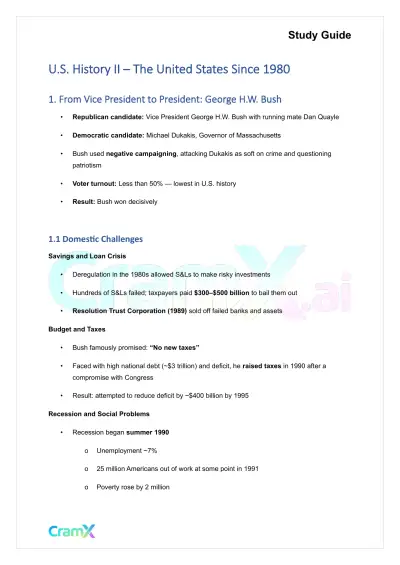 Quick Guides
U.S. History II - The United States Since 1980
History
16 pagesMar 2026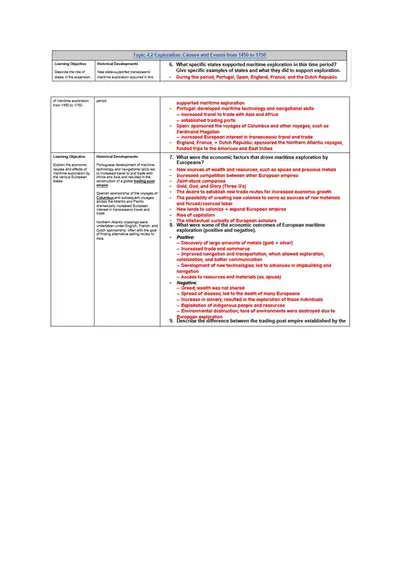 Solved Assignments
AP World History Unit 4 Study Guide (Transoceanic
History
14 pagesJun 2025 Solved Assignments
Liberty University CSTU 101 Quiz 3 Complete Solutions Correct Answers Key Four different versions
History
9 pagesMay 2025 Solved Assignments
Liberty University HIUS 221 Quiz 2 Complete Solutions Correct Answers Key
History
31 pagesMay 2025
Study this document with CramX
Once it is in your library, every tool can work from it.