

U.S. History I - Challenges for a New Nation
- History
- Texas A&M University
- 9 pages
- Shared March 2026
Preview 3 of 9 pages
See the first 3 pages exactly as they appear in the document.
Page 1 Read page 1 as text
Study Guide U.S. History I – Challenges for a New Nation 1 Foreign Policy Challenges After gaining independence, the United States faced many foreign policy problems . Some were leftover issues from the Revolutionary War, and others came from new political challenges. • Britain had promised to leave frontier forts but kept troops there for over ten years. • Native Americans looked for alliances with Britain and Spain to stop American settlers from moving west. • France had entered wars in Europe after its revolution, testing America’s ability to remain neutral. 1.1 Conflicts on the Frontier When George Washington became president, one urgent problem was fighting between settlers and Native Americans in the Ohio Valley . • American military campaigns in 1790 and 1791 against the Miami Confederacy (eight western tribes) failed. • For the third campaign, Washington sent General Anthony Wayne , a Revolutionary War veteran known for careful planning. Wayne’s well - trained army, over 2,000 men strong , defeated the tribes at the Battle of Fallen Timbers in August 1794. • The Treaty of Greenville followed, with twelve tribes giving up almost all of Ohio , parts of Indiana , and land for sixteen trading posts. • Native American resistance in the Northwest Territory largely ended for about twenty years . The Southeast Tribes In the southeast , relations were different. Washington negotiated peacefully with the Cherokee, Creek, and Choctaw . • Creek Chief Alexander McGillivray tried to use Spain against the U.S., but Washington still reached an agreement. • The Treaty of New York (1790) guaranteed the Creek’s land rights and restored lands to the Chickasaw and Choctaw .
Page 2 Read page 2 as text
Study Guide 1.2 Problems with France The French Revolution initially inspired Americans, but by 1793 many were worried: • The French executed their king and queen. • France declared war on Britain and Spain . • Southern planters feared unrest in the French Caribbean colonies. • Northern merchants worried about trade with Britain, their main export partner. Although the 1778 alliance with France remained, Washington knew the U.S. wasn’t ready for war. He issued the Proclamation of Neutrality on April 22, 1793 . Citizen Genet France sent Edmond Genet , known as Citizen Genet , as its ambassador. • He ignored diplomacy, recruiting Americans to fight Britain and Spain. • He appointed George Rogers Clark to lead a campaign against Spain in New Orleans (which failed). • Genet did succeed in recruiting privateers , and nearly 1,000 Americans captured over 80 British ships . 1.3 Problems with Great Britain The British violated American neutrality by: • Seizing U.S. ships in the West Indies • Impressing American sailors (forcing them into the British navy) Washington responded with diplomacy. He sent John Jay to negotiate a treaty. The Jay Treaty (1795) addressed: • British withdrawal from Northwest forts • Opening West Indies trade (with some limits) Unresolved: Compensation for slaves taken during the Revolution. • The treaty was controversial in the U.S., but it prevented war. • The Senate approved it by one vote .
Page 3 Read page 3 as text
Study Guide 1.4 Successful Negotiations with Spain Relations with Spain were more successful. Spain wanted peace because: • Its war with France was going poorly • Rumors suggested Americans might attack New Orleans Washington sent Thomas Pinckney to negotiate. • Spain agreed on the 31st parallel as the southern U.S. border • Spanish troops north of that line were withdrawn • Americans could use the Mississippi River freely • They were allowed temporary storage in New Orleans (Privilege of Deposit) • Trade rights with Spain were granted The agreement was formalized in the Treaty of San Lorenzo (Pinckney’s Treaty) on October 27, 1795 . 2. Ideological Challenges After Washington’s presidency, the United States faced major political and ideological challenges. While his foreign policy successes, such as the partial victory of the Jay Treaty and the triumph of Pinckney’s Treaty , supported neutrality, they did not solve the problem of a politically divided nation . Washington retired after two terms and, in his farewell address (1797) , warned Americans against political parties and entangling alliances in European conflicts. His advice would influence U.S. foreign policy for more than a century. 2.1 The Election of 1796 Despite Washington’s warnings, political parties had already formed: the Federalists and the Republicans (also called Democratic - Republicans). By 1796, these parties were in full swing. • Federalists dominated Congress and the presidency. • Republicans gained strength by attracting Irish immigrants and French refugees from Saint Domingue .
6 more pages in the full document
Unlock it once and it stays in your library, ready to chat with or turn into flashcards.
Unlock the full documentMore History study materials
See all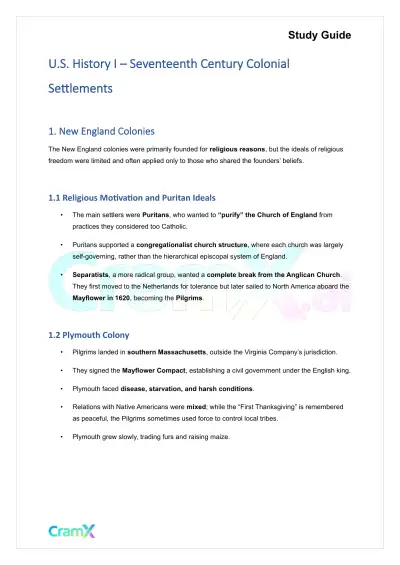 Quick Guides
U.S. History I - Seventeenth Century Colonial Settlements
History
8 pagesMar 2026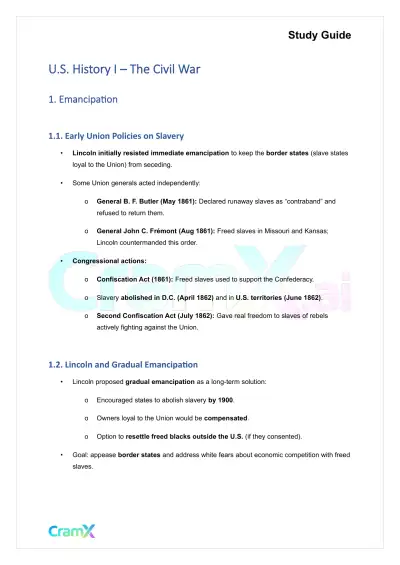 Quick Guides
U.S. History I - The Civil War
History
9 pagesMar 2026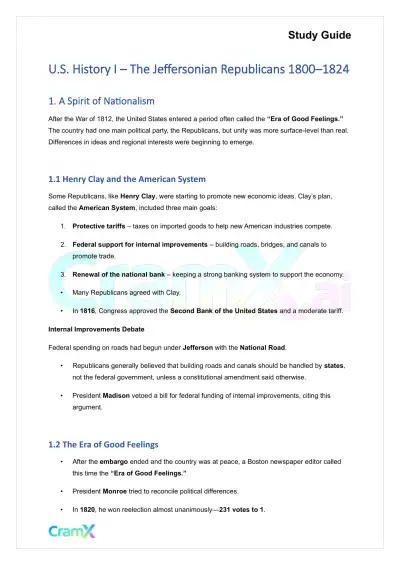 Quick Guides
U.S. History I - The Jeffersonian Republicans 1800–1824
History
11 pagesMar 2026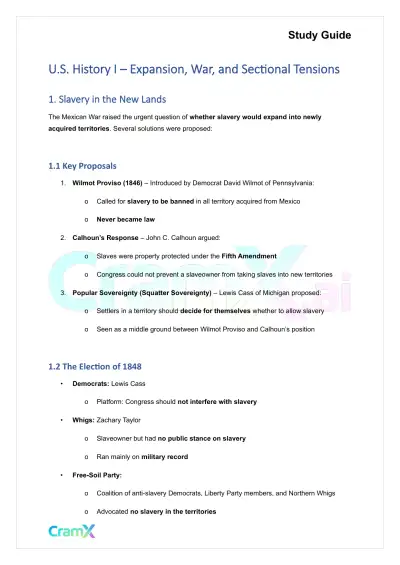 Quick Guides
U.S. History I - Expansion, War, and Sectional Tensions
History
9 pagesMar 2026 Quick Guides
U.S. History I - American Society and Culture 1815–1860
History
9 pagesMar 2026 Quick Guides
U.S. History I - Era of Reconstruction
History
9 pagesMar 2026 Quick Guides
U.S. History I - Economic Growth and Development 1815–1860
History
8 pagesMar 2026 Quick Guides
U.S. History I - Eighteenth Century Colonial America
History
11 pagesMar 2026
Study this document with CramX
Once it is in your library, every tool can work from it.