

U.S. History I - From Discontent to Revolution
- History
- Texas A&M University
- 11 pages
- Shared March 2026
Preview 4 of 11 pages
See the first 4 pages exactly as they appear in the document.
Page 1 Read page 1 as text
Study Guide U.S. History I – Creating a New Nation 1. Discontent in the Colonies After 1763, the relationship between Britain and its American colonies began to change. What had once seemed like a strong partnership slowly turned into conflict. Let’s explore why this happened and how colonial resistance began to grow. 1.1 Britain’s Growing Empire — and Its Growing Problems By 1763 , Britain had become a global power, with territory stretching from India to North America and the Caribbean . Winning this empire, especially through the Seven Years’ War , was expensive. Britain faced: • Massive war debt • Already high taxes at home • New costs to govern and protect its expanded lands British leaders believed the American colonies should help pay for these expenses. From Britain’s point of view, this seemed fair. The colonies had prospered during the war , especially by supplying the British military. The colonists, however, had their own expectations. They wanted: • Free access to western lands • Continued control over their local governments Although most colonists still thought of themselves as loyal English subjects , a stronger American identity was beginning to form. During the war, colonial assemblies had gained more power by demanding concessions from royal governors. After experiencing this independence, colonists were no longer sure they wanted to return to being passive subjects of the empi re.
Page 2 Read page 2 as text
Study Guide 1.2 Trouble in the West: Pontiac’s Rebellion The Seven Years’ War had started over control of the Ohio River Valley , and that region quickly became a problem for Britain after the war ended. Native American tribes understood that British victory meant more settlers moving onto their land . In 1763 , an Ottawa leader named Pontiac organized a coalition of tribes to resist British expansion. This uprising, known as Pontiac’s Rebellion , caused major unrest: • Eight British forts were captured • British settlements were threatened, including Detroit and Pittsburgh In a brutal response, British forces distributed smallpox - infected blankets to Native Americans — an early and disturbing example of biological warfare. Although Pontiac did not formally make peace until 1766 , Parliament tried to calm tensions sooner through new policies. 1.3 The Proclamation of 1763 To prevent further conflict, Britain issued the Proclamation of 1763 . This law: • Drew a boundary along the Appalachian Mountains • Banned settlers and traders from moving west without permission The goal was to separate colonists from Native American lands and reduce violence. Colonists, however, saw the proclamation as an attack on their land claims . Many ignored it and continued moving west. Within a few years, Britain negotiated treaties that opened large parts of New York, Pennsylvania, Ohio, and Virginia to settlement, making the proclamation largely ineffective. 1.4 New Taxes and Tighter Control The Proclamation of 1763 signaled Britain’s desire to tighten control over the colonies. The Sugar Act of 1764 reinforced this message. For over a century, the Navigation Acts had regulated trade mainly to protect British commerce, not to raise money. The Sugar Act changed that. Officially called the American Revenue Act , it aimed to generate income by: • Lowering the tax on foreign molasses • Cracking down on smuggling • Using vice - admiralty courts , which denied colonists jury trials
Page 3 Read page 3 as text
Study Guide 1. 5 The Stamp Act: A Turning Point The situation worsened with the Stamp Act of 1765 . This law required colonists to buy special stamped paper for: • Legal documents • Newspapers • Business contracts • Playing cards Almost everyone was affected, and violators faced harsh penalties. Unlike earlier taxes, the Stamp Act was an internal tax , meaning it directly taxed everyday activities inside the colonies. This made it especially unpopular. 1. 6 “No Taxation Without Representation” Some British leaders, including William Pitt , opposed the Stamp Act. They argued it violated the principle of no taxation without representation . Prime Minister George Grenville disagreed. He claimed colonists were virtually represented in Parliament — that lawmakers represented all British subjects, even those who did not vote for them. Colonists strongly rejected this idea. They argued that without American representatives in Parliament, British lawmakers could not truly understand or represent colonial interests. 1. 7 Colonial Resistance Grows Colonists responded quickly and forcefully to the Stamp Act: • The Virginia House of Burgesses , led by Patrick Henry , passed resolutions against it • Protest groups called the Sons of Liberty organized demonstrations • Stamp distributors were hung in effigy , and some had their homes destroyed In October 1765 , delegates from nine colonies met at the Stamp Act Congress . They agreed that Parliament could make laws for the colonies but could not impose direct taxes . As the law’s start date approached, colonists simply refused to use the stamps and launched a boycott of British goods . Faced with economic disruption, royal officials stopped enforcing the law.
Page 4 Read page 4 as text
Study Guide 1. 8 Repeal — and a Warning British merchants, hurt by the boycott, pressured Parliament to act. In March 1766 , Parliament repealed the Stamp Act. However, it passed the Declaratory Act at the same time, stating clearly that Parliament still had the right to make laws for the colonies. This showed that Britain had backed down for practical reasons, not because it accepted colonial arguments. 1. 9 The Townshend Duties In 1767 , Charles Townshend became prime minister. Although he had opposed the Stamp Act, he still believed the colonies should help raise revenue. The Townshend Acts placed taxes on imported goods such as: • Glass • Lead • Paper • Paint • Tea Townshend believed these external taxes would be accepted. Colonists disagreed. Writer John Dickinson , in his Letters from a Farmer in Pennsylvania , argued that only colonial assemblies had the right to raise revenue. Townshend also created the American Board of Customs Commissioners , whose agents became widely disliked for: • Spying on colonists • Issuing heavy fines • Seizing property for minor violations
7 more pages in the full document
Unlock it once and it stays in your library, ready to chat with or turn into flashcards.
Unlock the full documentMore History study materials
See all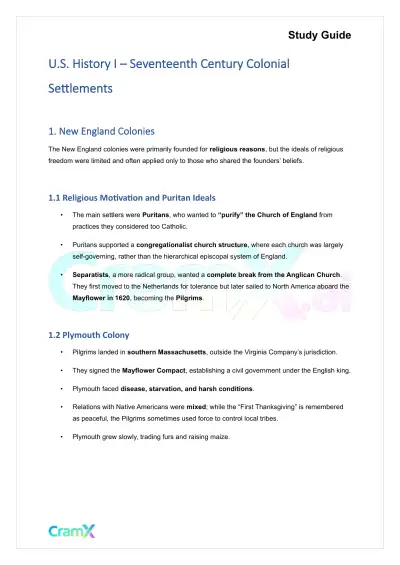 Quick Guides
U.S. History I - Seventeenth Century Colonial Settlements
History
8 pagesMar 2026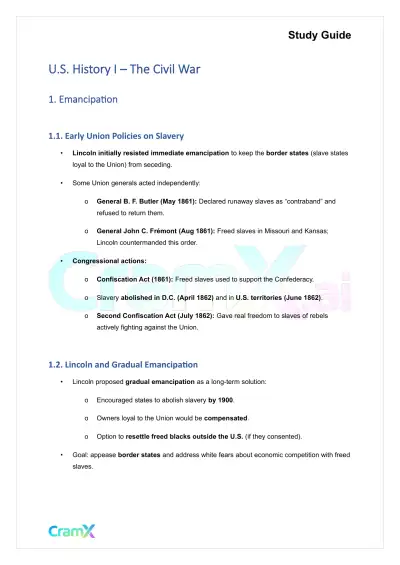 Quick Guides
U.S. History I - The Civil War
History
9 pagesMar 2026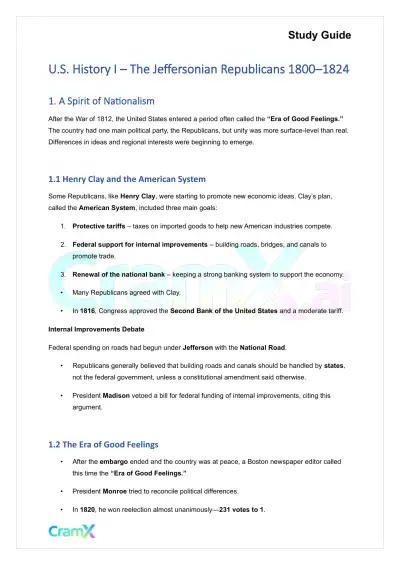 Quick Guides
U.S. History I - The Jeffersonian Republicans 1800–1824
History
11 pagesMar 2026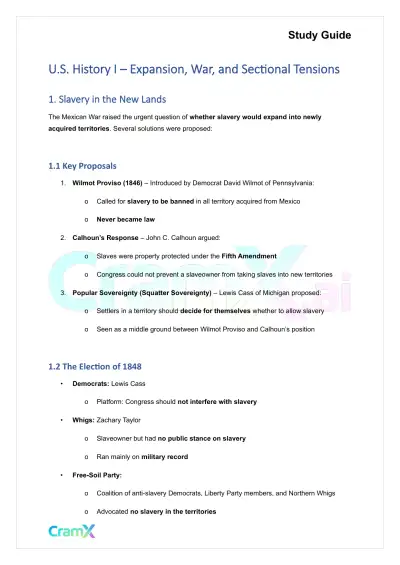 Quick Guides
U.S. History I - Expansion, War, and Sectional Tensions
History
9 pagesMar 2026 Quick Guides
U.S. History I - Challenges for a New Nation
History
9 pagesMar 2026 Quick Guides
U.S. History I - American Society and Culture 1815–1860
History
9 pagesMar 2026 Quick Guides
U.S. History I - Era of Reconstruction
History
9 pagesMar 2026 Quick Guides
U.S. History I - Economic Growth and Development 1815–1860
History
8 pagesMar 2026
Study this document with CramX
Once it is in your library, every tool can work from it.