

U.S. History I - Expansion, War, and Sectional Tensions
- History
- Texas A&M University
- 9 pages
- Shared March 2026
Preview 3 of 9 pages
See the first 3 pages exactly as they appear in the document.
Page 1 Read page 1 as text
Study Guide U.S. History I – Expansion, War, and Sectional Tensions 1. Slavery in the New Lands The Mexican War raised the urgent question of whether slavery would expand into newly acquired territories . Several solutions were proposed: 1.1 Key Proposals 1. Wilmot Proviso (1846) – Introduced by Democrat David Wilmot of Pennsylvania: o Called for slavery to be banned in all territory acquired from Mexico o Never became law 2. Calhoun’s Response – John C. Calhoun argued: o Slaves were property protected under the Fifth Amendment o Congress could not prevent a slaveowner from taking slaves into new territories 3. Popular Sovereignty (Squatter Sovereignty) – Lewis Cass of Michigan proposed: o Settlers in a territory should decide for themselves whether to allow slavery o Seen as a middle ground between Wilmot Proviso and Calhoun’s position 1.2 The Election of 1848 • Democrats: Lewis Cass o Platform: Congress should not interfere with slavery • Whigs: Zachary Taylor o Slaveowner but had no public stance on slavery o Ran mainly on military record • Free - Soil Party: o Coalition of anti - slavery Democrats, Liberty Party members, and Northern Whigs o Advocated no slavery in the territories
Page 2 Read page 2 as text
Study Guide Results: • Taylor won: 163 electoral votes (8 slave states, 7 free states) • Cass: 127 electoral votes (7 slave states, 8 free states) • Free - Soil party split Northern votes but did not win any states 1.3 California Gold Rush (1848 – 1852) • Gold discovered in January 1848 , confirmed by President Polk • Tens of thousands migrated to California ( “forty - niners” ) o Mostly young, single men o Later included free African Americans, Mexicans, Pacific Islanders, and Europeans • By 1852, mining shifted from individual prospectors to large mechanized operations • Many made more money providing food, lodging, and services than mining 1.4 Political Impact of California • California adopted a state constitution prohibiting slavery in 1849 • Admission threatened the balance of power : 15 free states vs. 15 slave states • Oregon had been organized as a free territory , north of the Missouri Compromise line • Congress now faced the challenge of deciding slavery’s status in the Mexican Cession 2. Expansion of America 2. 1 Western Boundary by 1803 • By spring 1803, the U.S. western border reached the Mississippi River . • The original 13 states had expanded to 17 : o Vermont (1791) o Kentucky (1792) o Tennessee (1796) o Ohio (1803)
Page 3 Read page 3 as text
Study Guide 2. 2 Louisiana Purchase (1803) • Doubled the size of the country. • Land stretched: o North to South: Gulf of Mexico → British Canada o East to West: Mississippi River → Rocky Mountains 2. 3 Further Expansion (1803 – 1850s) • Florida acquired from Spain in 1819. • Border disputes with Canada resolved: Webster - Ashburton Treaty (1842) . • Oregon Country settled at the 49th parallel (1846). • Texas : Won independence from Mexico in 1836; joined U.S. in 1845. • Mexican - American War (1846 – 1848) : U.S. gained the Southwest, including Texas, New Mexico, and California . 3. Mexican Borderlands and Oregon 3. 1 Mexico After Independence (1821) • Political instability : o Shifted from monarchy to republic. o Tensions between centralists (strong government in Mexico City) and federalists (provincial autonomy). • Northern provinces underpopulated : Texas to California were hard to defend; Mexico encouraged American settlement and trade to develop these areas.
6 more pages in the full document
Unlock it once and it stays in your library, ready to chat with or turn into flashcards.
Unlock the full documentMore History study materials
See all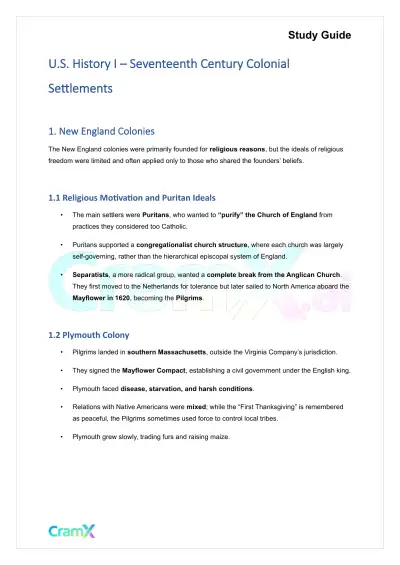 Quick Guides
U.S. History I - Seventeenth Century Colonial Settlements
History
8 pagesMar 2026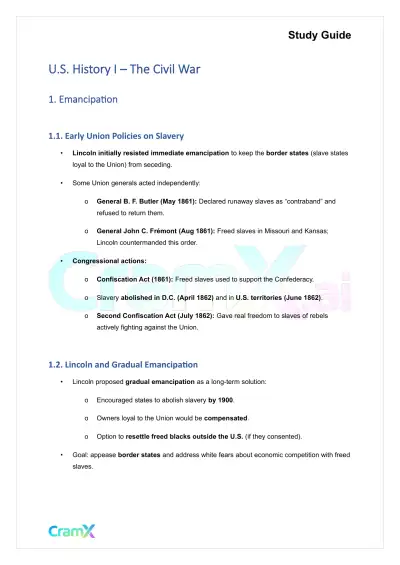 Quick Guides
U.S. History I - The Civil War
History
9 pagesMar 2026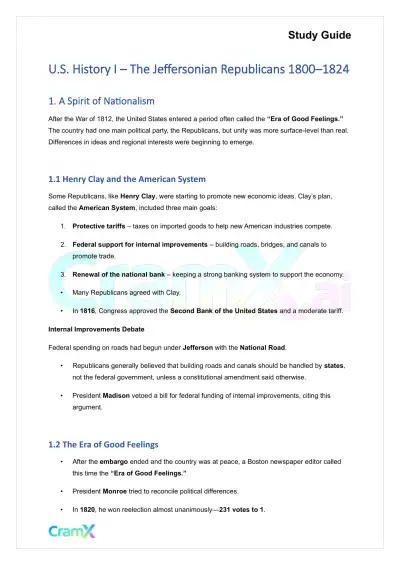 Quick Guides
U.S. History I - The Jeffersonian Republicans 1800–1824
History
11 pagesMar 2026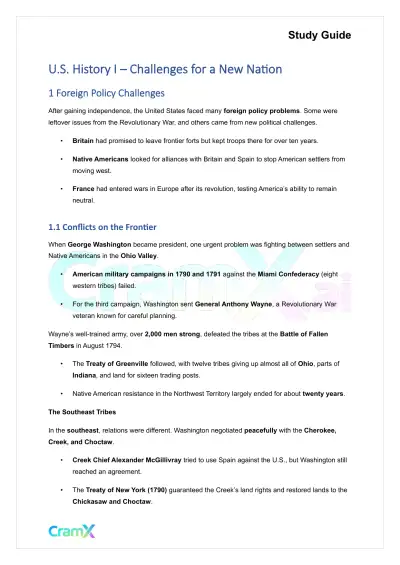 Quick Guides
U.S. History I - Challenges for a New Nation
History
9 pagesMar 2026 Quick Guides
U.S. History I - American Society and Culture 1815–1860
History
9 pagesMar 2026 Quick Guides
U.S. History I - Era of Reconstruction
History
9 pagesMar 2026 Quick Guides
U.S. History I - Economic Growth and Development 1815–1860
History
8 pagesMar 2026 Quick Guides
U.S. History I - Eighteenth Century Colonial America
History
11 pagesMar 2026
Study this document with CramX
Once it is in your library, every tool can work from it.